

























In Fast Ethernet networks, 100BASE FX and 100BASE TX are two widely used standards for delivering 100Mbps connectivity, but they rely on different transmission media and are designed for different deployment scenarios. While 100BASE TX uses twisted-pair copper cable for short-distance Ethernet connections, 100BASE FX uses fiber optic cables to extend network links over much longer distances and in environments where electrical interference is a concern.
Although both standards operate at the same 100Mbps speed under the IEEE 802.3u specification, their differences in cabling, maximum distance, interference resistance, and installation requirements can significantly influence network design decisions. Choosing the right option affects not only link reliability but also infrastructure cost and long-term scalability.
This guide compares 100BASE FX vs 100BASE TX in terms of transmission media, distance limitations, performance characteristics, installation considerations, and typical applications. By understanding the strengths and limitations of each Fast Ethernet standard, network engineers and IT professionals can determine which solution best fits their specific network environment.
? Introduction to 100BASE Ethernet Standards
100BASE Ethernet standards define how Fast Ethernet delivers 100Mbps network connectivity using different physical transmission media. Within the IEEE 802.3u specification, multiple variants were introduced to support diverse network environments, among which 100BASE FX and 100BASE TX are the most widely deployed. While both operate at the same data rate, they differ significantly in transmission medium, supported distance, and typical deployment scenarios.
These standards allow network designers to select the most appropriate physical layer technology depending on factors such as distance requirements, existing cabling infrastructure, and environmental conditions. The following sections explain how each standard works and where it is commonly used.
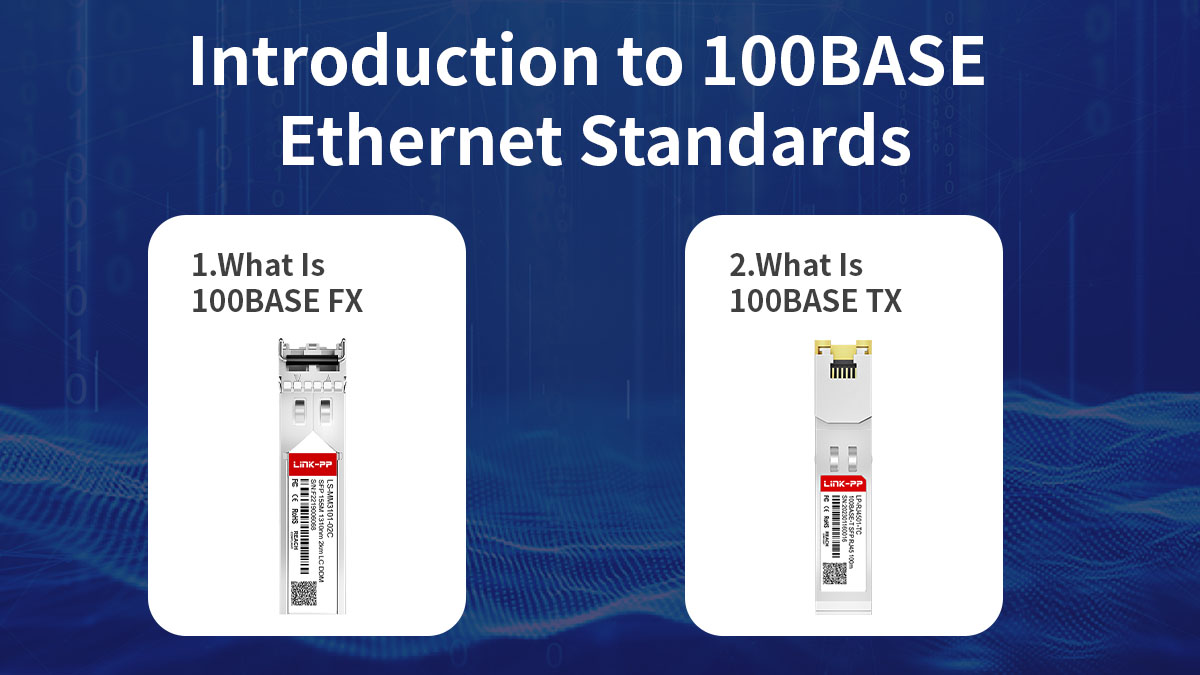
What Is 100BASE FX?
100BASE FX is a Fast Ethernet standard that transmits 100Mbps data over fiber optic cables, primarily designed for longer-distance and interference-resistant network links. It is commonly used in environments where copper cabling cannot provide sufficient reach or where electromagnetic interference could affect signal stability.
| Specification | 100BASE FX |
|---|---|
| Transmission Medium | Multimode fiber |
| Typical Wavelength | 1310nm |
| Maximum Distance | Up to 2km |
| Connector Types | LC |
Because fiber optic cables transmit data as light rather than electrical signals, 100BASE FX links are immune to electromagnetic interference (EMI). This characteristic makes them well suited for industrial facilities, factory automation networks, and building-to-building connections within campus networks.
Another advantage is the extended transmission distance. Compared with copper-based Fast Ethernet standards, 100BASE FX can support links up to 2km without signal regeneration, enabling stable connectivity across large facilities.
What Is 100BASE TX?
100BASE TX is the most common Fast Ethernet standard for copper-based Ethernet networks, delivering 100Mbps connectivity over twisted-pair copper cable. It is widely deployed in office LANs, enterprise access networks, and general Ethernet infrastructure.
| Specification | 100BASE TX |
|---|---|
| Transmission Medium | Twisted-pair copper (Cat5 or higher) |
| Maximum Distance | Up to 100m |
| Connector Type | RJ45 |
| Typical Use | LAN access connections |
Unlike fiber-based Ethernet, 100BASE TX uses electrical signals transmitted through copper conductors, which makes installation easier and more cost-effective in most office environments. Standard RJ45 connectors and structured cabling systems allow quick deployment without specialized fiber tools.
However, copper Ethernet links have inherent limitations. The maximum supported distance is 100m, and copper cables are more susceptible to electromagnetic interference, especially in environments with heavy machinery or high electrical noise.
Despite these limitations, 100BASE TX remains the dominant Fast Ethernet implementation due to its simplicity, widespread compatibility with Ethernet switches and network devices, and lower overall infrastructure cost.
? Physical Media Comparison
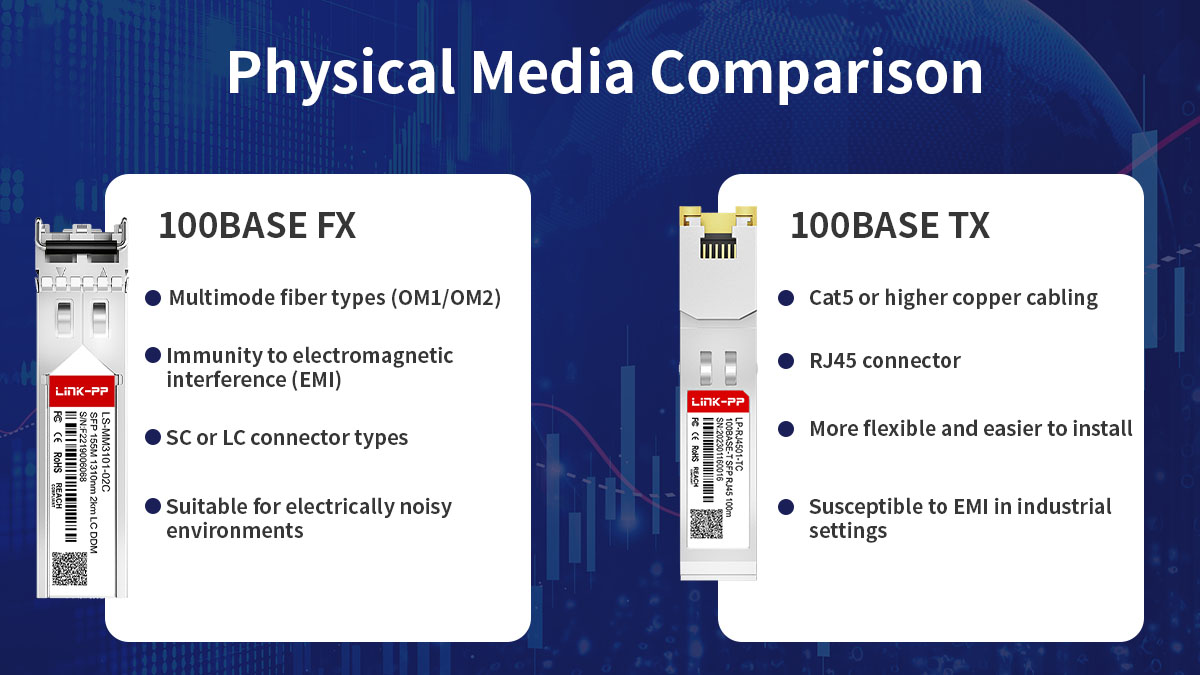
The most fundamental difference between 100BASE FX and 100BASE TX lies in the physical transmission medium. 100BASE FX uses fiber optic cabling to transmit data as light signals, while 100BASE TX relies on copper twisted-pair cables that carry electrical signals. This distinction directly affects network reliability, installation requirements, and environmental suitability.
Fiber Optic Cable (100BASE FX)
100BASE FX SFP uses multimode fiber to transmit Ethernet signals, making it ideal for longer distances and electrically noisy environments. Because fiber carries light instead of electrical current, it is naturally resistant to electromagnetic interference and signal degradation caused by nearby equipment.
| Feature | 100BASE FX Fiber |
|---|---|
| Cable Type | Multimode fiber (OM1 / OM2) |
| Connector Types | LC |
| EMI Immunity | Very high |
| Typical Distance | Up to 2km |
Fiber optic infrastructure offers several advantages in demanding network environments. Since the signal is transmitted optically, external electromagnetic fields do not affect signal integrity, which is particularly important in factories, transportation systems, and power facilities.
Fiber cables are also thinner and capable of supporting longer links without significant attenuation. For campus networks or industrial deployments, 100BASE FX often connects network switches across buildings or between distant network segments.
However, fiber installations typically require specialized tools for termination, inspection, and cleaning, which can increase deployment complexity compared to copper cabling.
Copper Twisted Pair Cable (100BASE TX)
100BASE TX SFP uses twisted-pair copper cables with RJ45 connectors, making it the most common solution for short-distance Ethernet connections. Copper cabling is widely used in structured LAN infrastructure due to its simplicity and cost efficiency.
| Feature | 100BASE TX Copper |
|---|---|
| Cable Type | Cat5 / Cat5e twisted pair |
| Connector Type | RJ45 |
| EMI Resistance | Moderate |
| Maximum Distance | 100m |
The twisted-pair design helps reduce electromagnetic interference by balancing electrical signals across wire pairs. This approach allows copper Ethernet to function reliably in typical office environments where interference levels are relatively low.
Another major advantage is installation convenience. Copper Ethernet cabling is easier to deploy, terminate, and maintain, and most switches include native RJ45 ports that support 100BASE TX connections without requiring additional transceivers.
However, copper cables remain vulnerable to signal degradation over longer distances and interference from electrical equipment. For this reason, 100BASE TX is typically limited to horizontal cabling within buildings, such as connecting workstations, printers, and access switches within a 100m range.
? Distance and Performance Comparison
When comparing 100BASE FX vs 100BASE TX, the most noticeable differences appear in transmission distance and signal stability. Although both Fast Ethernet standards deliver the same 100Mbps data rate, the physical medium determines how far the signal can travel and how reliably it performs under different environmental conditions.
Maximum Transmission Distance
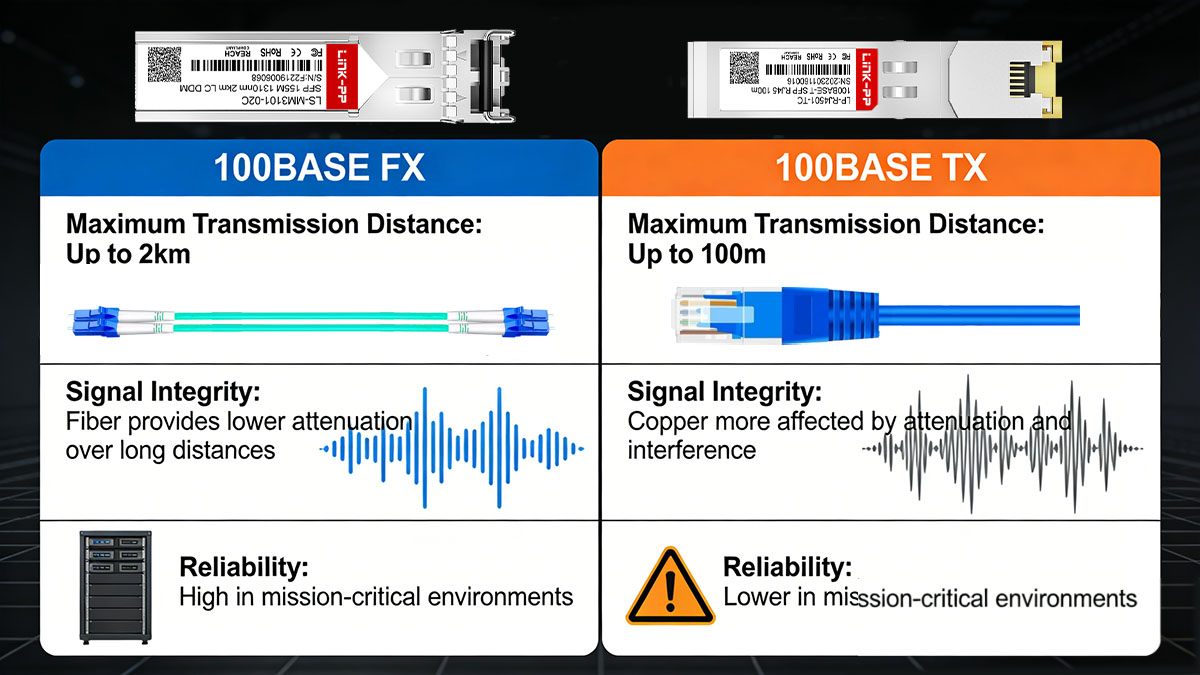
100BASE FX supports significantly longer link distances than 100BASE TX, making it suitable for campus and industrial networks. Fiber optic transmission experiences much lower signal attenuation over distance compared with copper cabling.
| Standard | Transmission Medium | Maximum Distance |
|---|---|---|
| 100BASE FX | Multimode fiber | Up to 2km |
| 100BASE TX | Twisted-pair copper | Up to 100m |
This distance difference plays an important role in network topology design. In large facilities or multi-building environments, 100BASE FX can directly connect remote switches without additional repeaters or intermediate devices. In contrast, copper-based 100BASE TX links are typically limited to structured cabling within a single floor or wiring closet.
In practical deployments, this means 100BASE FX is commonly used for backbone or distribution links, while 100BASE TX is used at the access layer where devices are located closer to switches.
Signal Integrity and Stability
Fiber-based Ethernet generally provides more stable signal transmission than copper in challenging environments. Since optical signals travel through glass fibers rather than electrical conductors, they are less affected by external interference.
| Performance Factor | 100BASE FX | 100BASE TX |
|---|---|---|
| Interference Resistance | Very high | Moderate |
| Signal Attenuation | Low over long distances | Higher over distance |
| Environmental Sensitivity | Minimal | More sensitive |
Fiber optic transmission maintains signal integrity even in locations with high electromagnetic interference (EMI), such as manufacturing plants, rail systems, and power facilities. This stability helps prevent packet loss or link interruptions caused by electrical noise.
Copper Ethernet, while reliable in standard office environments, may experience performance degradation when exposed to strong electromagnetic fields, improper grounding, or cable quality issues. Additionally, longer copper runs approach the physical limits of the Ethernet standard, which can increase the risk of transmission errors.
For these reasons, network designers typically choose 100BASE FX for long-distance or interference-prone environments, while 100BASE TX remains the preferred option for short, cost-efficient Ethernet connections inside buildings.
? Installation and Deployment Considerations
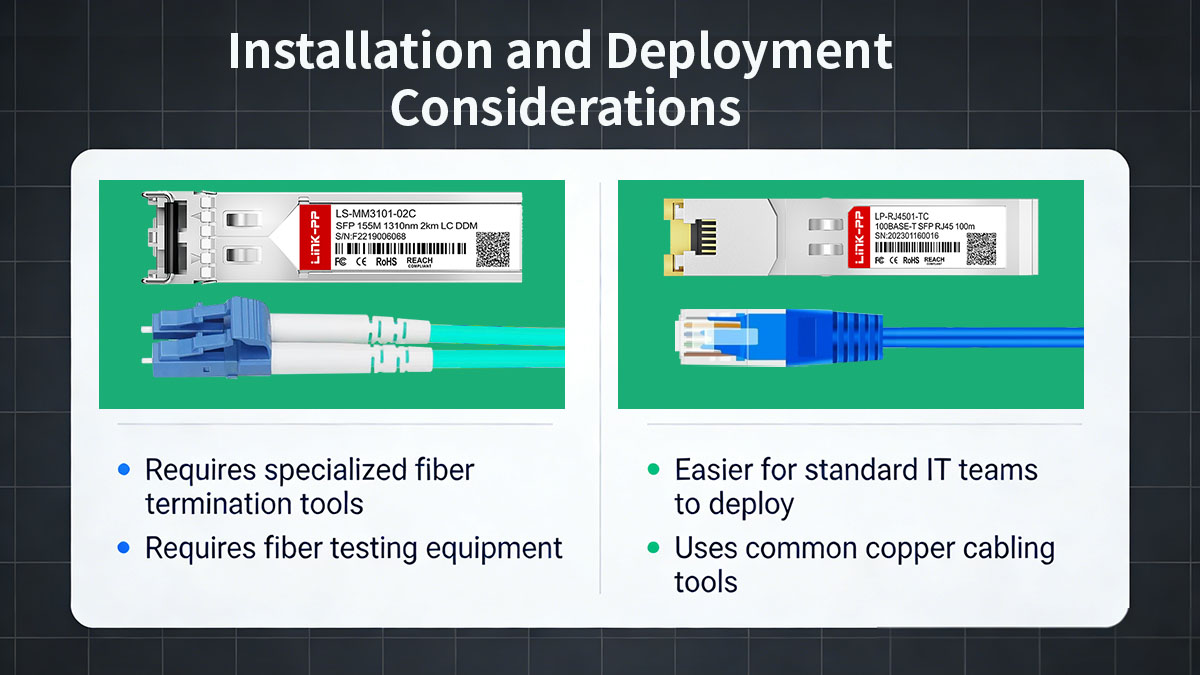
When evaluating 100BASE FX and 100BASE TX, installation complexity and deployment requirements often play an important role in technology selection. While both support Fast Ethernet at 100Mbps, their cabling infrastructure, installation tools, and maintenance practices differ significantly.
Deployment Complexity
In most enterprise environments, 100BASE TX is easier to deploy because it relies on familiar copper cabling systems. Standard Cat5 or Cat5e twisted-pair cables can be terminated using common RJ45 tools, and most Ethernet switches already provide built-in copper ports.
| Deployment Factor | 100BASE FX | 100BASE TX |
|---|---|---|
| Cabling Type | Multimode fiber | Cat5 / Cat5e copper |
| Connector Handling | Requires fiber termination | Standard RJ45 termination |
| Installation Skill | Fiber handling knowledge | Standard LAN installation |
Fiber deployments typically require additional preparation steps, including connector inspection, fiber cleaning, and proper optical termination. These tasks demand more specialized tools and training compared with copper cabling installation.
However, once installed correctly, fiber links tend to provide highly stable connectivity and may require less troubleshooting in environments affected by electrical noise.
Cost Considerations
The overall cost of deploying 100BASE FX or 100BASE TX depends on both infrastructure and equipment requirements.
| Cost Factor | 100BASE FX | 100BASE TX |
|---|---|---|
| Cabling Cost | Higher | Lower |
| Transceiver Requirement | Often required | Usually built-in ports |
| Maintenance Complexity | Moderate | Low |
Copper-based networks generally have lower upfront costs because twisted-pair cables and RJ45 connectors are inexpensive and widely available. In contrast, fiber installations may require optical transceivers, patch panels, and fiber management accessories.
That said, fiber can become cost-effective in long-distance deployments. Since 100BASE FX supports links up to 2km, it can eliminate the need for intermediate switches or repeaters in larger facilities.
Power and Equipment Requirements
The hardware interfaces used by 100BASE FX and 100BASE TX can also affect deployment planning.
| Equipment Aspect | 100BASE FX | 100BASE TX |
|---|---|---|
| Interface Type | Fiber SFP or fixed fiber port | RJ45 Ethernet port |
| Additional Devices | May require fiber transceiver or media converter | Usually none |
| Switch Compatibility | Requires fiber-capable ports | Supported by most switches |
Copper Ethernet networks are often simpler because RJ45 ports are standard on most switches and routers. Devices can typically be connected directly without additional hardware.
Fiber connections, however, may require SFP transceivers or dedicated fiber ports on switches. In some mixed environments, media converters are used to connect fiber links to copper Ethernet equipment.
For this reason, organizations planning to deploy 100BASE FX should verify switch compatibility, transceiver availability, and fiber management infrastructure before installation.
? Typical Use Cases
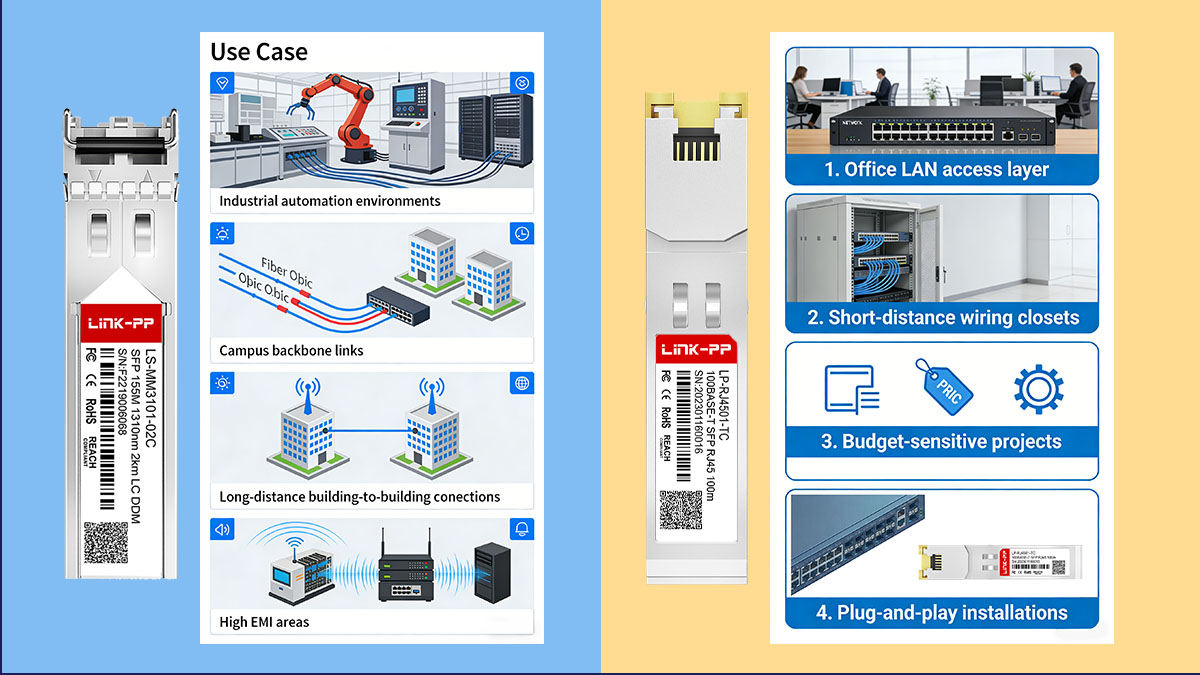
The choice between 100BASE FX and 100BASE TX largely depends on the deployment environment, required transmission distance, and infrastructure conditions. Although both deliver Fast Ethernet connectivity at 100Mbps, they are typically used in different network layers due to their physical media characteristics.
When to Choose 100BASE FX
100BASE FX is best suited for long-distance links and environments where electrical interference may affect copper networks. Its fiber optic transmission provides stable connectivity over extended distances and maintains signal quality even in electrically noisy locations.
Common deployment scenarios include:
-
Building-to-building network connections
Fiber links can connect switches across campus networks or industrial sites where distances exceed the 100m limit of copper Ethernet. -
Industrial automation networks
Manufacturing environments often contain heavy machinery that generates electromagnetic interference. Fiber-based links remain stable under these conditions. -
Utility and transportation systems
Railways, power facilities, and outdoor infrastructure networks frequently use fiber to maintain reliable connectivity across large areas. -
Campus distribution layers
Fiber connections are commonly used between aggregation switches or distribution switches within large enterprise or university networks.
In these situations, the longer reach and interference resistance of 100BASE FX help ensure consistent network performance.
When to Choose 100BASE TX
100BASE TX is typically used for short-distance Ethernet connections within buildings and office environments. Copper twisted-pair cabling integrates easily with structured LAN infrastructure and provides a simple, cost-effective way to connect endpoint devices.
Typical use cases include:
-
Office LAN access networks
Desktop computers, printers, and IP phones are commonly connected to access switches using RJ45 Ethernet cables. -
Data center management networks
Copper Ethernet is often used for management interfaces and auxiliary connectivity within equipment racks. -
Small business networks
Organizations with limited cabling distances can deploy copper Ethernet without the need for fiber infrastructure. -
Wiring closet connections
Devices located within the same floor or network cabinet can easily be connected using copper cables within the 100m limit.
In these environments, 100BASE TX offers a straightforward deployment model, requiring minimal specialized equipment while providing reliable connectivity for everyday network operations.
? Advantages and Limitations
Both 100BASE FX and 100BASE TX deliver Fast Ethernet connectivity at 100Mbps, but their advantages and limitations depend largely on the transmission medium. Understanding these trade-offs helps network designers choose the most appropriate technology for specific deployment scenarios.
Advantages and Limitations of 100BASE FX
The main strengths of 100BASE FX come from its fiber optic transmission, which enables longer distances and improved resistance to environmental interference.
| Aspect | 100BASE FX |
|---|---|
| Maximum Distance | Up to 2km |
| Interference Resistance | Very high |
| Signal Stability | Strong over long links |
| Infrastructure Cost | Higher than copper |
Because fiber carries data as light signals, 100BASE FX is not affected by electromagnetic interference (EMI). This makes it particularly reliable in industrial facilities, transportation systems, and utility networks where electrical noise can disrupt copper links.
Another advantage is extended transmission distance. Fiber links can span large campuses or connect separate buildings without requiring intermediate network devices.
However, fiber deployments often involve higher initial costs. Fiber cabling, optical interfaces, and installation tools typically increase infrastructure investment compared with copper-based networks.
Advantages and Limitations of 100BASE TX
The advantages of 100BASE TX are mainly related to ease of deployment and lower infrastructure costs. Copper twisted-pair Ethernet has been widely adopted in enterprise LAN environments due to its simplicity and compatibility with existing networking equipment.
| Aspect | 100BASE TX |
|---|---|
| Maximum Distance | Up to 100m |
| Installation Complexity | Low |
| Equipment Availability | Very high |
| Interference Resistance | Moderate |
Most Ethernet switches include built-in RJ45 ports that support 100BASE TX, allowing devices to be connected directly without additional transceivers. This reduces both installation time and equipment requirements.
Copper cabling is also easy to terminate and maintain using common network tools, making it suitable for office networks and access-layer connectivity.
The main limitation of 100BASE TX is its transmission distance. The standard supports a maximum link length of 100m, which restricts its use to relatively short network segments. In addition, copper cables are more susceptible to interference from nearby electrical systems, which can affect signal stability in certain environments.
? 100BASE FX vs 100BASE TX: Side-by-Side Comparison Table
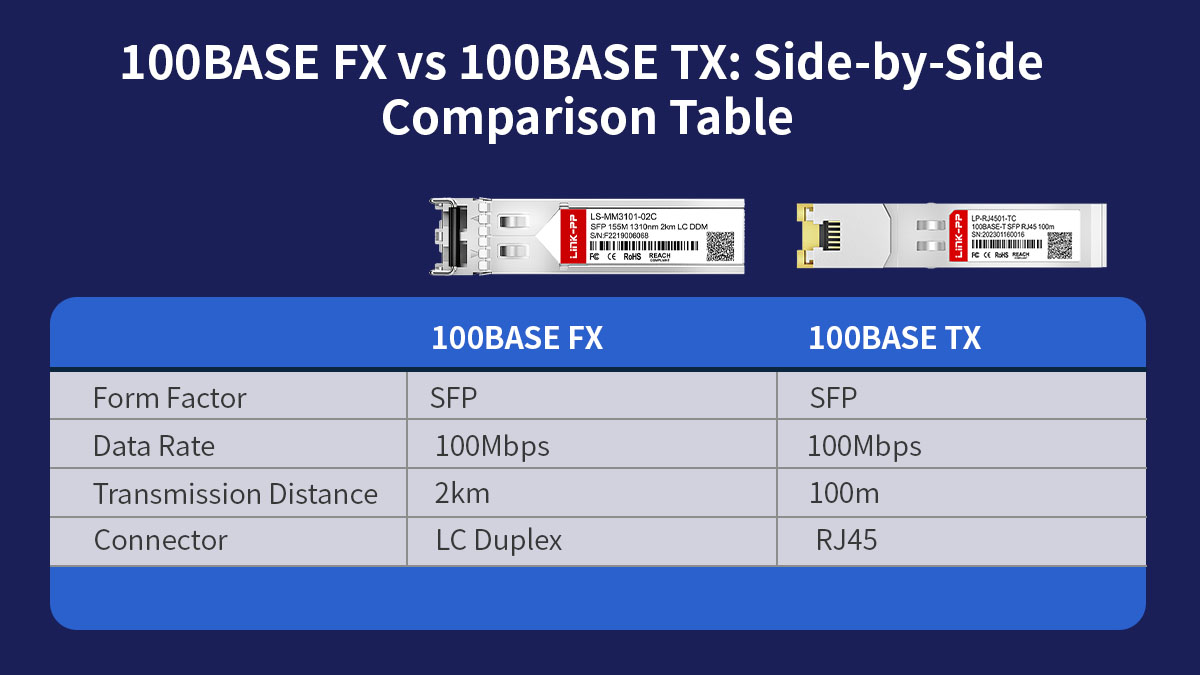
The key differences between 100BASE FX and 100BASE TX can be clearly understood by comparing their core technical characteristics. Although both standards belong to Fast Ethernet and operate at 100Mbps under IEEE 802.3u, they are designed for different physical media and network environments.
Technical Specification Comparison
The following table highlights the most important technical distinctions between the two standards.
| Feature | 100BASE FX | 100BASE TX |
|---|---|---|
| Transmission Medium | Multimode fiber | Twisted-pair copper |
| Maximum Distance | Up to 2km | Up to 100m |
| Connector Type | SC / LC | RJ45 |
| EMI Resistance | Very high | Moderate |
| Typical Applications | Campus backbone, industrial networks | Office LAN, access layer |
These differences directly influence how each standard is deployed within a network. 100BASE FX is typically used where longer distances or electrical interference make fiber the more reliable choice. In contrast, 100BASE TX remains the dominant option for short-distance connections inside buildings because copper cabling is easier to install and widely supported by networking equipment.
In practical network design, the two technologies are often complementary rather than competing. Fiber links using 100BASE FX may connect switches between buildings or distribution layers, while 100BASE TX handles endpoint connectivity within the local network infrastructure.
? Which One Should You Choose?
Choosing between 100BASE FX and 100BASE TX depends primarily on distance requirements, environmental conditions, and existing network infrastructure. Since both standards provide Fast Ethernet connectivity at 100Mbps, the decision is usually based on how and where the network link will be deployed rather than raw performance.
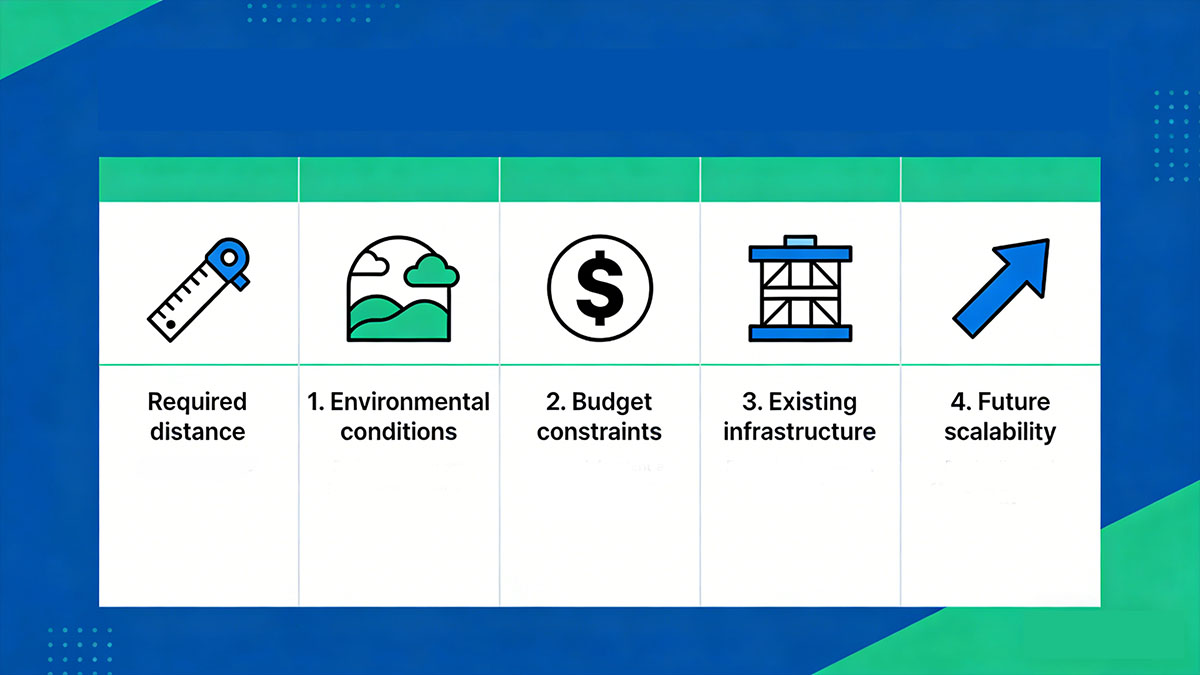
Decision Factors Checklist
The following factors can help determine which technology is more suitable for a specific network environment.
-
Required transmission distance
If the link must exceed 100m, 100BASE FX is the practical choice because fiber can support distances up to 2km without signal regeneration. -
Environmental conditions
Locations with high electromagnetic interference (EMI), such as factories or power facilities, benefit from fiber optic transmission because it is immune to electrical noise. -
Existing cabling infrastructure
Networks already built with Cat5 or Cat5e copper cabling can easily deploy 100BASE TX without additional fiber equipment. -
Budget considerations
Copper Ethernet solutions typically involve lower installation costs, making 100BASE TX suitable for small or budget-sensitive deployments. -
Network expansion plans
Fiber infrastructure may provide better long-term scalability, especially in campus environments where future upgrades or longer connections could be required.
In many real-world deployments, organizations use both technologies together. Fiber links based on 100BASE FX often connect switches across buildings or distribution layers, while 100BASE TX provides access-layer connectivity for endpoint devices such as computers, printers, and IP phones. This combination allows networks to balance performance, cost, and deployment flexibility.
? FAQs About 100BASE FX vs 100BASE TX
Can 100BASE FX connect directly to 100BASE TX?
No. 100BASE FX uses fiber optic signaling, while 100BASE TX uses copper electrical signaling. A media converter, fiber-capable switch, or dual-interface device is required to connect the two network types.
Do 100BASE FX and 100BASE TX support the same Ethernet speed?
Yes. Both standards are part of Fast Ethernet and support a maximum data rate of 100Mbps. The difference lies in the transmission medium rather than the network speed.
What type of cable is required for 100BASE TX?
100BASE TX requires Cat5 or higher twisted-pair copper cable with RJ45 connectors. The maximum supported cable length is 100m.
Is 100BASE FX full duplex or half duplex?
100BASE FX supports both half-duplex and full-duplex modes, depending on the network equipment configuration. Most modern deployments use full duplex for improved link efficiency.
Can 100BASE FX run over single-mode fiber?
The standard implementation of 100BASE FX is designed for multimode fiber, typically operating at 1310nm. However, some vendor-specific solutions support longer distances using single-mode fiber.
Why is 100BASE TX limited to 100 meters?
The 100m limit is defined by Ethernet physical layer specifications to maintain signal integrity, timing accuracy, and reliable collision detection within copper twisted-pair cabling systems.
? Conclusion
Both 100BASE FX and 100BASE TX are important Fast Ethernet standards designed to meet different networking requirements. While they deliver the same 100Mbps data rate, their differences in transmission media, maximum distance, and environmental tolerance make them suitable for different parts of a network infrastructure.
In general, 100BASE FX is preferred for longer-distance connections, industrial environments, and locations where electromagnetic interference could affect copper links. 100BASE TX, on the other hand, remains the most practical choice for short-distance LAN connectivity thanks to its lower cost, simple installation, and widespread compatibility with Ethernet devices.
When designing or upgrading a network, understanding these differences helps ensure the right technology is deployed for each segment. Many organizations combine both standards—using fiber-based 100BASE FX for backbone links and copper-based 100BASE TX for access-layer connections—to balance reliability, cost efficiency, and deployment flexibility.
If you are looking for reliable 100BASE FX fiber transceivers or 100BASE TX copper SFP modules for your network, explore the solutions available at the LINK-PP Official Store, where you can find compatible optical modules designed for stable performance across various networking environments.