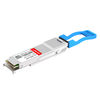
The demand for higher-speed yet cost-efficient optical networking continues to grow, especially in enterprise access networks, campus environments, and service provider aggregation layers. In this context, the 2.5G SFP transceiver has become a practical solution that bridges the gap between legacy 1Gbps optics and higher-cost 10Gbps infrastructure upgrades.
Unlike traditional 1G modules that often struggle with modern bandwidth-intensive applications such as Wi-Fi 6 access points, IP surveillance systems, and cloud-edge connectivity, 2.5G SFP optics deliver a balanced upgrade path. They provide increased throughput without requiring a full redesign of existing fiber infrastructure, making them especially attractive for incremental network expansion strategies.
From a selection perspective, choosing the right 2.5G SFP transceiver is not simply about speed. It involves evaluating compatibility with networking equipment, fiber type constraints, transmission distance requirements, power consumption, and long-term scalability. Misalignment in any of these areas can lead to suboptimal performance or deployment limitations.
This guide is designed to help network engineers, IT planners, and infrastructure decision-makers understand the key factors that influence 2.5G SFP transceiver selection. It focuses on practical criteria such as technical specifications, interoperability considerations, and real-world application requirements, enabling more informed and reliable purchasing decisions for modern network environments.
🕎 What Is a 2.5G SFP Transceiver?
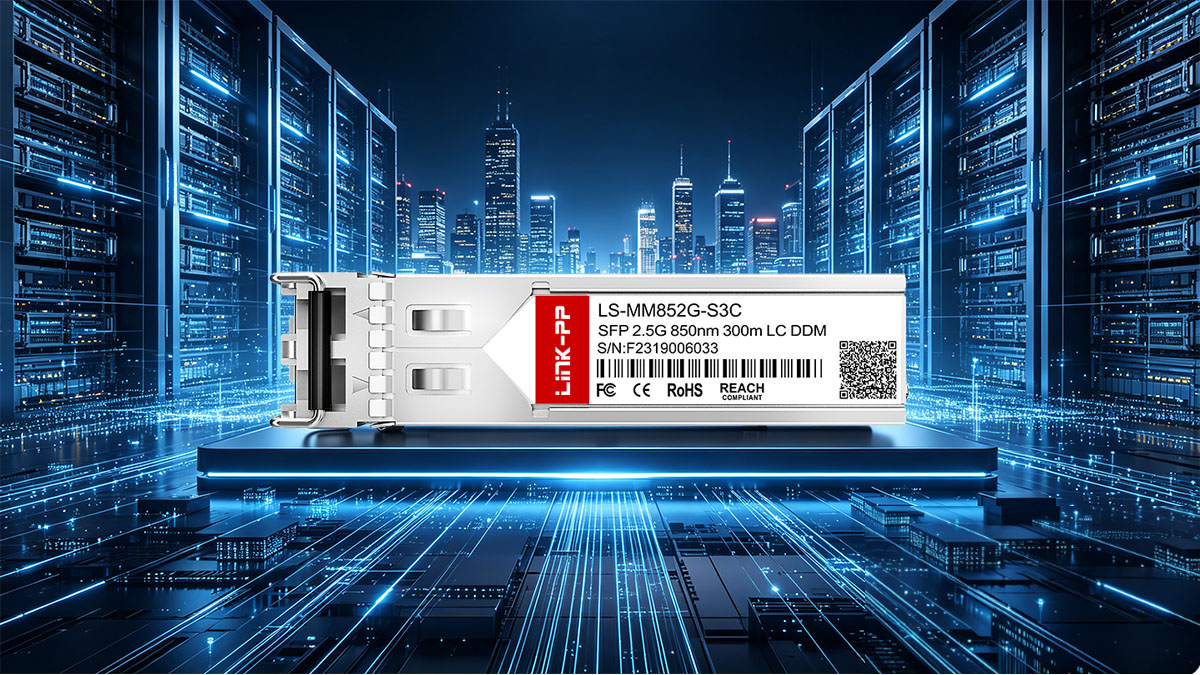
A 2.5G SFP transceiver is a compact optical networking module designed to transmit data at 2.5Gbps over fiber or copper links using the standard SFP (Small Form-factor Pluggable) interface. It is primarily used to upgrade network bandwidth beyond 1Gbps without requiring a full migration to 10Gbps infrastructure, making it a cost-efficient intermediate solution for modern Ethernet networks.
From a functional perspective, the 2.5G SFP transceiver serves as a physical-layer interface between networking equipment such as switches, routers, and optical fiber or twisted-pair cabling. It converts electrical signals into optical signals (or electrical signals for copper modules) and ensures stable data transmission across network segments.
Definition and Core Functionality
A 2.5G SFP transceiver is defined by its ability to support 2.5Gbps Ethernet transmission within an SFP form factor, typically aligned with IEEE-based 2.5G Ethernet standards such as 2.5GBASE-X or related implementations. It is widely used in access-layer and aggregation-layer network upgrades.
To better understand its core role, the following points summarize its primary functions:
Before listing its functions, it is important to note that these modules are not standalone devices but depend on host equipment compatibility and network architecture design.
- Converts electrical signals to optical signals (fiber models) or electrical signals over copper (RJ45 models)
- Enables 2.5Gbps data transmission between network devices
- Supports hot-swappable installation in compatible SFP ports
- Provides backward compatibility in some environments where auto-negotiation is supported
- Bridges performance gap between 1G and 10G Ethernet speeds
These functions make the 2.5G SFP transceiver particularly valuable in environments where incremental upgrades are preferred over complete infrastructure replacement.
After reviewing its functional scope, it becomes clear that the 2.5G SFP is not just a speed upgrade but a flexible connectivity component designed for scalable network evolution.
Key Advantages Over 1G and 10G Modules
The main value of a 2.5G SFP transceiver lies in its position between 1G and 10G optics, offering a balance between performance, cost, and infrastructure requirements. It is especially relevant in networks experiencing bandwidth growth but not yet ready for full 10G adoption.
Before comparing performance characteristics, it is important to understand that each speed tier serves different deployment priorities such as cost efficiency, power consumption, and scalability.
| Feature |
1G SFP |
2.5G SFP |
10G SFP+ |
| Data Rate |
1Gbps |
2.5Gbps |
10Gbps |
| Power Consumption |
Low |
Moderate |
High |
| Upgrade Cost Impact |
Minimal |
Balanced |
High |
| Use Case Fit |
Legacy networks |
Access/edge upgrades |
High-performance backbone |
This comparison highlights how the 2.5G SFP transceiver fills a critical performance gap in modern network design.
After evaluating these differences, several key advantages of 2.5G optics can be summarized:
- Provides a cost-effective upgrade path from 1G infrastructure
- Reduces the need for immediate migration to 10G hardware
- Supports modern high-bandwidth devices such as Wi-Fi 6/6E access points
- Improves network efficiency without significantly increasing power consumption
- Extends the lifespan of existing cabling and switching infrastructure
These advantages make it a strategic choice for organizations aiming to scale bandwidth gradually while controlling capital and operational expenditure.
🕎 Key Selection Factors for 2.5G SFP Transceivers
Selecting a 2.5G SFP transceiver requires evaluating multiple technical and environmental factors rather than focusing only on data rate. The correct choice directly affects link stability, compatibility, and long-term network performance, especially in mixed-generation Ethernet environments.
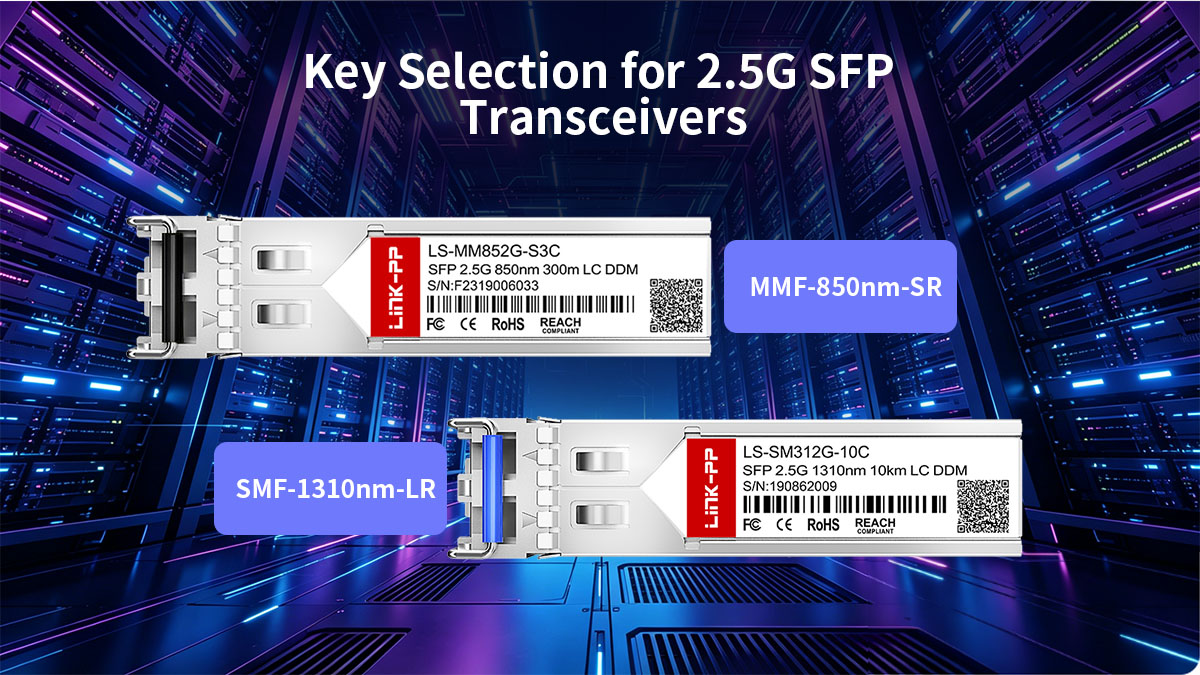
Below are the most critical selection dimensions that should be assessed before deployment decisions are made.
Transmission Distance Requirements
The first key factor in selecting a 2.5G SFP transceiver is transmission distance, since it determines whether the module can reliably support the physical layout of the network. Different optical types are designed for short-reach or long-reach applications.
Before choosing a module, it is important to match the required link distance with the correct optical specification, otherwise signal degradation or link failure may occur.
- Short-reach (SR): typically supports up to 300m over multimode fiber
- Long-reach (LR): commonly supports up to 10km or more over single-mode fiber
- Extended reach variants: may support even longer distances depending on design
After evaluating distance needs, the next step is ensuring the optical budget aligns with real-world deployment conditions such as connectors, patch panels, and splicing losses.
This ensures stable signal transmission and prevents underperformance caused by mismatched optical reach.
Fiber Type Compatibility
Fiber compatibility is another fundamental selection factor, as 2.5G SFP transceivers must match the installed cabling infrastructure. Using the wrong fiber type can result in no link or severely reduced performance.
To avoid compatibility issues, the fiber medium must be clearly identified before module selection.
- Multimode fiber (MMF): commonly used in short-distance campus or data center environments
- Single-mode fiber (SMF): used for long-distance transmission and carrier networks
- Common connector type: LC duplex for most 2.5G SFP modules
After identifying fiber type, it is equally important to verify whether the installed cabling (such as OM3, OM4, or OS2) supports the intended transmission distance.
This ensures full alignment between physical infrastructure and optical module design.
Wavelength and Optical Specifications
Wavelength selection directly impacts both transmission distance and signal quality. Different 2.5G SFP transceivers operate at specific wavelengths depending on their application scenario.
Understanding wavelength behavior helps prevent mismatches that could lead to signal loss or reduced link efficiency.
| Module Type |
Wavelength |
Fiber Type |
Typical Use Case |
| 2.5GBASE-SX |
850nm |
Multimode fiber |
Short-reach data center links |
| 2.5GBASE-LX |
1310nm |
Single-mode fiber |
Medium to long-distance links |
| Copper SFP |
N/A (electrical) |
Cat5e/Cat6 |
Enterprise LAN access |
After comparing wavelength options, network designers should align optical characteristics with both distance requirements and fiber infrastructure.
This ensures optimal signal integrity and minimizes attenuation-related performance issues.
Power Consumption and Thermal Performance
Power consumption and heat generation are critical factors, especially in high-density switch environments where multiple SFP modules operate simultaneously. Excessive power draw can increase system temperature and reduce long-term reliability.
Before selecting a module, it is important to consider the thermal design capacity of the host device.
- Low power modules reduce overall switch energy usage
- Efficient thermal design improves port density scalability
- Excess heat may require additional cooling strategies
After evaluating power requirements, it becomes clear that thermal efficiency directly affects network stability in dense deployment scenarios.
This makes low-power, well-optimized modules preferable for modern enterprise and data center environments where port density is high.
🕎 Compatibility and Interoperability Considerations
Compatibility and interoperability are critical when deploying 2.5G SFP transceivers, because even a technically correct module can fail to operate properly if it is not aligned with the host device, firmware, or network architecture. In real-world deployments, compatibility issues are one of the most common causes of link instability or port recognition failures.
To ensure reliable operation, it is necessary to evaluate not only physical specifications but also vendor compatibility, switch support, and protocol behavior.
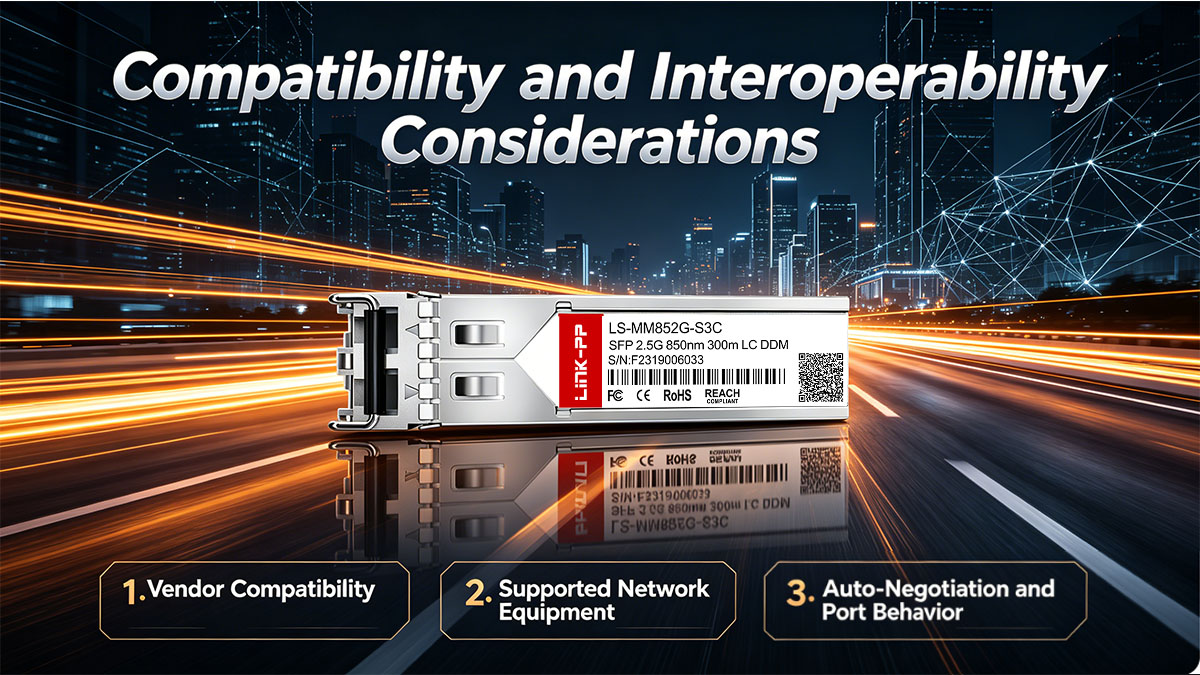
Vendor Compatibility (OEM vs Third-Party)
One of the most important compatibility decisions is whether to use OEM-branded transceivers or third-party compatible modules. This choice directly affects device recognition, firmware behavior, and long-term maintainability.
Before comparing options, it is important to understand that many modern switches enforce compatibility through firmware validation or coding mechanisms.
- OEM modules: designed and certified by original equipment manufacturers
- Third-party compatible modules: engineered to match OEM specifications and MSA standards
- Compatibility risk: varies depending on switch vendor and firmware restrictions
| Factor |
OEM Modules |
Third-Party Modules |
| Device Recognition |
Guaranteed |
Depends on coding/firmware |
| Cost Efficiency |
Higher |
Lower |
| Flexibility |
Limited sourcing |
Broad availability |
| Firmware Restrictions |
Minimal risk |
Possible compatibility checks |
After reviewing these differences, it becomes clear that the decision is often a balance between guaranteed compatibility and procurement flexibility.
In practice, many enterprise networks adopt MSA-compliant third-party modules to optimize cost while maintaining functional equivalence.
Supported Network Equipment
Not all networking devices that support SFP ports automatically support 2.5G speeds. This makes equipment compatibility one of the most overlooked selection factors in real deployments.
Before selecting a module, the host device must be verified for native 2.5G support or multi-rate capability.
- Switches must explicitly support 2.5G SFP or multi-gig ports
- Some devices support only 1G/10G but not 2.5G operation
- Router and NIC compatibility may vary depending on chipset and firmware
After identifying supported equipment, it is also important to confirm whether the port operates in fixed-speed mode or auto-negotiation mode.
This ensures the transceiver can function at the intended speed without forcing fallback to lower performance modes.
Auto-Negotiation and Port Behavior
Auto-negotiation behavior plays a key role in how 2.5G SFP transceivers interact with network ports. If not properly supported, the link may fail to establish or may default to a lower speed.
Before analyzing behavior, it is important to note that not all SFP ports are multi-rate capable.
- Multi-rate ports: support 1G/2.5G/10G depending on configuration
- Fixed-rate ports: operate only at a predefined speed
- Auto-negotiation support: varies by switch vendor and model
| Port Type |
Speed Flexibility |
2.5G Support |
Risk Level |
| Multi-rate SFP+ port |
High |
Often supported |
Low |
| Fixed 1G SFP port |
None |
Not supported |
High |
| Multi-gig RJ45 port |
Moderate |
Supported via copper SFP |
Medium |
After understanding these differences, network engineers should validate port configuration settings before deploying 2.5G optics.
This step helps prevent common issues such as link down states, speed mismatches, or forced fallback to 1G operation.
🕎 Common Types of 2.5G SFP Transceivers
2.5G SFP transceivers are available in several standardized variants designed for different transmission media, distances, and deployment environments. Selecting the correct type is essential because each variant is optimized for a specific use case, and mismatching types can lead to link failure or suboptimal performance.
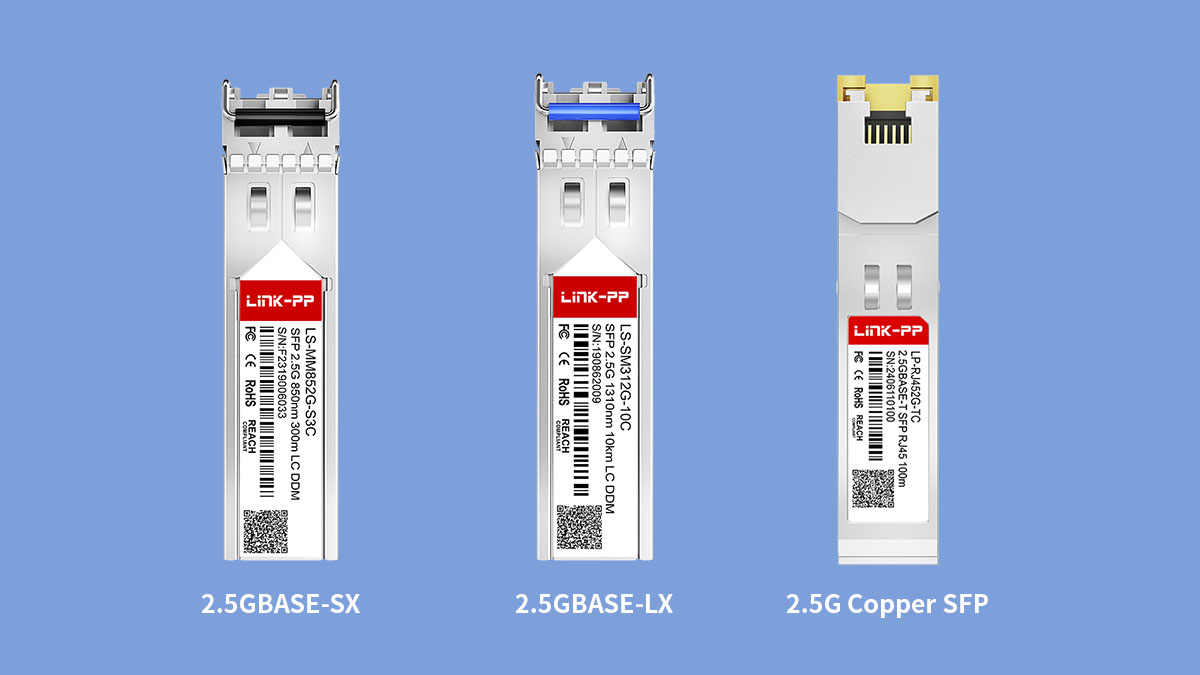
Below are the most widely used categories of 2.5G SFP transceivers in modern Ethernet networks.
2.5GBASE-SX (Short Reach)
2.5GBASE-SX transceivers are designed for short-distance communication over multimode fiber and are commonly used in data centers and campus networks. They operate at 850nm wavelength and are optimized for high-density, low-latency environments.
Before listing key characteristics, it is important to understand that this type is typically used where fiber runs are short and infrastructure density is high.
- Wavelength: 850nm
- Fiber type: Multimode fiber (OM2/OM3/OM4)
- Typical reach: up to 300m depending on fiber grade
- Primary use: data centers, enterprise access layers
After reviewing these attributes, it becomes clear that 2.5GBASE-SX is best suited for intra-building connectivity where cost-effective short-range links are required.
Its main advantage lies in high efficiency over short distances without requiring single-mode fiber infrastructure.
2.5GBASE-LX / LX10 (Long Reach)
2.5GBASE-LX and LX10 transceivers are designed for long-distance transmission over single-mode fiber. They are commonly deployed in metro networks, building interconnects, and service provider aggregation layers.
Before examining specifications, it is important to note that these modules are optimized for signal integrity over extended distances.
- Wavelength: 1310nm
- Fiber type: Single-mode fiber (OS2)
- Typical reach: up to 10km or more depending on module design
- Primary use: campus interconnects, metro Ethernet, backbone links
| Variant |
Wavelength |
Fiber Type |
Reach |
Use Case |
| 2.5GBASE-LX |
1310nm |
SMF |
~10km |
Enterprise campus links |
| 2.5GBASE-LX10 |
1310nm |
SMF |
up to 10km+ |
Metro and carrier networks |
After comparing these variants, LX-based modules are clearly more suitable for extended connectivity scenarios where multimode fiber cannot meet distance requirements.
They provide stable performance over long spans with lower attenuation and improved signal reliability.
2.5G Copper SFP Modules
Copper-based 2.5G SFP transceivers provide an alternative to fiber by enabling Ethernet transmission over twisted-pair cabling such as Cat5e or Cat6. These modules are widely used in enterprise LAN environments where fiber deployment is not practical.
Before outlining features, it is important to note that these modules function as electrical-to-electrical converters rather than optical devices.
- Interface: RJ45 copper port
- Cabling: Cat5e, Cat6, or better
- Typical reach: up to 100m
- Primary use: access layer networks, office environments
| Feature |
Copper SFP |
Fiber SFP |
| Medium |
Twisted-pair cable |
Optical fiber |
| Maximum distance |
~100m |
Up to 10km+ |
| Installation complexity |
Low |
Moderate to high |
| EMI resistance |
Lower |
Higher |
After evaluating these differences, copper SFP modules are particularly suitable for cost-sensitive environments where existing Ethernet cabling is already deployed.
However, they may be less ideal in electrically noisy environments or long-distance applications.
🕎 Application Scenarios and Use Cases
2.5G SFP transceivers are widely used in modern network environments where bandwidth demands exceed 1G but do not justify a full migration to 10G infrastructure. Their flexibility makes them suitable for enterprise, telecom, and edge deployments where incremental upgrades are preferred over complete network redesign.
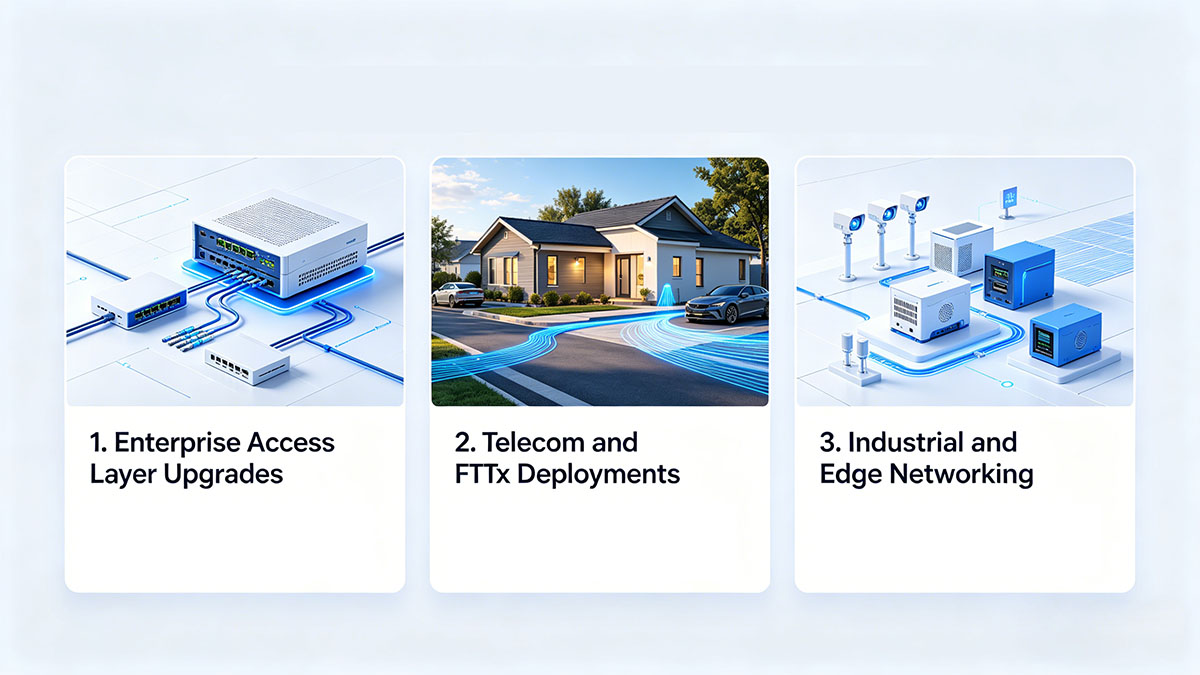
Below are the most common real-world application scenarios where 2.5G SFP transceivers are deployed.
Enterprise Access Layer Upgrades
2.5G SFP transceivers are frequently used in enterprise access networks to upgrade existing 1G infrastructure without increasing operational complexity. This scenario is especially relevant as organizations adopt higher-bandwidth devices such as Wi-Fi 6 and Wi-Fi 6E access points.
Before listing key use cases, it is important to understand that access-layer bottlenecks are often caused by aggregation of multiple high-speed endpoints.
- Supporting Wi-Fi 6/6E access points requiring more than 1Gbps uplink
- Upgrading office switches without replacing entire network backbone
- Improving performance for IP phones, cameras, and IoT devices
- Enabling smoother internal traffic flow in campus environments
After reviewing these use cases, it becomes clear that 2.5G SFP provides a balanced upgrade path that enhances performance while preserving existing infrastructure investments.
This makes it particularly valuable for organizations implementing phased network modernization strategies.
Telecom and FTTx Deployments
In telecom and fiber-to-the-x (FTTx) networks, 2.5G SFP transceivers are commonly used in aggregation and access layers where moderate bandwidth scaling is required. They help bridge the gap between subscriber demand and core network capacity.
Before analyzing specific applications, it is important to note that these environments require both scalability and cost efficiency.
- Fiber distribution networks (FTTH/FTTB/FTTC)
- Broadband aggregation switches in access nodes
- Service provider metro edge connections
- Residential and business internet service delivery
| Deployment Area |
Role of 2.5G SFP |
Key Benefit |
| FTTH access nodes |
Subscriber aggregation |
Efficient bandwidth scaling |
| Metro edge networks |
Traffic consolidation |
Reduced congestion |
| Broadband ISPs |
Last-mile connectivity |
Cost-effective expansion |
After evaluating these roles, it is evident that 2.5G optics provide a practical balance between capacity and infrastructure cost in telecom environments.
They enable service providers to expand bandwidth offerings without immediately transitioning to higher-cost 10G or 25G architectures.
Industrial and Edge Networking
2.5G SFP transceivers are also increasingly used in industrial and edge computing environments where reliability and stable throughput are more important than maximum speed. These environments often include harsh conditions or distributed network topologies.
Before listing applications, it is important to recognize that edge networks often require compact, durable, and energy-efficient connectivity solutions.
- Industrial automation systems and control networks
- Smart city infrastructure such as surveillance and sensors
- Edge computing nodes and micro data centers
- Transportation and utility network systems
After reviewing these scenarios, 2.5G SFP modules stand out as a practical choice due to their balance of performance and efficiency in distributed environments.
Their ability to maintain stable connectivity under varying conditions makes them suitable for mission-critical edge deployments.
🕎 Performance and Reliability Considerations
Performance and reliability determine whether a 2.5G SFP transceiver can maintain stable operation in real network environments, not just achieve nominal 2.5Gbps throughput under ideal conditions. In practice, long-term stability depends on optical signal quality, environmental tolerance, and system-level thermal design.
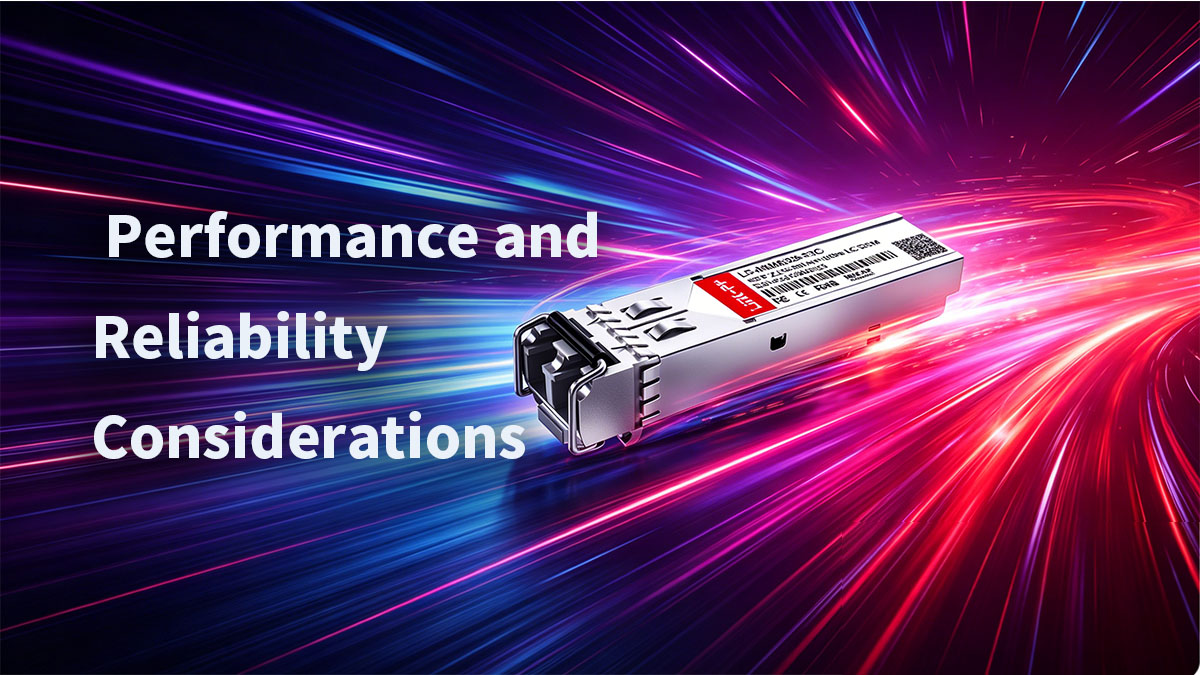
To evaluate this properly, it is necessary to break performance down into several measurable technical dimensions.
Link Stability and Signal Quality
Link stability is the foundation of reliable 2.5G optical transmission. Even when a transceiver supports 2.5Gbps on paper, poor signal integrity can still lead to packet loss, link flapping, or degraded throughput.
Before analyzing specific parameters, it is important to understand that optical performance is governed by the balance between transmitted power, receiver sensitivity, and total link attenuation.
- Optical transmit power must match receiver sensitivity range
- Excess insertion loss reduces usable transmission distance
- Poor connector quality increases signal reflection and attenuation
- Fiber bends or contamination can significantly degrade performance
To better understand how these parameters interact in real deployments, the following comparison highlights their operational impact:
| Parameter |
Function in Link |
Impact if Misaligned |
| TX Optical Power |
Signal emission strength |
Weak or unstable link |
| RX Sensitivity |
Signal detection capability |
Packet errors or loss |
| Link Loss Budget |
Total allowable attenuation |
Distance limitation |
After reviewing these core parameters, it becomes clear that maintaining a proper optical budget is essential for ensuring stable 2.5G SFP operation across different link distances and fiber conditions.
This stability directly influences application performance in both enterprise and service provider networks.
Environmental Tolerance
Beyond optical performance, environmental conditions play a significant role in long-term reliability. Temperature variations, airflow constraints, and installation environments can all affect module behavior.
Before listing key environmental factors, it is important to note that transceivers are typically designed for different operating temperature classes depending on deployment requirements.
- Commercial-grade modules operate in controlled indoor environments
- Industrial-grade modules support extended temperature ranges
- Poor ventilation increases thermal stress on optical components
- Outdoor or edge deployments require enhanced environmental resistance
To better illustrate how environmental classification affects deployment scenarios, the table below summarizes typical operating ranges:
| Module Type |
Temperature Range |
Deployment Scenario |
| Commercial Grade |
0°C to 70°C |
Enterprise and data center |
| Industrial Grade |
-40°C to 85°C |
Outdoor or harsh environments |
| Extended Temp Variants |
Varies by vendor |
Specialized deployments |
After examining these classifications, it becomes clear that selecting the correct temperature grade is essential to ensure stable operation under real-world environmental conditions.
This is particularly important for edge and industrial networking applications where temperature fluctuations are frequent.
Compliance and Optical Standards
Standards compliance ensures that 2.5G SFP transceivers operate consistently across different hardware platforms and vendor ecosystems. It also reduces interoperability risks in multi-vendor network environments.
Before listing relevant standards, it is important to highlight that most modern modules are designed around Multi-Source Agreement (MSA) specifications to ensure baseline compatibility.
- IEEE Ethernet standards define 2.5G transmission behavior
- SFP MSA ensures mechanical and electrical compatibility
- RoHS compliance ensures environmental safety requirements
- CE/FCC certifications support regulatory deployment approval
To better understand the role of standards in interoperability, the following summary highlights their functional purpose:
| Standard Type |
Purpose |
Benefit |
| IEEE Standards |
Define Ethernet behavior |
Ensures protocol consistency |
| SFP MSA |
Physical and electrical format |
Guarantees compatibility |
| Regulatory Certifications |
Safety and compliance |
Legal deployment approval |
After reviewing these standards, it is clear that compliance plays a critical role in ensuring predictable performance and reducing deployment risks across heterogeneous network environments.
This ultimately enhances both reliability and interoperability in large-scale deployments.
🕎 Cost Efficiency and Value Evaluation
Cost efficiency is a major reason why 2.5G SFP transceivers are widely adopted in modern network upgrades. Instead of forcing a full transition to 10G infrastructure, they provide a balanced performance increase while preserving existing switches, cabling, and optical systems. Evaluating value correctly requires looking beyond unit price and focusing on total cost of ownership (TCO), scalability, and long-term operational impact.
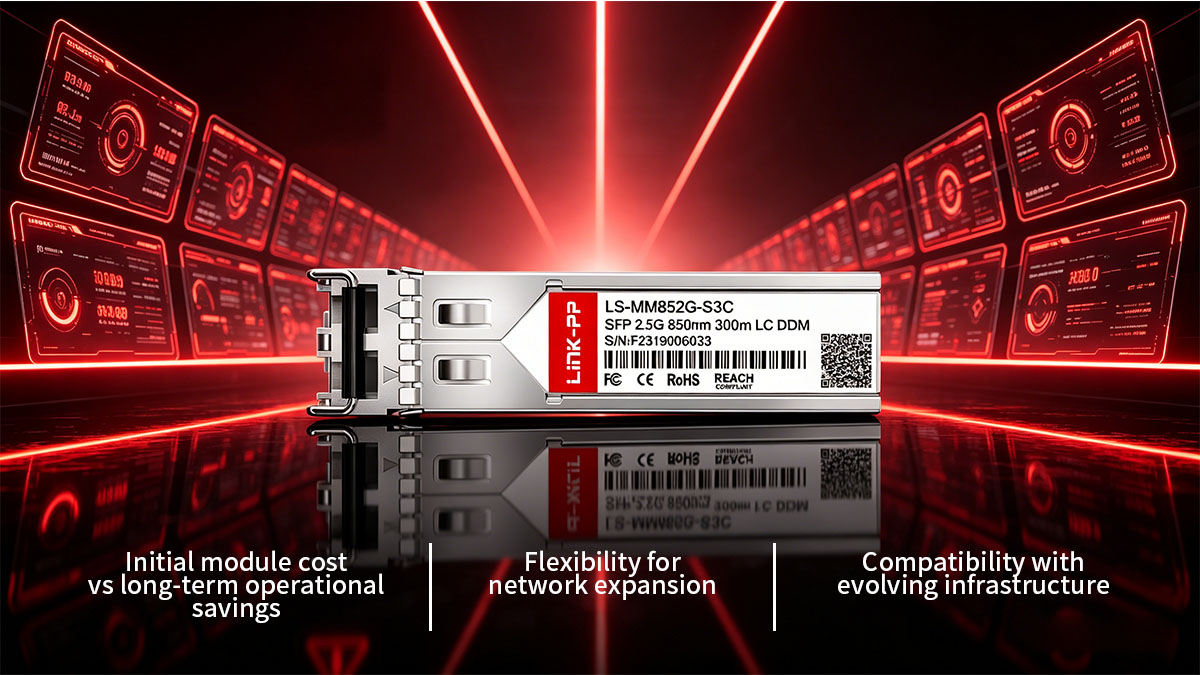
To make a rational selection decision, it is necessary to break down cost efficiency into measurable economic and technical dimensions.
Total Cost of Ownership (TCO)
Total cost of ownership provides a more accurate evaluation than upfront module pricing alone. In real deployments, the cost of network upgrades includes hardware, energy consumption, maintenance, and future scalability.
Before analyzing components, it is important to recognize that 2.5G SFP transceivers are often chosen specifically to minimize infrastructure replacement costs.
- Avoids full switch replacement in many upgrade scenarios
- Extends usable life of existing 1G cabling infrastructure
- Reduces need for immediate 10G uplink investment
- Lowers operational disruption during deployment
To better understand how cost is distributed across lifecycle stages, the table below summarizes key TCO components:
| Cost Component |
Impact Area |
2.5G SFP Advantage |
| Hardware Cost |
Module and switch investment |
Lower than 10G migration |
| Energy Consumption |
Power usage per port |
More efficient than 10G optics |
| Deployment Cost |
Installation and downtime |
Minimal infrastructure changes |
| Upgrade Cycle |
Future scalability |
Extends 1G infrastructure lifespan |
After reviewing these factors, it becomes clear that 2.5G SFP transceivers reduce overall lifecycle cost by balancing performance improvements with infrastructure reuse.
This makes them particularly attractive for organizations that require predictable budgeting and phased network expansion.
Scalability and Future-Proofing
Scalability is another important aspect of value evaluation, especially for networks expected to grow in bandwidth demand over time. A cost-effective solution is not only about current savings but also about avoiding premature infrastructure obsolescence.
Before analyzing scalability benefits, it is important to note that many modern network environments are transitioning gradually rather than in a single upgrade cycle.
- Supports incremental bandwidth upgrades from 1G to 2.5G
- Bridges gap toward future 10G or multi-gig deployments
- Reduces need for immediate backbone redesign
- Supports growing demand from Wi-Fi 6/6E and edge applications
To better illustrate scalability advantages, the following comparison highlights upgrade flexibility across common Ethernet speeds:
| Speed Tier |
Upgrade Complexity |
Infrastructure Impact |
Scalability |
| 1G |
Baseline |
Existing standard |
Limited |
| 2.5G |
Moderate upgrade |
Minimal changes required |
High |
| 10G |
Major upgrade |
Requires broader redesign |
High but costly |
After evaluating these differences, it becomes evident that 2.5G SFP occupies a strategic middle position, offering meaningful performance gains without triggering full-scale infrastructure replacement.
This allows organizations to align network upgrades with actual demand growth rather than over-investing early.
🕎 How to Choose the Right 2.5G SFP Transceiver for Your Network
Selecting the right 2.5G SFP transceiver requires a structured evaluation process that goes beyond speed specifications. In real deployments, the correct choice depends on compatibility, physical infrastructure, transmission requirements, and future scalability. A systematic approach helps avoid mismatches that can lead to link failure, performance degradation, or unnecessary cost.
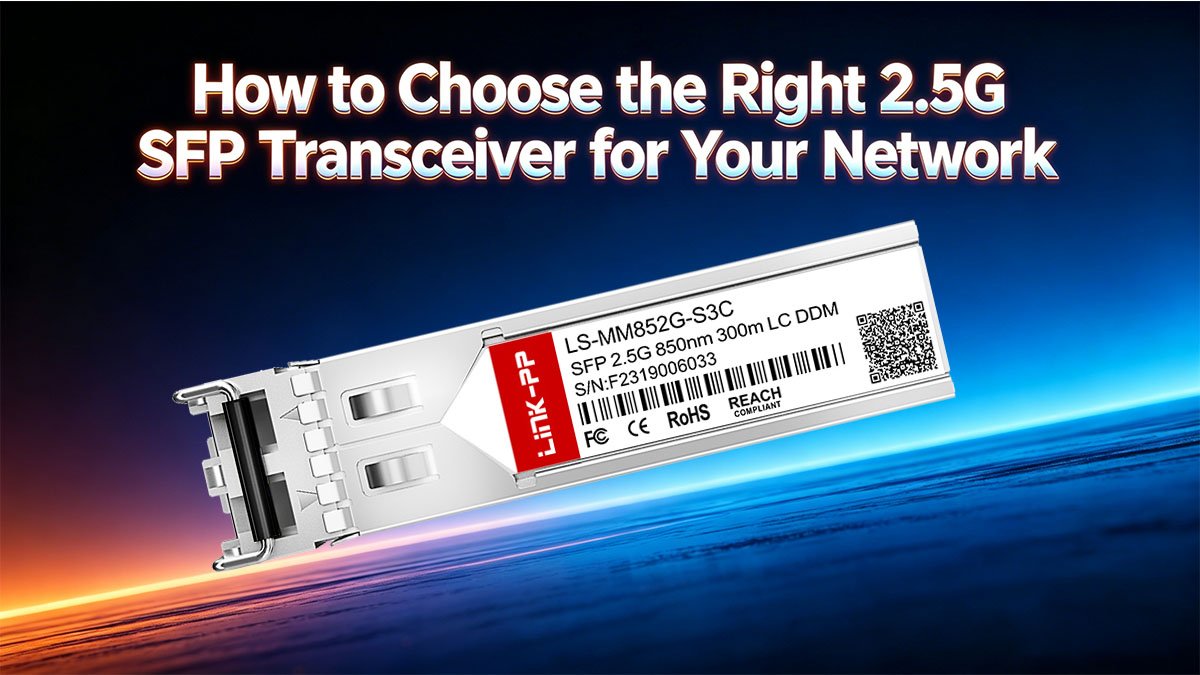
To simplify decision-making, the selection process can be broken down into clear, sequential steps.
Step 1: Identify Required Speed and Link Purpose
The first step is to define why 2.5G is needed in the network. This ensures the selected transceiver aligns with actual application demands rather than theoretical upgrades.
Before selecting a module, it is important to understand the traffic type and aggregation point it will support.
- Wi-Fi 6/6E access point uplinks requiring >1G bandwidth
- Aggregation of IP cameras or IoT devices
- Campus or enterprise access-layer upgrades
- Edge or branch office connectivity improvements
After identifying the use case, it becomes easier to determine whether 2.5G is the optimal speed tier or if a different upgrade path is required.
This step ensures the selection is demand-driven rather than specification-driven.
Step 2: Verify Switch and Port Compatibility
Switch compatibility is one of the most critical selection factors because not all SFP ports support 2.5G operation. Even if a transceiver is technically capable, it will not function correctly without proper host support.
Before evaluating module specifications, the hardware environment must be validated.
- Confirm whether switch supports 2.5G SFP or multi-gig ports
- Check if port operates at fixed speed or multi-rate mode
- Verify firmware compatibility with non-OEM modules if applicable
- Ensure SFP slot supports required coding or MSA standards
To better compare compatibility scenarios, the following table highlights common switch behaviors:
| Switch Type |
2.5G Support |
Behavior |
Risk Level |
| Multi-gig switch |
Native support |
Full 2.5G operation |
Low |
| Fixed 1G SFP switch |
Not supported |
Link failure or fallback |
High |
| Multi-rate SFP+ switch |
Conditional support |
Depends on configuration |
Medium |
After reviewing these conditions, it becomes clear that hardware validation is essential before any optical selection decisions are made.
This prevents deployment issues related to port negotiation or speed mismatch.
Step 3: Match Fiber Type and Physical Infrastructure
Fiber compatibility determines whether the transceiver can physically operate within the existing network infrastructure. Incorrect matching is one of the most common causes of deployment failure.
Before selecting a module type, the installed cabling environment must be clearly identified.
- Multimode fiber (OM2/OM3/OM4) for short-range links
- Single-mode fiber (OS2) for long-distance transmission
- Copper cabling (Cat5e/Cat6) for short Ethernet runs
- Connector type typically LC duplex for fiber modules
To better understand matching requirements, the table below summarizes common combinations:
| Module Type |
Fiber Type |
Typical Reach |
Deployment Scenario |
| 2.5GBASE-SX |
Multimode fiber |
Up to 300m |
Data center, campus |
| 2.5GBASE-LX |
Single-mode fiber |
Up to 10km |
Metro, inter-building |
| 2.5G Copper SFP |
Copper cabling |
Up to 100m |
Enterprise LAN access |
After evaluating infrastructure compatibility, it becomes clear that correct matching ensures stable signal transmission and prevents unnecessary attenuation or link failure.
This step ensures physical-layer alignment before performance optimization.
Step 4: Evaluate Distance and Link Budget Requirements
Distance requirements directly influence which optical variant should be selected. Beyond physical reach, link budget analysis ensures that the signal remains stable across the entire transmission path.
Before choosing a module, it is important to account for real-world loss factors.
- Fiber attenuation per kilometer
- Connector and splice losses
- Patch panel insertion loss
- Safety margin for aging and environmental variation
After considering these elements, the table below summarizes typical design constraints:
| Parameter |
Impact on Link |
Design Consideration |
| Distance |
Determines module type |
SX vs LX selection |
| Attenuation |
Reduces signal strength |
Budget calculation required |
| Safety Margin |
Ensures stability |
Typically 3–5dB buffer |
After reviewing these factors, it is clear that distance planning is not just about maximum reach, but about maintaining stable optical performance under real conditions.
This ensures long-term reliability and avoids marginal link behavior.
Step 5: Consider Cost, Scalability, and Vendor Strategy
The final step is balancing technical requirements with cost efficiency and long-term scalability. A well-chosen 2.5G SFP transceiver should support both current needs and future expansion.
Before evaluating cost structure, it is important to distinguish between upfront price and lifecycle value.
- OEM modules offer guaranteed compatibility but higher cost
- MSA-compliant alternatives provide cost flexibility
- Energy-efficient modules reduce operational expenses
- Scalable deployments reduce future upgrade disruptions
To better understand strategic trade-offs, the table below highlights key decision factors:
| Factor |
OEM Modules |
Compatible Modules |
| Cost |
Higher |
Lower |
| Compatibility |
Guaranteed |
Depends on vendor |
| Flexibility |
Limited |
High |
| Lifecycle Value |
Stable |
Cost-optimized |
After reviewing these considerations, it becomes clear that the optimal choice depends on deployment scale, budget constraints, and long-term network strategy.
A balanced selection ensures both performance stability and economic efficiency.
🕎 Conclusion
The 2.5G SFP transceiver has become a practical and strategic solution for modern network upgrades, sitting between legacy 1G optics and higher-cost 10G infrastructure. Throughout this guide, it is clear that selecting the right module is not a single-spec decision, but a structured evaluation of compatibility, fiber type, transmission distance, performance stability, and total cost efficiency.
From a selection perspective, several core principles consistently determine deployment success. First, ensuring switch and port compatibility is essential to avoid negotiation failures or speed mismatches. Second, matching fiber type and optical specifications guarantees stable transmission performance across the intended distance. Third, evaluating environmental and thermal conditions helps maintain long-term reliability, especially in high-density or edge deployments. Finally, considering total cost of ownership and scalability ensures that the chosen solution supports both current requirements and future network growth.
To summarize the key takeaways:
- 2.5G SFP fills the critical gap between 1G and 10G Ethernet upgrades
- Proper compatibility validation is essential before deployment
- Fiber type, wavelength, and distance must be precisely matched
- Thermal efficiency and environmental tolerance impact long-term stability
- Lifecycle cost and scalability are as important as initial module selection
For organizations planning network expansion or performance upgrades, choosing a reliable and standards-compliant optical module supplier is equally important as the technical selection itself. A well-verified source helps ensure consistent quality, interoperability, and long-term operational stability.
For dependable and standards-compliant optical solutions, you can explore the LINK-PP Official Store, which provides a wide range of compatible and high-performance transceiver modules designed to support diverse networking environments and deployment requirements.