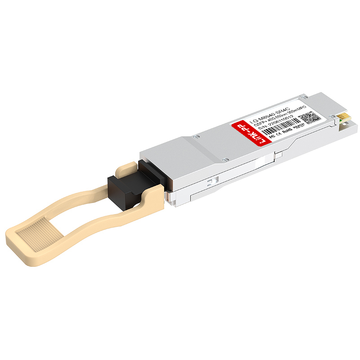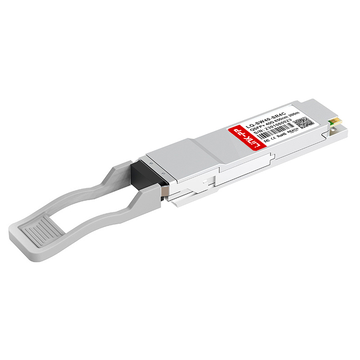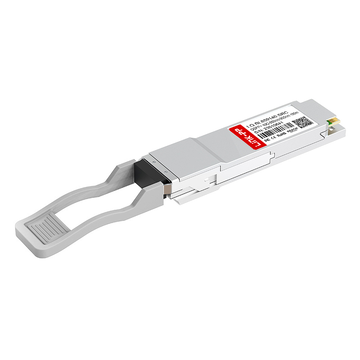
In modern data center and enterprise network upgrades, 40GBASE-SRBD (QSFP-40G-SR-BD) has become a frequently searched optical transceiver due to its unique ability to reuse existing duplex multimode fiber infrastructure while delivering 40GbE performance. Unlike traditional 40GBASE-SR4 optics that require MPO/MTP cabling, SRBD (BiDi) solutions operate over standard duplex LC fiber, making them especially attractive for organizations migrating from SFP+ 10G to QSFP+ 40G without rebuilding their cabling plant.
However, the growing search volume around “QSFP-40G-SRBD vs 40G-QSFP-SR4”, “compatibility issues”, and “will it work with my switch or NIC?” shows that most users are not just looking for definitions—they are trying to solve real deployment decisions and compatibility risks. This includes understanding whether SRBD optics are supported by specific vendors, how far they can transmit, and whether the cost premium is justified compared to SR4 alternatives.
From an engineering and procurement perspective, 40GBASE-SRBD sits at the intersection of cost efficiency, infrastructure reuse, and interoperability complexity. It is widely used in short-reach data center links, top-of-rack to aggregation switches, and environments where minimizing fiber re-cabling is a priority. At the same time, its BiDi (bidirectional) design introduces important considerations around wavelength pairing, power budgets, and vendor compatibility that are often misunderstood during purchasing decisions.
This guide is designed to provide a clear, technically accurate, and decision-focused explanation of 40GBASE-SRBD, helping network engineers, IT architects, and procurement teams confidently evaluate whether it is the right choice for their 40G upgrade path.
🔴 What Is 40GBASE-SRBD?
40GBASE-SRBD (QSFP-40G-SR-BD) is a 40GbE QSFP+ optical transceiver based on BiDi (bidirectional) short-reach technology, designed to transmit and receive data over standard duplex multimode fiber (MMF) using LC connectors. Unlike traditional parallel-optic solutions, SRBD enables 40G transmission over just two fibers instead of eight, making it a practical upgrade option for networks that already rely on 10G duplex cabling.
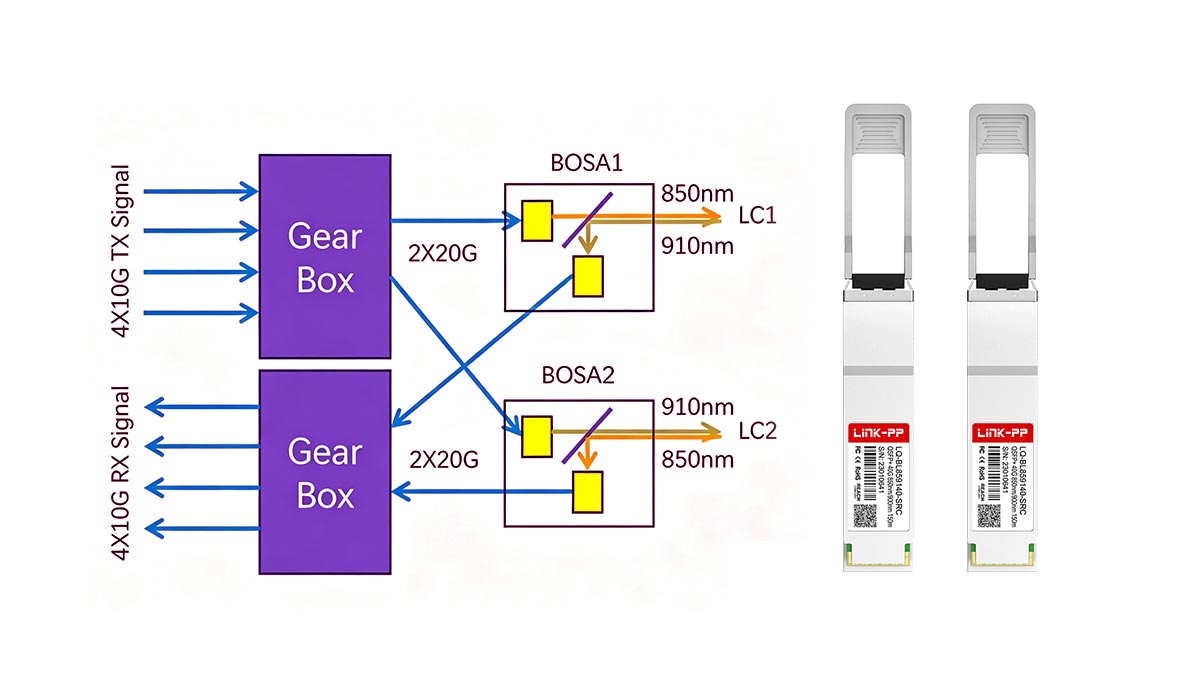
40GBASE-SRBD Definition and Working Principle
40GBASE-SRBD is built on BiDi optical transmission, meaning each fiber simultaneously carries data in both directions but at different wavelengths. One fiber transmits at one wavelength pair (e.g., 850 nm / 910 nm), while the other fiber carries the complementary pair in reverse.
This design allows:
-
Full 40Gbps bidirectional communication
-
Operation over existing duplex LC MMF links
-
Elimination of MPO/MTP parallel fiber infrastructure
In simple terms, SRBD works like two coordinated 20G channels over a duplex fiber pair, synchronized through wavelength division multiplexing (WDM) techniques.
Core Specs, Connector Type, and Fiber Type
From a deployment perspective, 40GBASE-SRBD is defined by several key physical and operational characteristics:
-
Form factor: QSFP+ (Quad Small Form-factor Pluggable Plus)
-
Data rate: 40GbE (4 × 10G internal channels using BiDi mapping)
-
Connector type: Duplex LC
-
Fiber type: Multimode fiber (OM3 / OM4 / OM5 supported depending on reach)
-
Typical reach:
-
~100 meters on OM3
-
~150 meters on OM4/OM5
-
-
Wavelength design: Dual-wavelength BiDi transmission (paired optics)
Compared with MPO-based SR4 optics, SRBD significantly reduces cabling complexity because it does not require polarity management of 8-fiber MPO trunks.
🔴 40GBASE-SRBD vs. 40GBASE-SR4: Which One Should You Buy?
Choosing between 40GBASE-SRBD and 40GBASE-SR4 is one of the most common decision points in 40G network upgrades. Although both support 40GbE over multimode fiber, they are designed for very different cabling environments and migration strategies. The right choice depends less on performance and more on existing infrastructure, scalability plans, and operational complexity.
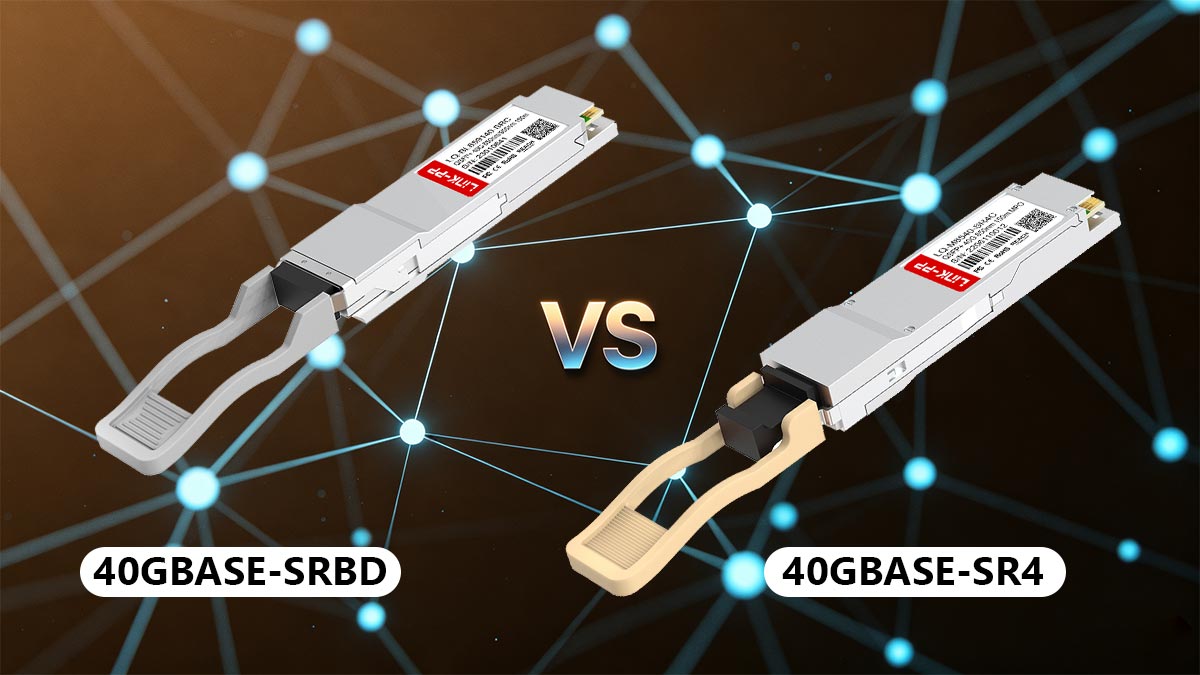
SRBD vs. SR4 Connector Differences
The most immediate difference between SRBD and SR4 is the physical connector type, which directly impacts cabling design.
-
40GBASE-SRBD (BiDi):
-
Uses duplex LC connectors (2 fibers)
-
Works with standard LC patch cords
-
No polarity management required
-
-
40GBASE-SR4:
-
Uses MPO/MTP connectors (8 fibers)
-
Requires structured MPO trunk cabling
-
Polarity must be correctly configured (Type A/B/C)
-
In practical terms, SRBD is designed for simplicity and reuse, while SR4 is designed for high-density structured cabling environments.
SRBD vs. SR4 Cabling and Deployment Differences
From a deployment standpoint, SRBD and SR4 follow two very different philosophies:
SRBD (BiDi deployment model):
-
Ideal for existing duplex LC multimode fiber
-
Enables 10G → 40G upgrades without replacing fiber plant
-
Reduces disruption in live data center environments
-
Simplifies patching and troubleshooting
SR4 (parallel optics model):
-
Requires MPO/MTP trunk infrastructure
-
Often used in new builds or high-density spine-leaf architectures
-
Supports 40G breakout to 4×10G for server connections
-
Better suited for structured cabling standardization
In summary, SRBD optimizes for retrofit environments, while SR4 optimizes for greenfield scalability and high-density design.
SRBD vs. SR4 Cost and Migration Trade-offs
Cost comparison between SRBD and SR4 is not only about optics pricing—it also includes infrastructure and operational overhead.
SRBD advantages:
-
No need to install MPO/MTP cabling
-
Lower migration cost in existing LC-based networks
-
Reduced installation and change management effort
-
Faster deployment in brownfield environments
SR4 advantages:
-
Typically lower-cost optics compared to BiDi transceiver modules
-
More standardized in modern data center designs
-
Easier scaling for high-density 40G/100G evolution
-
Supports breakout architectures more naturally
However, SRBD modules often carry a higher unit cost, which is offset by savings in cabling and labor. SR4, while cheaper per optic, may require significant infrastructure investment if MPO cabling is not already deployed.
40GBASE-SRBD vs. 40GBASE-SR4 Comparison Table
|
Feature |
40GBASE-SRBD (QSFP-40G-SR-BD) |
40GBASE-SR4 |
|---|---|---|
|
Transmission Technology |
BiDi (bidirectional WDM over duplex fiber) |
Parallel optics (4×10G lanes) |
|
Connector Type |
Duplex LC |
MPO/MTP (8-fiber) |
|
Fiber Type |
Multimode fiber (OM3/OM4/OM5) |
Multimode fiber (OM3/OM4/OM5) |
|
Fiber Count Required |
2 fibers |
8 fibers |
|
Cabling Model |
Existing LC duplex cabling reuse |
MPO trunk cabling required |
|
Deployment Type |
Brownfield (upgrade existing networks) |
Greenfield / structured cabling |
|
Typical Reach |
~100m (OM3), ~150m (OM4/OM5) |
~100m (OM3), ~150m (OM4/OM5) |
|
Breakout Support |
No |
Yes (40G → 4×10G) |
|
Installation Complexity |
Low |
Medium to High (polarity + MPO management) |
|
Cost Profile |
Higher optic cost, lower infrastructure cost |
Lower optic cost, higher cabling cost |
|
Best Use Case |
10G → 40G migration with existing LC fiber |
New high-density data center builds |
Decision Summary
-
Choose 40GBASE-SRBD if you want to reuse existing duplex LC MMF infrastructure and minimize disruption.
-
Choose 40GBASE-SR4 if you are building or already using MPO-based structured cabling and planning for future high-density scaling.
In most real-world deployments, the decision is driven less by optics capability and more by existing fiber plant strategy and long-term network architecture goals.
🔴 Compatibility Checklist Before You Deploy
Even though 40GBASE-SRBD (QSFP-40G-SR-BD) is designed to simplify 40G migration, it is also one of the most commonly misunderstood optics in terms of compatibility. Many deployment issues reported in real-world environments are not related to fiber distance or signal quality—but instead to host-side support, vendor restrictions, and power limitations.
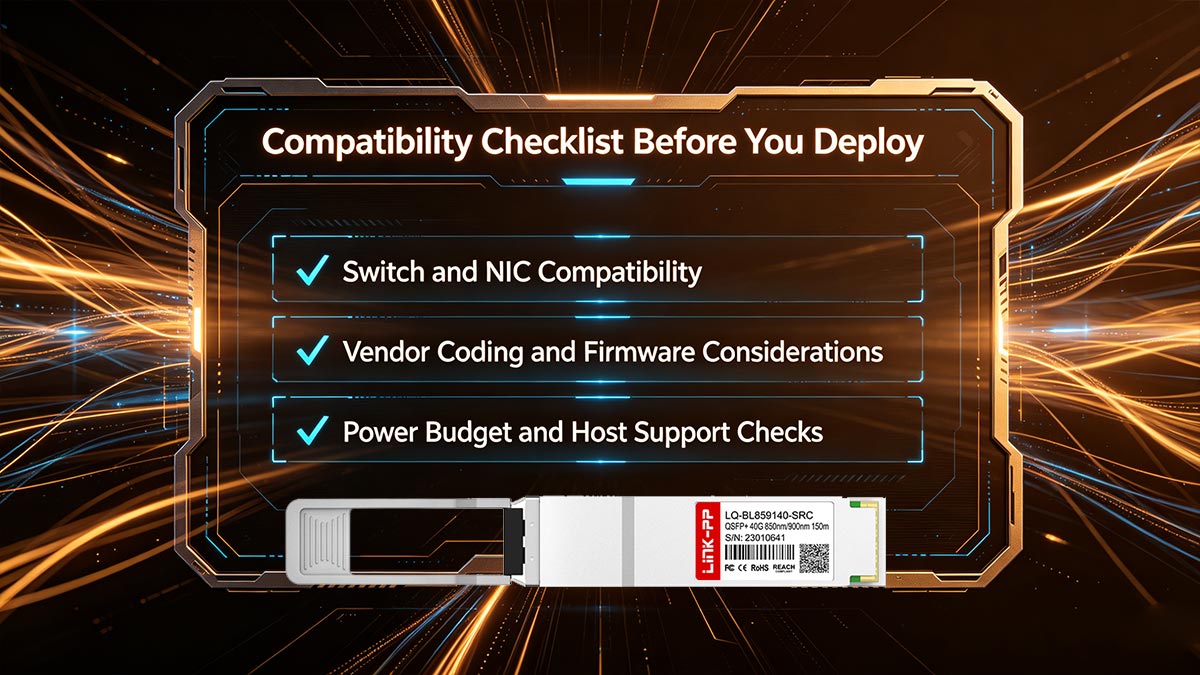
Before deploying SRBD optics, the following three areas should always be validated.
Switch and NIC Compatibility
The first and most critical step is confirming whether the switch or NIC officially supports QSFP-40G-SRBD.
Key checks include:
-
QSFP port type support (QSFP+ 40G only, not QSFP28-only ports)
-
Whether the platform supports BiDi optics explicitly
-
Compatibility lists from vendors (Cisco, Arista, Mellanox/NVIDIA, Juniper, etc.)
-
Support for 40GBASE-SRBD or equivalent encoded optics
Common real-world issue: Even if the port is QSFP+, some platforms only support SR4 or DAC/AOC, and will reject SRBD modules or keep the port in a “not supported” state.
Vendor Coding and Firmware Considerations
One of the most frequent deployment blockers for SRBD optics is vendor locking or firmware restrictions.
Important factors include:
-
EEPROM coding (vendor-specific vs. generic optics)
-
Switch OS version requirements (NX-OS, EOS, Junos, etc.)
-
“Third-party optics” policy settings
-
Need for commands such as:
-
service unsupported-transceiver -
or equivalent vendor unlock configurations
-
In many cases, SRBD modules will physically work, but are blocked by software unless explicitly enabled.
Best practice: Always verify firmware compatibility matrix + optics support matrix before purchase, especially in mixed-vendor environments.
Power Budget and Host Support Checks
Unlike passive copper DAC cables, SRBD optics are active optical modules, which means power consumption and host budget matter.
Key considerations:
-
Typical QSFP+ SRBD power draw is higher than DAC or SR4 optics
-
Each switch port has a limited QSFP power budget
-
Some NICs (especially older Mellanox ConnectX-3/ConnectX-4 variants) may fail to initialize SRBD optics due to insufficient power delivery
-
High-density switches may throttle or reject modules if power budget is exceeded
Common real-world failure mode: Optic is detected → link stays down → power or initialization failure in logs
✔ Best practice checklist:
-
Confirm QSFP port power class support
-
Validate max wattage per port
-
Check NIC vendor compatibility notes for BiDi optics
Deployment Takeaway
Most 40GBASE-SRBD issues are not fiber-related—they are host compatibility and firmware policy problems. A successful deployment requires validating three layers together:
-
Hardware support (switch/NIC)
-
Software authorization (firmware + optics policy)
-
Electrical/power budget (QSFP limits)
When these three align, SRBD becomes a very stable and efficient option for duplex MMF-based 40G upgrades.
🔴 40GBASE-SR-BD Cabling, Distance, and Network Use Cases
The main value of 40GBASE-SR-BD is not just 40G speed—it is the ability to deliver 40G over existing duplex LC multimode fiber infrastructure. This makes it especially relevant in brownfield data centers where cabling changes are expensive, disruptive, or operationally risky.
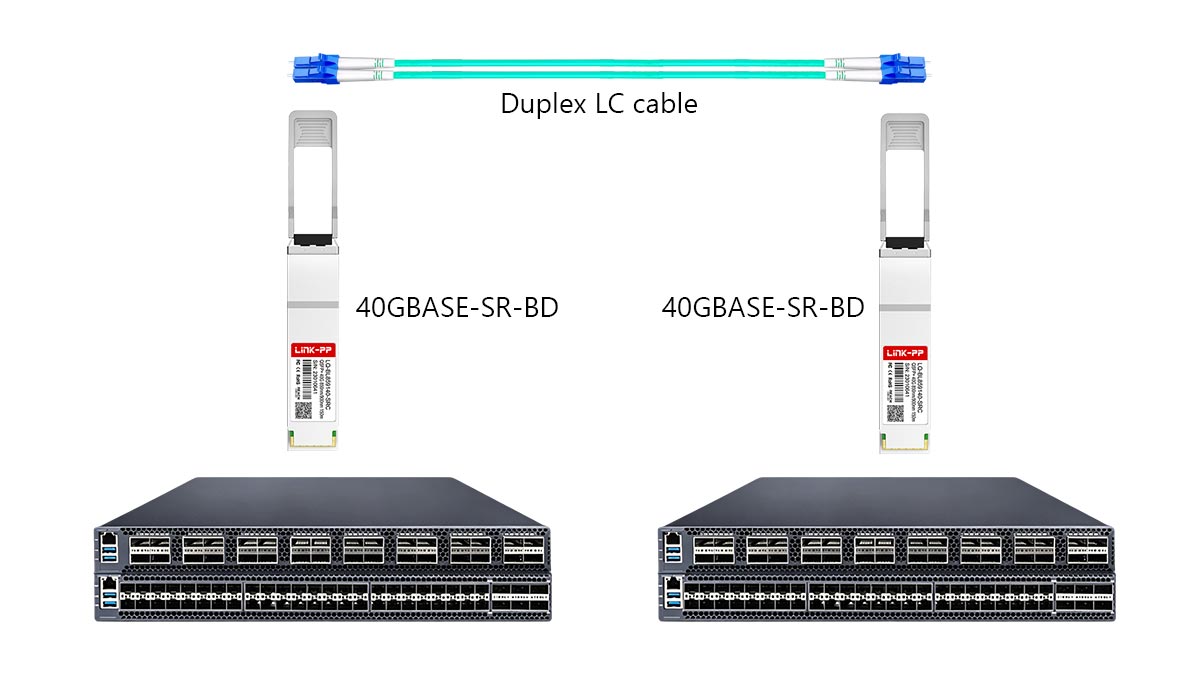
Understanding where SRBD fits best requires looking at real cabling environments, reuse scenarios, and architectural trade-offs against MPO-based SR4 optics.
Duplex LC Multimode Fiber Use Cases
40GBASE-SRBD is specifically designed for environments where duplex LC multimode fiber (MMF) is already installed.
Typical use cases include:
-
Top-of-rack (ToR) to aggregation switch uplinks
-
Server-to-switch connections in legacy 10G MMF environments
-
Campus or enterprise backbone upgrades
-
Data center zones where LC patch panels are already standardized
In these scenarios, SRBD allows operators to upgrade bandwidth without touching structured cabling, which significantly reduces downtime and labor costs.
Existing MMF Reuse Scenarios
One of the strongest reasons for choosing SRBD is fiber infrastructure reuse. Many data centers still rely on OM3/OM4 duplex LC cabling installed during the 10G era.
Common reuse scenarios include:
-
10G → 40G migration without recabling
-
Reusing LC patch panels and structured horizontal cabling
-
Incremental upgrades across racks or pods instead of full redesign
-
Extending lifecycle of existing multimode fiber plants
This makes SRBD particularly attractive in environments where:
-
Fiber trays are already full
-
Cabling changes require service windows
-
Budget constraints limit physical infrastructure upgrades
When SRBD is Better Than MPO-based Optics
Although 40GBASE-SR4 is widely used in modern high-density designs, SRBD becomes the better choice in specific operational conditions.
Choose SRBD when:
-
You already have duplex LC MMF infrastructure in place
-
You want to avoid deploying or managing MPO/MTP trunks
-
You need a low-disruption 10G → 40G upgrade path
-
Your network is spread across multiple smaller fiber zones rather than centralized high-density rows
SRBD is especially advantageous in:
-
Brownfield enterprise data centers
-
Financial or telecom environments with strict change control
-
Legacy structured cabling systems that are not MPO-ready
In contrast, SR4 is better suited for:
-
New builds with planned MPO backbone architecture
-
High-density spine-leaf data center fabrics
-
Environments requiring 40G-to-10G breakout flexibility
Practical Takeaway
40GBASE-SRBD is not a performance upgrade over SR4—it is a cabling strategy upgrade.
It wins when the goal is:
-
Preserve existing LC infrastructure
-
Minimize physical change
-
Reduce migration complexity
This is why SRBD continues to appear frequently in real-world deployments, especially in organizations modernizing networks without redesigning their entire fiber plant.
🔴 Common 40GBASE-SRBD Problems and How to Fix Them
Although QSFP-40G-SR-BD is designed for plug-and-play deployment over duplex LC multimode fiber, real-world installations often run into predictable issues. Most of these problems are not related to the optic’s core design, but rather to compatibility, fiber cleanliness, configuration, or power constraints.
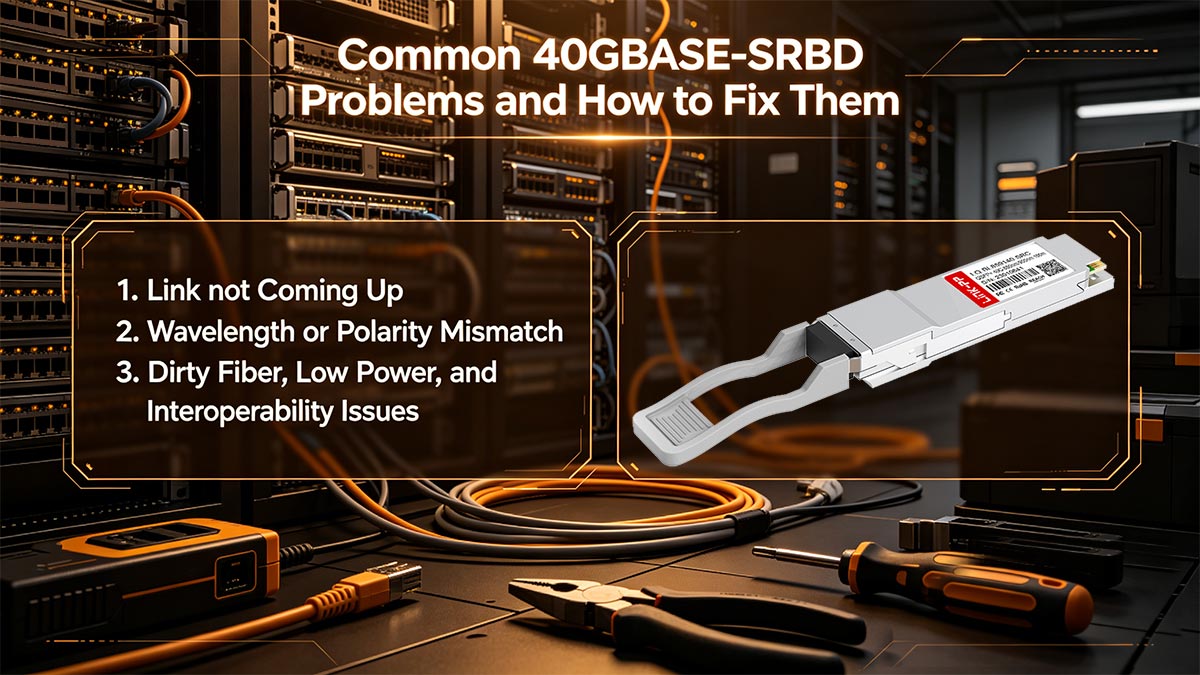
Below are the most common failure scenarios and practical troubleshooting steps.
1. Link not Coming Up
A “link down” or “no link detected” state is the most frequently reported issue with SRBD deployments.
Typical causes:
-
Switch or NIC does not support SRBD optics
-
Vendor restriction or unsupported transceiver mode
-
Incompatible firmware or outdated OS version
-
Insufficient QSFP port power budget
-
Incorrect optic insertion or seating issue
How to fix it:
-
Verify the device is listed in the vendor’s QSFP-40G-SRBD compatibility matrix
-
Check system logs for “unsupported transceiver” messages
-
Upgrade switch/NIC firmware if required
-
Enable third-party optics support if applicable
-
Reseat the module and confirm proper QSFP latch engagement
In many cases, the optic is physically functional but blocked at the software or policy level.
2. Wavelength or Polarity Mismatch
Although SRBD uses BiDi (bidirectional wavelength pairing) to simplify cabling, mismatches can still occur if optics are not correctly paired.
Typical causes:
-
Incorrect SRBD pair combination (non-matching wavelength sets)
-
Mixing SRBD with non-BiDi optics
-
Cross-connection errors in patching
-
Inconsistent vendor implementations
Symptoms:
-
Link comes up intermittently or stays unstable
-
High error rates or CRC errors
-
One side shows RX loss while TX appears normal
How to fix it:
-
Ensure SRBD modules are installed as a matched BiDi pair
-
Verify correct port-to-port fiber mapping (A ↔ B pairing)
-
Avoid mixing SRBD with SR4 or standard SR optics
-
Recheck patch panel labeling and fiber routing documentation
3. Dirty Fiber, Low Power, and Interoperability Issues
Because SRBD operates at high-speed optical transmission over multimode fiber, signal integrity issues can significantly impact stability.
Common root causes:
-
Dirty LC connectors
-
Dust or contamination on endfaces causes high insertion loss
-
-
Low optical power budget
-
Especially in high-density switches where QSFP ports share limited power
-
-
Interoperability issues
-
Third-party SRBD modules not fully aligned with vendor coding
-
-
Aging or degraded OM3/OM4 fiber
-
Older fiber plants may introduce unexpected attenuation
-
How to fix it:
-
Clean all LC connectors using proper fiber cleaning tools before deployment
-
Measure optical power levels using diagnostic commands or optical testers
-
Confirm fiber grade (OM3/OM4/OM5) meets required reach
-
Use optics validated by switch vendor or tested compatibility lists
-
Replace suspect patch cords if attenuation is inconsistent
Practical Takeaway
Most 40GBASE-SRBD issues fall into three categories:
-
Control-plane issues (compatibility, firmware, vendor lock)
-
Physical-layer issues (fiber cleanliness, polarity, cabling errors)
-
Electrical constraints (QSFP power budget limitations)
Once these three areas are validated, SRBD typically delivers very stable performance in duplex LC-based 40G networks, especially in brownfield deployments where infrastructure reuse is critical.
🔴 FAQs About 40GBASE-SRBD
Q1: What does SR stand for in 40GBASE-SR4?
SR stands for “Short Reach.” In 40GBASE-SR4, it refers to a short-distance multimode fiber standard designed for data center interconnects. It typically operates over OM3 or OM4 multimode fiber using 850nm VCSEL-based optics and is intended for links up to around 100–150 meters depending on fiber grade.
Q2: What is the difference between QSFP-40G-SRBD and QSFP-40G-SR4?
The key difference is cabling architecture and transmission method:
QSFP-40G-SRBD (BiDi):
- Uses duplex LC connectors
- Transmits 40G over 2 fibers using bidirectional wavelengths
- Designed for existing LC multimode fiber reuse
- Ideal for brownfield upgrades (10G to 40G)
QSFP-40G-SR4:
- Uses MPO/MTP connectors
- Requires 8 fibers (4 Tx + 4 Rx lanes)
- Supports parallel optics and 40G breakout (4×10G)
- Best suited for new structured cabling deployments
In short: SRBD focuses on simplicity and infrastructure reuse, while SR4 focuses on scalability and structured high-density design.
Q3: Is 40GBASE-SRBD good for existing duplex MMF upgrades?
Yes. 40GBASE-SRBD is specifically designed for upgrading existing 10G duplex LC multimode fiber networks to 40G without replacing cabling infrastructure.
It is a strong choice when:
- You already have OM3 or OM4 LC duplex fiber installed
- You want to avoid installing MPO/MTP trunks
- You need a low-disruption migration path from 10G to 40G
- You want to extend the life of existing structured cabling
However, it is important to ensure:
- Switch or NIC supports SRBD optics
- Firmware allows BiDi optics
- Optical power budget is sufficient for the link
Q4: Can SRBD and SR4 be used in the same network?
Yes, but not on the same link segment. They can coexist in the same data center, but SRBD links use LC duplex multimode fiber while SR4 links use MPO or MTP parallel fiber. They are not interoperable on a single fiber connection, so each must remain within its own cabling architecture.
Q5: Which is more cost-effective: SRBD or SR4?
It depends on the environment.
SRBD is more cost-effective in brownfield networks because it avoids fiber recabling costs.
SR4 is more cost-effective in greenfield deployments because optics and structured MPO cabling scale better long-term.
The real cost difference is often not in the optic itself, but in infrastructure change versus infrastructure reuse.
Q6: Why does SRBD sometimes fail to work even if fiber is correct?
Most SRBD failures are not fiber-related. Common causes include:
- Unsupported switch or NIC
- Vendor coding restrictions (non-approved optics)
- Insufficient QSFP power budget
- Incorrect firmware or OS version
- Improper BiDi pairing
In practice, SRBD is highly stable once host compatibility and firmware policy are correctly configured.
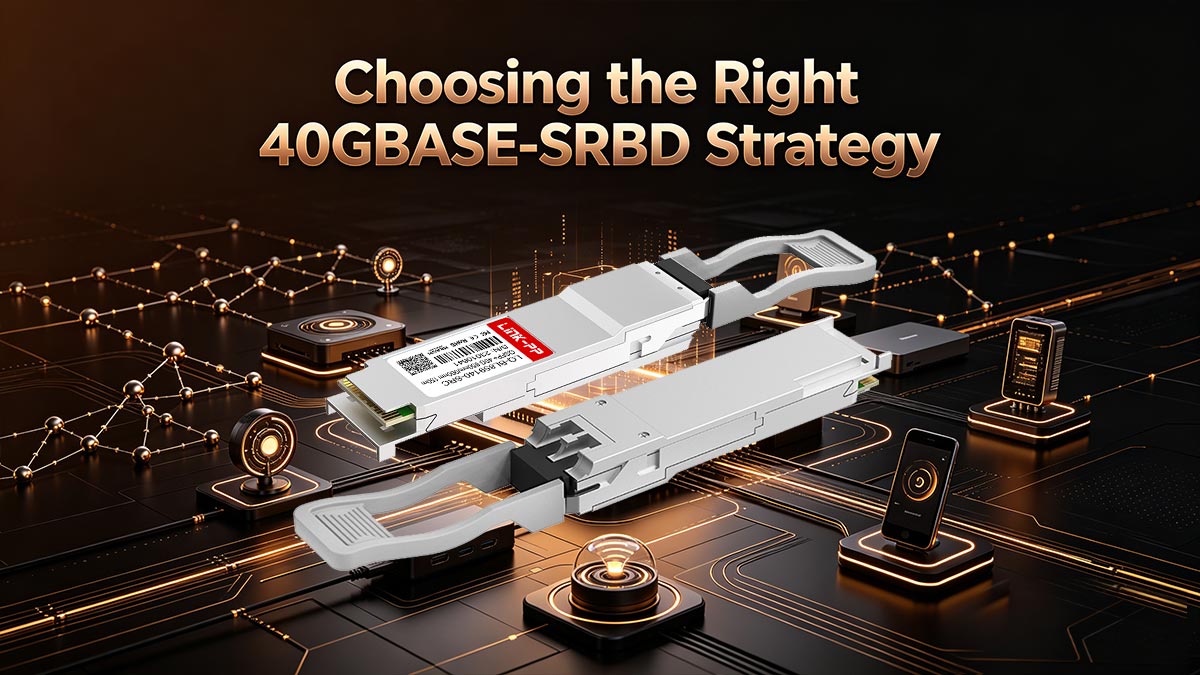
🔴 Final Thoughts: Choosing the Right 40GBASE-SRBD Strategy
40GBASE-SRBD (QSFP-40G-SR-BD) plays a very specific role in modern 40G network evolution: it is not just an alternative to SR4, but a migration-oriented solution designed for duplex LC multimode fiber environments. Its biggest advantage is clear—allowing organizations to upgrade from 10G to 40G without replacing existing fiber infrastructure or introducing MPO/MTP complexity.
However, as this guide has shown, successful deployment depends on more than just selecting the right optic. Real-world performance is shaped by switch and NIC compatibility, vendor firmware policies, power budget constraints, and correct BiDi pairing. When these factors are properly validated, SRBD becomes a stable and cost-efficient option for brownfield data center upgrades.
In contrast, 40GBASE-SR4 remains the better choice for new high-density architectures where MPO-based structured cabling is already in place or planned for future scalability. The decision is therefore less about performance superiority and more about infrastructure strategy and migration efficiency.
For network engineers and procurement teams, the key takeaway is simple:
SRBD = optimize existing duplex fiber
SR4 = optimize structured high-density design
Choosing correctly can significantly reduce both deployment cost and operational complexity in 40G rollouts.
Explore Reliable 40G Optical Solutions
If you are planning a 40G upgrade and want to ensure full compatibility across different network environments, selecting properly tested and vendor-compatible optics is critical.
You can explore a wide range of 40GBASE-SRBD, SR4, and other QSFP+ transceivers at the LINK-PP Official Store, where products are designed to support multi-vendor interoperability and real-world data center deployment requirements.