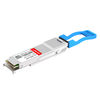
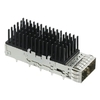
In modern high-speed network architectures, multimode SFP modules have emerged as a key enabler of reliable and cost-effective 100G connectivity. As enterprises and data centers continue to scale bandwidth to support cloud computing, virtualization, AI workloads, and large-scale storage systems, the choice of optical transceivers has evolved from a technical detail into a strategic decision. Multimode SFP module offers a practical solution for short- to medium-range 100G transmissions, particularly in high-density environments where performance, compatibility, and cost control are equally critical.
This guide provides a comprehensive overview of multimode SFP modules designed for 100G networks. It explains what a multimode SFP is, why it is widely adopted in 100G deployments, how it compares to single-mode SFP, and the practical benefits it offers. In addition, we explore common types of 100G multimode SFP modules, key technical factors to consider before selection, and frequently asked questions to help you choose the right multimode SFP for your 100G network.
? What is a Multimode SFP
Before choosing the right SFP transceiver for your 100G network, it’s important to understand what a multimode SFP is and how it fits into optical communication systems. Essentially, a multimode SFP is designed to transmit data over multimode fiber (MMF), which supports high bandwidth over shorter distances.
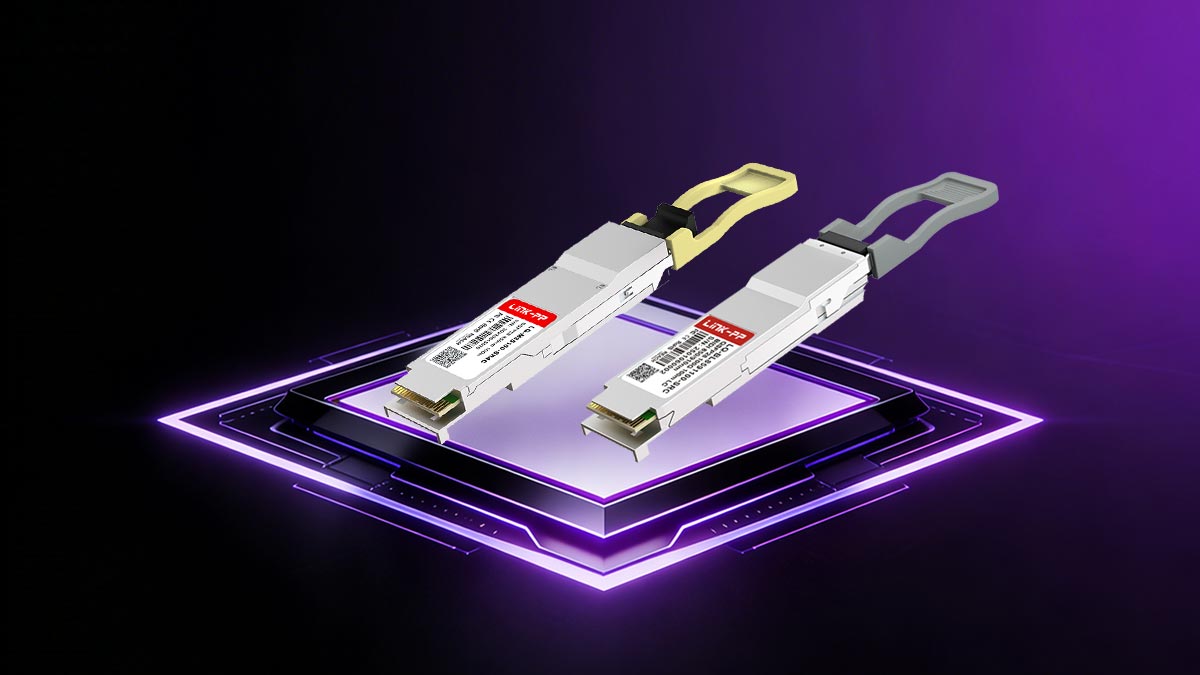
Definition of Multimode SFP
A multimode SFP is a compact, hot-pluggable optical transceiver module used to transmit and receive high-speed data over multimode fiber (MMF). It converts electrical signals from networking devices — such as switches, routers, or servers — into optical signals for transmission, and then converts incoming optical signals back into electrical signals at the receiving end. In 100G network deployments, multimode SFP modules typically use the QSFP28 form factor and support standards such as 100GBASE-SR4 or SWDM4.
Designed for short-distance transmission, multimode SFP modules operate over OM3, OM4, or OM5 fiber with a core diameter of 50/125µm, allowing multiple light modes to propagate simultaneously. They typically use short-wavelength lasers such as VCSELs, offering a cost-effective and energy-efficient solution for high-density data center environments where short-range transmission distances are required.
Key Features and Specifications of Multimode SFP
The design of multimode SFP modules is optimized for short-reach optical communication, where reliability, low latency, and efficiency are critical in confined environments such as data centers, campus backbones, and enterprise wiring closets. Their specific construction and operational features determine how effectively they support high transmission speeds like 100G and how seamlessly they integrate with a variety of network devices.
Here is a breakdown of the key features and specifications:
- Operating Wavelength: Most commonly centered around 850nm, optimized for VCSEL-based optical transmission over multimode fibers. Some advanced SFP modules like SWDM4 use multiple wavelengths to enable bidirectional or wavelength-division multiplexing over a single duplex fiber.
- Transmission Distance: Depending on fiber type and standard, multimode SFP modules can reach 70m to 150m at 100G (e.g., OM3 ≈ 70 m, OM4 ≈ 100 - 150m, and OM5 ≈ 150m), meeting most short-distance interconnect requirements in modern data centers.
- Connector Interface: Typically equipped with LC duplex or MTP/MPO connectors, multimode SFP transceivers support dense patching layouts and easy plug-and-play scalability, ideal for top-of-rack or spine-leaf architectures.
- Optical Transmitter Type: Uses Vertical-Cavity Surface-Emitting Lasers (VCSELs) for energy efficiency, lower cost, and stable short-distance signal generation compared with distributed feedback (DFB) lasers used in single-mode designs.
- Hot-pluggable Design: Allows network upgrades or replacements without shutting down the system, minimizing downtime during maintenance or scaling.
How Fiber Type Impacts Multimode SFP Performance
The choice of fiber type plays a critical role in determining the performance and transmission distance of a multimode SFP module. Multimode fibers come in several graded-index categories — OM1, OM2, OM3, OM4, and OM5 — each designed to support higher bandwidths and longer reaches as the standard evolves.
Among these, OM3, OM4, and OM5 are the most commonly used in 100G networks. For instance, 100G SR4 multimode SFP modules can typically transmit up to 70m over OM3 fiber, while OM4 extends that distance to around 100 - 150m with improved modal bandwidth. The latest OM5 fiber introduces wideband technology that supports multiple wavelengths simultaneously, enabling more efficient use of VCSEL-based transceivers such as SWDM4 modules.
Aside from distance, fiber type also affects signal integrity, attenuation, and future scalability. Higher-grade fibers with lower modal dispersion and higher effective bandwidth reduce error rates and maintain stable throughput in high-density interconnect environments. Network designers planning for long-term scalability often favor OM4 or OM5, as these fibers ensure backward compatibility with older multimode modules while optimizing performance for next-generation transceivers.
? Why Choose Multimode SFP for 100G Network Deployments
Selecting the right optical module is critical to achieving high performance and cost efficiency in 100G network deployments. Multimode SFP modules offer distinct advantages for short-reach, high-density environments such as data centers and enterprise networks.
Cost-Effective Solution for Short-Distance Transmissions
Multimode SFP modules are widely recognized for their cost efficiency in short-distance applications, typically up to 70 - 150m depending on the fiber type and module standard (e.g., OM3, OM4). Compared to single-mode solutions, multimode optics and cabling generally have lower acquisition costs, making them an economical choice for intra-rack and inter-rack connections within data centers.
Seamless Integration with Existing Multimode Infrastructure
Many enterprise and data center environments already deploy multimode fiber (MMF) for legacy 10G and 40G networks. Upgrading to 100G using multimode SFP modules allows organizations to leverage their existing cabling infrastructure without extensive rewiring. This compatibility minimizes downtime, reduces upgrade complexity, and accelerates deployment timelines. As a result, businesses can scale bandwidth efficiently while protecting prior infrastructure investments.
Reliable Performance for High-Density Environments
100G multimode SFP modules are designed to deliver stable and consistent performance in high-density networking environments. With support for parallel optics technologies such as SR4 or advanced solutions like SWDM4, these modules provide high throughput with low latency, which is essential for cloud computing, virtualization, and big data applications. Furthermore, multimode SFP modules typically offer strong signal integrity over short distances, ensuring reliable connectivity across densely packed racks and switches in modern data centers.
? Multimode SFP vs. Single-Mode SFP: Which is Better for 100G Network
When deploying a 100G network, choosing between multimode and single-mode SFP modules is a critical decision that directly impacts cost, transmission distance, and overall network architecture. The following comparison outlines their core differences and explains how to select the most suitable SFP module based on specific 100G network scenarios.

Key Differences Between Multimode and Single-Mode SFP
Multimode and single-mode SFP modules differ primarily in fiber type, transmission distance, wavelength, cost, and common deployment environments. Multimode SFP is optimized for short-distance, high-speed data transmission within data centers, while single-mode SFP is designed for long-distance communication across campuses, metropolitan areas, or telecom networks. Although both can support 100G data rates, their performance characteristics and cost considerations make them suitable for different use cases.
The following table summarizes the key differences:
| Feature |
Multimode SFP |
Single-Mode SFP |
| Fiber Type |
Multimode fiber (OM3, OM4, OM5) |
Single-mode fiber (OS2) |
| Core Diameter |
50/125µm |
9/125µm |
| Typical Wavelength |
850nm |
1310nm or 1550nm |
| Transmission Distance |
Up to 150m |
Up to 40km |
| Light Source |
VCSEL laser |
DFB laser |
| Cost |
Lower transceiver and cabling cost |
Higher module and fiber installation cost |
| Common Application |
Data center intra-rack/inter-rack |
Campus, metro, and long-haul links |
Choosing the Right SFP Module for Your 100G Network
In 100G data center environments — such as spine-leaf architectures, top-of-rack (ToR) to aggregation switches, or inter-rack connections within the same facility — multimode SFP modules like 100G SR4 or SWDM4 are typically the preferred choice. They offer sufficient transmission distance (usually within 100 - 150m), lower module costs, and compatibility with existing OM3/OM4 multimode fiber infrastructure. For high-density deployments where port count and power efficiency matter, multimode solutions provide a practical and economical option.
However, when the 100G link must span longer distances — such as between buildings on a campus, across metropolitan networks, or for telecom backhaul — single-mode SFP modules like 100G LR4 or 100G ER4 become more appropriate. Although the initial transceiver cost is higher, single-mode fiber supports significantly longer transmission distances (10km or 40km) and ensures stable performance over extended links. Therefore, the “better” option depends not only on performance requirements but also on transmission distance, existing fiber infrastructure, and overall budget considerations.
? What are the Different Types of Multimode SFP in 100G Network
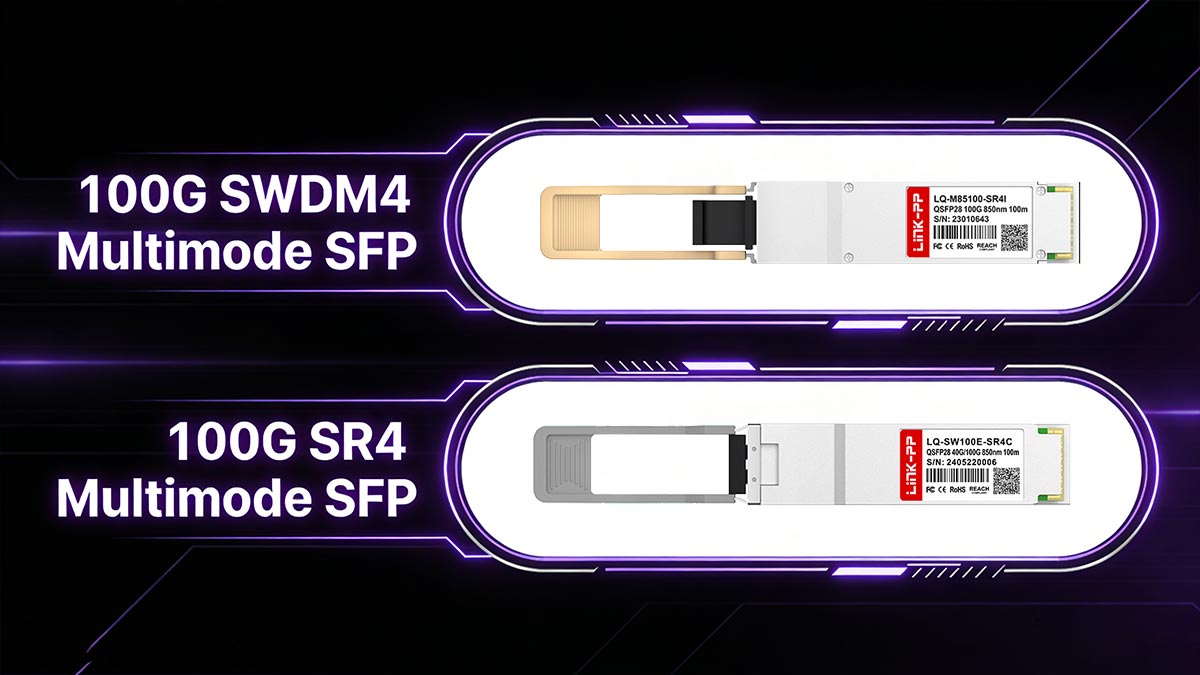
In 100G network deployments, multimode SFP modules are mainly available in two common types: 100G SWDM4 and 100G SR4. Each type is designed for high-speed short-reach transmission but differs in wavelength technology, fiber usage, and deployment flexibility.
The primary difference between 100G SWDM4 and 100G SR4 lies in their transmission method and fiber infrastructure requirements. SWDM4 uses multiple wavelengths over duplex LC multimode fiber, while SR4 uses parallel optics over MPO fiber, which impacts cabling complexity, upgrade cost, and scalability.
The following table highlights their technical differences to help you better understand which option best fits your 100G network deployment needs.
| Feature |
100G SWDM4 |
100G SR4 |
| Transmission Technique |
Short wavelength division multiplexing with 4 lanes |
Parallel 4-lane transmission |
| Operating Wavelength |
850 - 940nm (4 wavelengths) |
850nm |
| Connector Type |
Duplex LC |
MPO/MTP |
| Fiber Type |
OM3, OM4, OM5 |
OM3, OM4 |
| Cabling Complexity |
Lower (2 fibers) |
Higher (8 fibers) |
| Use Case |
Ideal for data centers upgrading existing duplex fiber links |
Suitable for high-density short-reach connections |
100G SWDM4 Multimode SFP
The 100G SWDM4 multimode SFP uses four wavelengths (typically 850nm to 940nm) to multiplex data onto a duplex multimode fiber pair. This allows it to achieve 100G transmission using only two fibers instead of eight, significantly reducing cabling complexity and cost. It is well-suited for organizations aiming to reuse existing duplex multimode infrastructure while upgrading from 40G or 10G networks.
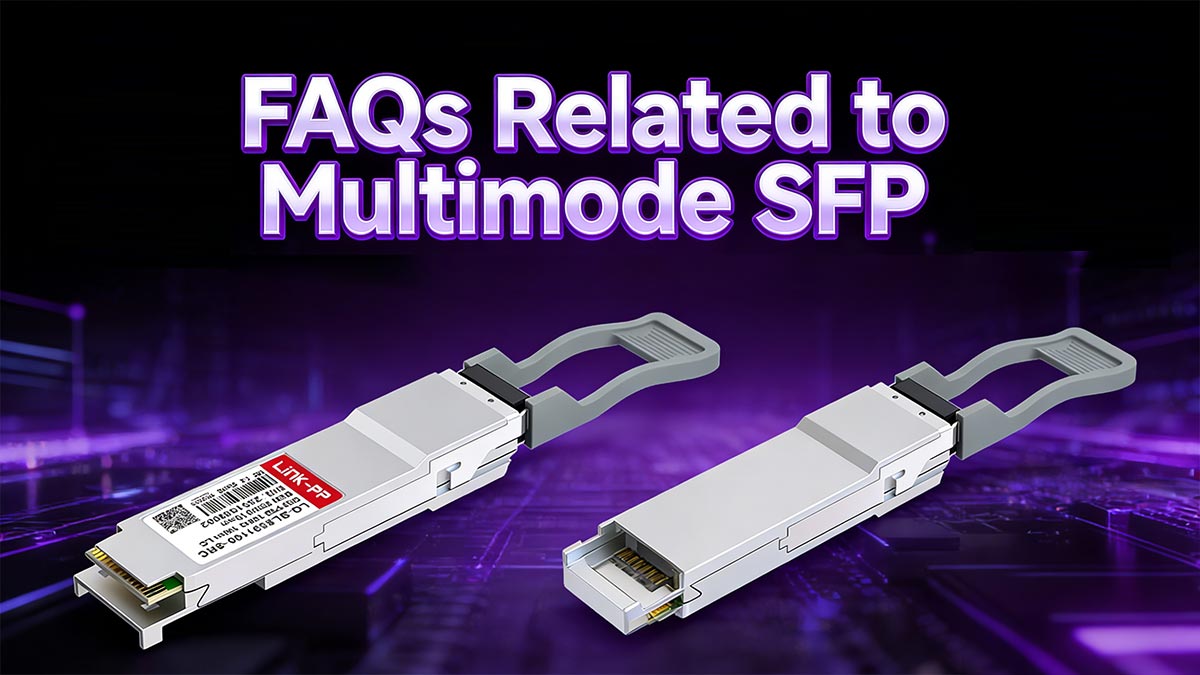
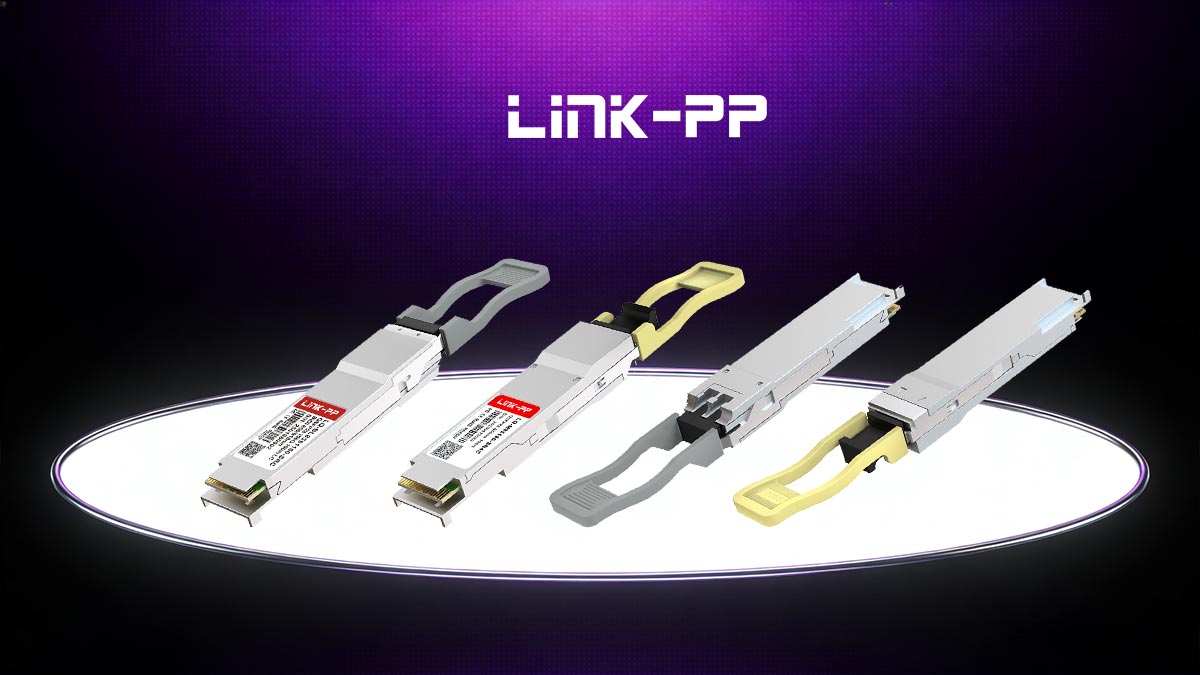
A recommended model is LINK-PP QSFP 100G SWDM4, which is designed for reliable 100G transmission over OM3 and OM4 multimode fiber. It supports duplex LC connectivity and is ideal for data center interconnections where preserving existing LC fiber infrastructure is critical.
Technical Specification of LINK-PP QSFP 100G SWDM4
| Parameter |
LINK-PP QSFP 100G SWDM4 |
| Form Factor |
QSFP28 |
| Max Data Rate |
100Gbps |
| Max Cable Distance |
OM3 70m / OM4 100m |
| Transmitter Type |
VCSEL |
| Receiver Type |
PIN |
| Power Consumption |
<4W |
| Power Supply |
3.3V |
| DDM/DOM |
Supported |
| Protocols |
QSFP28 MSA and IEEE 802.3bm CAUI-4 |
100G SR4 Multimode SFP
100G SR4 multimode SFP modules utilize parallel optics technology, transmitting 4 lanes of 25Gbps signals over 8 fibers (4 transmit and 4 receive) through an MPO connector. This architecture allows for extremely low latency and strong performance in high-density environments such as top-of-rack or spine-leaf data center designs. SR4 modules are favored when parallel cabling infrastructure is already available or when maximizing port density is a priority.
The preferred model is the LINK-PP QSFP 100G SR4, which delivers consistent high-speed transmission and excellent interoperability with major switch brands such as Cisco, Arista, Brocade, and Dell. It supports Digital Diagnostic Monitoring (DDM/DOM), allowing real-time monitoring of temperature, supply voltage, bias current, and optical power for improved network management.
In addition, the module integrates CDR (Clock and Data Recovery) technology to ensure stable signal performance across all four 25G lanes. With reliable plug-and-play operation, it is an ideal solution for short-reach 100G high-density connectivity.
Technical Specification of LINK-PP QSFP 100G SR4
| Parameter |
LINK-PP QSFP 100G SR4 |
| Form Factor |
QSFP28 |
| Wavelength |
850nm |
| Max Data Rate |
100Gbps |
| Max Cable Distance |
OM3 70m / OM4 100m |
| Transmitter Type |
VCSEL |
| Receiver Type |
PIN |
| Power Consumption |
≤3.3W |
| TX Power |
-8.4~2.4dBm |
| Minimum Receiver Power |
-10.3dBm |
| DDM/DOM |
Supported |
| CDR (Clock and Data Recovery) |
TX & RX Built-in CDR |
| Protocols |
IEEE 802.3bm, QSFP28 MSA, SFF-8665, SFF-8636, RoHS, CPRI, eCPRI |
? Technical Factors to Consider When Choosing a Multimode SFP
Choosing a multimode SFP for a 100G network requires careful evaluation beyond simply matching the required transmission speed. A thorough understanding of key technical parameters — such as reach, fiber compatibility, interface type, and monitoring capabilities — is essential to ensure stable performance, seamless integration, and long-term reliability in high-bandwidth network environments.
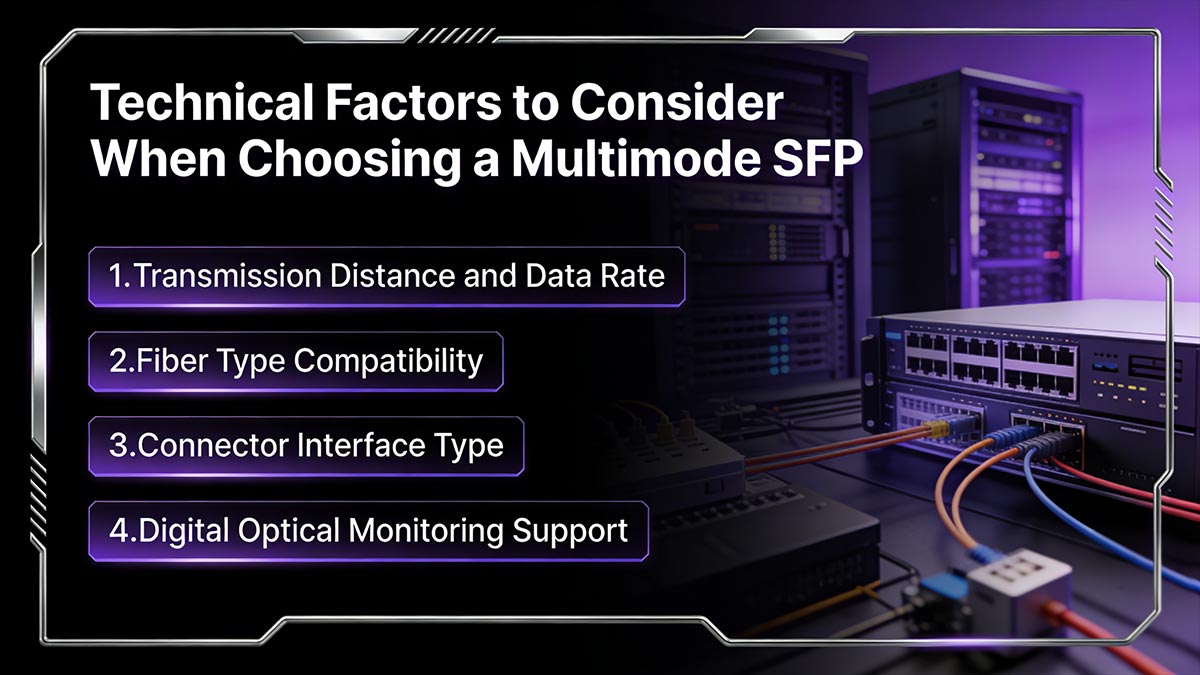
Transmission Distance and Data Rate
One of the most critical aspects to evaluate is the relationship between transmission distance and data rate. In multimode applications, signal attenuation and modal dispersion typically limit transmission reach compared to single-mode systems. For instance, a 100G SR4 multimode SFP generally supports distances up to 70m over OM3 fiber or up to 100 - 150m with OM4 fiber.
When designing your network, you must balance speed and reach — higher data rates often result in shorter transmission capabilities due to increased signal dispersion. Therefore, planning fiber lengths and transceiver locations according to module specifications is essential to avoid signal degradation and data loss.
Fiber Type Compatibility
Fiber compatibility directly affects link performance and scalability. Multimode SFP modules are designed to operate with specific multimode fiber grades, including OM3, OM4, and OM5. Each fiber type offers different bandwidth and distance capabilities.
For instance, OM4 and OM5 fibers provide higher modal bandwidth compared to OM3, enabling longer reach and improved signal integrity at 100G speeds. If your infrastructure already uses OM3 fiber, you must confirm that the selected SFP module can operate reliably within its supported distance range. For new deployments, investing in OM4 or OM5 fiber may offer better future-proofing and flexibility for network upgrades.
Connector Interface Type
Another important factor is the connector interface type. Most 100G multimode SFP modules use MPO/MTP connectors, particularly in SR4 configurations that transmit over multiple fiber lanes. Ensuring that your patch panels, trunk cables, and transceivers share the same connector type is critical to avoid signal loss or connectivity issues.
In addition, attention should be paid to polarity management and fiber count (e.g., 8-fiber vs. 12-fiber MPO). Mismatched connectors or improper polarity configuration can result in link failures even when all components are technically compatible.
Digital Optical Monitoring Support
Digital Optical Monitoring (DOM) support enhances network visibility and maintenance efficiency. SFP modules with DOM functionality allow real-time monitoring of key parameters such as optical power levels, temperature, voltage, and laser bias current.
For 100G networks operating in high-density data center environments, proactive monitoring is essential for identifying potential issues before they escalate into downtime. By selecting multimode SFP modules with robust DOM support, network administrators can improve troubleshooting efficiency, maintain stable performance, and extend the overall lifespan of the optical infrastructure.
? What You Need to Know before Buying Multimode SFP
Before buying multimode SFP modules for your 100G network, there are several critical factors beyond just technical specifications that can determine the success of your deployment. Understanding these prerequisites ensures you avoid compatibility issues, network downtime, and unnecessary expenses while securing a reliable investment for your infrastructure.
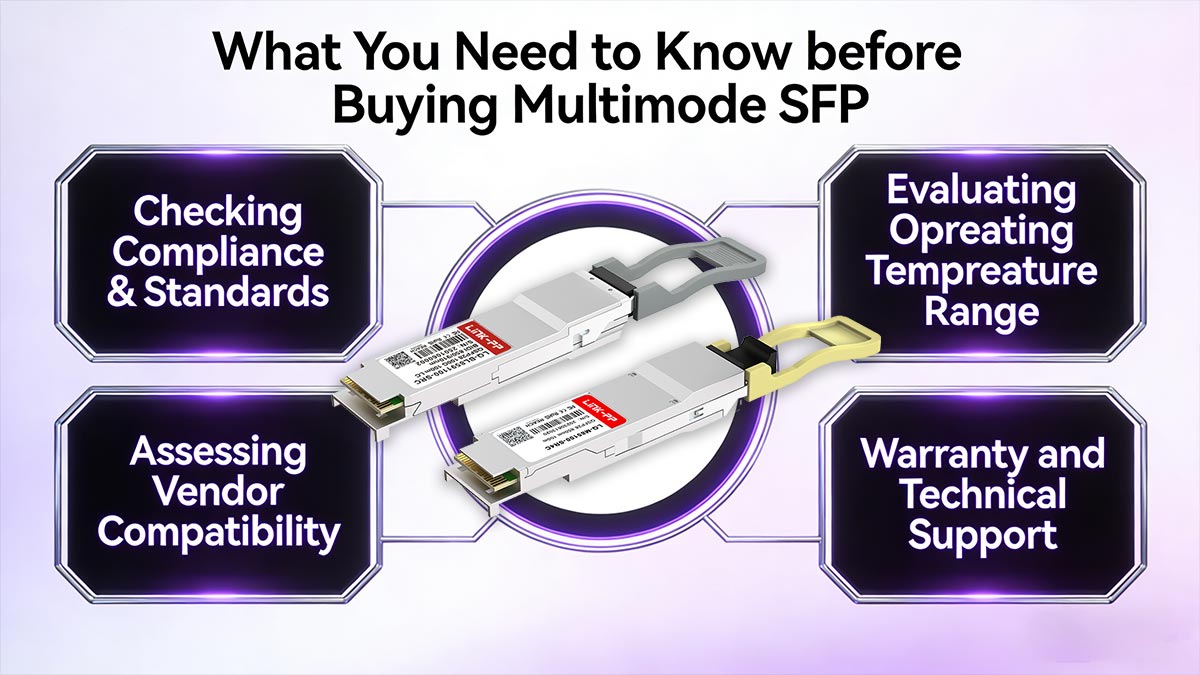
Checking Compliance & Standards
Ensuring that your multimode SFP module adheres to industry standards is the first step to guaranteeing network stability and interoperability. Look for modules that comply with Multi-Source Agreement (MSA) standards, which dictate mechanical dimensions and electrical interfaces, ensuring they fit and function in standard ports.
Additionally, verify that the module meets the specific IEEE 802.3bm (for 100G SR4) or other relevant optical specifications to ensure it performs as expected and can legally interoperate with other standard-compliant networking gear.
Assessing Vendor Compatibility
Despite adherence to MSA standards, some networking equipment manufacturers implement proprietary encoding or firmware that may cause genuine third-party SFP transceivers to be rejected by the switch or router. Therefore, before making a purchase, it is essential to verify that the module is compatible with your specific hardware brand, such as Cisco, Juniper, or Arista.
Many third-party suppliers, including LINK-PP, offer compatible SFP modules specifically coded to interoperate seamlessly with major brands. Choosing an incompatible module may result in the switch failing to power on the unit or generating persistent error alerts, which can disrupt network operations.
Evaluating Operating Temperature Range
Multimode SFP modules are available in different temperature grades to suit various deployment environments. If the module is intended for a standard office environment with controlled air conditioning, a commercial temperature range (0°C to 70°C) is usually sufficient.
However, if the switch is located in an unventilated shed, an industrial setting, or outdoor enclosure, you must opt for industrial-grade modules (-40°C to 85°C) to prevent signal degradation or hardware failure caused by thermal stress.
Warranty and Technical Support
Warranty terms can vary significantly between manufacturers, and they reflect the supplier’s confidence in product quality. Look for vendors that offer multi-year warranties and clear replacement policies. A longer warranty period can reduce maintenance costs and provide peace of mind for large-scale 100G network deployments.
Equally important is access to responsive technical support. Reliable vendors provide pre-sales consultation, compatibility guidance, and troubleshooting assistance. Strong technical support ensures that any configuration issues or performance concerns can be resolved quickly, minimizing network downtime and operational disruptions.
? FAQs Related to Multimode SFP
Can I use a multimode SFP with single-mode fiber?
No, a multimode SFP is specifically designed for multimode fiber (MMF) with a 50/125µm core size and typically operates at 850nm. Using it with single-mode fiber (SMF) can result in severe signal loss, high attenuation, and link failure. For single-mode fiber, you should select a single mode SFP.
What are some common applications for multimode SFP?
Multimode SFP modules are widely used in short-reach, high-density environments such as data centers, enterprise campus networks, and server rooms. Typical applications include top-of-rack (ToR) to aggregation switch connections, spine-leaf architectures, and intra-rack or inter-rack interconnections. They are ideal for scenarios where transmission distances are within 70 - 150m.
Can multimode SFP support 100G over long distances?
No, multimode SFP modules are optimized for short-distance transmission, typically up to 70 - 150m depending on fiber type (OM3, OM4, or OM5). For long-distance 100G links beyond 150m, single-mode SFP modules such as 100G LR4 or ER4 are required.
Is 100G SR4 multimode SFP compatible with OM3 fiber?
Yes, 100G SR4 multimode SFP modules are compatible with OM3 fiber, supporting transmission distances up to 70m. For optimal performance and extended reach up to 100 - 150m, OM4 or OM5 fiber is recommended due to their higher modal bandwidth.
What is the maximum distance of multimode SFP for 100G network?
For typical 100G multimode SFP transceivers, the maximum practical reach is usually in the 70 - 150m range depending primarily on fiber type and link quality. As a rule of thumb, you can expect about 70m over OM3, 100 - 150m over OM4, and up to roughly 150m over OM5 when using standards-compliant 100G multimode SFP modules.
?Conclusion: Selecting the Right Multimode SFP for 100G Network
Selecting the right multimode SFP for a 100G network requires a careful balance of transmission distance, fiber compatibility, connector type, power consumption, and vendor interoperability. For short-reach data center deployments, modules such as 100G SR4 and 100G SWDM4 provide cost-effective, high-density, and energy-efficient connectivity.
If your infrastructure already uses duplex LC multimode fiber, SWDM4 can help reduce cabling complexity while preserving existing investments. On the other hand, SR4 is ideal for parallel MPO-based architectures where maximum port density and low latency are priorities.
Beyond technical specifications, it is equally important to verify IEEE and MSA compliance, confirm switch compatibility, and choose a vendor that provides reliable warranty coverage and technical support. By aligning module selection with your network architecture and long-term scalability goals, you can ensure stable 100G performance while controlling overall deployment costs.
To explore high-performance and fully compatible 100G multimode SFP solutions, visit the LINK-PP Official Store and find the right optical transceiver for your network upgrade.