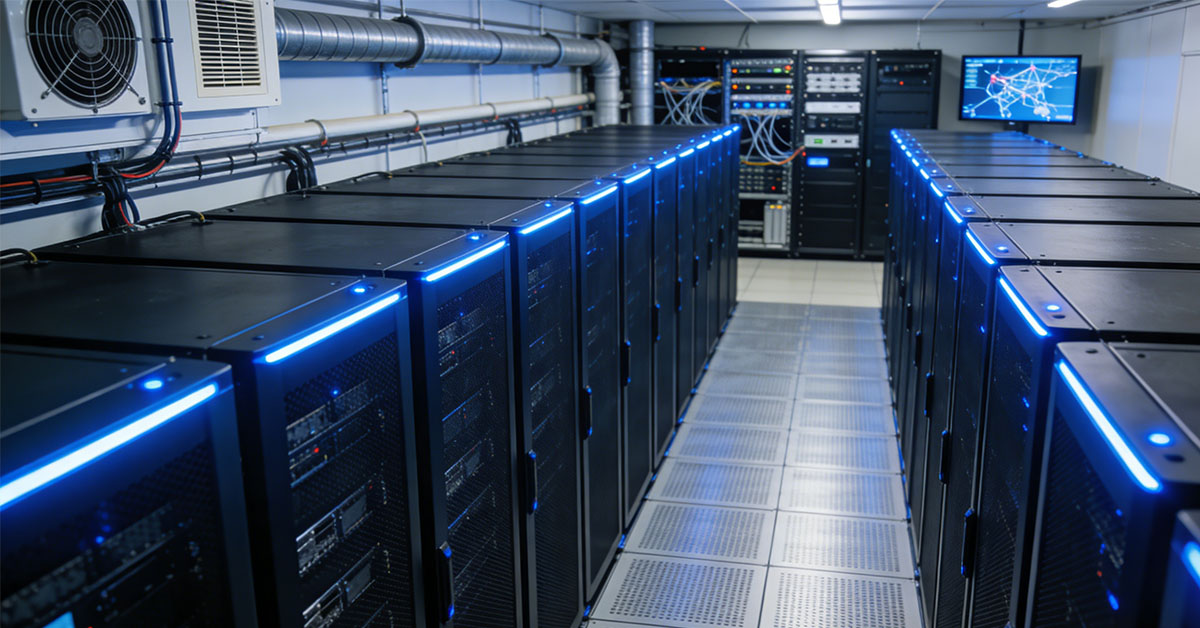
As modern networks continue to demand higher bandwidth and faster data transmission, optical communication technologies have become essential for supporting large-scale data traffic. Technologies such as wavelength division multiplexing (WDM) allow multiple optical signals to travel through a single fiber, significantly improving fiber utilization and network scalability. Among these technologies, LAN-WDM has emerged as an important solution for high-speed Ethernet transmission, particularly in data center and enterprise networking environments.
LAN-WDM (Local Area Network Wavelength Division Multiplexing) is designed to support high-capacity optical links over single-mode fiber by transmitting multiple wavelengths within the 1310nm window. This approach enables optical modules to deliver high data rates—such as 100GbE and 400GbE—without requiring additional fiber infrastructure. As a result, LAN-WDM plays a key role in modern optical transceivers used for data center interconnects and high-speed campus networks.
This article explains what LAN-WDM is, how the technology works, and why it has become widely adopted in high-speed optical networking. It also explores how LAN-WDM compares with other WDM technologies such as CWDM and DWDM, along with its typical applications and deployment considerations.
✅ What Is LAN-WDM?
LAN-WDM is a wavelength division multiplexing technology designed for high-speed Ethernet transmission over single-mode fiber. It enables multiple optical signals, each operating on a different wavelength, to be transmitted simultaneously through the same fiber pair. By combining several wavelengths within the 1310nm transmission window, LAN-WDM allows optical transceivers to deliver high aggregate data rates while maintaining efficient use of fiber infrastructure.
Compared with traditional single-wavelength transmission, LAN-WDM improves bandwidth density and supports modern Ethernet standards such as 100GbE and 400GbE. This makes it particularly suitable for data centers, enterprise backbone networks, and short-to-medium distance optical links.
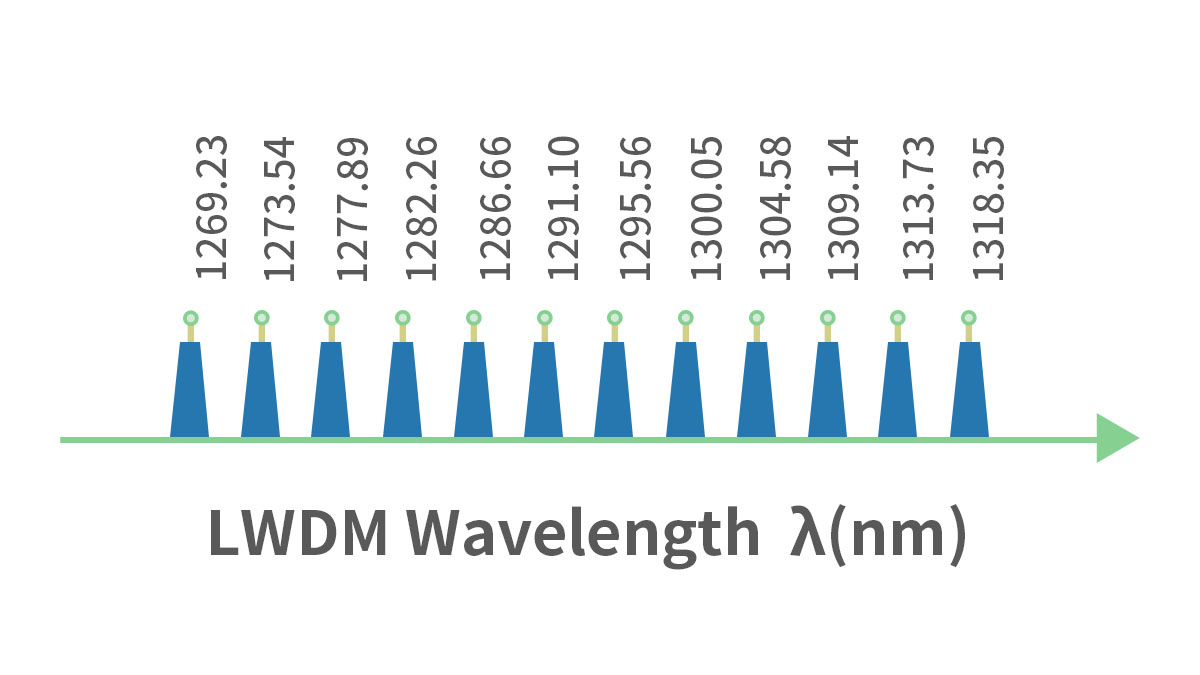
Definition of LAN-WDM
LAN-WDM stands for Local Area Network Wavelength Division Multiplexing, a specific WDM implementation optimized for Ethernet-based networking environments. It uses multiple closely spaced wavelengths in the 1310nm range to carry parallel data channels within a single optical link.
The core concept is similar to other WDM technology: several optical signals are multiplexed into one fiber at the transmitter and separated at the receiver. However, LAN-WDM is specifically designed for short-to-medium reach Ethernet transmission, balancing performance, cost efficiency, and compatibility with IEEE Ethernet standards.
Typical characteristics of LAN-WDM include:
- Use of multiple wavelengths within the 1310nm band
- Tighter wavelength spacing compared with CWDM
- Optimization for high-speed Ethernet optical transceiver module
- Deployment primarily in data center and enterprise network environments
These characteristics allow LAN-WDM to provide high bandwidth while maintaining relatively simple optical system design.
Why LAN-WDM Was Developed
LAN-WDM was introduced to address the growing bandwidth requirements of modern Ethernet networks, especially in large-scale data centers. As network speeds evolved from 10GbE to 40GbE and 100GbE, single-lane optical transmission became insufficient for delivering higher aggregate throughput.
Several challenges led to the development of LAN-WDM technology:
- Limited bandwidth of single-wavelength transmission
Increasing the data rate on a single optical channel quickly reaches physical and cost limitations.
- Need for efficient fiber utilization
Deploying additional fiber pairs for every bandwidth upgrade increases infrastructure complexity and cost.
- Rising demand for high-speed data center connectivity
Cloud computing, virtualization, and large-scale storage systems require high-capacity interconnects.
By transmitting multiple wavelengths simultaneously, LAN-WDM enables optical modules to achieve higher total bandwidth without requiring additional fibers. This design approach became the foundation for many modern high-speed optical transceivers.
Key Characteristics of LAN-WDM
LAN-WDM systems are defined by their wavelength allocation and channel structure, which are optimized for Ethernet optical interfaces operating in the 1310nm region.
A typical LAN-WDM implementation uses four wavelengths with relatively tight spacing, enabling parallel transmission within a compact optical module.
| Parameter |
Typical Value |
Notes |
| Wavelength Range |
~1295nm – ~1310nm |
Located in the O-band |
| Channel Count |
4 wavelengths |
Used in many 100Gb transceiver |
| Channel Spacing |
~800GHz (~4.5nm) |
Tighter than CWDM |
This wavelength arrangement allows multiple data lanes to be transmitted simultaneously while maintaining stable optical performance.
Because the wavelengths are closely spaced, LAN-WDM systems require precise laser control and temperature stabilization to maintain wavelength accuracy. However, the tighter spacing also improves spectral efficiency compared with broader WDM technologies.
As a result, LAN-WDM has become a key optical technology for high-speed Ethernet modules such as 100G LR4, where multiple optical lanes are required to achieve higher aggregate bandwidth over single-mode fiber.
✅ How LAN-WDM Technology Works
LAN-WDM works by transmitting multiple optical signals at different wavelengths through the same single-mode fiber and separating them at the receiver. Each wavelength carries an independent data channel, allowing several data streams to be transmitted simultaneously over a single fiber pair. This multiplexing process enables high aggregate bandwidth while maintaining efficient use of optical infrastructure.
In practical fiber optic transceiver, each wavelength corresponds to one data lane. These lanes are combined using optical multiplexing components at the transmitter and separated again at the receiver using demultiplexers. The result is a compact optical interface capable of supporting high-speed transmission such as 100GbE or 400GbE.
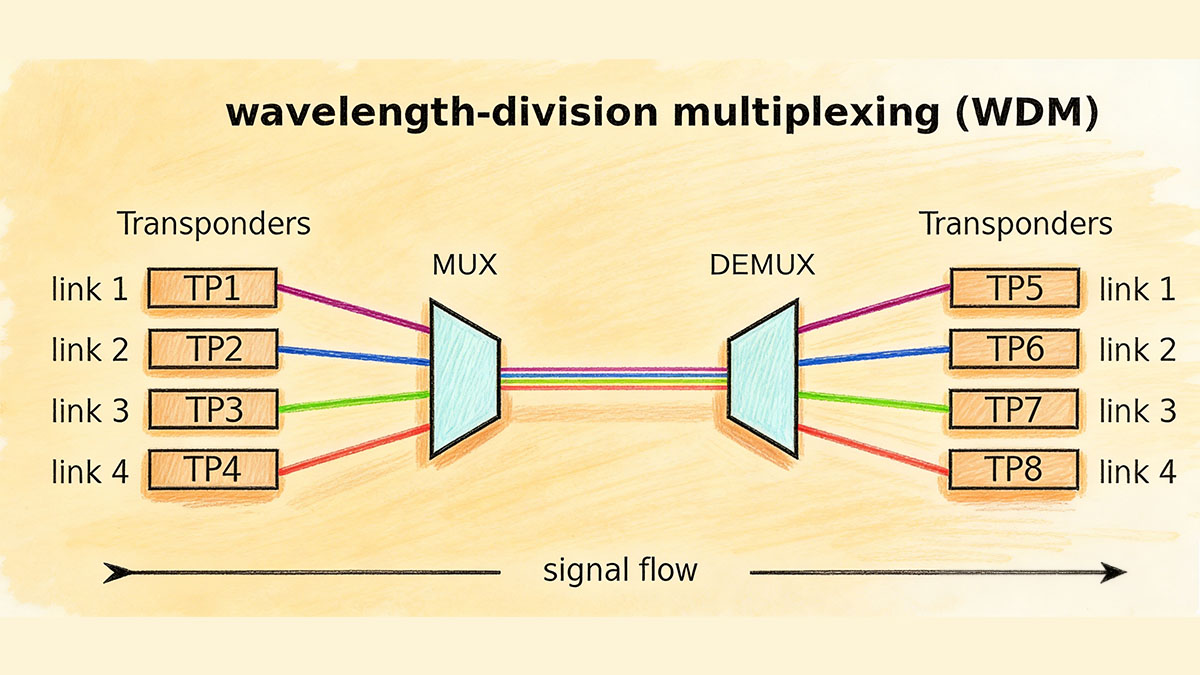
Principle of Wavelength Division Multiplexing
The core principle behind LAN-WDM is wavelength division multiplexing (WDM), where multiple optical signals coexist within a single fiber by operating at different wavelengths. Because optical wavelengths do not interfere with each other, several channels can travel simultaneously without signal overlap.
The basic transmission process typically includes the following steps:
- Data conversion to optical signals
Electrical data signals from the switch or router are converted into optical signals by laser transmitters.
- Multiple wavelength generation
Each laser generates light at a specific wavelength within the LAN-WDM band.
- Optical multiplexing
A multiplexer combines the individual wavelength channels into a single composite optical signal.
- Transmission over fiber
The combined signal travels through a single-mode fiber link.
- Optical demultiplexing
At the receiver side, a demultiplexer separates the wavelengths.
- Optical-to-electrical conversion
Photodiodes convert each optical channel back into electrical data.
This process allows multiple independent data streams to share the same physical fiber while maintaining reliable high-speed communication.
Wavelength Allocation in LAN-WDM
LAN-WDM systems use a set of closely spaced wavelengths located in the O-band (around 1310nm). These wavelengths are carefully defined to align with Ethernet optical standards and to minimize chromatic dispersion over short-to-medium transmission distances.
A typical LAN-WDM wavelength plan includes four channels.
| Channel |
Typical Wavelength |
Purpose |
| Channel 1 |
~1295.56nm |
Data lane transmission |
| Channel 2 |
~1300.05nm |
Data lane transmission |
| Channel 3 |
~1304.58nm |
Data lane transmission |
| Channel 4 |
~1309.14nm |
Data lane transmission |
This wavelength arrangement provides several advantages:
- Efficient spectral use within the 1310nm region
- Compatibility with common single-mode fiber infrastructure
- Alignment with high-speed Ethernet optical module designs
Because the spacing between channels is relatively narrow compared with CWDM systems, LAN-WDM requires precise wavelength control to ensure stable operation.
Optical Components Used in LAN-WDM Modules
LAN-WDM optical modules integrate several specialized optical components to enable multiplexing and high-speed signal transmission. These components are tightly integrated inside modern transceivers such as QSFP28 or QSFP-DD modules.
The main components typically include:
- Distributed feedback (DFB) lasers
Generate stable optical signals at specific LAN-WDM wavelengths.
- Optical multiplexers (MUX)
Combine multiple wavelength channels into one output fiber.
- Optical demultiplexers (DEMUX)
Separate incoming wavelengths into individual channels at the receiver.
- Photodiodes
Detect optical signals and convert them back to electrical signals.
- Driver and receiver integrated circuits
Manage signal modulation, amplification, and processing.
These components work together to create a compact optical interface capable of supporting high data rates while maintaining stable wavelength control and efficient power consumption. As optical integration technology advances, LAN-WDM modules continue to achieve higher port densities and improved performance in modern networking equipment.
✅ LAN-WDM in Modern Optical Transceivers
LAN-WDM is widely used in modern fiber transceiver to support high-speed Ethernet transmission over single-mode fiber. By combining multiple wavelengths within a single optical module, LAN-WDM enables high aggregate data rates while maintaining compact module design and efficient fiber utilization. This technology is particularly important for optical interfaces supporting 100GbE and 400GbE networking environments.
In practical deployments, LAN-WDM allows multiple data lanes to be transmitted through a single duplex fiber link, making it an effective solution for data center interconnects, enterprise backbone networks, and cloud infrastructure.
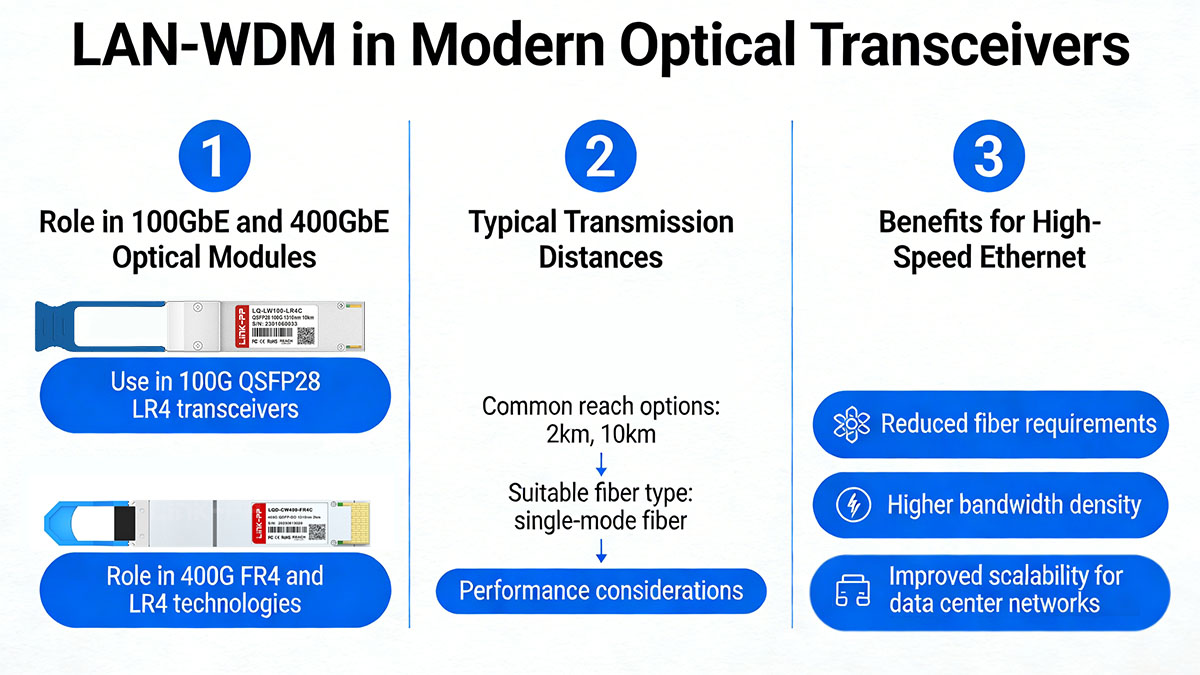
Role in 100GbE and 400GbE Optical Modules
LAN-WDM plays a central role in enabling high-speed Ethernet optical modules that rely on multiple optical lanes to achieve their total data rate. Instead of transmitting the entire bandwidth through a single wavelength, these modules distribute traffic across several wavelengths and combine them using optical multiplexing.
The following table shows how LAN-WDM is commonly used in high-speed Ethernet transceivers.
In modules such as 100G LR4 transceiver, each lane operates on a separate LAN-WDM wavelength in the 1310nm region. The optical multiplexer combines the four wavelengths into a single output fiber, allowing the module to deliver a total data rate of 100Gbps.
For 400G transceiver, LAN-WDM is combined with PAM4 modulation, allowing each wavelength to carry higher data rates. This approach increases bandwidth while keeping the number of optical lanes relatively low.
Typical Transmission Distances
LAN-WDM optical transceivers are primarily designed for short-to-medium reach connections over single-mode fiber. The use of the 1310nm wavelength region helps minimize chromatic dispersion, which improves signal integrity over moderate distances.
Typical deployment distances include:
- 2km links
Common in large data center environments where buildings or facilities are located within the same campus.
- 10km links
Often used for metropolitan data center interconnects or enterprise backbone connections.
- Intermediate distances
Many enterprise and campus networks deploy links ranging from several hundred meters to a few kilometers.
These distance capabilities make LAN-WDM suitable for networks that require high bandwidth but do not need the extended reach of long-haul optical transport technologies.
Benefits for High-Speed Ethernet
LAN-WDM offers several technical advantages that make it well suited for high-speed Ethernet optical interfaces. By transmitting multiple wavelengths through a single fiber pair, the technology helps networks scale bandwidth efficiently without increasing fiber requirements.
Key benefits include:
- Higher bandwidth density
Multiple optical channels increase total throughput within a compact module.
- Reduced fiber usage
Parallel wavelengths eliminate the need for additional fiber pairs when scaling bandwidth.
- Improved port density in switches
Compact optical modules allow high-density network equipment to support more high-speed ports.
- Compatibility with Ethernet standards
LAN-WDM wavelengths align with IEEE specifications used in common optical modules.
These advantages explain why LAN-WDM has become a core technology in modern Ethernet optics. As data center networks continue to scale toward higher speeds and greater port densities, LAN-WDM remains an important foundation for efficient optical connectivity.
✅ LAN-WDM vs CWDM vs DWDM
LAN-WDM, CWDM, and DWDM are all wavelength division multiplexing technologies, but they differ significantly in wavelength spacing, system complexity, and deployment scenarios. LAN-WDM is optimized for high-speed Ethernet transmission in data center and enterprise environments, while CWDM and DWDM are typically used for metro or long-haul optical networks.
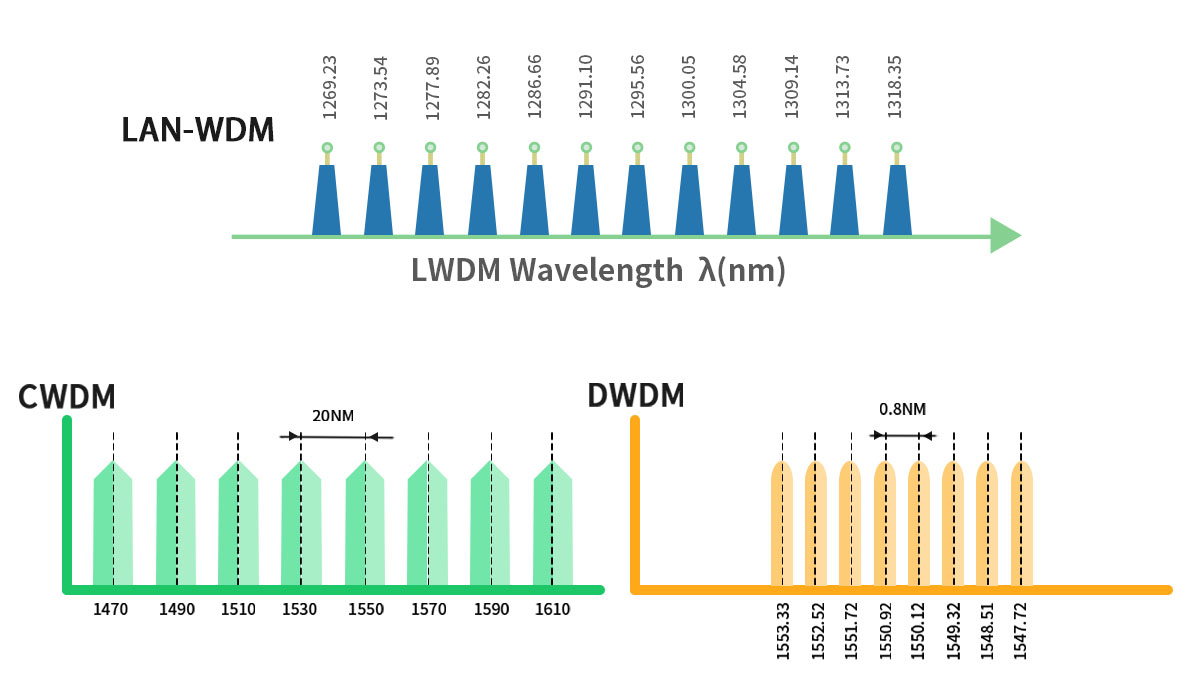
Understanding the differences between these technologies helps network engineers choose the most suitable optical solution based on transmission distance, bandwidth requirements, and infrastructure constraints.
Differences in Wavelength Spacing
The most fundamental difference between LAN-WDM, CWDM, and DWDM lies in channel spacing and wavelength allocation. LAN-WDM uses relatively tight spacing within the 1310nm region, while CWDM and DWDM operate across broader wavelength ranges with different channel densities.
| Technology |
Typical Channel Spacing |
Wavelength Region |
| LAN-WDM |
~800GHz (~4.5nm) |
Around 1310nm (O-band) |
| CWDM |
20nm |
1270–1610nm |
| DWDM |
100GHz / 50GHz |
Around 1550nm (C-band) |
LAN-WDM’s tighter spacing allows multiple Ethernet lanes to operate within a narrow wavelength band, enabling compact optical module designs. CWDM uses wider spacing to simplify system requirements, while DWDM achieves very high channel density for carrier-grade optical transport networks.
Deployment Scenarios
Each WDM technology is designed for different types of network environments. The choice often depends on transmission distance, network scale, and required bandwidth capacity.
LAN-WDM is most commonly deployed in environments such as:
- Data center interconnect (DCI) where high bandwidth and moderate distance are required
- Enterprise network backbones connecting core switches
- Campus networks requiring scalable high-speed optical links
CWDM is typically used for:
- Metro access networks
- Enterprise optical transport
- Medium-distance point-to-point fiber connections
DWDM is generally deployed in:
- Long-haul telecommunications networks
- Large-scale metro transport systems
- Carrier backbone infrastructure with extremely high capacity requirements
These different deployment environments reflect the design priorities of each technology, from cost efficiency to maximum transmission capacity.
Cost and Complexity Comparison
LAN-WDM, CWDM, and DWDM also differ in terms of system complexity, hardware requirements, and operational cost.
| Technology |
System Complexity |
Typical Network Use |
| LAN-WDM |
Moderate |
Data centers and enterprise networks |
| CWDM |
Low |
Access and metro networks |
| DWDM |
High |
Carrier and long-haul transport |
LAN-WDM systems require more precise wavelength control than CWDM but remain simpler than DWDM transport systems. CWDM benefits from wider wavelength spacing, which reduces the need for strict temperature control and wavelength stabilization. DWDM systems, on the other hand, require highly precise lasers, advanced optical amplification, and complex network management.
Because of these differences, LAN-WDM occupies an important middle ground. It provides higher spectral efficiency than CWDM while avoiding the complexity and cost typically associated with DWDM systems, making it well suited for high-speed Ethernet optical modules used in modern networking infrastructure.
✅ Advantages of LAN-WDM Technology
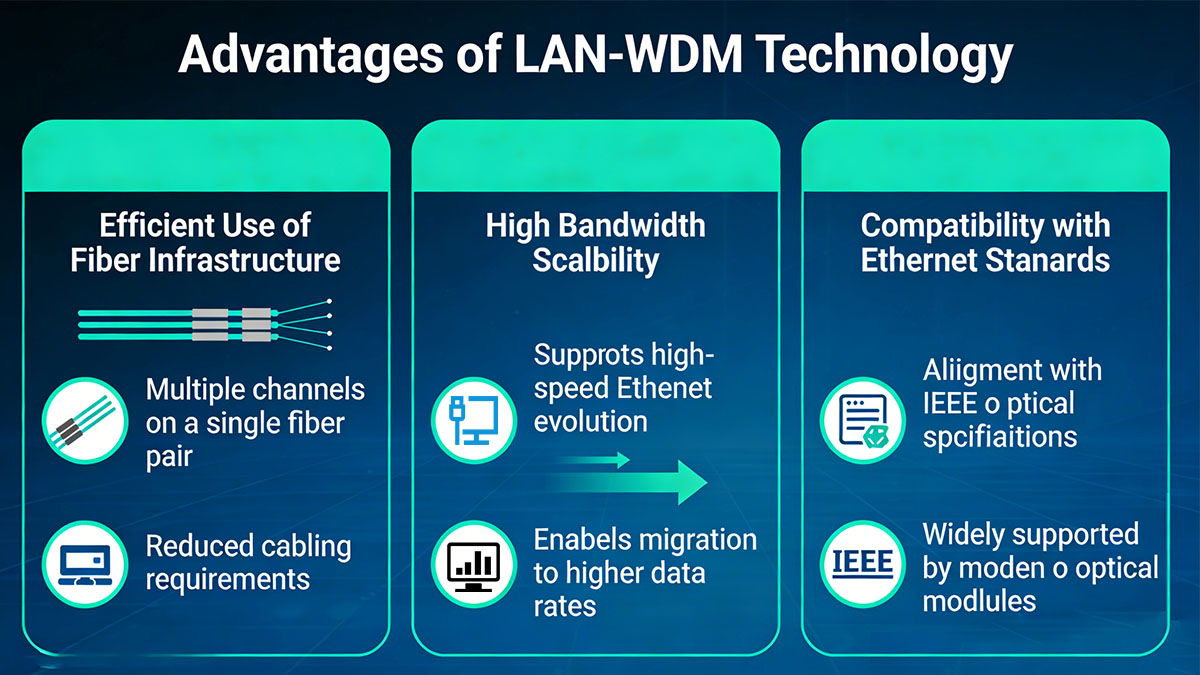
LAN-WDM technology provides an efficient way to increase network bandwidth without requiring additional fiber infrastructure. By transmitting multiple wavelengths within the 1310nm region, LAN-WDM enables high-speed Ethernet links to achieve higher data rates while maintaining compact optical module design and stable performance.
These advantages make LAN-WDM particularly suitable for modern networking environments such as data centers, enterprise backbone networks, and cloud infrastructure.
Efficient Use of Fiber Infrastructure
LAN-WDM significantly improves fiber utilization by allowing multiple optical channels to share a single fiber pair. Instead of deploying additional fibers for every new data lane, several wavelengths can carry independent data streams simultaneously.
| Transmission Method |
Fiber Requirement |
Bandwidth Expansion |
| Single-wavelength transmission |
One fiber pair per channel |
Limited scalability |
| LAN-WDM multiplexing |
Multiple channels per fiber pair |
Higher bandwidth density |
Because several data lanes are transmitted through the same fiber link, LAN-WDM helps reduce the amount of physical cabling required in high-speed networks. This is particularly valuable in large data centers where fiber infrastructure must support thousands of high-bandwidth connections.
In addition, improved fiber efficiency can simplify network design and reduce the complexity of cable management in high-density environments.
High Bandwidth Scalability
LAN-WDM supports the scaling of Ethernet speeds by distributing traffic across multiple optical wavelengths. Instead of relying on a single high-speed channel, the total bandwidth is achieved by combining several lower-speed lanes.
This approach enables:
- Parallel optical transmission, where each wavelength carries a portion of the total data rate
- Gradual performance scaling, allowing networks to transition from 25Gbps lanes to higher-speed architectures
- Efficient support for emerging Ethernet standards, including 100GbE and 400GbE
As data center traffic continues to grow due to cloud computing, virtualization, and large-scale storage systems, this parallel transmission model provides a flexible path for network capacity expansion.
Compatibility with Ethernet Standards
LAN-WDM technology is closely aligned with IEEE Ethernet optical specifications, which helps ensure interoperability across networking equipment and optical modules.
Many widely deployed Ethernet optical interfaces rely on LAN-WDM wavelengths for their operation.
Because LAN-WDM wavelengths match these standardized optical interfaces, network operators can deploy compatible modules across different switches, routers, and optical platforms without major infrastructure changes.
This compatibility has contributed to the widespread adoption of LAN-WDM technology in modern Ethernet-based optical networking.
✅ Common Applications of LAN-WDM
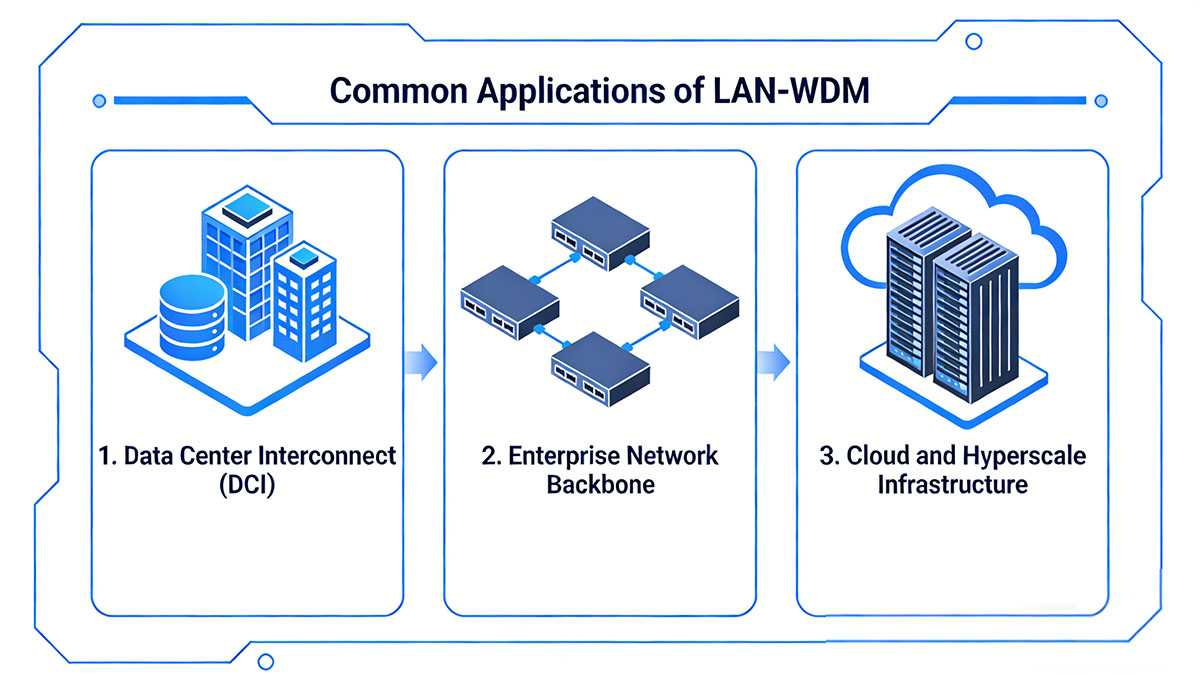
LAN-WDM is widely used in high-speed optical networking environments that require efficient bandwidth scaling over single-mode fiber. Because it enables multiple wavelengths to operate within a compact optical interface, LAN-WDM is particularly well suited for modern network architectures where high capacity and efficient fiber utilization are essential.
Typical deployment scenarios include data center interconnects, enterprise backbone networks, and large-scale cloud infrastructure.
Data Center Interconnect (DCI)
LAN-WDM is commonly used for data center interconnect (DCI) links that connect separate data center facilities within the same campus or metropolitan area. These links require high bandwidth, low latency, and reliable optical transmission.
Typical characteristics of LAN-WDM-based DCI links include:
- High-capacity optical connections between data center buildings
- Support for 100GbE or 400GbE Ethernet links
- Use of single-mode fiber for distances up to several kilometers
| DCI Scenario |
Typical Distance |
Common Optical Modules |
| Intra-campus data centers |
500m – 2km |
100G CWDM4 |
| Metro data center links |
Up to 10km |
QSFP28 LR4 |
In these environments, LAN-WDM allows high-speed optical modules to transmit multiple data lanes over a single fiber pair, helping operators maintain efficient infrastructure while scaling network capacity.
Enterprise Network Backbone
Large enterprise networks often require high-bandwidth links between core switches, aggregation layers, and data center gateways. LAN-WDM optical modules are frequently used to support these backbone connections.
Typical enterprise deployment scenarios include:
- Core switch to aggregation switch connectivity
- Data center to campus backbone links
- High-capacity connections between network distribution layers
These links typically require:
- Reliable 10km or shorter optical reach
- High throughput to support large numbers of users and applications
- Compatibility with existing single-mode fiber infrastructure
LAN-WDM enables these backbone networks to deliver high bandwidth without requiring additional fiber deployment, which simplifies network upgrades.
Cloud and Hyperscale Infrastructure
Cloud service providers and hyperscale data centers rely heavily on high-density optical connectivity to support large-scale computing platforms. LAN-WDM plays an important role in enabling high-speed links between switches, storage systems, and distributed computing clusters.
Typical uses within cloud environments include:
- High-speed spine–leaf switch interconnections
- Optical links between large computing clusters
- Inter-building connectivity within hyperscale campuses
These infrastructures benefit from LAN-WDM because it allows network architects to:
- Increase port density in switching platforms
- Reduce fiber requirements across large facilities
- Support high-speed Ethernet standards while maintaining compact optical module designs
As hyperscale data centers continue to scale in size and traffic volume, LAN-WDM remains an important technology for enabling efficient optical connectivity across modern cloud infrastructure.
✅ Key Considerations When Using LAN-WDM
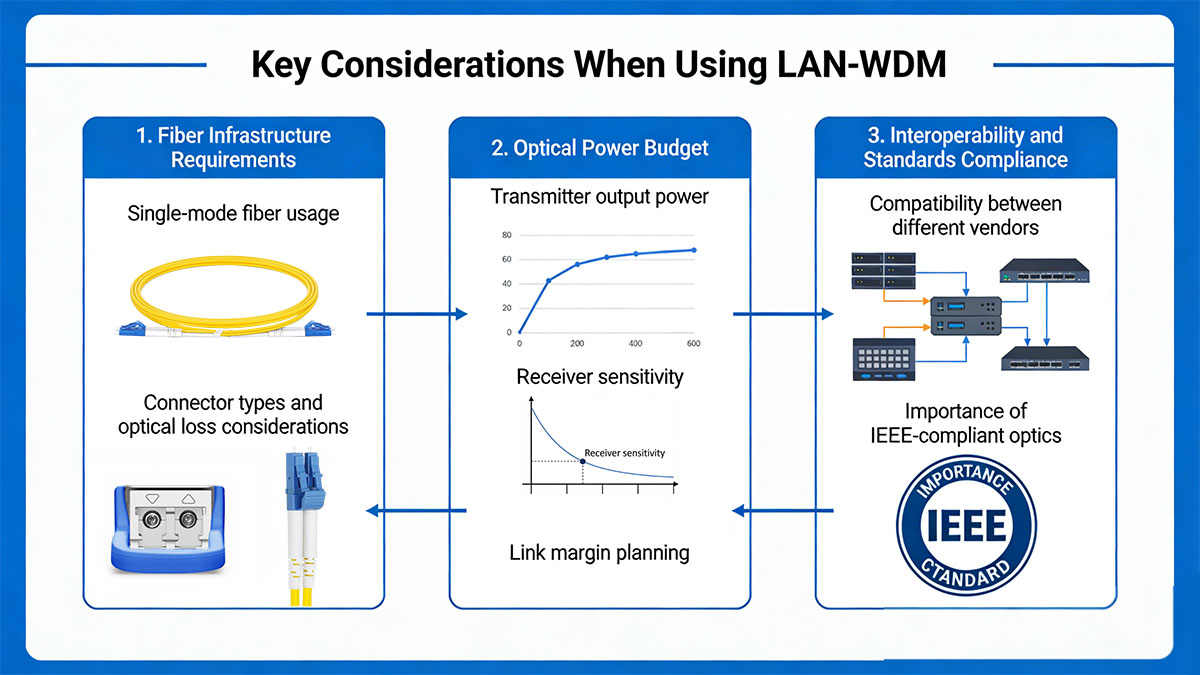
LAN-WDM technology enables efficient high-speed optical transmission, but proper deployment requires careful planning of fiber infrastructure, optical link budgets, and module compatibility. Evaluating these factors helps ensure stable network performance and prevents common issues such as signal loss, interoperability problems, or insufficient link margins.
Network engineers typically assess several technical aspects before deploying LAN-WDM optical modules in production environments.
Fiber Infrastructure Requirements
LAN-WDM optical links are designed to operate over single-mode fiber (SMF), which provides low attenuation and stable transmission performance within the 1310nm wavelength region. Ensuring the correct fiber type and connector standard is essential for maintaining reliable communication.
| Fiber Parameter |
Typical Requirement |
Notes |
| Fiber Type |
Single-mode fiber (SMF) |
Common standards include OS1 and OS2 fiber |
| Connector Type |
LC duplex |
Widely used in Ethernet optical modules |
| Operating Wavelength |
Around 1310nm |
Optimized for O-band transmission |
Single-mode fiber helps reduce chromatic dispersion in the 1310nm band, which allows LAN-WDM systems to maintain stable signal integrity across several kilometers. Proper fiber management, including low-loss connectors and clean patch panels, is also important for minimizing optical attenuation.
Optical Power Budget
The optical power budget determines whether a LAN-WDM link can reliably operate over a given distance. It represents the difference between the transmitter output power and the receiver sensitivity after accounting for fiber loss and connector attenuation.
Key factors that influence the power budget include:
- Transmitter optical output power
Determines how strong the transmitted signal is when entering the fiber.
- Receiver sensitivity
Defines the minimum optical power required for accurate signal detection.
- Fiber attenuation
Loss caused by fiber length, typically measured in dB per kilometer.
- Connector and splice losses
Additional attenuation introduced by connectors, patch panels, or splicing points.
Proper link design ensures that the total optical loss remains within the allowable power budget of the optical module, maintaining sufficient signal margin for stable operation.
Interoperability and Standards Compliance
LAN-WDM optical modules are typically designed to comply with IEEE Ethernet standards, but compatibility between equipment vendors should still be considered when planning deployments.
| Compatibility Factor |
Consideration |
Impact |
| IEEE compliance |
Alignment with Ethernet standards |
Ensures predictable performance |
| Vendor compatibility |
Support across different platforms |
Enables flexible deployment |
| Firmware recognition |
Switch or router validation |
Prevents interface errors |
Using standards-compliant optical modules helps maintain interoperability across network equipment such as switches, routers, and optical transport devices. In multi-vendor environments, verifying compatibility before deployment can prevent configuration issues and ensure consistent performance across the network.
Careful attention to these factors allows LAN-WDM optical links to deliver stable high-speed connectivity in modern networking infrastructures.
✅ Future Trends of LAN-WDM in Optical Networking
LAN-WDM continues to play an important role in high-speed optical networking as Ethernet technologies evolve toward higher bandwidth and greater port density. With the rapid expansion of cloud computing, hyperscale data centers, and AI workloads, network infrastructures require scalable optical interconnect solutions that can deliver higher throughput while maintaining efficient fiber utilization.
Several technology trends are shaping how LAN-WDM will be used in next-generation optical networks.
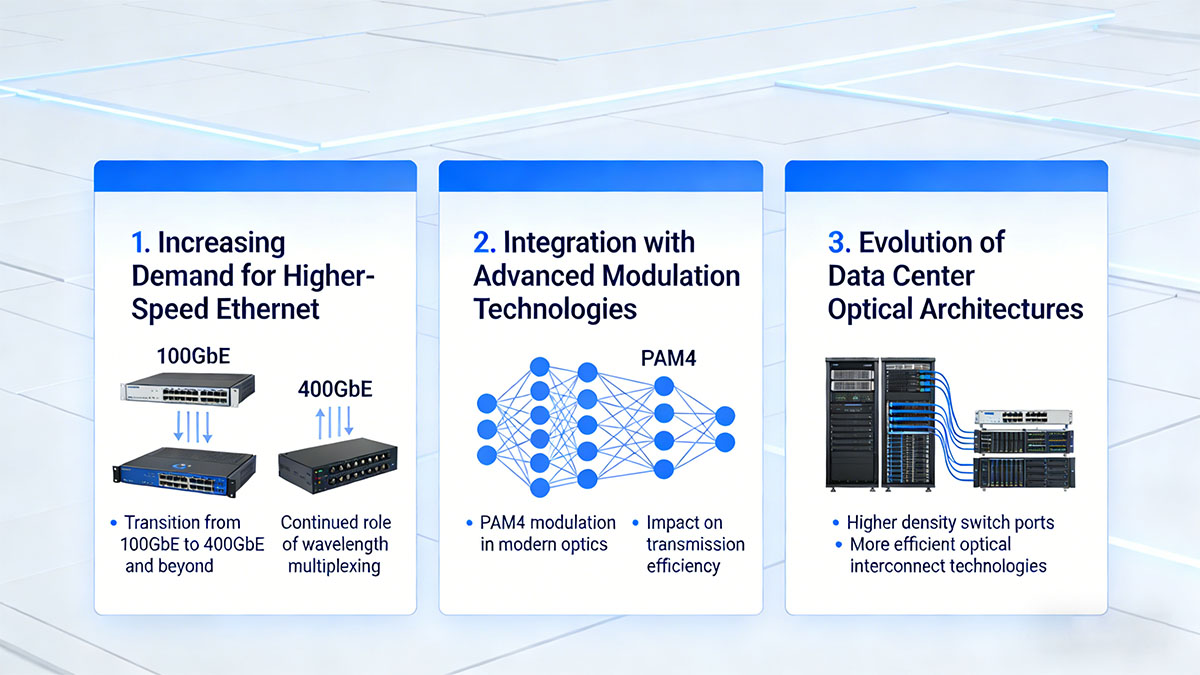
Increasing Demand for Higher-Speed Ethernet
The growth of data-intensive applications has accelerated the transition from traditional 100GbE networks to higher-speed architectures such as 400GbE and beyond. LAN-WDM supports this evolution by enabling multiple high-speed optical lanes to operate within the same fiber link.
Common Ethernet speed generations supported by LAN-WDM-based optical modules include:
| Ethernet Generation |
Typical Module Example |
Lane Structure |
| 100GbE |
QSFP28 LR4 |
4 × 25Gbps |
| 100GbE |
QSFP28 ER4 |
4 × 25Gbps (NRZ) |
| 400GbE |
QSFP-DD LR4 |
4 × 100Gbps (PAM4) |
As network equipment continues to adopt higher interface speeds, LAN-WDM remains a practical method for transmitting multiple high-speed channels within a compact optical module. This approach helps maintain compatibility with existing single-mode fiber infrastructure while supporting the growth of network capacity.
Integration with Advanced Modulation Technologies
Modern optical transceivers increasingly rely on advanced modulation techniques to increase data throughput without dramatically increasing the number of optical wavelengths. One of the most important developments is the adoption of PAM4 (Pulse Amplitude Modulation 4-level) signaling.
Compared with traditional NRZ modulation, PAM4 allows each optical lane to carry twice the data rate by transmitting four signal levels instead of two.
| Modulation Type |
Signal Levels |
Data Efficiency |
| NRZ |
2 levels |
Baseline transmission |
| PAM4 |
4 levels |
Approximately double the data per lane |
By combining LAN-WDM wavelength multiplexing with PAM4 modulation, modern optical modules can significantly increase total bandwidth while maintaining the same number of optical lanes. This combination is widely used in high-speed modules such as 400G FR4 and similar optical interfaces.
Evolution of Data Center Optical Architectures
Data center networks are evolving toward architectures that emphasize high port density, scalable switching fabrics, and efficient optical connectivity. LAN-WDM contributes to these architectures by enabling compact high-speed optical modules that reduce fiber usage while supporting large numbers of high-bandwidth links.
Key architectural trends influencing LAN-WDM deployment include:
- Higher switch port density
Modern switches support hundreds of high-speed ports, requiring compact and efficient optical modules.
- Spine–leaf network expansion
Data centers increasingly rely on scalable spine–leaf topologies, which require large numbers of high-speed optical links.
- Large-scale distributed computing environments
Workloads such as cloud platforms, big data processing, and AI clusters require massive east–west traffic within data centers.
As these architectures continue to evolve, LAN-WDM technology remains an important building block for high-speed Ethernet optics, enabling networks to scale bandwidth efficiently while maintaining manageable infrastructure complexity.
✅ FAQs About LAN-WDM
What does LAN-WDM stand for?
LAN-WDM stands for Local Area Network Wavelength Division Multiplexing. It is a technology that transmits multiple optical wavelengths within the 1310nm band over a single fiber pair to support high-speed Ethernet links.
How many wavelengths are typically used in LAN-WDM?
Most LAN-WDM implementations use four wavelengths in the 1310nm region. Each wavelength carries an independent data lane, which together form the total transmission rate of the optical module.
What fiber type is used with LAN-WDM?
LAN-WDM optical links typically operate over single-mode fiber (SMF). Single-mode fiber provides low attenuation and stable signal transmission for distances commonly ranging from a few hundred meters up to around 10km.
What is the difference between LAN-WDM and CWDM?
LAN-WDM uses tightly spaced wavelengths around 1310nm, while CWDM uses widely spaced wavelengths across a broader spectrum (1270–1610nm). LAN-WDM is mainly used in high-speed Ethernet optics, whereas CWDM is commonly deployed in metro and access networks.
Which optical modules commonly use LAN-WDM?
LAN-WDM technology is widely used in 100G LR4, 400G FR4, and 400G LR4 optical transceivers, where multiple wavelengths are combined to deliver high aggregate data rates over single-mode fiber.
What transmission distance does LAN-WDM support?
LAN-WDM optical modules typically support transmission distances of up to 10km, depending on the specific module type and optical link budget.
Why is LAN-WDM important for high-speed Ethernet?
LAN-WDM enables multiple optical lanes to share the same fiber pair, which allows high-speed Ethernet interfaces such as 100GbE and 400GbE to achieve high bandwidth while maintaining efficient fiber usage.
✅ Conclusion
LAN-WDM has become an important technology in modern optical networking, enabling high-speed Ethernet transmission by multiplexing multiple wavelengths within the 1310nm band. By allowing several optical lanes to share a single fiber pair, LAN-WDM helps networks achieve higher bandwidth while maintaining efficient fiber utilization. This approach has made it a foundational technology for widely deployed optical modules used in data centers, enterprise backbones, and cloud infrastructure.
As Ethernet speeds continue to scale from 100GbE to 400GbE and beyond, LAN-WDM remains a practical solution for supporting higher data rates without requiring major changes to existing fiber infrastructure. Its balance of spectral efficiency, manageable system complexity, and alignment with Ethernet standards ensures that it will continue to play a key role in next-generation optical interconnects.
For organizations evaluating high-speed optical connectivity solutions, understanding how LAN-WDM works—and where it is most effectively deployed—can help support more scalable and efficient network design. To explore a range of compatible optical transceivers designed for modern networking environments, you can visit the LINK-PP Official Store for additional technical information and product resources.