



































WDM SFP modules have become essential components in modern optical networks, enabling multiple wavelengths to transmit over a single fiber and significantly increasing network capacity. By integrating mux/demux functionality within compact pluggable modules, these devices streamline network architecture, reduce fiber usage, and improve spectral efficiency. Whether in data center interconnects, metro networks, or enterprise deployments, WDM SFP modules offer a scalable solution for bandwidth-intensive applications while optimizing existing fiber infrastructure. Understanding their operation, types, and spectral characteristics is critical for designing high-performance and cost-effective optical networks.
? Introduction to WDM SFP Modules
WDM SFP modules are specialized optical transceivers that enable multiple wavelength channels to be transmitted over a single fiber, maximizing bandwidth while reducing cabling complexity. Their compact form factor, combined with advanced wavelength multiplexing and compatibility with QSFP+/QSFP28 ecosystems, makes them ideal for high-density network environments where scalability and efficiency are critical. These modules are widely deployed in data centers, metro networks, and enterprise networks to optimize fiber utilization and support growing bandwidth demands.
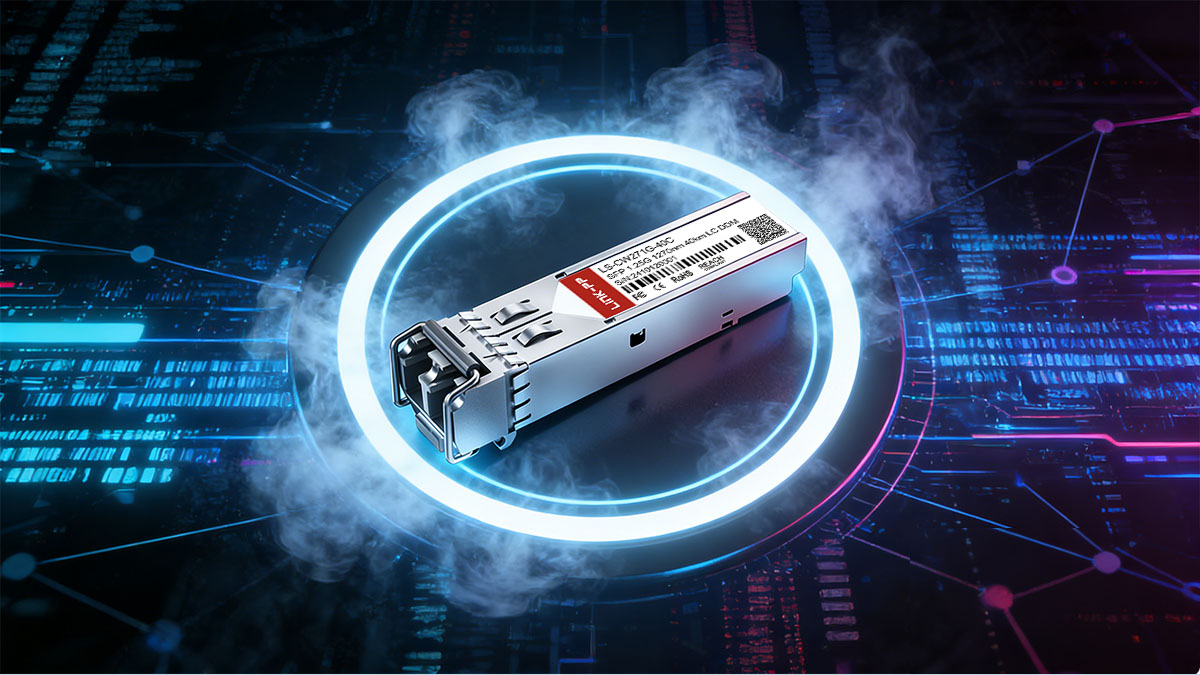
What is a WDM SFP Module?
WDM SFP modules are small, pluggable transceivers designed to work with wavelength division multiplexing technology. They differ from standard fiber SFP modules by transmitting data on specific wavelengths, allowing multiple channels to coexist on the same fiber.
Key points about WDM SFP modules include:
- They combine SFP form factor convenience with wavelength-selective transmission.
- Each module operates on a specific wavelength (such as CWDM-SFP-1590 or CWDM-SFP-1310) in the CWDM or DWDM grid.
- Some modules support bidirectional communication on a single fiber, further reducing fiber requirements.
These features allow network designers to increase overall fiber capacity without adding physical cables, making WDM SFP modules a cost-effective and space-efficient solution for modern optical networks.
Why WDM Technology Matters in Modern Networks
WDM technology addresses the growing need for higher bandwidth and efficient fiber usage in increasingly data-intensive networks. By multiplexing multiple wavelengths onto a single fiber, networks can scale capacity without proportional increases in infrastructure.
Primary advantages of WDM technology include:
- Maximizing the use of existing fiber resources.
- Supporting high-bandwidth applications such as cloud computing, video streaming, and data center interconnects.
- Enabling network scalability without extensive physical upgrades.
- Reducing cabling complexity and operational costs compared to deploying additional fibers.
As network traffic continues to grow, the adoption of WDM SFP modules ensures that optical networks remain flexible, efficient, and capable of meeting future bandwidth demands.
? Fundamentals of WDM Technology
Wavelength Division Multiplexing (WDM) is a key method for increasing optical fiber capacity by transmitting multiple independent data streams simultaneously over a single fiber. The core advantage of WDM lies in its ability to maximize spectral efficiency, reduce the need for additional fibers, and support scalable high-bandwidth 40GBASE, 100GBASE, and 400GBASE networks. Understanding the distinctions between CWDM and DWDM, as well as the underlying multiplexing principles, is essential for effective network design.
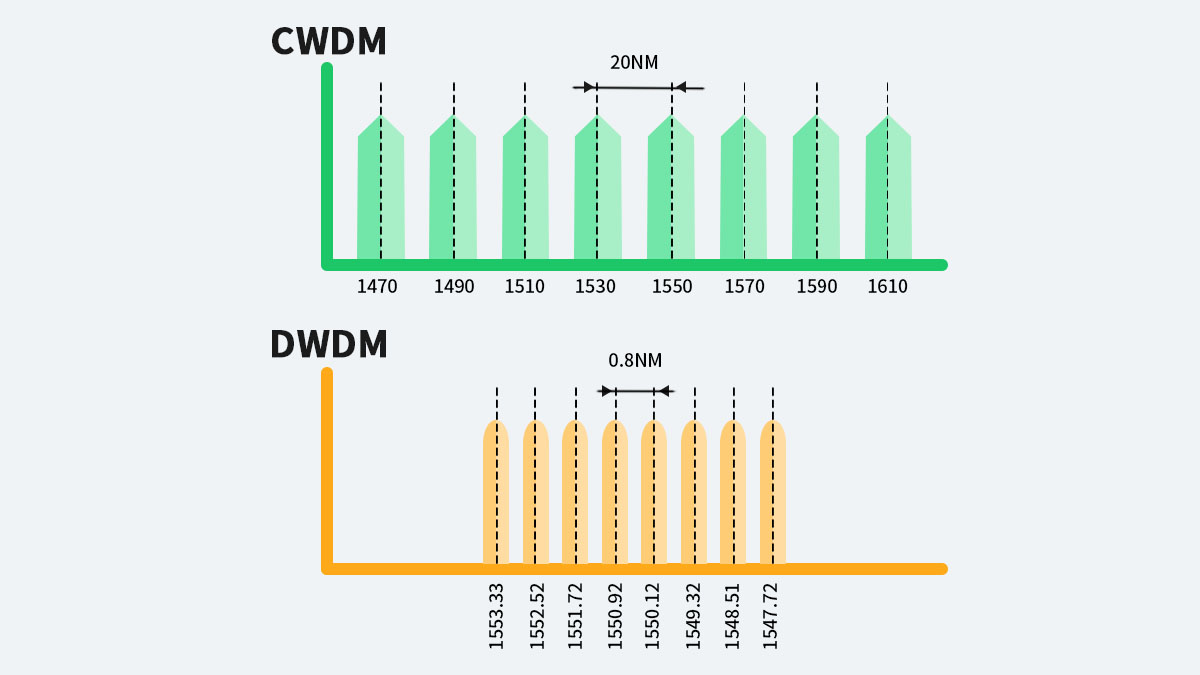
CWDM vs DWDM Explained
The choice between CWDM (Coarse Wavelength Division Multiplexing) and DWDM (Dense Wavelength Division Multiplexing) primarily depends on capacity, distance, and cost requirements. CWDM uses wider wavelength spacing, making it cost-effective for short to medium distances, whereas DWDM enables higher channel density for long-haul and high-capacity networks.
| Feature | CWDM | DWDM |
|---|---|---|
| Channel Spacing | 20nm | 0.8nm / 0.4nm |
| Number of Channels | Up to 18 | 40–96 or more |
| Typical Transmission Distance | Up to 80 km | 80–2000+ km (with amplification) |
| Cost | Lower | Higher |
| Use Cases | Metro, enterprise, short-haul | Long-haul, data center interconnect, backbone |
CWDM is often chosen for cost-sensitive metro networks and campus deployments where moderate capacity suffices. DWDM is suited for high-capacity backbone and intercontinental links where fiber resources are limited but traffic demands are substantial. Selecting the appropriate WDM type requires balancing channel density, transmission distance, and network scalability.
How Wavelength Multiplexing Works
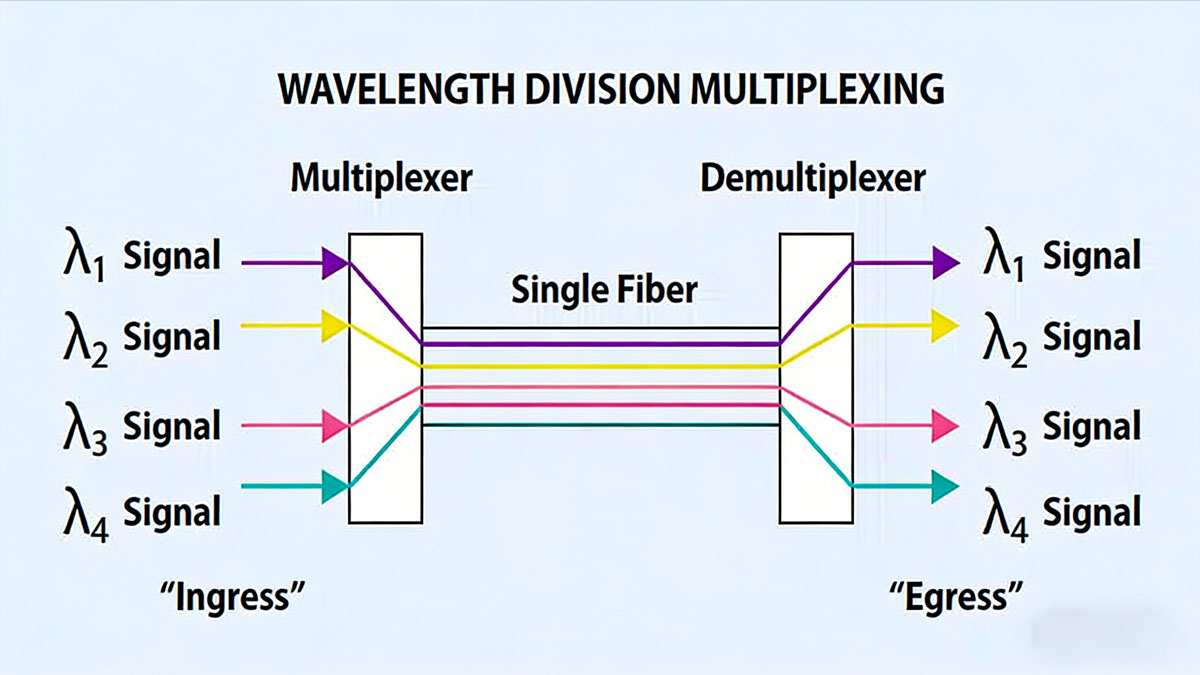
Wavelength multiplexing combines multiple optical signals at different wavelengths into a single fiber for transmission, and then separates them at the receiving end. This approach maximizes fiber utilization while maintaining signal integrity.
The process involves:
- Assigning distinct wavelengths to each data channel.
- Combining signals using a multiplexer (mux) at the transmitting end.
- Transmitting the combined wavelengths over a single fiber.
- Separating the signals with a demultiplexer (demux) at the receiving end.
This principle enables multiple independent data streams to coexist without interference when channels are properly spaced and managed. In DWDM systems, tight channel spacing allows dozens of channels to operate simultaneously, substantially increasing network capacity.
Key Optical Components in WDM Systems
Efficient WDM operation relies on specialized optical components that manage signal multiplexing, amplification, and filtering:
- Lasers: Provide stable, narrow-linewidth wavelengths for each channel.
- Multiplexers/Demultiplexers: Combine and separate wavelengths; can be integrated into modules or deployed as standalone units.
- Optical Amplifiers (e.g., EDFA): Boost signal power over long distances, maintaining signal quality in DWDM systems.
- Filters: Ensure precise wavelength separation to minimize crosstalk between channels.
Understanding these components and their interactions is crucial for designing networks that leverage WDM SFP modules effectively. Proper component selection affects spectral efficiency, signal integrity, and overall system performance.
? Mux/Demux Integration in WDM SFP Modules
Integrated mux/demux functionality in WDM SFP modules simplifies optical network design by combining multiple wavelength channels within a single compact module. This integration reduces the need for external multiplexers and demultiplexers, lowers insertion loss, and enables higher port density in constrained environments. The approach is particularly beneficial in data center interconnects and enterprise networks, where space, power, and fiber resources are limited.
What is Mux/Demux Integration?
Mux/demux integration refers to embedding wavelength multiplexing and demultiplexing functionality directly inside the SFP module, rather than relying on separate rack-mounted units. By combining these operations within a pluggable module, networks can transmit multiple wavelengths over a single fiber while minimizing external hardware requirements.
Key aspects of integrated mux/demux design include:
- Internal optical filtering to separate wavelengths accurately.
- Bidirectional transmission support, enabling two-way communication over a single fiber.
- Compact footprint that fits standard SFP cages, allowing high-density deployment.
This design not only streamlines network architecture but also improves efficiency by reducing the number of fiber connectors and interconnections, which are common points of loss and signal degradation.
How Integrated Mux/Demux Works Inside SFP Modules
The internal operation of a WDM fiber optic SFP module with integrated mux/demux relies on precise optical components to manage multiple wavelengths:
- Arrayed Waveguide Gratings (AWG) or thin-film filters selectively combine and separate channels.
- Signals entering the module are either merged (multiplexed) onto a single output fiber or split (demultiplexed) to individual receivers.
- In bidirectional modules, paired wavelengths allow simultaneous upstream and downstream data flow on the same fiber.
This approach ensures minimal insertion loss and reduces the need for external optical components, which is especially important in high-density deployments where every connector and meter of fiber contributes to potential signal degradation.
Advantages of Integrated Mux/Demux Design
Integrating mux/demux functionality directly into SFP modules provides multiple operational and cost benefits:
- Reduced Infrastructure Complexity: Eliminates the need for standalone multiplexers and patch panels.
- Lower Insertion Loss: Fewer interconnections reduce signal attenuation.
- Space and Power Efficiency: Compact modules allow higher port density and reduce power consumption compared to external mux/demux setups.
- Simplified Maintenance: Modular pluggable design facilitates quick swaps and upgrades without major network disruption.
By adopting integrated mux/demux modules, network designers can achieve higher fiber utilization, more efficient spectral management, and streamlined deployment—all crucial factors for modern high-bandwidth optical networks.
? Spectral Efficiency and Its Importance
Spectral efficiency measures how effectively an optical network utilizes available bandwidth. High spectral efficiency allows more data to be transmitted over the same fiber, reducing the need for additional infrastructure while maximizing network capacity. In WDM SFP modules, spectral efficiency is a key factor in determining channel density, wavelength spacing, and overall system performance.
What is Spectral Efficiency in Optical Networks?
Spectral efficiency is defined as the number of bits transmitted per second per unit of optical spectrum (bits/s/Hz). It directly impacts how many channels can coexist on a single fiber and how much total data can be carried.
Factors influencing spectral efficiency include:
- Channel spacing: narrower spacing increases capacity but requires more precise control.
- Modulation format: advanced schemes like PAM4 or coherent modulation allow more bits per symbol.
- Signal quality: optical impairments like crosstalk and noise can limit achievable efficiency.
Higher spectral efficiency reduces the need for additional fibers and lowers operational costs, making it a critical metric in DWDM and high-capacity metro networks.
How WDM SFP Modules Improve Spectral Efficiency
WDM SFP modules enhance spectral efficiency through advanced wavelength control and compact integration:
| Feature | Impact on Spectral Efficiency | Notes |
|---|---|---|
| Narrow Linewidth Lasers | Allow tighter channel spacing | Reduces interference between adjacent wavelengths |
| Dense Wavelength Packing (DWDM) | Increases total channel count | Requires precise temperature and wavelength management |
| Integrated Mux/Demux | Minimizes insertion loss | Maintains signal integrity for closely spaced channels |
| Advanced Modulation Formats | Higher bits per symbol | Enables more data without increasing fiber count |
By combining these techniques, WDM SFP modules can transmit more channels per fiber while maintaining high signal quality, effectively maximizing the optical spectrum’s potential.
Trade-offs Between Efficiency and Performance
While increasing spectral efficiency is desirable, it introduces technical challenges that must be carefully managed:
- Crosstalk Risk: Tighter channel spacing increases the likelihood of signal interference.
- Thermal Stability Requirements: Narrow linewidth lasers are sensitive to temperature changes, requiring precise thermal control.
- Cost Considerations: Higher spectral efficiency often comes with more complex components and tighter manufacturing tolerances.
Network designers must balance spectral efficiency with performance reliability, cost, and system complexity to achieve optimal outcomes in both short-reach and long-haul deployments.
? Types of WDM SFP Modules
WDM SFP modules come in several types, each optimized for different network requirements. Choosing the appropriate module type depends on factors such as required channel count, transmission distance, fiber availability, and cost considerations. CWDM/DWDM SFP and BiDi modules represent the primary categories, offering different trade-offs between capacity, complexity, and deployment scope.
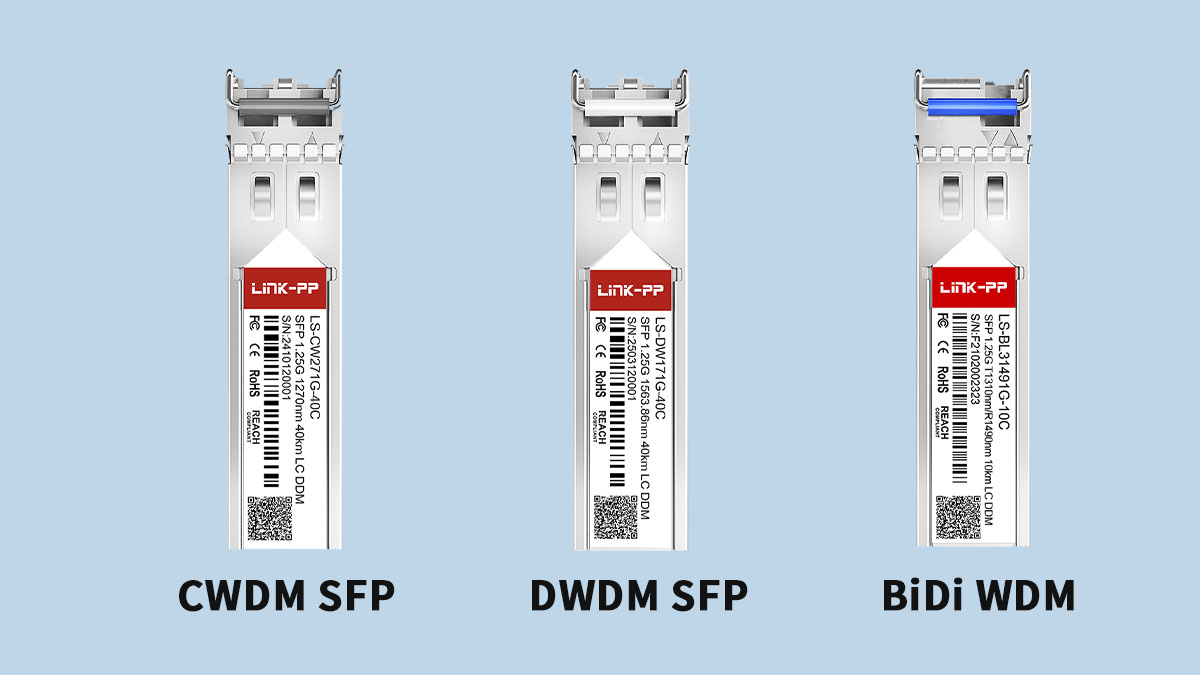
CWDM SFP Modules
CWDM (Coarse Wavelength Division Multiplexing) SFP modules are designed for cost-effective, medium-capacity networks. They use wider channel spacing, typically 20nm, which simplifies design and reduces laser precision requirements.
Key characteristics of CWDM SFP modules:
- Channel range typically spans 1270nm–1610nm with up to 18 wavelengths.
- Suitable for metro networks, campus environments, and enterprise links where fiber resources are sufficient.
- Lower cost due to simpler laser and thermal management requirements.
- Typically support transmission distances up to 80 km without optical amplification.
CWDM modules are ideal for scenarios where moderate bandwidth is needed over relatively short distances without the complexity or cost of DWDM systems.
DWDM SFP Modules
DWDM (Dense Wavelength Division Multiplexing) SFP modules provide higher channel density and spectral efficiency, making them suitable for long-haul and high-capacity networks.
| Feature | DWDM SFP Module | Notes |
|---|---|---|
| Channel Spacing | 0.8nm or 0.4nm | Enables up to 96 channels or more on a single fiber |
| Typical Distance | 80–2000+ km | Supports optical amplification (EDFA) for long-haul links |
| Wavelength Grid | ITU-T Compliant | Ensures compatibility across different vendors |
| Cost | Higher than CWDM | Due to precise lasers, thermal control, and integration complexity |
DWDM modules such as QSFP-100G-CWDM4 are widely deployed in backbone networks, data center interconnects, and any scenario where fiber resources are limited but bandwidth demand is high. Precise wavelength control and advanced thermal management are crucial for maintaining signal integrity across tightly spaced channels.
BiDi WDM SFP Modules
BiDi (Bidirectional) WDM SFP modules transmit and receive data over a single fiber by using two separate wavelengths. This design is particularly useful in fiber-constrained environments.
Key advantages of BiDi modules include:
- Single-fiber operation reduces cabling and connector requirements.
- Supports medium-range applications, typically 10–80 km depending on the wavelength and optical budget.
- Often used in enterprise networks, campus connections, or retrofitting existing fiber infrastructure.
- Paired wavelengths ensure simultaneous upstream and downstream transmission without interference.
BiDi modules allow operators to maximize existing fiber assets while maintaining high throughput, making them an efficient solution for dense networks with limited fiber availability.
? Key Technical Specifications to Consider
When selecting WDM SFP modules, understanding key technical specifications is critical for ensuring compatibility, optimal performance, and long-term network reliability. Core factors include wavelength accuracy, transmission distance, optical budget, and power consumption. These specifications directly influence spectral efficiency, signal integrity, and deployment scalability.
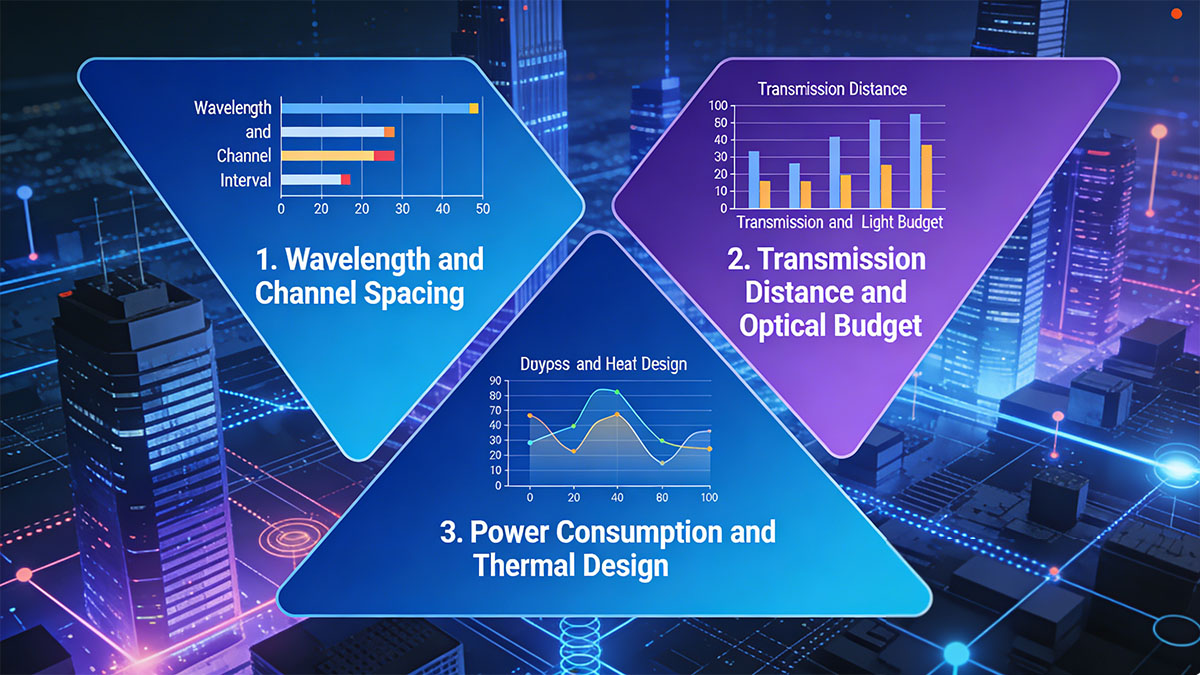
Wavelength and Channel Spacing
Accurate wavelength assignment is essential for maintaining spectral efficiency and minimizing crosstalk between channels. Each WDM SFP transceiver is designed for a specific wavelength in the CWDM or DWDM grid.
Key considerations include:
- Wavelength Tolerance: Ensures the laser remains within specified limits, typically ±0.3nm for CWDM and ±0.05nm for DWDM.
- Channel Spacing: Determines how many channels can coexist on a single fiber. DWDM allows denser spacing but requires precise thermal control.
- ITU Compliance: Modules following ITU-T standards are more interoperable across different vendors and network setups.
Proper wavelength planning avoids signal interference and maximizes the number of channels per fiber, which is especially important in dense network deployments.
Transmission Distance and Optical Budget
Transmission distance is a critical factor, determined by both fiber type and optical budget—the difference between transmitter output power and receiver sensitivity.
| Specification | Typical Values | Notes |
|---|---|---|
| CWDM Module Distance | Up to 80 km | Usually without amplification |
| DWDM Module Distance | 80–2000+ km | Requires optical amplifiers like EDFA |
| BiDi Module Distance | 10–80 km | Depends on wavelength pair and optical budget |
| Optical Budget | 10–20 dB for short-reach, 25–30 dB+ for long-haul | Includes fiber loss, connectors, and splices |
Selecting modules with the appropriate optical budget ensures reliable transmission while accounting for fiber loss, connectors, and splices. Miscalculating the optical budget can lead to signal degradation or link failure.
Power Consumption and Thermal Design
High-density deployments require careful consideration of module power consumption and thermal behavior. Excess heat can degrade laser performance, impacting wavelength accuracy and spectral efficiency.
Critical factors include:
- Module Power: Typical SFP modules consume 0.5–1W, but high-channel-density DWDM modules may require more.
- Thermal Management: Adequate airflow or heat sinks are essential for maintaining laser stability.
- Environmental Tolerance: Modules rated for extended temperature ranges (-5°C to 70°C or higher) are necessary for outdoor or harsh environments.
Ensuring proper thermal design maintains module performance, protects spectral integrity, and prolongs operational life, especially in data centers or long-haul network installations.
? Deployment Scenarios and Use Cases
WDM SFP modules are versatile solutions for a variety of optical network deployments. Their ability to transmit multiple wavelengths over a single fiber allows operators to optimize fiber usage, reduce infrastructure costs, and scale bandwidth efficiently. Understanding specific deployment scenarios helps network designers select the appropriate transceiver type and configuration.

Data Center Interconnect (DCI)
For data center interconnects, WDM SFP modules enable high-capacity, low latency links between geographically separated facilities.
Key benefits and considerations include:
- High-Density Connectivity: Supports dozens of channels per fiber, reducing cabling and port requirements.
- Scalable Bandwidth: Modules can be added incrementally as data traffic grows.
- Short-to-Medium Reach Optimization: CWDM is often sufficient for metro-area data center links, while DWDM is used for long-haul connections.
- Simplified Infrastructure: Integrated mux/demux modules reduce rack space and maintenance complexity.
DCI deployments benefit from WDM SFP modules’ ability to increase capacity without major changes to existing fiber infrastructure, providing cost-effective scalability.
Metro and Access Networks
In metro and access networks, WDM SFP modules enable operators to deliver high-bandwidth services over existing fiber networks without extensive physical upgrades.
Deployment advantages include:
- Cost Efficiency: CWDM modules reduce the need for additional fiber while supporting multiple services.
- Flexible Channel Allocation: Operators can dynamically assign wavelengths based on traffic demand.
- Simplified Upgrades: Adding new wavelengths requires minimal infrastructure changes.
- Medium-Distance Optimization: CWDM is ideal for distances up to 80 km, while DWDM can extend to longer metro spans with amplification.
WDM modules in metro and access networks help maximize spectral efficiency, reduce operational costs, and provide future-proof scalability for bandwidth-hungry services.
Enterprise and Campus Networks
Enterprises and large campuses often face fiber constraints and diverse connectivity needs. WDM SFP modules provide an efficient solution by enabling multiple high-speed connections over a single fiber.
Key deployment considerations:
- Fiber Conservation: BiDi WDM modules allow bidirectional communication on a single fiber, ideal for limited infrastructure.
- Flexible Network Design: Modules can be deployed for backbone, inter-building, or cross-campus links.
- Ease of Maintenance: Pluggable modules allow quick swaps and upgrades without disrupting operations.
- Support for High-Bandwidth Applications: Cloud services, video streaming, and backup solutions benefit from higher capacity links.
By adopting WDM SFP modules, enterprise networks can achieve efficient fiber utilization, simplified network expansion, and reliable high-speed connectivity across multiple sites.
? Benefits and Limitations of WDM SFP Modules
WDM SFP modules provide significant advantages in optical network design, but they also have certain limitations that network engineers must consider. Evaluating both the benefits and constraints ensures optimized deployment and avoids performance or cost pitfalls.

Key Benefits
The main benefits of WDM SFP modules stem from their ability to efficiently use fiber infrastructure while providing scalable, high-bandwidth connectivity:
- Maximized Fiber Utilization: Multiplexing multiple wavelengths on a single fiber reduces the need for additional cabling and fiber resources.
- High Scalability: Modules can be added incrementally as network traffic grows, supporting both CWDM and DWDM configurations.
- Space and Power Efficiency: Pluggable modules with integrated mux/demux reduce rack space and power consumption compared to standalone optical components.
- Simplified Network Architecture: Fewer external components and interconnections lower insertion loss, reduce points of failure, and simplify maintenance.
- Flexibility Across Applications: Suitable for data center interconnects, metro networks, enterprise backbones, and campus environments.
These benefits make WDM SFP modules a highly efficient solution for operators needing to scale capacity without significant infrastructure investment.
Potential Limitations
Despite their advantages, WDM SFP modules have limitations that must be addressed during network planning:
- Higher Initial Cost for DWDM: Dense wavelength modules require precise lasers and thermal management, increasing upfront costs.
- Thermal Sensitivity: Narrow linewidth lasers and tightly spaced channels are sensitive to temperature variations, requiring careful thermal design.
- Complex Channel Planning: Accurate wavelength assignment and spectral management are critical to prevent crosstalk and signal degradation.
- Limited Transmission Distance for CWDM: Without amplification, CWDM modules are constrained to medium-range deployments (typically ≤80 km).
- Maintenance Expertise Required: High-density networks with multiple channels may require trained personnel to monitor and maintain optimal performance.
Understanding these limitations helps network engineers balance cost, complexity, and performance when selecting WDM SFP modules for specific deployments.
? Best Practices for Network Design and Integration
Effective network design and integration are crucial for realizing the full benefits of WDM SFP modules. Following best practices ensures high spectral efficiency, reliable performance, and simplified maintenance, while minimizing operational risks in both short-reach and long-haul deployments.
Plan for Wavelength and Channel Management
Proper wavelength planning is essential to avoid crosstalk and ensure optimal spectral efficiency:
- Assign Channels Strategically: Map each module’s wavelength according to network topology, considering distance and optical loss.
- Maintain Wavelength Spacing: Ensure CWDM or DWDM spacing is strictly observed to prevent interference.
- Use ITU-Compliant Modules: Standardized wavelength grids improve interoperability across different vendors.
- Document Assignments: Maintain a centralized wavelength plan for easy troubleshooting and future upgrades.
Strategic wavelength planning reduces signal degradation, simplifies network expansion, and supports long-term scalability.
Optimize Fiber and Port Utilization
Efficient fiber and port management enhances network capacity without adding physical infrastructure:
- Leverage BiDi Modules: Use bidirectional modules in fiber-constrained environments to double fiber utilization.
- Deploy High-Density SFP Ports: Concentrate WDM modules in high-density switches or patch panels to minimize footprint.
- Reduce Connector Count: Fewer interconnections lower insertion loss and maintenance complexity.
By carefully designing fiber routes and port allocation, operators can maximize spectral efficiency and reduce operational costs.
Consider Thermal and Environmental Conditions
Maintaining module performance requires attention to thermal and environmental factors:
- Ensure Adequate Cooling: Use airflow management, heat sinks, or fan trays in high-density racks.
- Select Extended Temperature Modules: For outdoor or non-controlled environments, choose modules rated for wider temperature ranges.
- Monitor Laser Stability: Regularly verify wavelength accuracy to prevent spectral drift and crosstalk.
Thermal and environmental planning protects signal integrity, particularly in DWDM systems with tightly spaced channels.
Maintain Modular and Scalable Architecture
A modular approach simplifies upgrades, maintenance, and network expansion:
- Use Pluggable Modules: SFP modules allow quick swaps and future upgrades without major downtime.
- Plan for Incremental Capacity Growth: Deploy modules in phases, adding channels as traffic demand increases.
- Integrate with Existing Infrastructure: Ensure compatibility with current fiber, switches, and patch panels to avoid redesign costs.
Adopting a modular and scalable architecture ensures that network evolution is cost-effective, minimizes disruption, and supports high-density optical deployments.
? Future Trends in WDM SFP Technology
WDM SFP technology is entering a phase of rapid evolution driven by the growing demand for high-bandwidth networks, dense data center interconnects, and long-haul optical backbone systems. The trends focus on higher spectral efficiency, increased channel density, smarter network integration, and energy-efficient designs. These developments are reshaping how optical networks are deployed, managed, and scaled.

Evolution Toward Higher Channel Density
The demand for network capacity is pushing WDM SFP modules toward supporting more wavelengths per fiber:
- Ultra-Dense DWDM Grids: Future modules will support 96–192 channels on a single fiber, leveraging ultra-narrow linewidth lasers.
- Multi-Band Wavelength Support: Combining C-band and L-band channels within one module increases total fiber throughput without additional fiber deployment.
- Compact High-Density Designs: Miniaturized optical components allow more SFP ports per switch or patch panel, supporting high-density data center applications.
This evolution enables network operators to maximize fiber utilization while reducing infrastructure expansion and deployment costs.
Advanced Modulation and Signal Integrity
Spectral efficiency improvements are being driven by advanced modulation formats and error management:
| Trend | Description | Benefit |
|---|---|---|
| Coherent Modulation | QPSK, 16-QAM, and higher-order modulation | Increases bits per symbol for higher per-channel capacity |
| Forward Error Correction (FEC) | Enhanced coding schemes | Improves signal integrity over long distances, reduces retransmissions |
| Adaptive Power Control | Dynamically adjusts transmitter output | Minimizes crosstalk and maintains channel separation in dense DWDM grids |
By combining these techniques, WDM SFP modules achieve higher throughput, longer reach, and more reliable performance across both metro and long-haul networks.
Integration with Intelligent and Software-Defined Networks
The future of WDM SFP technology includes tight integration with AI-driven and software-defined network (SDN) systems:
- Real-Time Spectral Monitoring: AI monitors wavelength drift, power fluctuations, and crosstalk in real time.
- Predictive Maintenance: Machine learning predicts module aging and optimizes replacement schedules to prevent service disruption.
- Dynamic Wavelength Allocation: SDN controllers automatically adjust channel assignments to maximize spectral efficiency and network performance.
Intelligent integration transforms WDM SFP modules from static optical devices into adaptive network components that actively optimize capacity and reliability.
Energy Efficiency and Environmental Considerations
With large-scale optical networks consuming significant power, energy efficiency is becoming a critical trend:
- Low-Power Transmitters: Optimized laser designs reduce electrical consumption while maintaining high optical output.
- Passive Thermal Management: Advanced module materials and passive cooling solutions lower operational heat.
- Green Network Design: Efficient modules contribute to sustainability goals and reduce total cost of ownership in data centers.
Energy-efficient designs align with the global push for sustainable network infrastructure, especially for cloud-scale deployments and high-capacity backbone networks.
? Conclusion
WDM SFP modules are transforming optical networking by enabling high-capacity, space-efficient, and scalable transmission over single fibers. Through integrated mux/demux functionality, enhanced spectral efficiency, and a variety of module types—CWDM, DWDM, and BiDi—these modules provide flexible solutions for data center interconnects, metro networks, and enterprise backbones. By carefully considering key technical specifications, deployment scenarios, and best practices, network designers can optimize performance while future-proofing their infrastructure.
As optical networks continue to evolve toward higher density, advanced modulation, and intelligent, AI-driven management, WDM SFP modules will remain a critical component for maximizing fiber utilization and maintaining reliable, high-speed connectivity.
For professional-grade WDM SFP modules that meet industry standards and support next-generation network performance, explore the full selection at the LINK-PP Official Store to find solutions tailored for your deployment needs.







