



































The SFP 8G transceiver remains a critical component in modern storage networks, offering a reliable balance between performance and compatibility. With an 8Gbps data rate, it supports a wide range of Fibre Channel deployments, from legacy storage area networks to hybrid enterprise systems. Despite the emergence of higher-speed standards, SFP 8G continues to provide stable connectivity, cost efficiency, and interoperability, making it a preferred choice for organizations that require consistent performance without extensive infrastructure upgrades. This article explores the evolution, specifications, applications, and deployment considerations of fiber SFP 8G, helping IT professionals understand its role in storage systems today and in the near future.
? Introduction to SFP 8G Technology
SFP 8G modules serve as the backbone of many Fibre Channel storage networks, providing high-speed connectivity with low latency and broad interoperability. Their continued relevance is driven by the need to support legacy storage systems while enabling reliable data transfer in modern hybrid environments. Organizations deploy SFP 8G to achieve consistent performance, maintain infrastructure compatibility, and optimize operational costs without immediate investment in higher-speed transceivers.
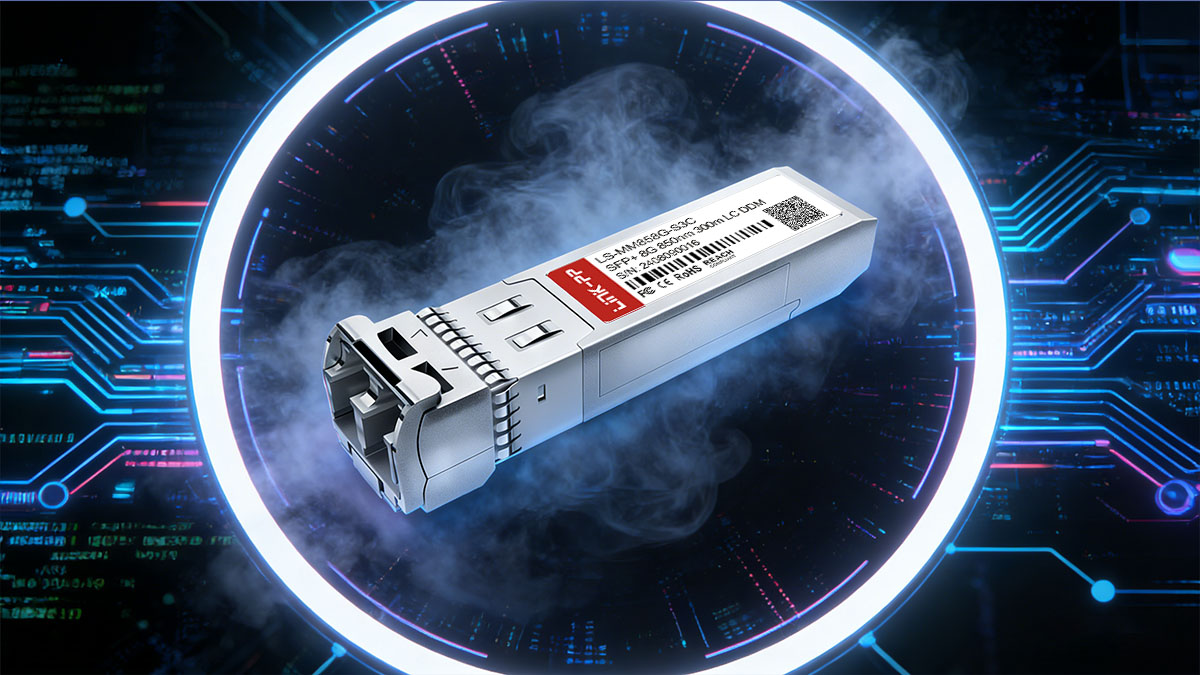
What Is SFP 8G?
SFP 8G, or 8 Gigabit Small Form-factor Pluggable transceiver, is designed for high-speed Fibre Channel communication between servers, switches, and storage arrays. It supports a line rate of 8.5Gbps and operates under the FC-PI-4 specification. Key characteristics include:
- Compact, hot-pluggable form factor that simplifies installation and replacement
- Support for both short-reach (SR) and long-reach (LR) optical signals
- Low power consumption suitable for densely populated storage switches
These optical modules are compatible with a wide range of Fibre Channel switches, host bus adapters (HBAs), and storage systems, making them an essential tool for maintaining stable storage area networks (SANs).
Why SFP 8G Still Matters Today
Despite newer standards like 16G and 32G Fibre Channel, SFP 8G remains widely used in enterprise environments. Its value lies in:
- Legacy system support: Many organizations operate storage arrays designed for 4G/8G Fibre Channel, where SFP 8G ensures seamless connectivity.
- Cost efficiency: Upgrading entire SAN infrastructures to higher-speed modules can be expensive; SFP 8G offers reliable performance without major investment.
- Interoperability: Multi-vendor environments benefit from the standardized nature of SFP 8G modules, which comply with the Multi-Source Agreement (MSA) and allow for cross-vendor deployments.
By providing stable, high-speed links without requiring immediate network overhauls, SFP 8G remains a practical solution for many organizations managing both legacy and evolving storage infrastructures.
? The Evolution of Fibre Channel Standards
The evolution of Fibre Channel (FC) standards has been driven by increasing demands for higher bandwidth, lower latency, and greater reliability in storage networks. SFP 8G occupies a pivotal position in this progression, bridging the gap between early low-speed modules and modern high-performance transceivers. Its widespread adoption reflects the maturity of 8Gbps technology and its ability to deliver stable performance across diverse SAN environments.
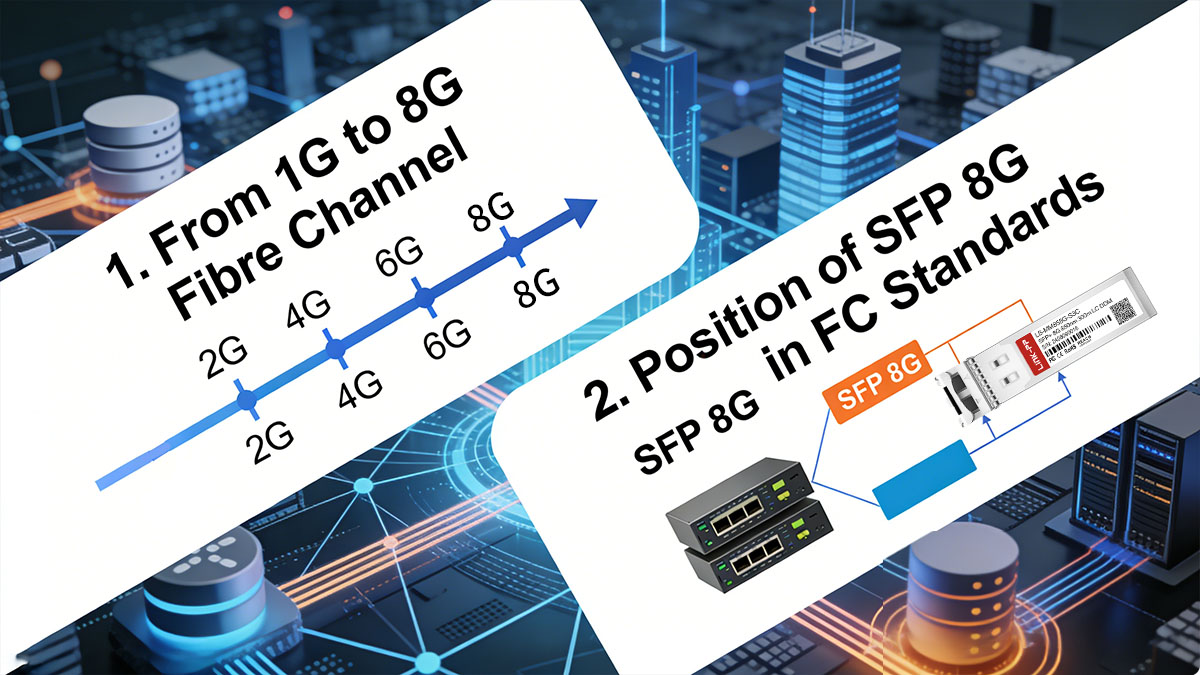
From 1G to 8G Fibre Channel
SFP 8G represents the culmination of several generations of Fibre Channel development. The key points of this evolution include:
- 1G SFP FC: Introduced in the 1990s, supporting basic storage connectivity with 1Gbps line rates, limited distance, and 8b/10b encoding.
- 2G SFP FC: Improved data rates to 2Gbps, reduced latency, and supported longer distances, enabling more flexible SAN topologies.
- 4G SFP FC: Further doubled the bandwidth, introduced more efficient error detection, and gained widespread adoption in enterprise storage networks.
- 8G SFP FC: Delivered an 8.5Gbps line rate, optimized encoding, and greater interoperability, forming the foundation for high-speed yet cost-effective storage links.
| Generation | Line Rate (Gbps) | Encoding | Typical Reach | Key Improvement |
|---|---|---|---|---|
| 1G FC | 1 | 8b/10b | 500m (MMF) | Basic SAN connectivity |
| 2G FC | 2 | 8b/10b | 2km (MMF/SMF) | Extended distance & reduced latency |
| 4G FC | 4 | 8b/10b | 10km (SMF) | Higher bandwidth & widespread adoption |
| 8G FC | 8.5 | 8b/10b | 10km (SMF) | Mature standard, cost-efficient high-speed links |
This table highlights the incremental performance and reach improvements that made 8G a stable and versatile choice for modern SANs. The evolution also reflects gradual enhancements in reliability, power efficiency, and cross-vendor compatibility.
Position of SFP 8G in FC Standards
SFP 8G serves as a bridge between legacy and modern storage infrastructures, offering both backward compatibility and forward interoperability. Key aspects include:
- FC-PI-4 Specification: Defines the physical interface, signaling, and electrical characteristics that ensure 8G modules operate reliably across different vendors’ hardware.
- Speed Compatibility: SFP 8G can interoperate with 2G and 4G devices through auto-negotiation, supporting mixed-speed SAN environments.
- Form Factor Standardization: Multi-Source Agreement (MSA) compliance guarantees that SFP 8G modules fit universally in compatible switch and HBA slots.
This positioning ensures that enterprises can integrate SFP 8G into existing networks without sacrificing performance or interoperability, allowing for gradual upgrades to higher-speed Fibre Channel technologies when needed.
? Technical Specifications of SFP 8G Modules
SFP 8G modules deliver reliable 8Gbps connectivity in storage networks by combining precise optical and electrical design with standardized form factors. Their specifications ensure consistent performance, broad compatibility, and manageable power consumption, making them suitable for a wide range of Fibre Channel SFP deployments.
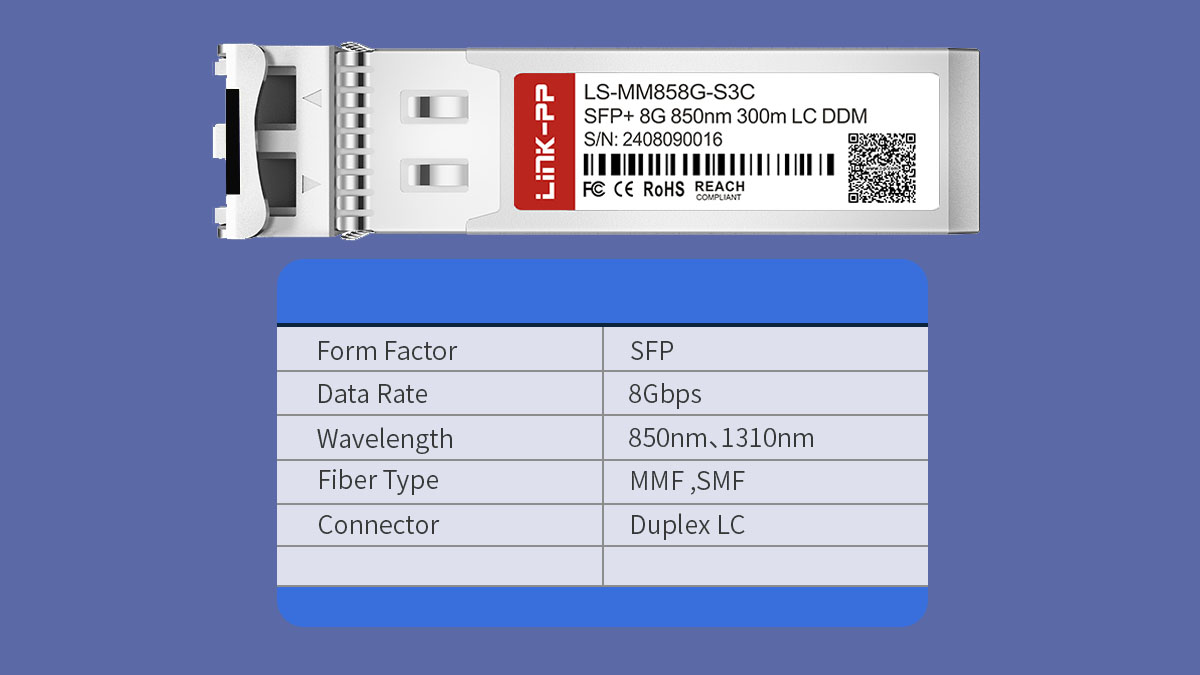
Optical and Electrical Parameters
SFP 8G modules support both short-reach and long-reach applications, enabling flexibility in network design. Key parameters include:
| Parameter | Typical Value | Notes |
|---|---|---|
| Wavelength | 850nm (SR), 1310nm (LR) | Matches multimode (MMF) and single-mode fiber (SMF) |
| Maximum Distance | 150m (SR), 10km (LR) | Depends on fiber type and transceiver types |
| Connector Type | LC Duplex | Standardized for FC modules |
| Transmit Power | -8 to -2 dBm (SR), -4 to +0.5 dBm (LR) | Ensures reliable link margin |
| Receiver Sensitivity | ≤ -11 dBm (SR), ≤ -13 dBm (LR) | Critical for low BER performance |
These specifications allow SFP 8G modules to maintain stable signal quality over varying distances, supporting SANs from short in-rack connections to longer campus-level deployments.
Performance Characteristics
The performance of SFP 8G modules directly influences storage network efficiency and reliability. The main characteristics are:
- Data Rate: 8.5Gbps line rate ensures high throughput for transactional and block storage workloads.
- Bit Error Rate (BER): Typically ≤10⁻¹², guaranteeing near-error-free communication across long fiber runs.
- Power Consumption: Around 1–1.5W per fiber optic SFP module, allowing high-density switch deployment without excessive thermal load.
- Latency: Low end-to-end latency suitable for latency-sensitive storage applications such as database and virtualization workloads.
These performance traits make SFP 8G suitable for both legacy and moderately modern storage environments where consistent and predictable connectivity is essential.
Compatibility and Form Factor
SFP 8G modules are designed for universal interoperability and ease of deployment:
- MSA Compliance: Ensures multi-vendor compatibility and hot-swappable operation.
- Backward Compatibility: Supports 2G and 4G FC devices through auto-negotiation, enabling seamless integration in mixed-speed SANs.
- Hot-Pluggable Design: SFP transceiver can be inserted or removed without shutting down the system, minimizing maintenance windows.
This combination of standardization and interoperability reduces operational risks and simplifies network management, making SFP 8G a versatile solution for varied SAN topologies.
? SFP 8G vs Other Transceiver Standards
SFP 8G remains a practical choice for many storage networks, but understanding its performance and limitations relative to other optical transceiver standards is critical for informed infrastructure planning. Compared with lower-speed and higher-speed modules, SFP 8G offers a balance between cost, compatibility, and performance, particularly in environments that still operate legacy Fibre Channel systems.
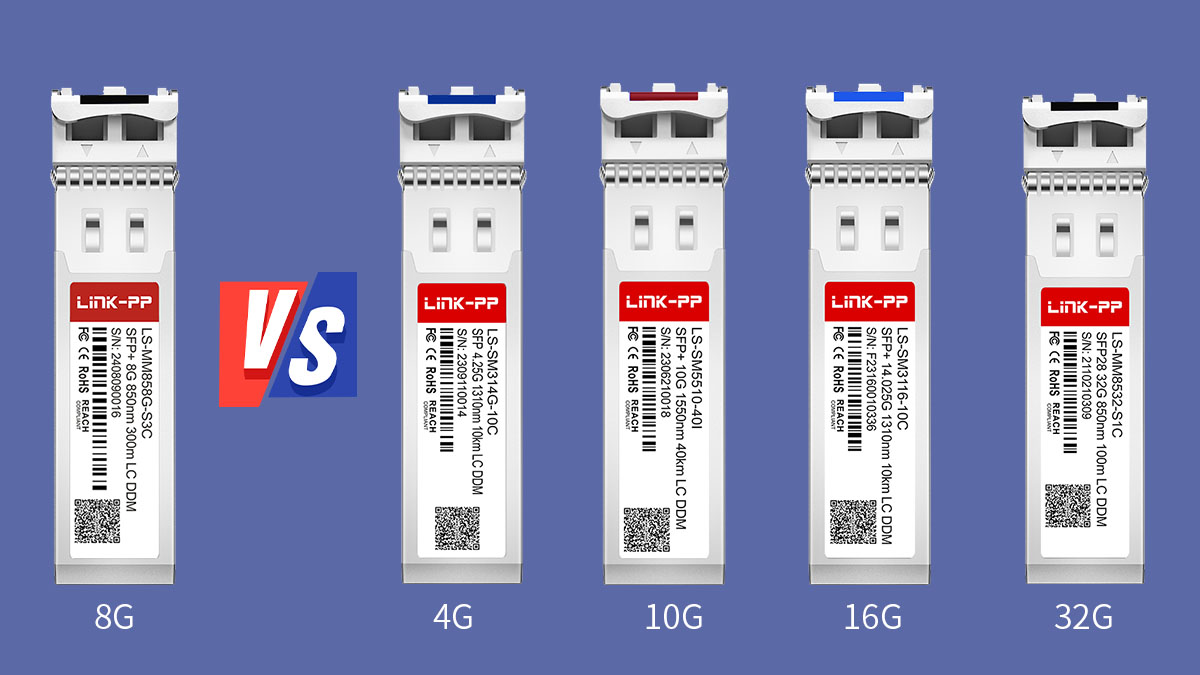
SFP 8G vs SFP 4G
SFP 8G offers significant performance improvements over 4G modules while maintaining backward compatibility. Key comparisons include:
| Feature | SFP 4G | SFP 8G | Notes |
|---|---|---|---|
| Data Rate | 4.25Gbps | 8.5Gbps | Doubled bandwidth improves throughput |
| Maximum Distance | 10km (SMF) | 10km (SMF) | Distance remains comparable for long-reach links |
| Power Consumption | ~1W | 1–1.5W | Slightly higher due to increased speed |
| BER | ≤10⁻¹² | ≤10⁻¹² | Maintains high reliability |
| Compatibility | Legacy SAN devices | Legacy + newer FC | SFP 8G supports mixed-speed environments |
SFP 8G enables a smooth upgrade path for networks originally built on 4G modules, effectively doubling throughput without requiring extensive changes to existing infrastructure.
SFP 8G vs SFP+ (10G Ethernet)
While SFP+ is commonly associated with Ethernet networks rather than Fibre Channel, comparisons are important for converged storage and network designs:
- Protocol Difference: SFP 8G is optimized for Fibre Channel, whereas SFP+ operates at 10Gbps Ethernet.
- Latency and Jitter: SFP 8G generally provides lower deterministic latency, critical for storage applications.
- Use Case: SFP+ 10G is suited for IP-based storage (iSCSI, NAS) or high-speed network uplinks, while SFP 8G is optimized for SAN block storage.
This distinction emphasizes that while SFP+ offers slightly higher nominal speed, SFP 8G remains preferable in latency-sensitive Fibre Channel SAN environments.
SFP 8G vs 16G/32G FC Modules
Higher-speed modules such as 16G and 32G FC provide increased throughput but come with trade-offs. Key considerations:
- Performance Scaling: 16G (like DS-SFP-FC16G-SW) and 32G (like DS-SFP-FC32G-SW) deliver double or quadruple the bandwidth of 8G, supporting high-performance storage arrays and larger SAN fabrics.
- Cost and Complexity: Upgrading requires compatible HBAs, switches, and fiber infrastructure, resulting in higher capital expenditure.
- Migration Path: SFP 8G can coexist with higher-speed modules in hybrid SANs, enabling gradual upgrades while preserving existing investment.
| Feature | SFP 8G | SFP 16G | SFP 32G | Notes |
|---|---|---|---|---|
| Line Rate (Gbps) | 8.5 | 16 | 32 | Bandwidth scaling for high-demand workloads |
| Power Consumption | 1–1.5W | 2–3W | 4–5W | Higher speeds increase thermal requirements |
| Backward Compatibility | 2G/4G FC | 8G/4G FC | 16G/8G FC | Gradual migration possible |
| Typical Use Case | Legacy/mid-tier | High-performance SAN | Ultra-high-speed SAN | Infrastructure planning determines module choice |
This comparison shows that SFP 8G remains viable for cost-conscious environments and legacy systems, while higher-speed modules target cutting-edge SAN deployments with demanding throughput requirements.
? Common Applications of SFP 8G in Storage Systems
SFP 8G modules are widely deployed across enterprise storage networks because they offer reliable, high-speed connectivity without requiring a full infrastructure overhaul. Their applications span core SAN environments, enterprise data centers, and backup or disaster recovery systems, where stability, interoperability, and predictable latency are essential.
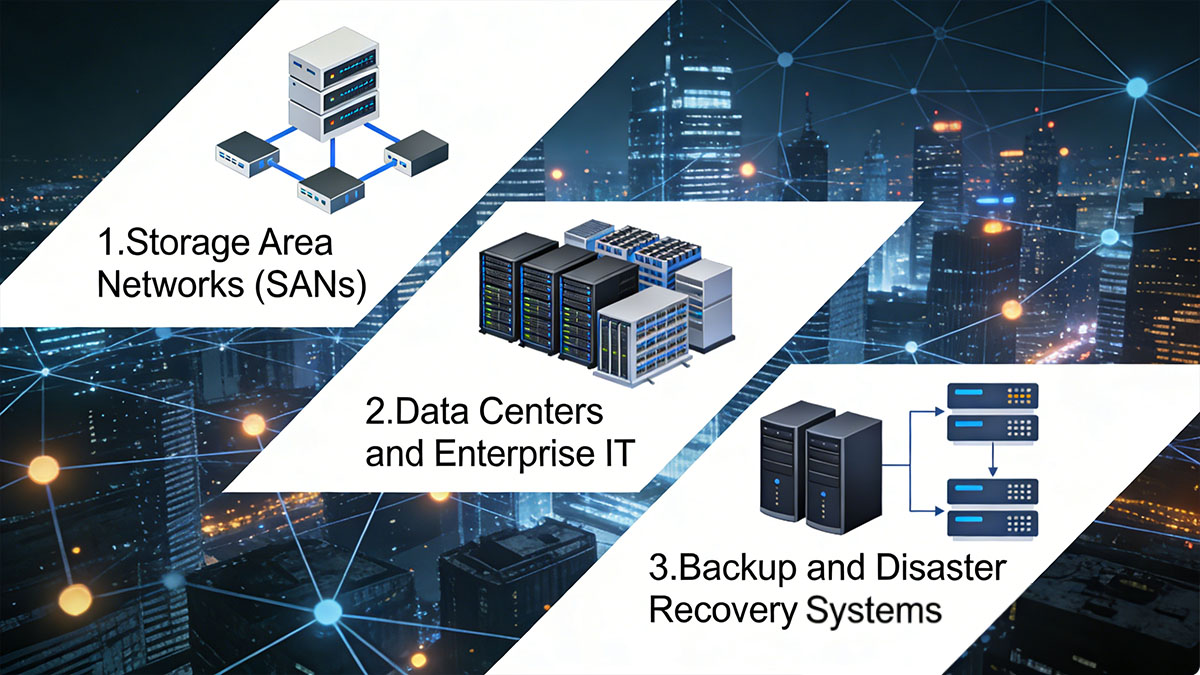
Storage Area Networks (SANs)
SFP 8G modules are most commonly used to interconnect devices within Fibre Channel SANs. They provide consistent high-speed links between servers, storage arrays, and switches, ensuring low-latency access to critical data. Typical applications include:
- Linking multiple storage arrays for centralized storage management
- Connecting host servers to SAN switches with minimal latency
- Supporting mixed-speed environments where legacy 4G or 2G devices coexist with 8G modules
These deployments benefit from SFP 8G’s standardized form factor and backward compatibility, reducing network disruptions during upgrades.
Data Centers and Enterprise IT
Enterprise data centers rely on SFP 8G to maintain stable connectivity for mid-tier and legacy systems. Key use cases include:
- Virtualization platforms where multiple VMs require consistent block storage access
- Consolidated data center infrastructure with mixed vendor hardware
- Moderate-density SANs where cost-efficiency and reliability outweigh the need for ultra-high bandwidth
The flexibility and hot-pluggable nature of SFP 8G modules simplify maintenance, allowing IT teams to replace or upgrade transceivers without impacting production workloads.
Backup and Disaster Recovery Systems
SFP 8G modules play a critical role in replication and disaster recovery strategies. They ensure that data is transmitted reliably between primary and secondary storage systems with minimal latency. Common applications include:
- Remote replication between data centers over long-reach fiber connections
- High-availability SAN configurations that require continuous synchronization
- Offsite backup links where predictable performance is essential for recovery objectives
The reliability of SFP 8G modules supports mission-critical environments by reducing the risk of data loss and maintaining consistent throughput for backup and recovery operations.
? Advantages and Limitations of SFP 8G
SFP 8G modules provide a mature, cost-effective solution for Fibre Channel storage networks, but their suitability depends on the specific needs of an organization. Understanding their strengths and limitations is crucial for making informed deployment decisions.
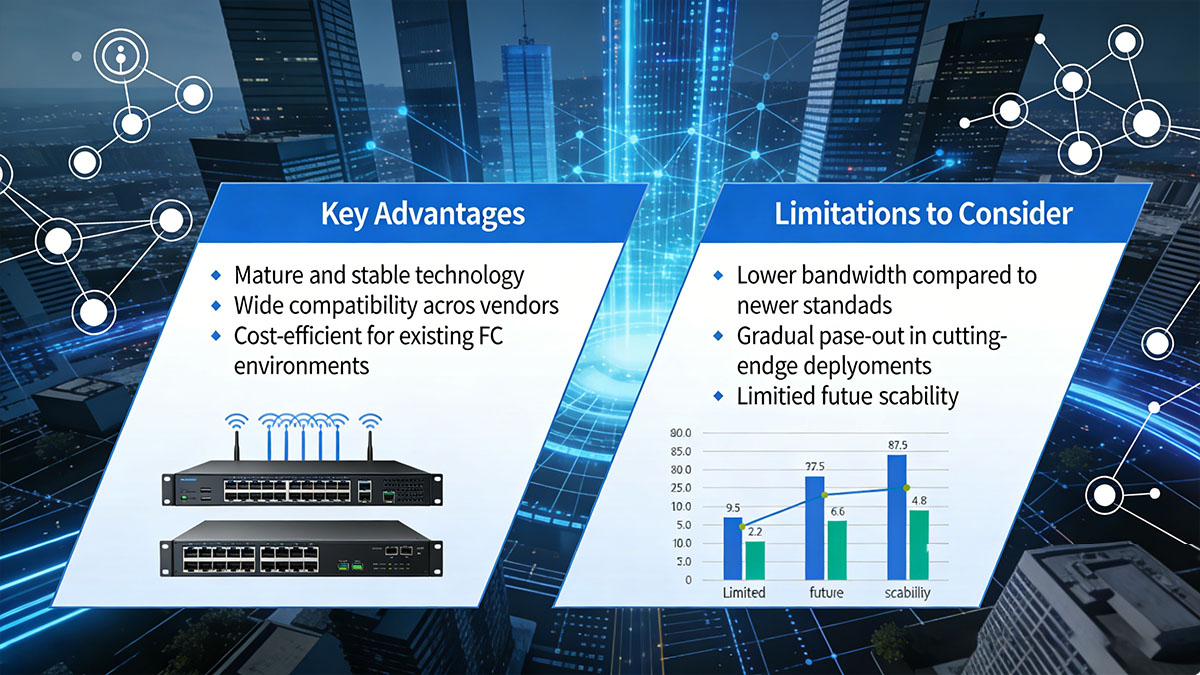
Key Advantages
SFP 8G offers several benefits that make it a reliable choice for existing and hybrid storage systems:
- Mature Technology: Having been widely deployed, SFP 8G modules are stable, with predictable performance and well-understood operational characteristics.
- Cost-Efficient: Lower price point compared to higher-speed 16G or 32G modules, enabling organizations to maintain SAN infrastructure without significant capital expenditure.
- Broad Compatibility: Supports multi-vendor environments due to MSA compliance and backward compatibility with 2G and 4G Fibre Channel devices.
- Flexible Deployment: Hot-pluggable design and support for both short-reach and long-reach fiber links simplify installation and maintenance.
These advantages ensure that SFP 8G remains a practical choice for organizations managing legacy or mixed-speed SAN environments while balancing cost and performance.
Limitations to Consider
Despite its benefits, SFP 8G modules have inherent limitations compared with newer high-speed transceivers:
| Limitation | Description |
|---|---|
| Bandwidth Ceiling | Maximum 8.5Gbps may be insufficient for modern high-throughput workloads. |
| Gradual Phase-Out | Increasing adoption of 16G, 32G, and higher-speed FC may reduce vendor support over time. |
| Limited Future Scalability | While backward-compatible, SFP 8G may constrain network growth and modernization efforts. |
| Energy Efficiency | Slightly higher power per Gbps compared with newer 16G/32G modules, impacting dense deployments. |
Organizations must weigh these factors against their operational requirements. In many cases, SFP 8G continues to provide a cost-effective and reliable solution for existing SAN deployments, but it may not be ideal for high-performance or future-proof networks.
? Deployment Considerations and Best Practices
Effective deployment of SFP 8G modules requires careful attention to compatibility, environmental factors, and network design. Following best practices ensures consistent performance, minimizes downtime, and extends the life of existing storage infrastructure.
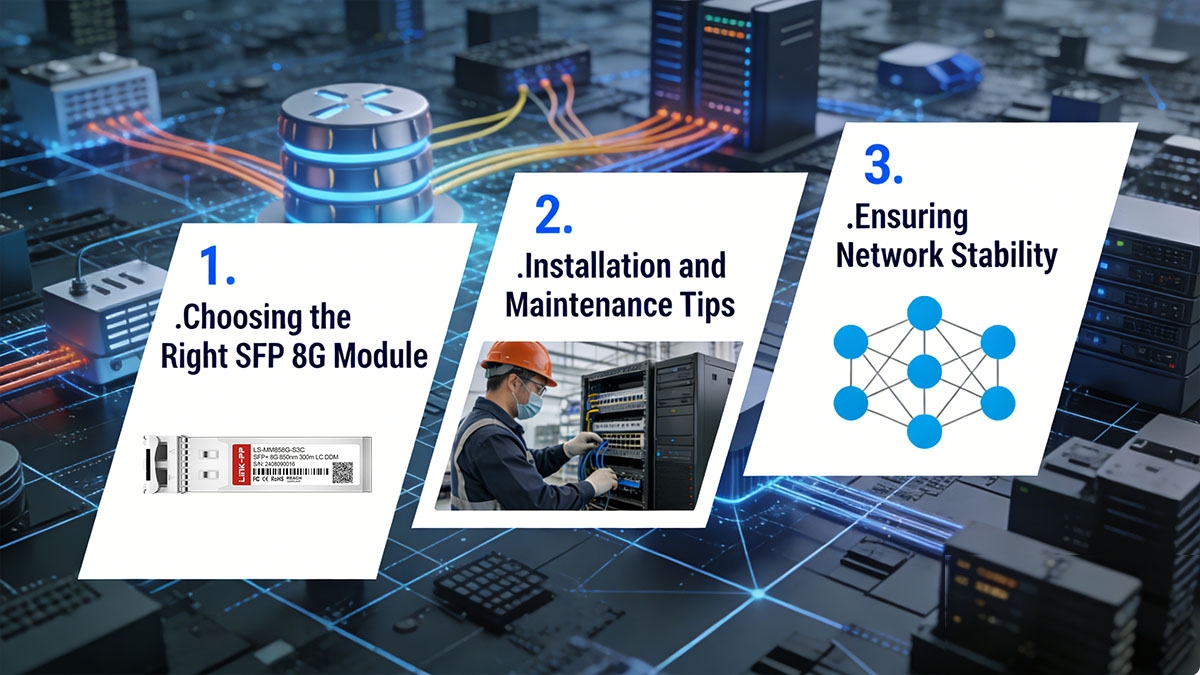
Choosing the Right SFP 8G Module
Selecting the appropriate module is critical for maintaining reliable connectivity and avoiding compatibility issues. Key factors include:
- Short-Reach vs Long-Reach: Short-range optics are ideal for in-rack or data center connections up to 150m over multimode fiber, while Long-range modules support distances up to 10km over single-mode fiber.
- Vendor Compatibility: Verify that the module complies with both the host device (switch or HBA) and the storage array specifications to avoid interoperability problems.
- Environmental Requirements: Consider operating temperature, humidity, and thermal load, especially in densely populated switches or racks.
These considerations help ensure that the chosen SFP 8G module aligns with both technical requirements and operational constraints.
Installation and Maintenance Tips
Proper handling and maintenance of SFP 8G modules reduce failures and improve network reliability:
- Proper Handling: Avoid touching optical interfaces and use protective caps when modules are not installed.
- Cleaning and Inspection: Regularly clean LC connectors and inspect for dust or scratches that can degrade signal quality.
- Monitoring Diagnostics: Use DOM (Digital Optical Monitoring) or DDM (Digital Diagnostic Monitoring) features to track module performance, including temperature, voltage, and optical power levels.
- Slot Management: Ensure proper seating of modules in switches or HBAs to prevent intermittent connections.
Following these steps reduces signal degradation and prevents avoidable downtime.
Ensuring Network Stability
SFP 8G deployment must consider overall network design to maintain a stable SAN environment:
- Avoid Mismatched Transceivers: Mixing incompatible modules can cause link failures or increased latency.
- Firmware and Hardware Validation: Confirm that switch, HBA, and storage array firmware versions support the SFP 8G modules.
- Redundancy Planning: Deploy redundant paths and dual-switch architectures to minimize the impact of a single module or link failure.
- Regular Testing: Periodically test link performance, error rates, and failover behavior to detect potential issues proactively.
By adhering to these practices, organizations can maximize uptime, ensure predictable performance, and simplify future upgrades within their storage networks.
? Future Outlook of SFP 8G in Storage Networking
SFP 8G modules will continue to play a role in storage networks for the foreseeable future, particularly in environments where cost efficiency, stability, and legacy support are priorities. While newer high-speed standards dominate cutting-edge deployments, SFP 8G remains relevant for hybrid infrastructures and phased upgrades.
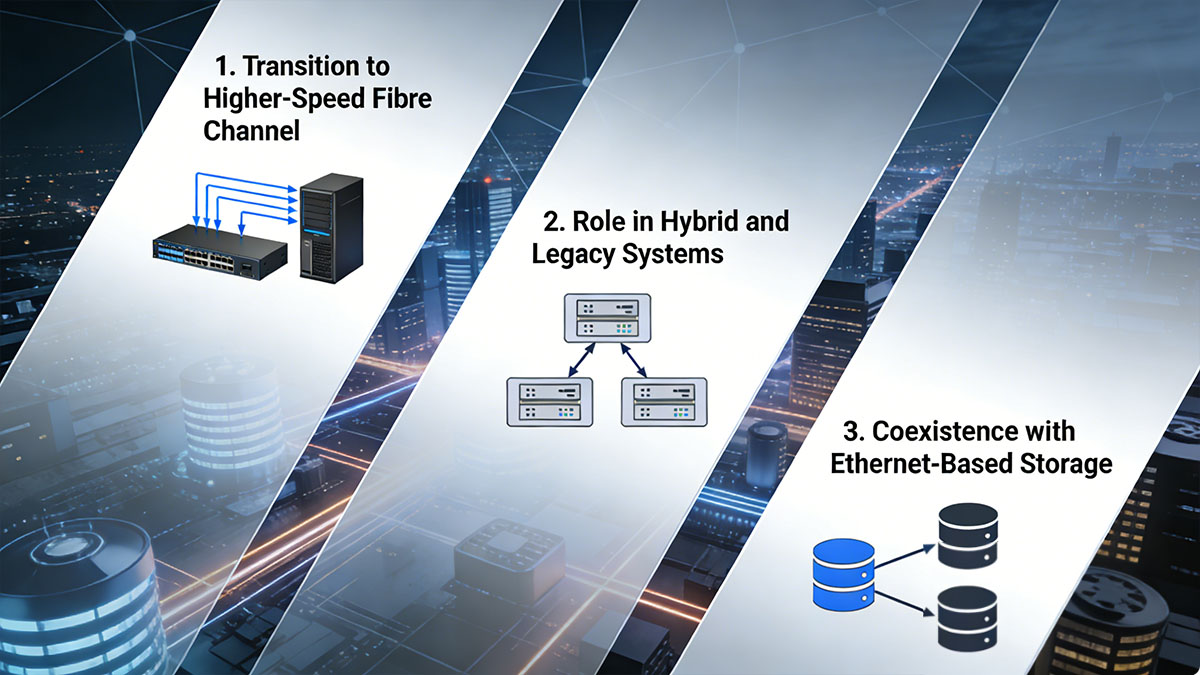
Transition to Higher-Speed Fibre Channel
SFP 8G is gradually being supplemented or replaced by 16G, 32G, and even 64G Fibre Channel modules in high-performance SANs. Key points include:
- Performance Demand: Data-intensive applications, such as large-scale virtualization, AI analytics, and high-speed database workloads, increasingly require higher bandwidth than 8G can provide.
- Upgrade Path: Organizations often maintain SFP 8G in peripheral or legacy segments while deploying higher-speed modules in core areas.
- Mixed-Speed Environments: Backward compatibility allows gradual migration without disrupting existing 8G links.
This transition highlights that SFP 8G will remain relevant in certain network segments even as enterprises adopt higher-speed FC for performance-critical operations.
Role in Hybrid and Legacy Systems
SFP 8G modules continue to provide value in systems that combine modern and legacy equipment. Key roles include:
- Connecting older storage arrays to newer switches without requiring full infrastructure replacement
- Supporting mid-tier SAN deployments where ultra-high bandwidth is unnecessary
- Enabling cost-effective expansion of storage networks with predictable performance
These applications ensure that organizations can extend the useful life of existing assets while preparing for incremental upgrades.
Coexistence with Ethernet-Based Storage
The growth of Ethernet-based storage protocols, such as iSCSI and NVMe over Fabrics (NVMe-oF), introduces new design considerations:
- SFP 8G remains optimized for Fibre Channel block storage, providing low-latency, deterministic performance that Ethernet links cannot always match.
- Hybrid architectures may combine SFP 8G Fibre Channel links with 10G SFP+/25G SFP28/40G QSFP+ Ethernet for converged storage and networking, balancing performance, cost, and flexibility.
- Organizations can leverage SFP 8G in legacy SANs while using Ethernet links for emerging IP-based storage, reducing overall migration risk.
By coexisting with Ethernet-based solutions, SFP 8G allows IT teams to manage a phased transition toward converged and high-speed storage networks without immediate disruption.
? FAQs About SFP 8G
Is SFP 8G compatible with all Fibre Channel switches?
SFP 8G is compatible with most Fibre Channel switches that support the FC-PI-4 standard, but verification of vendor specifications is recommended for interoperability.
Can SFP 8G be used in virtualized storage environments?
Yes, SFP 8G modules provide low-latency connectivity suitable for virtualized workloads and multi-VM storage access.
How does SFP 8G affect SAN latency?
SFP 8G maintains low deterministic latency, ensuring consistent performance for block storage operations, which is critical for databases and transactional applications.
What is the typical lifespan of an SFP 8G module?
Under normal operating conditions, SFP 8G modules typically last 5–10 years, depending on usage, temperature, and handling.
Can SFP 8G support long-distance connections?
Yes, long-reach (LR) SFP 8G modules support distances up to 10km over single-mode fiber, suitable for campus-level or inter-data center links.
Are SFP 8G modules hot-swappable?
Yes, they are hot-pluggable, allowing installation or replacement without powering down the switch or HBA, minimizing operational disruption.
? Conclusion
SFP 8G modules continue to provide reliable, cost-effective connectivity for Fibre Channel storage networks, balancing performance, compatibility, and operational simplicity. Their maturity and backward compatibility make them ideal for legacy systems, hybrid SAN environments, and mid-tier enterprise deployments. While higher-speed standards such as 16G and 32G are increasingly adopted in performance-critical networks, SFP 8G remains relevant for organizations seeking stable, predictable, and interoperable storage links.
For IT professionals looking to source high-quality SFP 8G modules that meet industry standards and ensure seamless SAN integration, the LINK-PP Official Store offers a comprehensive range of reliable options suitable for diverse deployment needs.







