In modern data center environments, the demand for high speed, low latency connectivity continues to grow as cloud computing, virtualization, and large-scale applications become increasingly prevalent. While other high-speed transceivers technologies such as 25G SFP28 and 100G QSFP28 are gaining traction, 10Gbps Ethernet still plays a critical role in many enterprise and hyperscale deployments. In particular, short-reach optical connections remain essential for efficient communication between switches, servers, and fabric components within the same rack or across adjacent racks.
Against this backdrop, FET-10G has emerged as a specialized solution designed to address specific architectural needs within Cisco data center ecosystems. Unlike standard 10GBASE-SR modules, FET-10G is optimized for use with Cisco Nexus switches and Fabric Extenders (FEX), offering a cost-efficient and streamlined approach for short-distance connectivity. However, its unique positioning also introduces questions around compatibility, performance, and appropriate deployment scenarios, making it important to fully understand its technical characteristics.
This article provides a comprehensive breakdown of FET-10G, focusing on its technical specifications, performance metrics, compatibility scope, and real-world use cases. It also compares FET-10G with standard 10GBASE-SR modules, explores cabling and deployment considerations, and highlights common challenges along with practical solutions. By the end, you will gain a clear understanding of when FET-10G is the right choice and how to integrate it effectively into modern data center networks.
? What Is FET-10G and Where Is It Used
FET-10G is a specialized 10Gbps optical transceiver designed primarily for Cisco Fabric Extender (FEX) architectures, where it enables short-reach, high-density connectivity between parent switches and FEX devices. Unlike standard SFP+ modules, it is optimized for specific Cisco platforms, making it highly efficient in targeted deployment scenarios but limited in general interoperability.
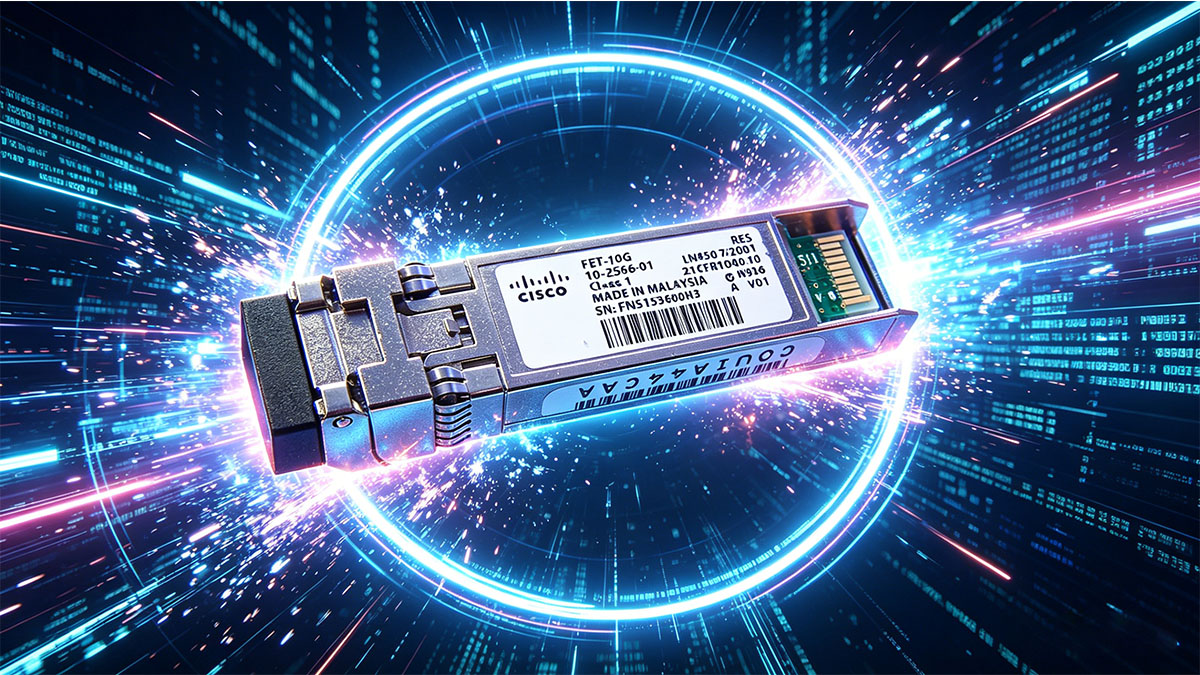
Definition of FET-10G
FET-10G refers to a Fabric Extender Transceiver that operates at 10Gbps over multimode fiber and is engineered specifically for Cisco Nexus environments. Its primary purpose is to support fabric-based architectures where centralized switching is extended to access layers using FEX technology.
From a functional perspective, FET-10G differs from standard 10G SFP+ modules in how it is recognized and validated by network devices. It is not a universal transceiver but rather a purpose-built module aligned with Cisco’s system design.
| Parameter | FET-10G | Standard 10G SFP+ (SR) |
|---|---|---|
| Design Purpose | FEX connectivity | General 10G networking |
| Compatibility | Cisco Nexus & FEX only | Multi-vendor |
| Operating Mode | Fabric-optimized | Ethernet standard |
This distinction means that while FET-10G can deliver similar physical-layer performance to SR modules, its usability is tightly coupled with specific network architectures.
Typical Deployment Scenarios
FET-10G is primarily used in environments where Cisco Nexus switches are deployed alongside Fabric Extenders, enabling scalable and simplified network topologies. Its short-reach capability makes it ideal for dense, high-performance data center layouts.
Common deployment scenarios include:
- Top-of-Rack (ToR) switch to FEX uplinks within the same rack
- Inter-rack connections in closely spaced data center rows
- High-density server access layers using FEX for port extension
- Environments requiring cost-efficient short-distance 10Gbps links
These use cases highlight that FET-10G is not intended for long-distance transmission or heterogeneous networks, but rather for tightly controlled infrastructure where compatibility and efficiency are prioritized.
In practice, its value becomes most evident in large-scale deployments where reducing per-link cost and simplifying cabling can significantly impact overall operational efficiency.
Compatibility Scope
FET-10G is designed with a narrow but well-defined compatibility scope, ensuring seamless operation within supported Cisco platforms while restricting use in broader networking environments. This design choice reinforces performance consistency but limits flexibility.
The following factors define its compatibility:
- Supported on specific Cisco Nexus switches and FEX models
- Requires platform-level support and firmware recognition
- Typically not supported on standard SFP+ ports outside FEX contexts
- Limited or no interoperability with third-party networking equipment
Because of these constraints, deployment planning must include careful validation of hardware and software compatibility before implementation.
In summary, FET-10G is best understood as a purpose-built optical module tailored for Cisco-centric data center architectures. Its strength lies in optimized performance and cost efficiency within FEX deployments, while its limitations stem from restricted interoperability outside that ecosystem.
? Key Technical Specifications of Cisco FET-10G
Cisco FET-10G delivers 10Gbps short-reach optical connectivity over multimode fiber, with specifications closely aligned to 10GBASE-SR in terms of physical performance, but optimized for FEX-based architectures. Its technical characteristics define not only how it transmits data, but also where it can be reliably deployed.
Optical and Transmission Parameters
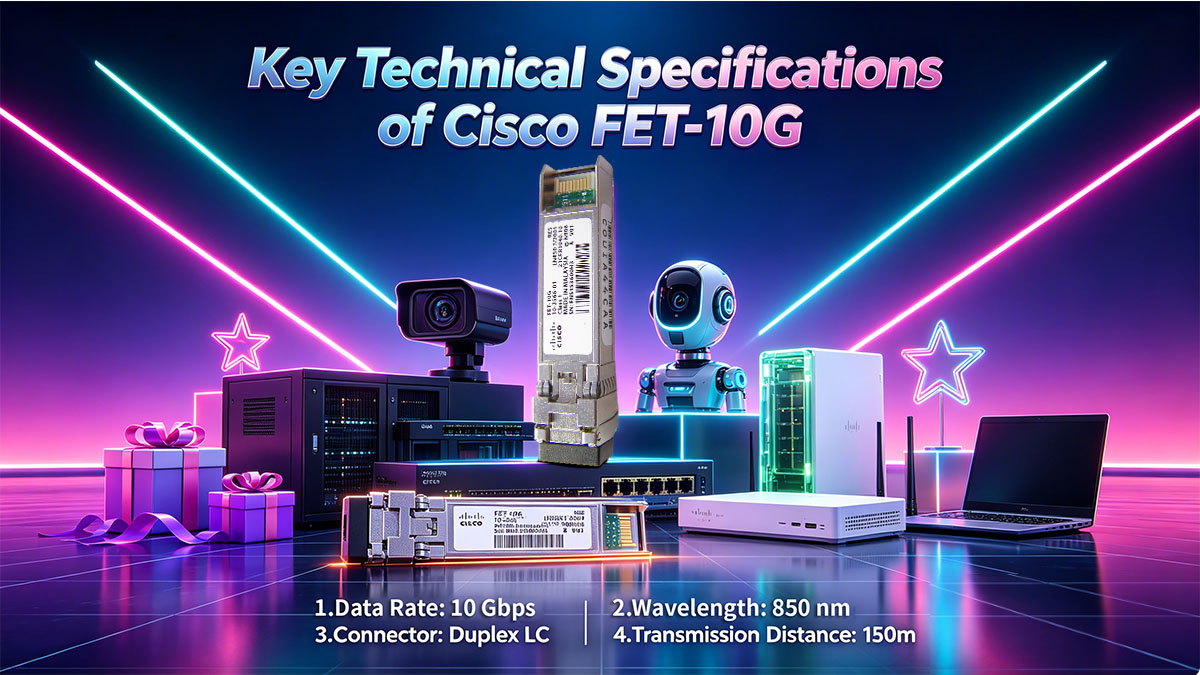
FET-10G operates at an 850nm wavelength and is designed for short-distance transmission over multimode fiber, making it suitable for intra-data center connectivity. It supports standard duplex LC interfaces and leverages widely deployed OM3 and OM4 fiber types.
| Parameter | Specification |
|---|---|
| Wavelength | 850nm |
| Max Distance | 100m (OM3), 150m (OM4) |
| Connector Type | LC duplex |
| Fiber Type | Multimode (OM3/OM4) |
These parameters indicate that FET-10G is optimized for high-density environments where short links dominate. The use of OM4 fiber allows slightly extended reach and improved signal performance, which can be beneficial in larger rack rows or aggregation zones.
In practical deployments, ensuring the correct fiber type and maintaining link distances within supported limits is essential to avoid signal degradation and link instability.
Performance Metrics
FET-10G provides a full 10Gbps data rate with stable transmission characteristics suitable for high throughput applications. Its performance is comparable to standard short-range optics at the physical layer, ensuring reliable data delivery in supported environments.
Key performance aspects include:
- Line rate of 10Gbps Ethernet
- Low latency suitable for east-west traffic flows
- Stable bit error rate (BER) within standard thresholds
- Consistent signal integrity over supported distances
These characteristics make FET-10G well-suited for latency-sensitive workloads such as virtualization traffic, storage networking, and high-frequency data exchange between servers and switches.
While the module itself does not inherently reduce latency beyond physical limitations, its optimized integration within Cisco FEX architectures contributes to predictable and consistent network performance.
Environmental and Physical Specifications
FET-10G follows the standard SFP+ form factor, allowing hot-swappable installation and efficient use of switch port density. It is designed to operate reliably within typical data center environmental conditions.
| Parameter | Specification |
|---|---|
| Form Factor | SFP+ |
| Operating Temperature | 0°C to 70°C |
| Power Consumption | < 1W |
| Installation | Hot-swappable |
These specifications ensure that FET-10G can be deployed without special cooling or power considerations, making it suitable for large-scale, high-density environments.
From an operational perspective, low power consumption contributes to overall energy efficiency, while the hot-swappable design simplifies maintenance and reduces downtime during upgrades or replacements.
? FET-10G vs Standard 10GBASE-SR Modules
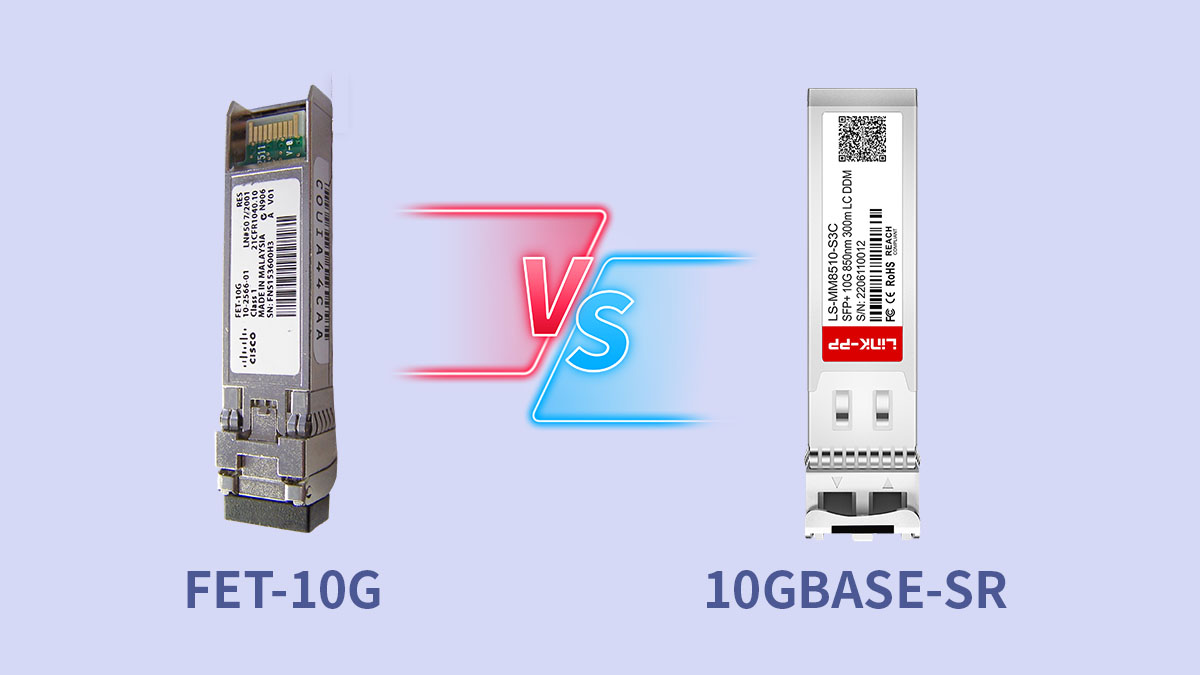
FET-10G and standard 10GBASE-SR modules (like SFP-10G-SR) offer similar physical-layer performance, but they are designed for fundamentally different use cases. FET-10G is optimized for Cisco FEX architectures with restricted compatibility, while 10GBASE-SR provides broader interoperability across multi-vendor environments. Choosing between them depends primarily on deployment architecture rather than raw performance.
Functional Differences
The core difference lies in how each module is designed to operate within a network. FET-10G is tailored for fabric-based extensions, whereas 10GBASE-SR follows open Ethernet standards for general-purpose connectivity.
| Aspect | FET-10G | 10GBASE-SR |
|---|---|---|
| Primary Use | FEX connectivity | General Ethernet links |
| Standardization | Cisco-specific | IEEE 802.3ae compliant |
| Device Recognition | Platform-restricted | Widely supported |
| Interoperability | Limited | Multi-vendor |
This means that FET-10G operates seamlessly within supported Cisco systems but may not even be recognized in non-FEX ports, whereas SR modules are universally deployable across switches, servers, and network devices.
In environments where flexibility and cross-platform compatibility are required, SR modules are typically the default choice. In contrast, FET-10G excels in tightly controlled Cisco deployments.
Cost and Efficiency Considerations
FET-10G is generally positioned as a cost-efficient option within Cisco ecosystems, particularly when used at scale in FEX-based architectures. Its design eliminates unnecessary features required for broader compatibility, allowing for streamlined deployment.
Key considerations include:
- Lower per-link cost in FEX deployments
- Reduced overhead due to simplified architecture
- Optimized resource utilization in high-density environments
- Potential cost savings when deploying large numbers of short links
However, these efficiencies are context-dependent. If the network includes mixed vendors or requires flexible connectivity, the cost advantage may diminish due to compatibility limitations.
Ultimately, FET-10G provides economic benefits when used exactly as intended, but may introduce indirect costs if used outside its optimal scope.
Deployment Flexibility Comparison
Deployment flexibility is where the distinction between FET-10G and 10GBASE-SR becomes most evident. FET-10G is purpose-built and constrained, while SR modules are adaptable across a wide range of scenarios.
- FET-10G is limited to specific Cisco Nexus and FEX combinations
- 10GBASE-SR supports switches, NICs, and devices from multiple vendors
- FET-10G is ideal for homogeneous, pre-validated environments
- SR modules are better suited for heterogeneous or evolving networks
These differences influence long-term network design decisions. For example, organizations planning future expansion or vendor diversification often prefer SR modules to avoid lock-in.
In contrast, networks that are fully standardized on Cisco infrastructure can leverage FET-10G to achieve a more streamlined and cost-effective deployment model.
? Cabling and Infrastructure Requirements
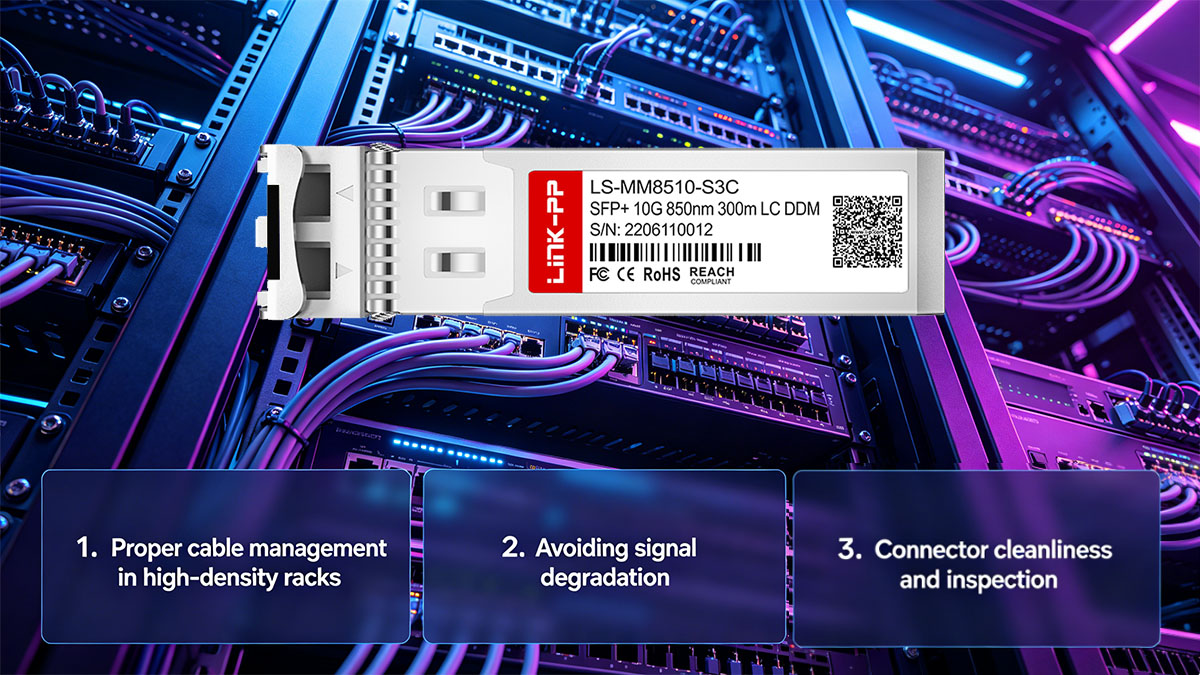
FET-10G relies on multimode fiber infrastructure and short-reach optical design, meaning proper cabling selection and installation practices are essential for stable performance. While its requirements are similar to 10GBASE-SR, ensuring alignment with distance limits, fiber type, and physical conditions directly impacts link reliability.
Supported Fiber Types
FET-10G is designed to operate over OM3 and OM4 multimode fiber, with each type offering different performance characteristics in terms of reach and signal quality. Selecting the appropriate fiber type is critical for maintaining stable links within supported distances.
| Fiber Type | Maximum Distance | Core Size | Typical Use Case |
|---|---|---|---|
| OM3 | 100m | 50µm | Standard data center links |
| OM4 | 150m | 50µm | Extended short-reach links |
OM4 fiber provides better modal bandwidth, allowing longer transmission distances and improved signal integrity compared to OM3. In environments where rack spacing is wider or cable routing paths are less direct, OM4 can offer additional margin and reliability.
In practice, most modern data centers deploy OM4 as a baseline to future-proof infrastructure, although OM3 remains sufficient for shorter, well-contained links.
Cabling Best Practices
Maintaining signal quality in FET-10G deployments depends heavily on proper cable handling and installation. Even when specifications are met, poor physical practices can lead to performance degradation or link failure.
Key best practices include:
- Maintain proper bend radius to avoid signal attenuation
- Keep connectors clean to prevent insertion loss
- Use high-quality patch cords and consistent fiber types
- Label and organize cables to reduce human error
- Avoid excessive patch panel transitions where possible
These practices help preserve optical signal integrity and reduce the likelihood of intermittent connectivity issues, which are often difficult to diagnose in high-density environments.
Consistent cabling standards across racks and rows also simplify troubleshooting and improve long-term maintainability.
Compatibility with Existing Infrastructure
FET-10G can be integrated into existing multimode fiber infrastructure, but compatibility must be carefully validated to ensure optimal performance. While the physical layer may align with standard SR optics, architectural constraints still apply.
| Factor | Consideration |
|---|---|
| Existing Fiber Type | Must be OM3 or OM4 |
| Connector Interface | LC duplex required |
| Patch Panels | Should support low-loss connections |
| Legacy Cabling | May limit achievable distance |
When upgrading from older optical modules, it is important to verify that the installed cabling meets current performance standards. Legacy fiber with higher attenuation or poor termination quality can reduce effective link distance or introduce instability.
Additionally, testing and validation should be performed before full deployment, including optical power checks and link verification, to ensure that the infrastructure can support consistent FET-10G operation.
Overall, successful FET-10G deployment depends not only on the transceiver itself but also on the quality and suitability of the underlying cabling system.
? Advantages and Limitations of FET-10G
FET-10G offers clear benefits in cost efficiency and architectural simplicity when deployed within Cisco FEX environments, but these advantages come with trade-offs in flexibility and interoperability. Understanding both sides is essential for making informed deployment decisions.

Key Advantages
FET-10G is particularly effective in scenarios where the network architecture is standardized around Cisco Nexus switches and Fabric Extenders. Its design aligns closely with these environments, enabling efficient and predictable performance.
The main advantages include:
- Lower cost compared to standard 10GBASE-SR modules in FEX deployments
- Optimized for high-density, short-reach connections
- Simplified configuration within Cisco-managed environments
- Reduced power consumption supporting energy-efficient operations
- Consistent performance due to platform-specific validation
These strengths make FET-10G especially suitable for large-scale data centers where thousands of short-distance links are required and cost control is a priority.
In such environments, the combination of reduced hardware cost and operational simplicity can significantly improve overall deployment efficiency.
Known Limitations
Despite its advantages, FET-10G introduces several limitations that can affect its usability in broader networking scenarios. These constraints are primarily related to its specialized design and restricted compatibility.
| Limitation Area | Description | Impact |
|---|---|---|
| Interoperability | Limited to specific Cisco platforms | Cannot be used in mixed networks |
| Vendor Dependency | Requires Cisco Nexus and FEX support | Reduced flexibility |
| Port Compatibility | Not recognized in standard SFP+ ports | Deployment constraints |
| Scalability Scope | Limited outside FEX architectures | Restricted future expansion |
These limitations mean that FET-10G is not suitable for environments that require cross-vendor compatibility or flexible network evolution.
In particular, organizations planning to diversify hardware vendors or adopt more open architectures may encounter challenges when relying heavily on FET-10G.
When to Choose FET-10G
FET-10G is the right choice when the deployment environment aligns with its intended design and constraints. Selecting it in the wrong context can lead to compatibility issues and reduced long-term flexibility.
It is best suited for the following scenarios:
- Fully Cisco-based data center environments
- Deployments using Nexus switches with Fabric Extenders
- High-density short-reach connectivity within racks or adjacent racks
- Projects with strict cost optimization requirements for large-scale links
However, alternative modules such as 10GBASE-SR are preferable when:
- Multi-vendor interoperability is required
- Network expansion plans are uncertain or evolving
- Links need to connect to servers, NICs, or non-FEX devices
- Greater flexibility and standard compliance are priorities
By evaluating these conditions, network designers can determine whether FET-10G aligns with both current requirements and future scalability goals.
In summary, FET-10G is a highly efficient solution within its intended scope, but its value depends entirely on deploying it in the right architectural context.
? Deployment Best Practices for Stable Performance
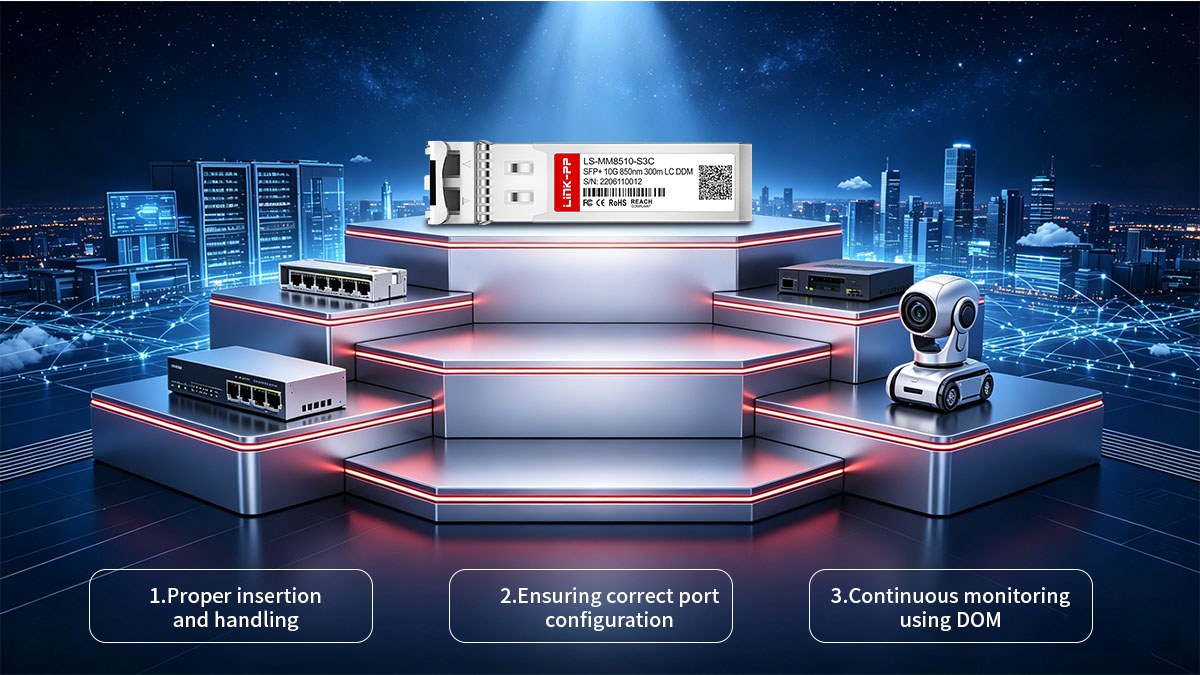
Achieving stable performance with FET-10G depends on proper installation, correct configuration, and continuous validation of both optical and network conditions. While the module itself is straightforward, inconsistencies in handling or setup can lead to link instability or reduced performance.
Installation Guidelines
Proper installation ensures that FET-10G modules function reliably from the start. Most issues observed in production environments originate from physical handling errors or incomplete validation during deployment.
Key installation practices include:
- Insert the module firmly into the SFP+ port until fully seated
- Verify that the module is supported on the target Cisco platform
- Avoid touching optical connectors to prevent contamination
- Use dust caps when ports are not in use
- Follow ESD protection procedures during handling
These steps help prevent immediate link failures and reduce the risk of latent issues caused by poor physical conditions.
After installation, it is important to confirm that the device correctly recognizes the module before proceeding with further configuration.
Network Configuration Tips
Correct configuration at the switch level is essential to ensure that FET-10G links operate as expected. Even when the physical layer is properly installed, misconfiguration can prevent link establishment.
| Configuration Item | Recommendation |
|---|---|
| Port Mode | Ensure compatibility with FEX uplinks |
| Speed Settings | Fixed at 10Gbps (no auto-negotiation) |
| Firmware Version | Match supported Cisco software releases |
| Interface Status | Verify link is administratively up |
Ensuring that firmware and platform software versions support FET-10G is particularly important, as unsupported combinations may result in the module not being recognized.
In addition, consistent configuration templates across devices can reduce deployment errors in large-scale environments.
Testing and Validation
Post-deployment validation is necessary to confirm that the link performs within expected parameters. Without proper testing, issues such as marginal signal quality or intermittent errors may go unnoticed.
Recommended validation steps include:
- Measure optical transmit and receive power levels
- Verify link stability over time under normal traffic load
- Check for errors such as CRC or packet drops
- Use Digital Optical Monitoring (DOM) data where available
- Perform end-to-end connectivity tests between devices
These validation steps provide insight into both immediate functionality and long-term reliability.
Ongoing monitoring should also be implemented to detect gradual degradation caused by factors such as fiber wear, contamination, or environmental changes.
Overall, stable FET-10G performance is achieved through a combination of careful installation, accurate configuration, and continuous operational monitoring.
? Common Issues and Troubleshooting
FET-10G issues typically stem from compatibility mismatches, cabling problems, or environmental factors rather than inherent hardware defects. Identifying the root cause requires a structured approach that examines physical connections, device support, and real-time diagnostics.
Link Establishment Failures
When a link fails to come up, the most common cause is incompatibility between the FET-10G module and the device or port configuration. Unlike standard optics, FET-10G requires specific platform support, making validation critical.
Typical causes of link establishment failure include:
- Unsupported switch or FEX platform
- Incorrect port type (non-FEX or unsupported interface)
- Mismatched or incorrect fiber cabling
- Disabled or misconfigured network interface
- Firmware or software version incompatibility
To resolve these issues, a systematic validation process is required.
- Confirm that both devices support FET-10G
- Verify that the port is configured for the correct role
- Check that the fiber type and connectors match specifications
- Ensure both ends of the link are properly connected
- Review system logs for hardware or compatibility errors
Following these steps helps isolate whether the issue is related to hardware, configuration, or platform limitations.
Performance Degradation
If the link is established but performance is inconsistent, the issue is often related to signal quality or environmental conditions rather than configuration.
| Issue Source | Description | Typical Impact |
|---|---|---|
| Dirty Connectors | Dust or contamination on fiber ends | Increased attenuation |
| Fiber Bending | Excessive bend radius | Signal loss or instability |
| Cable Quality | Low-grade or damaged fiber | Higher error rates |
| Temperature | Elevated operating conditions | Reduced module stability |
These factors can introduce subtle issues such as intermittent packet loss, increased latency, or degraded throughput.
Regular inspection and maintenance of fiber infrastructure are essential to maintaining consistent performance, especially in high-density deployments.
Diagnostic Methods
Effective troubleshooting relies on using available diagnostic tools to gather accurate data about link conditions and module behavior.
Key diagnostic methods include:
- Checking interface status and error counters via CLI
- Monitoring optical power levels (Tx/Rx)
- Reviewing Digital Optical Monitoring (DOM) data
- Analyzing system logs for hardware or compatibility alerts
- Performing loopback or isolation tests to pinpoint faults
These tools provide visibility into both physical and logical layers, enabling faster identification of root causes.
In practice, combining multiple diagnostic methods yields the most reliable results. For example, correlating DOM readings with error counters can help distinguish between physical signal issues and configuration-related problems.
Overall, troubleshooting FET-10G requires a methodical approach that prioritizes compatibility verification, physical inspection, and data-driven diagnostics.
? Future Outlook of FET-Based Connectivity
FET-10G and similar fabric extender transceiver modules occupy a niche role in modern data centers, optimized for short-reach connectivity within Cisco FEX architectures. While their current use cases are clear, understanding future trends is essential for planning network evolution and infrastructure investment.

Evolution of Data Center Architectures
As data centers move toward higher-speed networking and software-defined environments, FET-based modules are positioned to remain relevant in specific scenarios but may face competition from newer technologies.
Key trends include:
- Gradual migration from 10G to 25G or 100G in aggregation and spine layers
- Continued use of FET-10G for intra-rack and short inter-rack links where 10G is sufficient
- Adoption of modular architectures that separate high-speed backbone from cost-efficient access layers
While 10G links may eventually be replaced by faster standards in some environments, FET-based optics will continue to provide cost-effective solutions for access-layer connectivity, especially in homogeneous Cisco deployments.
Role of Specialized Transceivers
FET-10G illustrates the advantages of purpose-built optics: efficiency, predictable performance, and simplified deployment. In the future, such specialized modules may coexist with more universal solutions to optimize cost and operational complexity.
Considerations for future use include:
- Niche optimization versus universal interoperability
- Integration with software-defined networking (SDN) and automated provisioning
- Potential for new FET variants to support evolving Cisco switch and FEX platforms
By leveraging specialized transceivers where appropriate, data center operators can balance high performance with cost efficiency while maintaining predictable behavior across large-scale deployments.
Long-Term Viability
The long-term relevance of FET-based connectivity depends on balancing performance needs with network evolution. Organizations should consider both current and anticipated requirements when planning deployments.
Factors influencing viability include:
- Scalability: FET-10G remains effective for high-density, short-distance links but may require replacement in spine or core upgrades
- Vendor dependency: Continued reliance on Cisco-only platforms may limit flexibility as networks diversify
- Migration strategies: Planning for future adoption of 25G/100G optics in aggregation layers while maintaining FET-10G for access links
In summary, FET-10G is likely to remain a practical solution for the foreseeable future within its intended scope. Its efficiency and integration advantages make it a valuable tool in Cisco-centric data centers, while awareness of evolving network standards ensures that long-term planning can accommodate future upgrades and architectural shifts.
? Conclusion
FET-10G provides a purpose-built solution for short-reach, high-density connectivity within Cisco data center environments. Its design offers cost efficiency, simplified deployment, and predictable performance when used with Nexus switches and Fabric Extenders. At the same time, its specialized nature introduces limitations in interoperability and flexibility, making careful planning essential for optimal deployment.
Understanding FET-10G’s technical specifications, cabling requirements, performance characteristics, and troubleshooting considerations allows network architects to make informed decisions about where and how to deploy these modules effectively. By aligning deployment with the right infrastructure and operational practices, organizations can maximize both performance and cost savings.
For organizations looking to integrate FET-10G into their Cisco networks or explore compatible alternatives, more detailed technical resources and modules are available at the LINK-PP Official Store. This ensures reliable, high-performance connectivity while supporting efficient and scalable data center architectures.