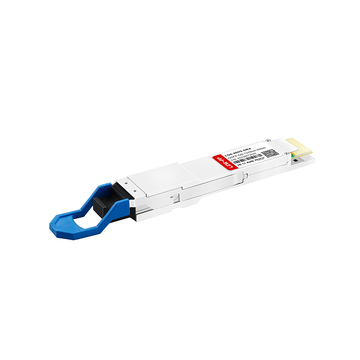
As data centers and telecom networks continue to expand, the demand for compact, high-density connectivity has never been greater. Traditional Small Form-factor Pluggable (SFP) modules have served reliably for years, but the rapid growth of cloud computing, AI workloads, and edge systems now requires more efficient use of physical space and improved port scalability. The compact SFP (CSFP) form factor emerges as a solution tailored to these evolving needs — offering a reduced footprint while maintaining compliance with industry standards and delivering performance comparable to standard SFP modules.
The CSFP design represents a significant step forward in optical transceiver miniaturization. By doubling port density within the same physical area, it enables network architects to optimize rack space, streamline front-panel configurations, and lower overall infrastructure costs. As networking environments move toward high bandwidth, large-scale deployments, understanding the CSFP form factor becomes essential for implementing next-generation architectures that balance compactness, efficiency, and signal integrity in modern optical systems.
♠️ Understanding Compact SFP (CSFP) Form Factor in Modern Optical Design
The compact SFP (CSFP) form factor redefines optical transceiver design by enabling higher port density in space-limited environments like data centers and edge networks. It builds on the proven SFP standard but shrinks dimensions to support bi-directional (BiDi) operations in a single module.
Definition of Form Factor in Optical Transceivers
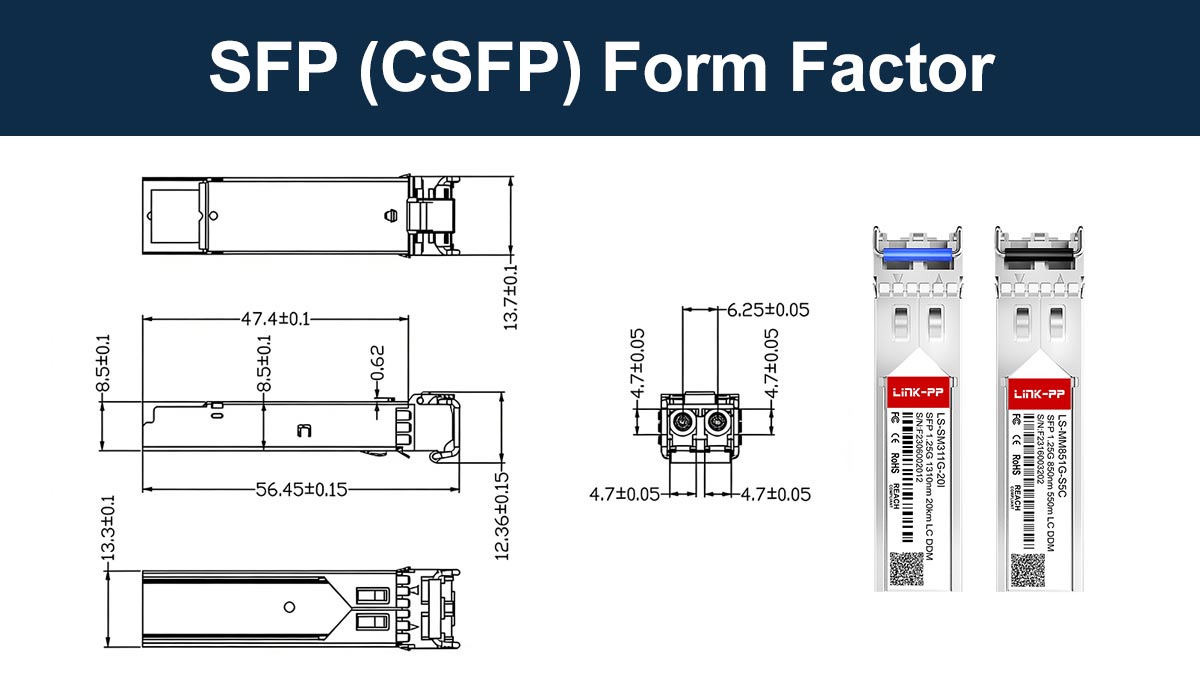
In optical transceivers, "form factor" refers to the standardized physical size, shape, and interface of a pluggable module, ensuring compatibility with host systems like switches and routers. It dictates how modules mount into cages on device faceplates, balancing portability, hot-swappability, and performance. CSFP form factor specifically optimizes this for duplex applications, housing two optical channels in one compact unit.
How Compact SFP Form Factor Differs from Standard SFP
Compact SFP (CSFP) modules are designed to improve port density compared to standard SFP transceivers, though their physical footprint depends on the specific type. Single-channel compact fiber optic SFP module occupy about half the volume of a standard SFP, while dual-channel CSFP modules fit into the same mechanical dimensions as a standard SFP but support two independent bidirectional channels within a single housing. In contrast, standard SFP modules typically support only one channel per module.
CSFP modules maintain the same electrical interface and are mechanically compatible with standard SFP cages, enabling drop-in replacement in many high-density switches, routers, and aggregation devices. However, their optical performance is generally limited to lower speeds (e.g., 1Gbps and below); for higher data rates, other form factors such as SFP+, SFP28, QSFP+, QSFP28, or QSFP-DD are more suitable. CSFP modules are also optimized for power efficiency and thermal management, making them ideal for applications requiring maximum port density in a given rack space.
Key Physical and Electrical Specifications
The key specifications of compact SFP modules focus on dimensions, power, and signal performance, balancing miniaturization with reliability. Unlike standard SFPs, CSFPs require careful attention to voltage regulation, thermal dissipation, and pin assignments to support multi-channel operation without degradation.
The following table summarizes typical physical and electrical parameters for modern CSFP modules:
| Specification | Typical Value | Notes |
| Dimensions (L × W × H) | 13.4mm x 56.5mm x 8.5mm | Same mechanical dimension as standard SFP |
| Channel Count | 2 | Multi-channel integration for higher density |
| Power Consumption | 1.0 - 1.5W per channel | Optimized for thermal efficiency |
| Operating Voltage | 3.3V | Common for host compatibility |
| Data Rate per Channel | 1Gbps | Supports multiple Ethernet, SONET/SDH standards |
| Connector Type | LC duplex (single-fiber BiDi) | High-density optical interface |
Industry Standards and Compliance
Compact SFP (CSFP) transceiver modules adhere to a variety of industry standards, including the Multi-Source Agreement (MSA) specifications, IEEE Ethernet standards, and ITU-T optical interface guidelines. Compliance ensures interoperability across vendors, consistent signal quality, and reliable operation in diverse deployment scenarios. Manufacturers often follow additional safety and electromagnetic compatibility (EMC) certifications to meet regulatory requirements in different regions.
♠️ Evolution of Compact SFP (CSFP) Form Factor for High-Density Networking
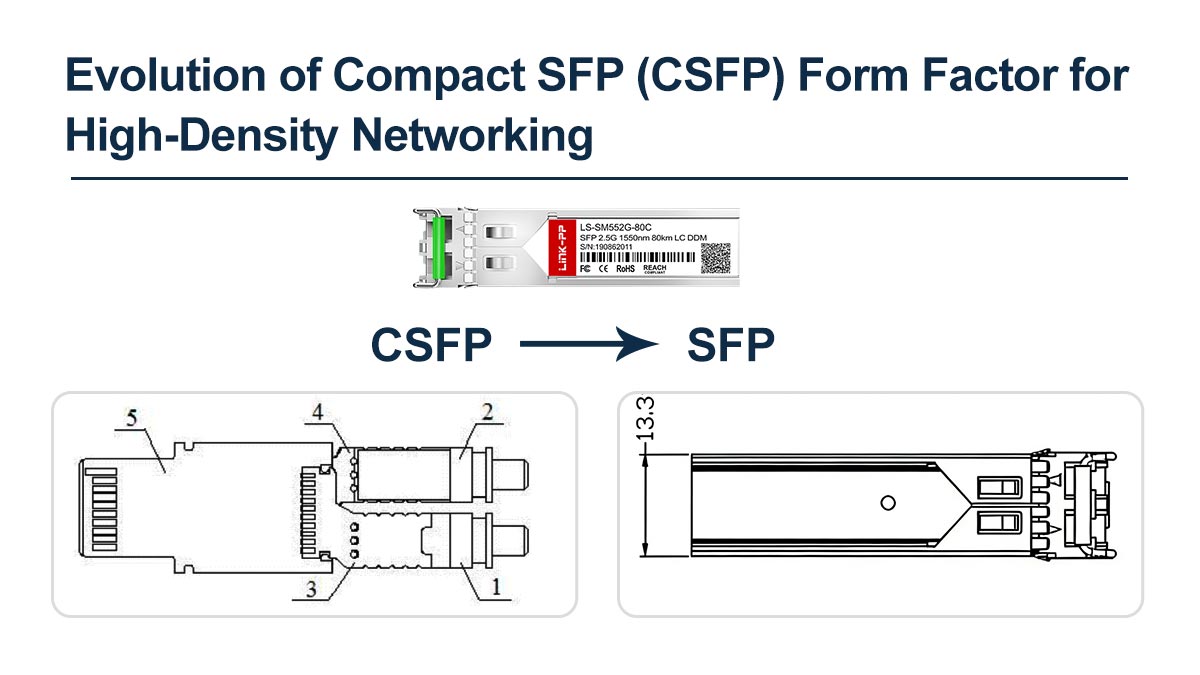
The compact SFP (CSFP) form factor has evolved to meet the increasing demands of high-density networking environments. Driven by the need for smaller module footprints, higher port counts, and efficient thermal management, CSFP has become a key enabler for modern data center and telecom architectures.
Limitations of Traditional SFP Modules
Traditional SFP modules were originally designed for moderate port densities and single-channel applications. As network speeds increased and bandwidth demands grew, these modules became constrained by their physical size and limited multi-channel capabilities, which restricted scalability in high-density switches and routers.
Additionally, standard fiber SFP modules often present challenges in thermal management and power consumption, especially when deployed in densely packed racks. The lack of integrated multi-channel designs meant that achieving higher interface density required more complex and space-consuming hardware layouts, limiting overall efficiency.
Drivers Behind Miniaturization Trends
The push for miniaturization in optical transceivers is largely fueled by the exponential growth in data traffic and the shift toward high-speed networking standards. Reducing module size allows network equipment manufacturers to fit more ports into the same rack space, directly supporting the scalability of modern data centers.
Moreover, advances in semiconductor technology and optical packaging have enabled more compact transceiver designs without compromising performance. Innovations in materials, integration techniques, and power efficiency further support the trend toward smaller, high-performance modules suitable for dense deployment scenarios.
Transition Toward Compact and Dense Interfaces
The transition from traditional SFP modules to compact SFP modules involves rethinking the interface design to accommodate multiple channels within a single module. This shift not only increases port density but also simplifies cabling and reduces the footprint on host boards, enabling more streamlined network topologies.
Compact and dense interfaces also facilitate modularity and hot-swappability, which are critical for operational flexibility in large-scale network deployments. By standardizing multi-channel CSFP designs, manufacturers can provide interoperable solutions that maintain signal integrity and meet stringent industry specifications.
Influence of Data Center Growth on Form Factor Design
Rapid expansion of data centers and cloud infrastructure has created a direct demand for smaller, higher-density optical modules. To maximize usable rack space, network designers increasingly rely on compact SFP modules that offer multiple channels per slot, thereby supporting higher aggregate bandwidth within the same physical footprint.
This growth has also driven the need for robust thermal management, low-power operation, and simplified maintenance. As a result, CSFP form factors are designed not only for compactness but also for reliability and efficiency in large-scale, mission-critical environments where uptime and scalability are essential.
♠️ Structural Advantages of Compact SFP (CSFP) in Space-Constrained Systems
Compact SFP (CSFP) modules offer structural advantages that are critical for network devices in space-limited environments. By minimizing module size while maintaining performance, CSFP optical modules enable higher port density, more efficient front-panel layouts, and improved scalability for racks and chassis.
Multi-Channel and Port Density Optimization
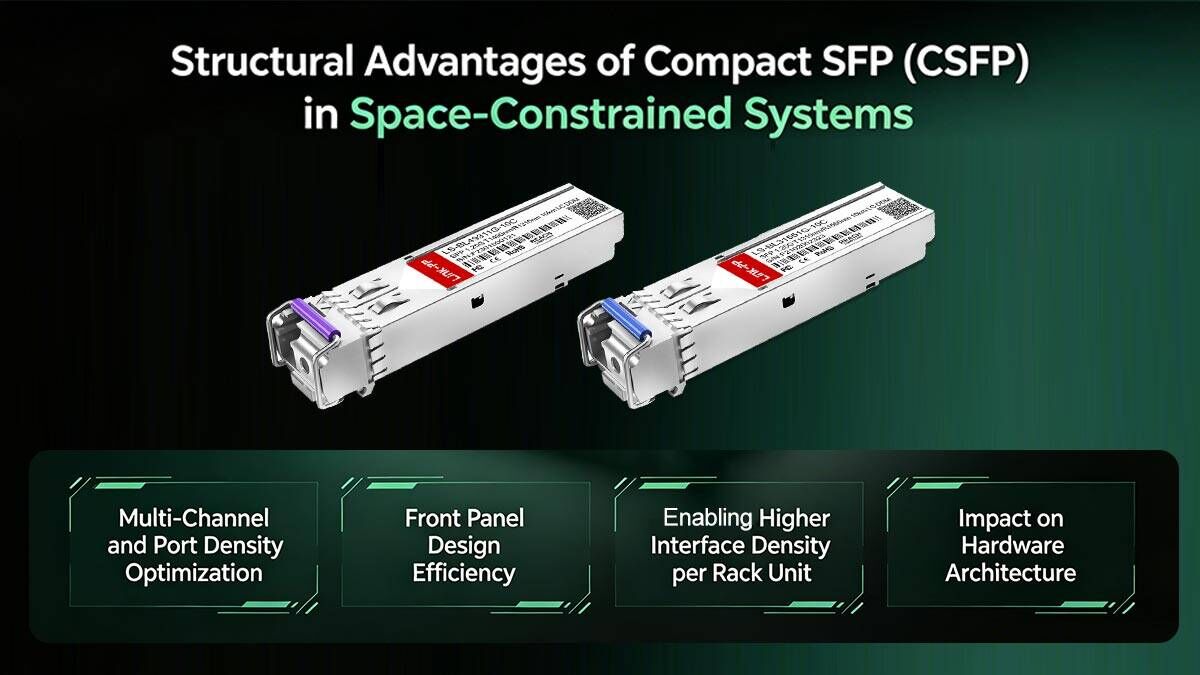
Although compact SFP modules have the same physical dimensions as standard SFP transceivers, they offer significant advantages in port density by integrating multiple channels within a single module. This multi-channel design allows network devices to achieve higher aggregate bandwidth without increasing the number of physical slots, effectively optimizing the use of panel space. As a result, operators can scale network capacity while maintaining the same chassis size.
The structural benefits of this approach include:
- Multi-Channel Operation: Each CSFP module can support 2 channels, reducing the total number of modules required for high-density deployments.
- Efficient Panel Layouts: With fewer modules needed to achieve the same bandwidth, front panels remain less cluttered and more accessible for cabling and maintenance.
- Scalable Bandwidth: Network designers can increase throughput without expanding the chassis footprint, enabling more efficient use of existing rack space.
By leveraging multi-channel integration rather than a smaller size, CSFP modules optimize port density while maintaining compatibility with standard SFP slots and infrastructure.
Front Panel Design Efficiency
Efficient front-panel design is critical for simplifying network operations and improving maintainability. Compact SFP modules, with their multi-channel capability, reduce the total number of modules needed for a given bandwidth, which allows for cleaner cable routing and easier access to individual ports. This organization helps network engineers manage connections more effectively and reduces the likelihood of errors during installation or maintenance.
The practical advantages for front-panel operations include:
- Simplified Cable Management: Fewer modules with multiple channels reduce cable clutter and make it easier to trace and organize connections.
- Improved Accessibility: Clear port separation and logical organization facilitate quick insertion, removal, or troubleshooting of modules.
- Enhanced Operational Workflow: Consistent module placement and labeling support faster deployment and reduce human error in high-density environments.
Enabling Higher Interface Density per Rack Unit
By supporting more ports per rack unit (RU), CSFP optical modules enable network architects to achieve higher aggregate bandwidth without expanding physical footprint. This is particularly valuable in high-capacity switches and aggregation devices, where maximizing data throughput per RU is a priority. The compact design also allows for future scaling, making it easier to add additional ports as network demands grow.
The following points highlight how this translates into practical advantages:
- Increased Aggregate Bandwidth: More modules per RU means higher total data capacity.
- Scalable Deployments: Higher density simplifies network expansion without requiring additional racks.
- Cost Efficiency: Concentrating more ports in fewer racks reduces capital, power, and cooling costs.
Impact on Hardware Architecture
CSFP transceiver modules influence hardware architecture by enabling more efficient multi-channel signal routing and simplified system integration. With multiple channels consolidated into a single module, PCB layouts can be designed to optimize signal paths, reduce complexity, and maintain high-speed signal integrity. This allows for more predictable performance in high-density networking devices, particularly in switches and aggregation equipment.
The architectural benefits include:
- Optimized Signal Routing: Multi-channel CSFP modules simplify internal connections and reduce the number of discrete trace routes, improving signal integrity and minimizing latency.
- Enhanced System Integration: Fewer individual modules mean easier integration with power management, monitoring, and diagnostic systems.
- Functional Flexibility: Consolidated channels allow designers to implement advanced network features such as port aggregation, redundancy, and dynamic bandwidth allocation without additional hardware complexity.
♠️ Compact SFP (CSFP) Form Factor and Thermal Management Challenges
As network devices grow denser and incorporate multi-channel compact SFP modules, managing heat generation becomes a critical concern. Effective thermal management is essential to ensure consistent performance, prevent overheating, and maintain the reliability of high-density optical deployments.

Heat Dissipation in High-Density Deployments
High-density deployments, where multiple compact SFP modules operate simultaneously, generate significant heat that can impact both the module and surrounding components. Efficient heat dissipation strategies are required to maintain optimal operating temperatures and avoid thermal throttling or component degradation.
Designers often employ thermal simulation tools to predict hotspots and optimize the placement of modules and heat-sensitive components. Heat sinks, thermal pads, and other conductive pathways are used within the module or host chassis to facilitate passive or active heat transfer and maintain safe operating conditions.
Airflow Design Considerations
Proper airflow is essential to carry heat away from densely populated optical modules. Network equipment must be designed to ensure sufficient airflow through chassis vents, fans, and cooling channels without causing turbulence that could interfere with optical signal stability.
In addition, airflow management often involves directing air along predictable paths, optimizing fan placement, and controlling pressure differentials within racks. By carefully designing airflow, engineers can maintain consistent cooling for each module, ensuring long-term reliability in high-density systems.
♠️ Electrical and Signal Integrity in Compact SFP (CSFP) Form Factor Designs
As data rates rise and multi-channel designs become increasingly common in CSFP modules, ensuring electrical performance and signal integrity is of paramount importance. In dense networking environments, maintaining reliable performance hinges on the proper management of high-speed signals, electromagnetic interference, and PCB layout.

High-Speed Signal Transmission Constraints
Compact SFP modules operate in the high-frequency domain where signal attenuation, reflection, and inter-symbol interference can degrade link quality. Compact layouts shorten path lengths but can intensify coupling between adjacent circuits. To overcome these limits, designers use controlled impedance PCB traces and differential signaling to keep the transmission balanced and stable. Precise matching of line parameters ensures minimal jitter and meets the eye mask requirements defined by SFF and IEEE standards for SFP 1G transmission.
EMI and Crosstalk Mitigation
Electromagnetic interference (EMI) and crosstalk become more prominent as transceiver density increases and spacing between lines narrows. CSFP designs implement shielding at the module level alongside optimized grounding and isolation zones within the host PCB. Using metal cages and low-loss dielectric materials helps confine electromagnetic fields while reducing leakage paths. These mitigation practices allow compact modules to co-exist without impacting bit error rate (BER) or overall signal fidelity.
PCB Layout Optimization
The PCB layout must balance electrical integrity with manufacturability. Designers apply fine-pitch routing and consistent trace geometry to maintain signal impedance while minimizing skew across differential pairs. Layer stack-up selection and via placement also influence return paths and noise coupling. By incorporating design rules for high-speed interfaces, engineers can ensure stable performance even under dense arrangements typical of CSFP cages in high-bandwidth systems.
Connector and Interface Reliability
Connector reliability in compact SFP modules is essential for maintaining consistent signal transmission and long-term operational stability. Durable contact materials, precise alignment, and controlled insertion force ensure low resistance and minimal signal loss across repeated connections. High-quality plating and spring mechanisms prevent oxidation and wear, enabling reliable performance through extensive hot-swapping and vibration conditions common in network equipment.
♠️ Compact SFP (CSFP) in Data Center High-Density Applications
Compact SFP (CSFP) modules play a crucial role in modern data centers by enabling high-density connectivity within existing SFP interfaces. Their multi-channel design allows operators to scale bandwidth efficiently while maintaining compatibility with current infrastructure. This makes CSFP a practical solution for supporting growing demands in cloud computing, AI workloads, and large-scale network architectures.
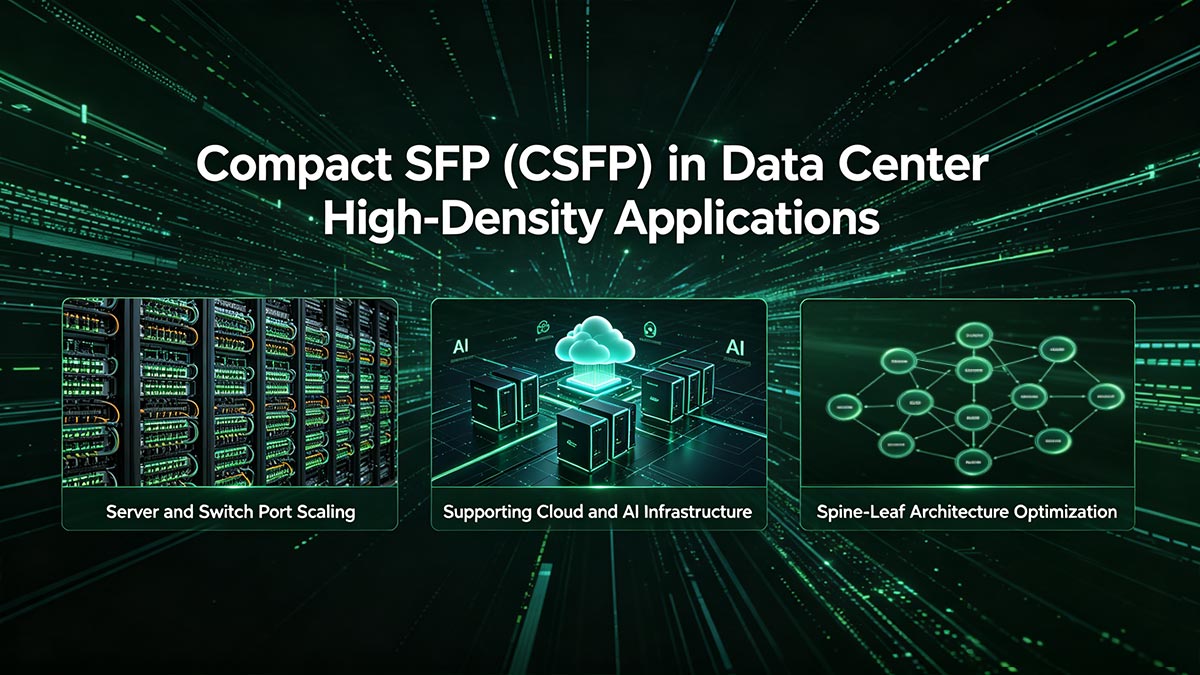
Server and Switch Port Scaling
As data centers grow, the demand for additional server and switch ports rises, and CSFP modules provide a practical solution. By offering multiple channels per module, they allow administrators to connect more devices without adding extra chassis or expanding rack units. This approach ensures network scalability while maintaining a manageable number of physical modules.
Furthermore, CSFP modules enhance operational flexibility in large deployments. Hot-swappable capability and compatibility with standard SFP slots enable incremental network expansion and simplified maintenance. Network engineers can upgrade bandwidth or replace modules without interrupting service, supporting continuous availability and high operational efficiency.
Supporting Cloud and AI Infrastructure
Cloud and AI applications require high-throughput, low-latency connections to process massive datasets efficiently. CSFP modules provide the dense, multi-channel connectivity necessary to meet these demanding requirements. Their integrated design reduces the need for multiple single-channel modules, streamlining network management and improving system reliability.
In addition to bandwidth, CSFP modules support the dynamic demands of cloud and AI workloads by maintaining signal integrity and stable operation under varying load conditions. This ensures consistent performance across large clusters of servers and storage devices, enabling data centers to meet the performance expectations of modern applications while supporting efficient resource utilization.
Spine-Leaf Architecture Optimization
Spine-leaf network architectures rely on high port density and redundant interconnections to achieve low-latency, high-throughput performance. CSFP modules support these designs by providing multiple channels per slot, reducing the number of modules needed for spine-to-leaf and leaf-to-leaf links. This approach simplifies network planning and enhances overall efficiency.
Moreover, the multi-channel capability of CSFP modules facilitates failover and load-balancing strategies within spine-leaf networks. With fewer individual modules required, cabling complexity is reduced, airflow management is improved, and network maintenance becomes more straightforward. This makes CSFP an ideal solution for dense, high-performance data center architectures.
♠️ Compact SFP (CSFP) in Telecom and Edge Network Deployments
Compact SFP modules are widely used in telecom and edge network environments, where reliable, high-density optical connectivity is essential. Their multi-channel capability and compatibility with standard SFP interfaces make them suitable for applications ranging from 5G infrastructure to metro networks and edge computing nodes.
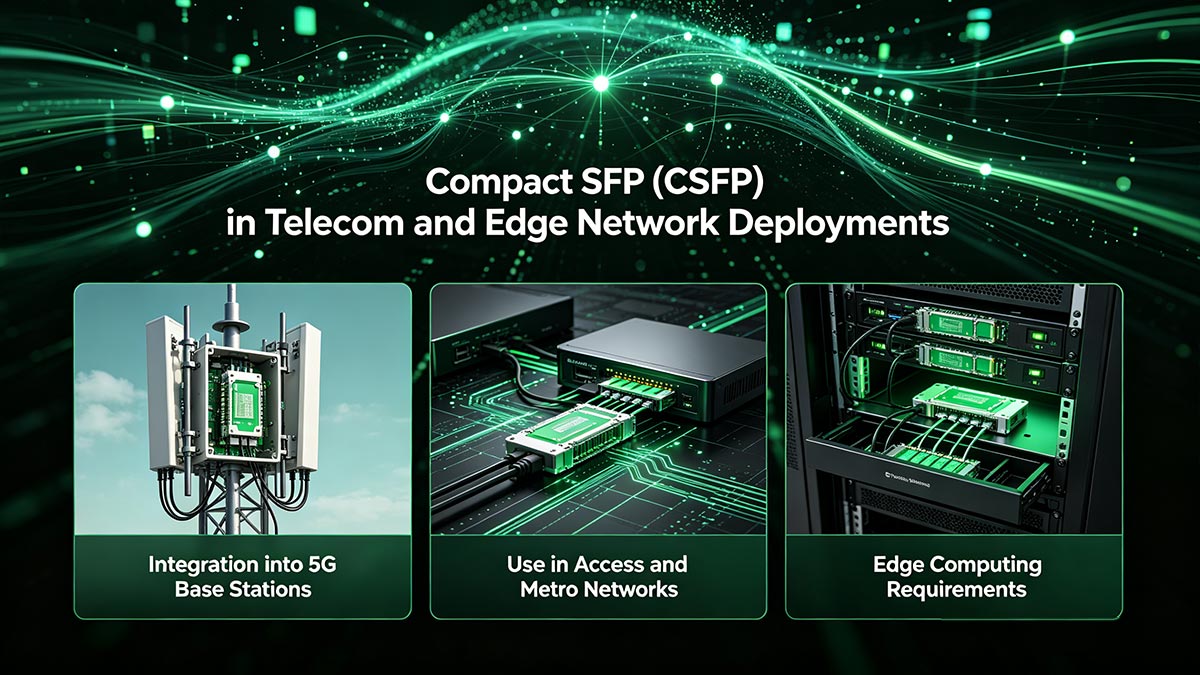
Integration into 5G Base Stations
5G networks demand high-speed, low-latency links to handle backhaul and fronthaul traffic efficiently. CSFP modules deliver multi-channel connectivity within existing SFP slots, supporting the dense fiber connections required in base station deployments. Their reliable operation ensures that high-bandwidth data streams are maintained even under heavy network loads.
Beyond connectivity, CSFP modules provide operational advantages for 5G infrastructure. Their multi-channel design reduces the number of modules and cabling required, simplifying installation and maintenance. This flexibility allows network engineers to deploy scalable 5G networks quickly while supporting redundancy and failover mechanisms.
Use in Access and Metro Networks
Access and metro networks often require scalable and reliable optical interconnects to serve multiple subscribers or network nodes. CSFP modules provide multiple channels per module, enabling operators to connect more devices without additional equipment, which simplifies network expansion and reduces costs.
Additionally, CSFP modules improve operational management in these networks. Their hot-swappable capability allows upgrades and replacements without service interruption, while signal integrity and channel reliability ensure stable performance across distributed network nodes. This combination of scalability and reliability is critical for modern access and metro deployments.
Edge Computing Requirements
Edge computing nodes typically operate in constrained environments, where high-density, reliable connectivity is crucial. CSFP modules support multiple channels in a single slot, providing high-throughput connections for edge servers and storage systems without the need for extra hardware.
These modules also ensure consistent performance under variable conditions often encountered at the edge, including fluctuating power and temperature. By maintaining signal integrity and supporting scalable deployments, CSFP modules enable efficient edge computing infrastructure that can meet increasing data processing demands.
♠️ Selecting the Right Compact SFP (CSFP) for Your Application
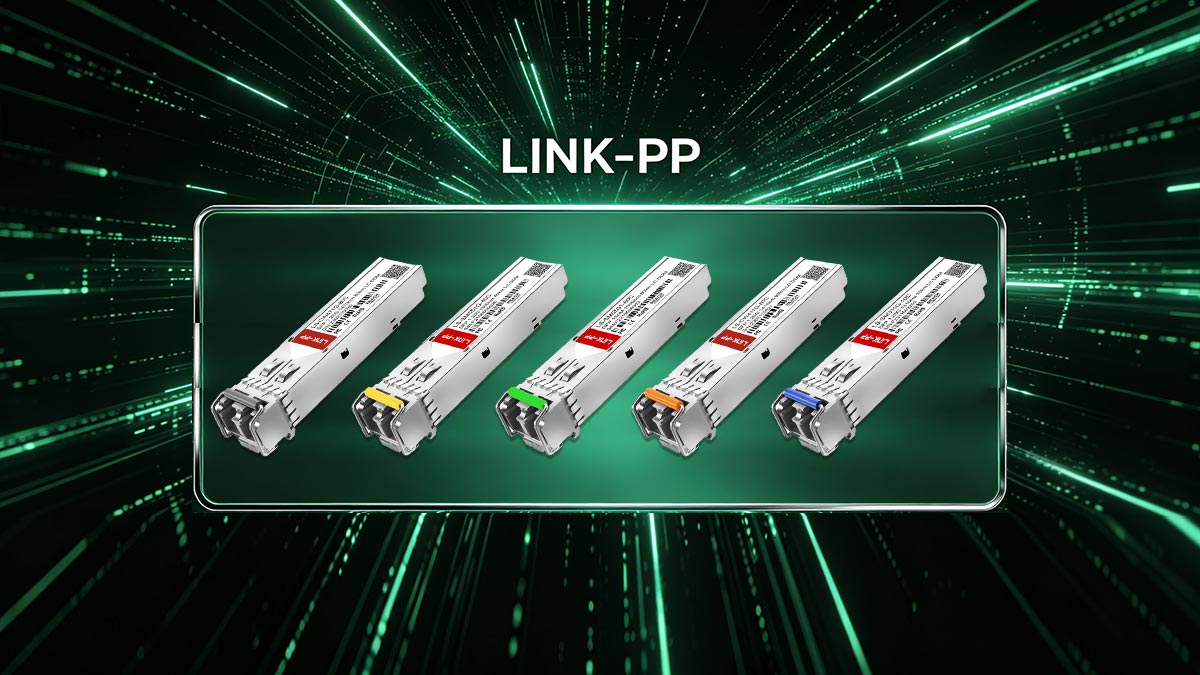
Choosing the right Compact SFP (CSFP) module is not only about matching specifications — it’s about aligning technical performance with operational goals. After understanding how CSFP form factors have evolved, their structural and thermal advantages, and their roles in data center and telecom deployments, the final step is ensuring that your selection meets the specific needs of your network environment.
When evaluating which CSFP best suits your application, consider the following key aspects:
- Interface Compatibility: Verify the form factor’s compatibility with your existing network equipment such as switches, routers, or media converters. The CSFP’s electrical interface and cage design must fit seamlessly into your current architecture.
- Data Rate and Transmission Distance: Determine whether your network demands support for 1G data rates, and ensure the CSFP module meets your required optical reach — be it short-range interconnects or long-distance metro links.
- Thermal and Power Efficiency: In high-density environments, selecting modules with optimized heat dissipation and lower power consumption ensures long-term system stability and minimizes cooling costs.
- Compliance and Reliability: Always look for modules that align with industry standards such as MSA, IEEE, and RoHS. Verified compliance helps guarantee signal integrity, interoperability, and consistent performance over time.
- Vendor Expertise and Support: Partner with a trusted manufacturer that provides not only quality products but also technical guidance and lifecycle support. This helps streamline deployment and minimizes downtime in mission-critical systems.
Ultimately, the right CSFP solution bridges technical precision with operational efficiency — powering faster data throughput, lower latency, and greater space utilization across data centers, telecom networks, and edge computing systems. If you’re looking to source reliable, standards-compliant SFP modules, explore the LINK-PP Official Store. Their wide selection of SFP transceiver solutions is engineered for performance, durability, and seamless integration into today’s high-density network architectures.