


























? What Is the Cisco GLC-TE 1000BASE-T SFP Module?
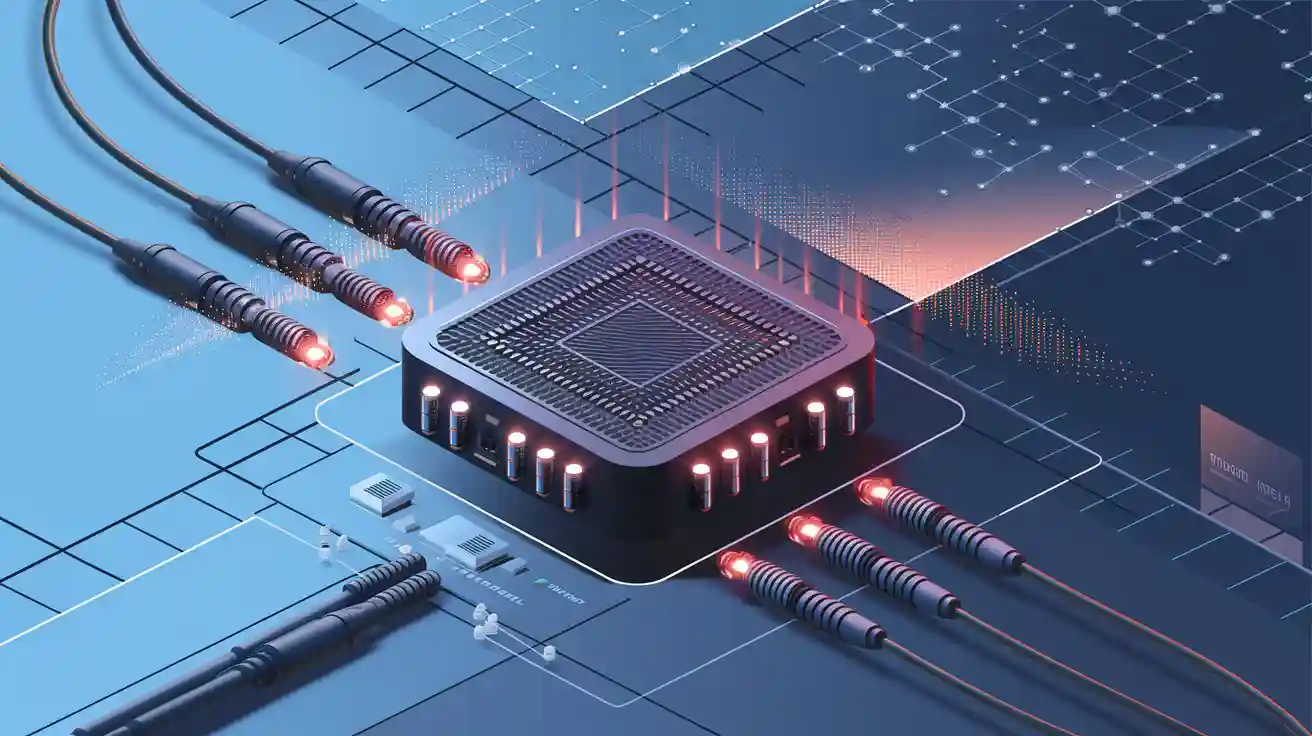
The Cisco GLC-TE is a Gigabit Ethernet copper SFP transceiver that allows network devices with SFP ports to connect to standard RJ45 Ethernet cabling. It operates according to the 1000BASE-T standard, enabling data transmission at 1Gbps over twisted-pair copper cables for distances up to 100m. This type of module is commonly used when switches or routers require flexible connectivity to copper-based network infrastructure.
Unlike optical SFP transceivers that rely on fiber optics and optical signals, the GLC-TE sfp use electrical signaling over Ethernet copper cables. This makes it suitable for short-distance network links where existing Cat5e or Cat6 cabling is already deployed. Because it uses the standard SFP form factor, the module can be easily installed, removed, or replaced without powering down the network device.

Overview of the GLC-TE Transceiver
The Cisco GLC-TE transceiver is designed to provide Gigabit Ethernet connectivity over copper infrastructure while maintaining the flexibility of modular SFP interfaces. It allows switches and routers to support RJ45 connections without requiring fixed copper ports.
| Specification | Description |
|---|---|
| Form Factor | SFP (Small Form-factor Pluggable) |
| Ethernet Standard | 1000BASE-T |
| Interface | RJ45 |
| Maximum Distance | 100m |
Because it supports the IEEE 802.3ab standard, the module can operate with typical Ethernet copper cabling used in most office and enterprise networks. This makes deployment straightforward in environments where fiber installation may not be necessary.
Key Features
The Cisco GLC-TE is designed to deliver reliable Gigabit Ethernet connectivity while maintaining compatibility with standard Ethernet cabling.
Key features include:
-
1Gbps data rate supporting Gigabit Ethernet transmission
-
RJ45 copper interface for direct connection to Ethernet cables
-
Hot-swappable SFP design, allowing installation without shutting down equipment
-
Support for Cat5e, Cat6, and Cat6a cables
-
Auto-negotiation for 10/100/1000Mbps speeds
These features make the module suitable for network environments where flexible copper connectivity is required.
Why Copper SFP Modules Are Still Important
Copper SFP modules like the Cisco GLC-TE remain widely used because they provide a practical solution for short-distance network connections where fiber optics may not be necessary.
Several factors contribute to their continued adoption:
-
Existing copper infrastructure
Many buildings already have Cat5e or Cat6 cabling installed, making copper connectivity easy to deploy. -
Lower deployment cost
Copper Ethernet cables and connectors are generally less expensive than fiber optic infrastructure. -
Simplified installation
RJ45 cables are widely familiar to network technicians and do not require specialized fiber handling tools. -
Flexible network expansion
SFP-based copper modules allow switches to support additional Ethernet ports without fixed copper interfaces.
For these reasons, modules such as the Cisco GLC-TE are commonly used in enterprise networks, campus environments, and small business deployments where Gigabit Ethernet over copper remains a practical and cost-effective solution.
? Cisco GLC-TE Specifications and Technical Details
The Cisco GLC-TE sfp is designed to deliver Gigabit Ethernet connectivity over copper cabling using the 1000BASE-T standard. Its specifications define the supported data rate, cabling type, transmission distance, and operational characteristics, which determine how the module performs in real network environments.
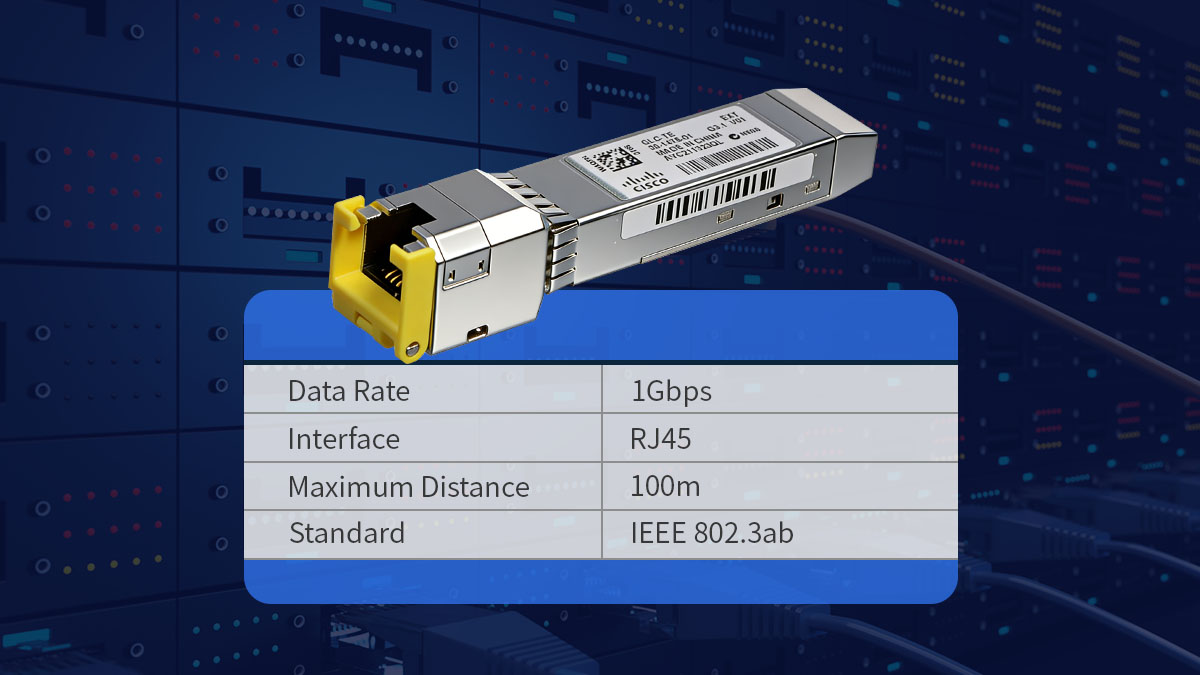
Understanding these technical details helps network administrators ensure proper deployment, compatibility with switches, and stable link performance.
Core Technical Specifications
The Cisco GLC-TE provides Gigabit Ethernet connectivity through a standard SFP interface while using RJ45 copper cabling. The following specifications summarize the key operational parameters of the module.
| Parameter | Specification |
|---|---|
| Data Rate | 1Gbps |
| Ethernet Standard | IEEE 802.3ab (1000BASE-T) |
| Interface Type | RJ45 |
| Maximum Transmission Distance | 100m |
Because the module follows the IEEE 802.3ab standard, it supports Gigabit Ethernet transmission over twisted-pair copper cabling. The 100m distance limitation is defined by the Ethernet standard and depends on proper cable quality and installation.
In typical deployments, the GLC-TE is used to connect switches, routers, and other Ethernet-enabled devices within the same wiring closet, office floor, or equipment rack.
Cabling Requirements
The Cisco GLC-TE transceiver is designed to operate with standard Ethernet twisted-pair cables, allowing it to integrate directly with existing copper infrastructure.
The supported cabling types include:
-
Cat5e – commonly used in Gigabit Ethernet networks and sufficient for most deployments
-
Cat6 – provides improved noise resistance and performance margin
-
Cat6a – supports higher bandwidth and better shielding in dense environments
| Cable Type | Maximum Distance | Typical Use |
|---|---|---|
| Cat5e | 100m | Standard office networks |
| Cat6 | 100m | Enterprise switching environments |
| Cat6a | 100m | High-density networking environments |
Although the standard allows up to 100m, actual performance can be affected by cable quality, patch panels, connectors, and electromagnetic interference. Ensuring proper cable termination and minimizing signal loss can help maintain stable Gigabit links.
Power Consumption and Hardware Design
Copper SFP modules generally consume more power than optical transceivers because they must perform electrical signal processing for Ethernet over twisted-pair cables. The Cisco GLC-TE includes internal circuitry that handles signal encoding, equalization, and auto-negotiation.
Typical hardware characteristics include:
-
Integrated PHY chip supporting 10/100/1000Mbps Ethernet signaling
-
Auto-negotiation support for speed and duplex configuration
-
Hot-swappable SFP interface allowing installation without shutting down the device
-
Digital diagnostics support on some platforms
Compared with optical modules such as 1000BASE-SX or 1000BASE-LX, copper modules generate more heat due to the electrical processing required for RJ45 transmission. For this reason, high-density switch deployments often limit the number of copper SFP modules used simultaneously to maintain optimal thermal conditions.
Understanding these hardware characteristics helps ensure that the Cisco GLC-TE is deployed in environments where copper Gigabit connectivity is practical and operationally efficient.
? Cisco GLC-TE Compatibility
The Cisco GLC-TE module is designed to work with network devices that support SFP copper transceivers compliant with the 1000BASE-T standard. Compatibility primarily depends on whether the switch or router supports RJ45-based SFP modules and recognizes the module’s firmware identification.
Before deployment, it is important to verify device support to ensure the module can be correctly detected and that the network interface operates at Gigabit Ethernet speeds.
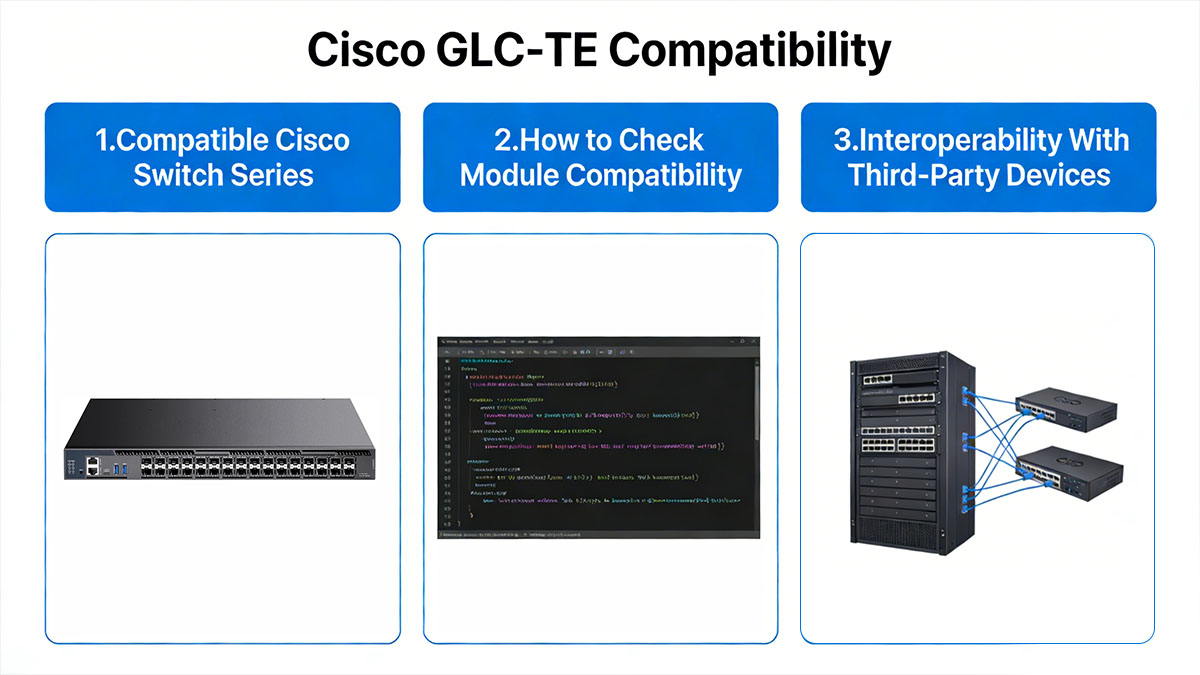
Compatible Cisco Switch Series
The Cisco GLC-TE module is commonly supported across many Cisco switching platforms that provide SFP interfaces for Gigabit Ethernet connectivity.
Typical compatible device categories include:
| Device Category | Example Series | Typical Use |
|---|---|---|
| Enterprise Access Switches | Catalyst 2960 / 3560 / 3750 | Campus and office access networks |
| Aggregation Switches | Catalyst 3850 / 4500 | Distribution layer networking |
| SMB Switches | Cisco Small Business 300 / 500 Series | Small and medium business environments |
These switches use SFP slots to provide flexible uplink or downlink options, allowing administrators to choose between copper or fiber connections depending on the deployment requirements.
Because compatibility can vary between hardware revisions and operating systems, administrators typically verify supported modules using official platform documentation.
How to Check Module Compatibility
The most reliable way to confirm whether a Cisco device supports the GLC-TE module is to check the platform’s compatibility information or verify the module directly on the device.
Common verification methods include:
-
Consult the device datasheet
Cisco switch datasheets usually list supported SFP modules for each model. -
Check the official compatibility matrix
Cisco publishes module compatibility information for many networking platforms. -
Use CLI commands on the switch
Network administrators can check installed modules with commands such as:-
show inventory -
show interface status -
show module
-
-
Check SFP port capabilities
Some SFP ports support only optical modules and may not support copper transceivers.
Performing these checks helps ensure the switch can recognize the module and bring the Ethernet link up correctly.
Interoperability With Third-Party Devices
Because the Cisco GLC-TE follows the IEEE 802.3ab 1000BASE-T standard, it can technically operate with devices from multiple vendors as long as both sides support Gigabit Ethernet over RJ45.
However, practical interoperability depends on several factors:
-
Vendor firmware restrictions
Some switches verify module identifiers and may reject unsupported modules. -
Auto-negotiation behavior
Copper Ethernet links rely on speed and duplex negotiation between devices. -
Hardware compatibility
Certain switches may have limitations on the number of copper SFP modules supported simultaneously.
In multi-vendor environments, administrators often verify interoperability through compatibility testing or by using modules that are specifically coded for the target switch platform. This approach helps ensure stable connectivity and avoids link initialization issues during deployment.
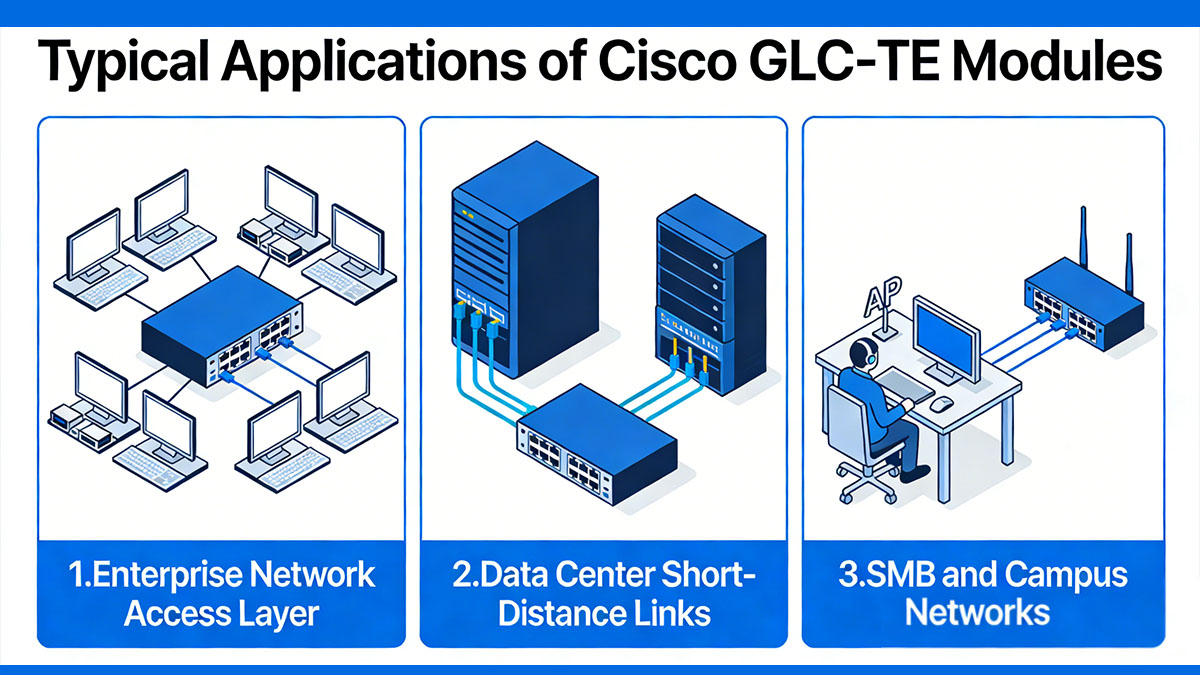
? Typical Applications of Cisco GLC-TE Modules
The Cisco GLC-TE module is primarily used for short-distance Gigabit Ethernet connections over copper cabling. It allows network devices with SFP ports to connect directly to RJ45-based Ethernet networks, making it a practical option in environments where fiber links are unnecessary or existing copper infrastructure is already available.
Because it supports standard Ethernet cabling and up to 100m transmission distance, the module is widely deployed across enterprise networks, data centers, and small to medium-sized business environments.
Enterprise Network Access Layer
The Cisco GLC-TE is commonly used in the access layer of enterprise networks, where switches connect end-user devices or access switches within the same building.
Typical deployment scenarios include:
-
Connecting access switches to aggregation switches
-
Providing RJ45 uplinks for Gigabit Ethernet switches
-
Supporting workstations, printers, and office network devices
-
Expanding copper Ethernet ports on switches that primarily use SFP uplinks
In many office environments, structured cabling systems already rely on Cat5e or Cat6 Ethernet cables. The GLC-TE module allows these networks to maintain copper connectivity while still using switches designed with modular SFP ports.
Data Center Short-Distance Links
Although fiber optics are widely used in data centers, copper SFP modules such as the GLC-TE can still be useful for short rack-level connections where distance requirements are minimal.
Common use cases include:
| Application | Description | Typical Distance |
|---|---|---|
| Top-of-Rack Connectivity | Linking servers to rack switches | 1–30m |
| Switch-to-Switch Links | Short copper interconnections within racks | 10–50m |
| Management Network | Connecting out-of-band management devices | <100m |
These short-distance connections often benefit from the simplicity of RJ45 cabling, especially in smaller data centers or lab environments where copper wiring is easier to manage.
SMB and Campus Networks
Small and medium-sized businesses often deploy Cisco switches that include SFP slots for flexible uplink connectivity. The Cisco GLC-TE module enables these networks to extend Gigabit Ethernet links using existing copper cabling.
Typical scenarios include:
-
Campus building connections within 100m
-
Network expansion in offices or retail environments
-
Connecting network switches across floors
-
Upgrading legacy Fast Ethernet networks to Gigabit speeds
Because many SMB networks already rely heavily on Ethernet cabling, using copper SFP modules can simplify network upgrades while avoiding the cost of installing fiber infrastructure.
Overall, the Cisco GLC-TE module remains a practical choice in situations where Gigabit connectivity is required but transmission distance stays within the 100m limitation of copper Ethernet standards.
? Cisco GLC-TE vs Other Gigabit SFP Modules
The Cisco GLC-TE differs from other Gigabit SFP modules primarily in transmission medium, supported distance, and deployment scenarios. While the GLC-TE uses copper Ethernet cabling, many other SFP modules rely on fiber optics to achieve longer transmission distances and lower signal loss.
Choosing between copper and fiber SFP modules depends on several factors, including existing infrastructure, link distance, installation environment, and network scalability requirements.
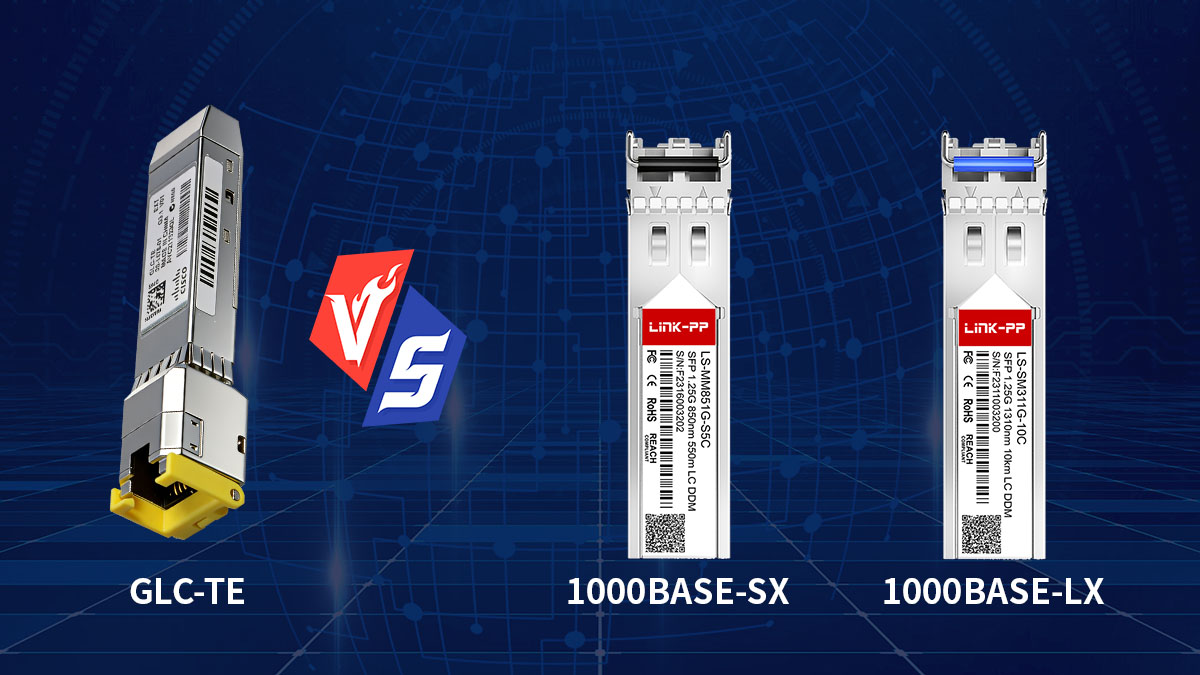
GLC-TE vs Fiber SFP Modules
The most significant difference between the Cisco GLC-TE and fiber-based SFP modules is the type of transmission medium. Copper modules transmit electrical signals over twisted-pair cables, while optical modules transmit light signals through fiber optic cables.
| Feature | Cisco GLC-TE (1000BASE-T) | Fiber SFP Modules |
|---|---|---|
| Transmission Medium | Copper (RJ45) | Optical Fiber |
| Maximum Distance | 100m | 300m–10km+ |
| Typical Cabling | Cat5e / Cat6 | Multimode Fiber or Single-mode Fiber |
| Deployment Complexity | Low | Moderate |
Copper modules are typically preferred when short-distance connectivity is sufficient and existing Ethernet cabling is available. Fiber modules are more suitable for longer-distance links, higher-density environments, and scenarios where electromagnetic interference may affect copper cables.
GLC-TE vs 1000BASE-SX Modules
The 1000BASE-SX SFP module is designed for short-distance fiber connections using multimode fiber. Compared with the copper-based GLC-TE, it supports longer distances while maintaining low latency and stable optical transmission.
| Parameter | GLC-TE | 1000BASE-SX |
|---|---|---|
| Transmission Medium | Copper | Multimode Fiber |
| Typical Distance | Up to 100m | Up to 550m |
| Connector Type | RJ45 | LC |
| Typical Deployment | Office networks | Campus and data centers |
1000BASE-SX modules are commonly used for switch uplinks or inter-switch connections within buildings or data centers where fiber infrastructure is available.
GLC-TE vs 1000BASE-LX Modules
The 1000BASE-LX SFP module is designed for long-distance Gigabit Ethernet transmission over single-mode fiber. Compared with the GLC-TE, it provides significantly greater reach and is commonly used in backbone or campus networks.
| Parameter | GLC-TE | 1000BASE-LX |
|---|---|---|
| Transmission Medium | Copper | Single-mode Fiber |
| Maximum Distance | 100m | Up to 10km |
| Connector Type | RJ45 | LC |
| Typical Applications | Access layer connections | Campus backbone links |
Because 1000BASE-LX supports long-distance optical transmission, it is widely used for building-to-building connections and network aggregation layers where copper cables cannot reach.
Overall, the Cisco GLC-TE is most suitable for short-distance Gigabit Ethernet connections using copper cabling, while fiber SFP modules such as 1000BASE-SX and 1000BASE-LX are better suited for networks requiring longer reach, higher scalability, or fiber infrastructure.
? Installation and Deployment Best Practices
Proper installation and configuration of the Cisco GLC-TE module helps ensure stable Gigabit Ethernet connectivity and prevents common network issues such as link instability or speed negotiation errors. Because the module operates over copper cabling and relies on auto-negotiation between devices, both the hardware installation and network configuration should follow recommended deployment practices.

How to Install a GLC-TE Module
Installing the Cisco GLC-TE module is straightforward because it uses the standard hot-swappable SFP form factor. The module can be inserted or removed while the switch or router remains powered on.
Typical installation steps include:
-
Inspect the SFP port
Ensure the port is clean and free from dust or physical damage. -
Insert the GLC-TE module into the SFP slot
Align the module with the port and gently push it in until it clicks into place. -
Connect the Ethernet cable
Insert an RJ45 connector from a Cat5e, Cat6, or Cat6a cable into the module. -
Verify link status on the switch
Check whether the port LED indicates an active link. -
Confirm interface status through CLI
Use commands such asshow interface statusto confirm that the port is operating at Gigabit speed.
Following these steps ensures the module is correctly installed and recognized by the network device.
Network Configuration Considerations
Most Cisco switches automatically configure copper SFP ports using auto-negotiation, allowing devices to determine the optimal speed and duplex settings.
The following configuration factors can affect link stability:
-
Speed negotiation
The GLC-TE supports 10/100/1000Mbps auto-negotiation. Both devices on the link should allow negotiation to occur. -
Duplex settings
Gigabit Ethernet typically operates in full-duplex mode. Mismatched duplex settings can cause packet loss or reduced performance. -
Port configuration
Ensure the switch interface is enabled and not administratively shut down.
| Configuration Parameter | Recommended Setting |
|---|---|
| Speed | Auto |
| Duplex | Auto |
| Interface State | Enabled |
Using automatic settings generally provides the most reliable connectivity for Gigabit Ethernet copper links.
Troubleshooting Common Issues
If a Cisco GLC-TE module fails to establish a link or experiences unstable connectivity, several factors may be responsible. Identifying these issues can help restore normal operation.
Common causes include:
-
Poor cable quality
Damaged or low-grade Ethernet cables may prevent stable Gigabit connections. -
Exceeding maximum cable distance
Copper Ethernet links should remain within the 100m limit defined by the 1000BASE-T standard. -
Incorrect port configuration
Manual speed settings may interfere with auto-negotiation. -
Unsupported module or compatibility restriction
Some switches may reject modules that are not recognized by the device firmware.
Basic troubleshooting steps include:
-
Replace the Ethernet cable with a tested Cat5e or Cat6 cable.
-
Verify that the switch port supports copper SFP modules.
-
Restart the interface or reseat the module.
-
Check switch logs for module recognition errors.
Applying these deployment practices helps ensure that Cisco GLC-TE modules operate reliably in Gigabit Ethernet networks while minimizing connectivity issues during installation.
? Advantages and Limitations of Cisco GLC-TE
The Cisco GLC-TE module offers a practical solution for Gigabit Ethernet connectivity over copper cabling, particularly in networks where fiber deployment is unnecessary or existing Ethernet infrastructure is already available. At the same time, like all copper-based transceivers, it also has certain limitations related to distance, power consumption, and scalability.
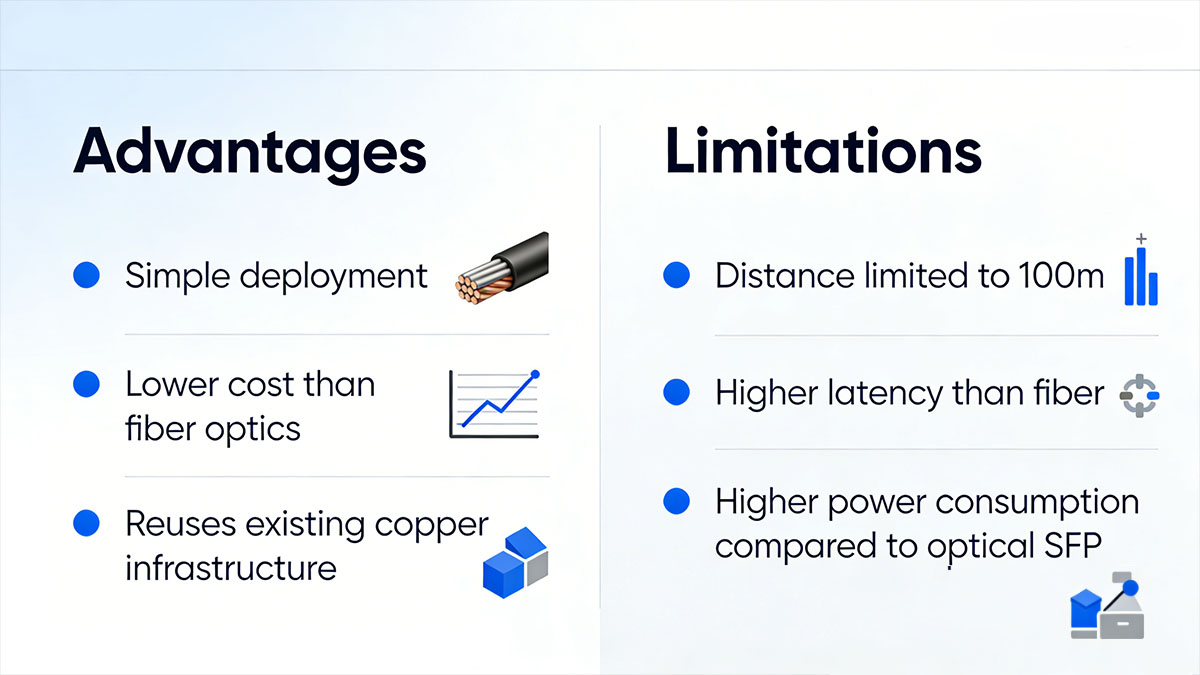
Understanding both the advantages and limitations helps determine whether the GLC-TE is suitable for a specific network deployment.
Advantages
The Cisco GLC-TE is widely used because it provides a convenient way to deliver Gigabit connectivity using familiar Ethernet infrastructure. In environments where short-distance connections are sufficient, copper SFP modules can simplify deployment and reduce installation costs.
Key advantages include:
-
Compatibility with standard Ethernet cabling
The module works with Cat5e, Cat6, and Cat6a cables commonly used in office and enterprise networks. -
Simple installation and maintenance
RJ45 connectors are widely used and do not require specialized fiber optic handling tools. -
Cost-effective deployment
Copper cabling and connectors are typically less expensive than fiber infrastructure. -
Flexible port expansion
SFP slots allow switches to add RJ45 connectivity when fixed copper ports are unavailable.
These advantages make the Cisco GLC-TE particularly useful for access-layer networking, office connectivity, and short-distance switch links.
Limitations
Despite its practicality, the Cisco GLC-TE has some constraints that should be considered during network design.
The most significant limitations relate to transmission distance and hardware efficiency.
| Limitation | Description |
|---|---|
| Distance Restriction | Maximum transmission distance is limited to 100m |
| Higher Power Consumption | Copper SFP modules generally consume more power than optical modules |
| Heat Generation | Additional electrical processing can produce more heat |
| Scalability Constraints | Less suitable for long-distance or high-density network designs |
These limitations arise from the physical characteristics of copper Ethernet transmission, where electrical signals are more susceptible to attenuation and interference over longer distances.
For networks that require longer links, higher density, or future scalability, fiber-based SFP modules such as 1000BASE-SX or 1000BASE-LX are often preferred. However, for short-distance Gigabit connections within the 100m range, the Cisco GLC-TE remains an efficient and practical option.
? How to Choose the Right Gigabit SFP Module
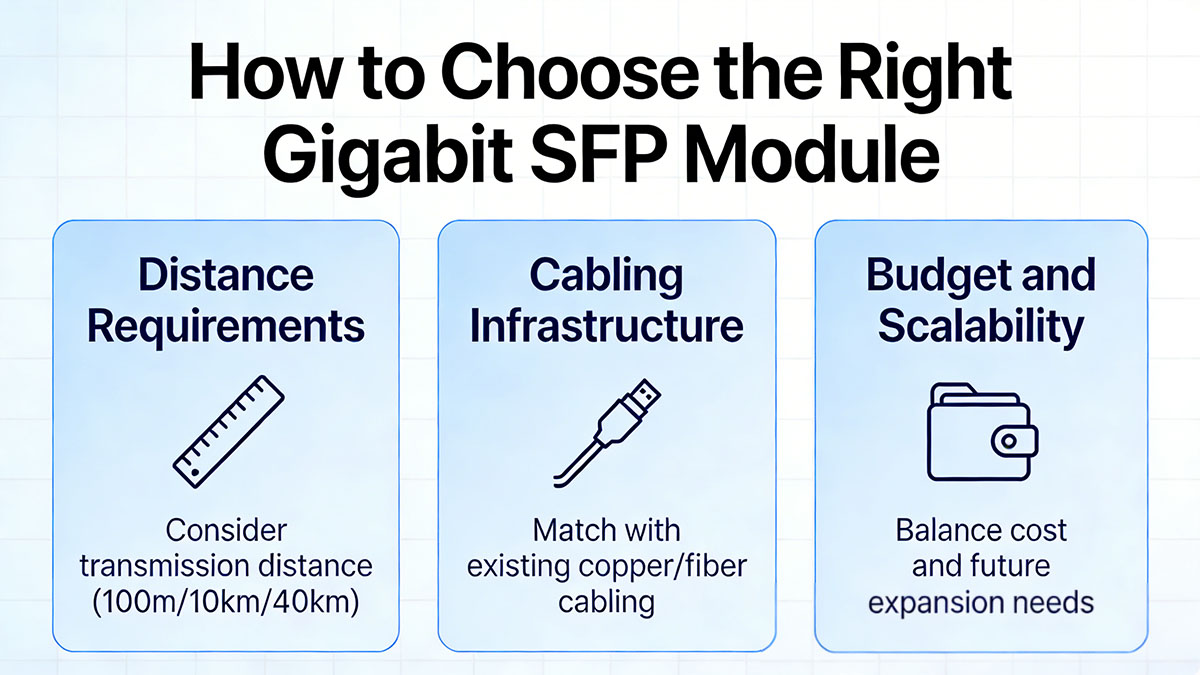
Selecting the right Gigabit SFP module depends on several technical factors, including transmission distance, cabling infrastructure, and long-term network scalability. While the Cisco GLC-TE is well suited for short-distance copper connections, fiber-based modules may be more appropriate in environments that require longer reach or higher interference resistance.
Evaluating these factors before deployment helps ensure that the selected module matches both the network design and operational requirements.
Distance Requirements
Transmission distance is one of the most important factors when selecting a Gigabit SFP module. Copper-based modules such as the Cisco GLC-TE are designed for short links, while fiber modules support significantly longer distances.
| Module Type | Transmission Medium | Typical Maximum Distance |
|---|---|---|
| 1000BASE-T SFP | Copper Ethernet | 100m |
| 1000BASE-SX SFP | Multimode Fiber | Up to 550m |
| 1000BASE-LX SFP | Single-mode Fiber | Up to 10km |
If the connection distance remains within 100m, a copper module can provide a simple and cost-effective solution. For links extending beyond that range, optical modules are typically required.
Cabling Infrastructure
The existing cabling environment often determines which type of SFP module can be deployed efficiently.
Common infrastructure considerations include:
-
Existing copper Ethernet wiring
Buildings with structured Cat5e or Cat6 cabling can easily support copper SFP modules like the GLC-TE. -
Fiber optic infrastructure availability
Data centers and campus networks often already deploy multimode or single-mode fiber. -
Installation complexity
Fiber deployments require specialized connectors and cleaning procedures, while copper cabling is easier to handle.
In environments where copper wiring is already installed and distances are short, using a copper SFP module can simplify installation and reduce infrastructure changes.
Budget and Scalability
Budget constraints and future network expansion plans should also influence module selection.
Important considerations include:
-
Initial hardware cost
Copper Ethernet cables and RJ45 connectors are generally less expensive than fiber components. -
Future bandwidth upgrades
Networks planning to upgrade to higher speeds may benefit from deploying fiber infrastructure early. -
Network density and power usage
Optical modules typically consume less power and generate less heat in high-density switch deployments.
Choosing the appropriate Gigabit SFP module requires balancing current network requirements with long-term scalability. In many enterprise and SMB environments where links remain short and copper infrastructure already exists, the Cisco GLC-TE provides a practical solution for delivering reliable Gigabit Ethernet connectivity.
? FAQs About Cisco GLC-TE 1000BASE-T SFP Module
What is the maximum distance supported by the Cisco GLC-TE module?
The Cisco GLC-TE supports a maximum transmission distance of 100m using standard twisted-pair Ethernet cables such as Cat5e, Cat6, or Cat6a, according to the 1000BASE-T Ethernet standard.
Can the Cisco GLC-TE work at 10Mbps or 100Mbps speeds?
Yes. The module supports auto-negotiation for 10Mbps, 100Mbps, and 1Gbps connections, allowing it to automatically match the speed of the connected device.
Does the Cisco GLC-TE require fiber optic cables?
No. The Cisco GLC-TE is a copper SFP transceiver that uses an RJ45 interface and operates over standard Ethernet cables rather than fiber optic cables.
Can the Cisco GLC-TE be hot-swapped?
Yes. Like most SFP modules, the Cisco GLC-TE supports hot-swapping, meaning it can be inserted or removed from a compatible SFP port without powering off the switch or router.
What type of Ethernet cable should be used with the GLC-TE?
The module works with Cat5e, Cat6, and Cat6a twisted-pair Ethernet cables, which are commonly used in Gigabit Ethernet networks.
Why do copper SFP modules consume more power than optical modules?
Copper SFP modules require additional signal processing to transmit Ethernet signals over twisted-pair cables, which increases power consumption compared with optical SFP modules that transmit light signals through fiber.
? Conclusion
The Cisco GLC-TE 1000BASE-T SFP transceiver module provides a practical way to enable Gigabit Ethernet connectivity over standard RJ45 copper cabling. With support for the IEEE 802.3ab standard, up to 100m transmission distance, and auto-negotiation for multiple Ethernet speeds, it is widely used in enterprise access networks, campus environments, and SMB deployments where short-distance connections are required.
By understanding the module’s specifications, compatibility considerations, and deployment scenarios, network administrators can determine when copper SFP modules like the GLC-TE are the most appropriate choice. In environments where existing Cat5e or Cat6 infrastructure is already in place, using a 1000BASE-T SFP module can simplify network expansion while maintaining reliable Gigabit performance.
For organizations seeking compatible and cost-effective alternatives to original Cisco modules, sourcing transceivers from reliable suppliers is equally important. You can explore high-quality Cisco GLC-TE compatible modules through the LINK-PP Official Store, where a range of tested optical and copper transceivers are available to support stable and scalable network deployments.