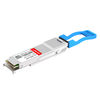
As hyperscale data centers, telecom operators, and cloud exchange facilities continue pushing beyond traditional 100G and 200G transmission limits, the demand for higher-capacity optical transport over limited fiber infrastructure has accelerated rapidly. This is where 400G DWDM optics have become one of the most important technologies in modern coherent networking.
Unlike conventional short-reach 400G Ethernet transceivers designed only for intra-data-center links, 400G DWDM coherent optics are engineered to transmit a full 400 Gigabit signal over tunable Dense Wavelength Division Multiplexing (DWDM) channels, allowing operators to carry massive bandwidth across metro, regional, and even long-haul fiber routes without deploying additional dark fiber.
In practical terms, this means a single pluggable coherent module can now help network architects:
- increase fiber utilization dramatically,
- simplify IP over DWDM architectures,
- reduce dependence on standalone transponder shelves,
- and scale data center interconnect (DCI) bandwidth with lower power and lower cost per bit.
As coherent pluggable standards such as 400ZR and OpenZR+ mature, 400G DWDM optics are no longer niche carrier products—they are becoming a mainstream deployment choice for:
- cloud DCI,
- metro Ethernet transport,
- hyperscale backbone expansion,
- ROADM-based optical networks,
- and carrier-grade wavelength services.
However, many engineers and buyers searching for 400G DWDM optics still face several practical questions:
- What exactly makes a 400G optic “DWDM coherent”?
- How far can 400G DWDM optics really transmit?
- What is the difference between 400ZR, 400ZR+, and OpenZR+?
- Do these optics require mux/demux, EDFA amplifiers, or ROADM systems?
- Which QSFP-DD or OSFP coherent modules are best for DCI deployment?
These are not just product questions—they are real network design decisions that directly affect optical reach, interoperability, CAPEX, and long-term scalability.
In this complete guide, we will break down how 400G DWDM optics work, compare today’s leading coherent standards, explain deployment architectures, and show how to choose the right 400G coherent transceiver for your DCI or metro optical network.
🌐 What Are 400G DWDM Optics and Where Are They Used?
400G DWDM optics are coherent optical transceivers that combine 400 Gigabit Ethernet client bandwidth with tunable Dense Wavelength Division Multiplexing (DWDM) transmission, enabling a single optical module to carry ultra-high-speed data across metropolitan, regional, and long-distance fiber networks.
In simpler terms, instead of using a standard gray 400G Ethernet optic that can only send traffic over a dedicated short-reach fiber pair, a 400G DWDM coherent optic converts that 400G data stream into a wavelength-selectable colored optical signal that can be inserted directly into a DWDM multiplexing system alongside many other wavelengths.
This is the key reason 400G DWDM optics have become foundational to modern IP over DWDM (IPoDWDM) architecture:
one router or switch port = one coherent 400G wavelength = one high-capacity transport service.
That dramatically reduces the amount of standalone transport hardware previously required in traditional transponder-based optical networks.
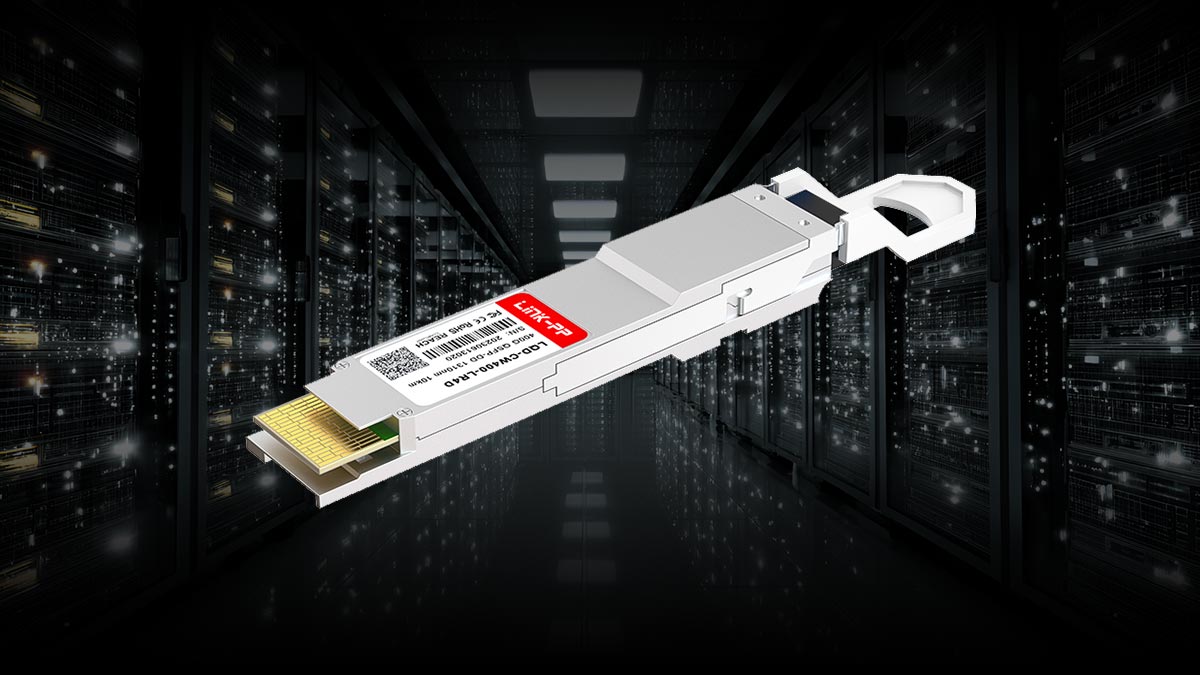
Understanding the Core Technology Behind 400G DWDM Optics
A 400G DWDM optic is not simply a faster Ethernet module—it is a coherent digital signal processor (DSP)-based transmission engine packed into a pluggable form factor such as:
Inside the module, several advanced optical technologies work together:
- tunable laser wavelength selection,
- coherent modulation (typically QPSK / 16QAM / advanced probabilistic shaping),
- digital signal processing,
- forward error correction (FEC),
- optical impairment compensation.
This coherent architecture allows the transceiver to tolerate:
- chromatic dispersion,
- polarization mode dispersion,
- optical noise,
- and multi-span amplified transport conditions
that would completely exceed the capability of normal 400G SR, DR, or FR Ethernet optics.
As a result, 400G DWDM optics are purpose-built for routed optical transport rather than simple patch-cord Ethernet connectivity.
Why 400G DWDM Optics Are Different From Standard 400G Ethernet Modules
Many buyers initially confuse 400G DWDM optics with standard data center optics such as:
- 400G SR8
- 400G DR4
- 400G FR4
- 400G LR4
But these are fundamentally different products.
Standard Ethernet optics are designed for:
- short-reach point-to-point transmission,
- fixed wavelengths,
- dedicated fiber usage,
- no DWDM multiplexing capability.
By contrast, 400G DWDM coherent optics are designed to:
- tune across ITU DWDM channels,
- operate through mux/demux filters,
- work with EDFAs and ROADMs,
- survive amplified optical spans,
- support metro to long-haul coherent transmission.
This means a single pair of leased or owned dark fibers can simultaneously carry dozens of independent coherent wavelengths, with each wavelength potentially delivering 400G service.
The economic implication is enormous:
higher bandwidth without laying more fiber.
For hyperscale operators and carriers, this directly translates into lower infrastructure expansion cost per transported bit.
Main Application Scenarios of 400G DWDM Optics
Search behavior shows that users looking for 400G DWDM optics are rarely just looking for datasheet definitions—they usually want to know whether these modules fit a real deployment scenario.
The answer is yes, especially in the following environments.
1. Data Center Interconnect (DCI)
This is currently the largest growth market.
Cloud providers and enterprise data centers often need to transport:
- east-west storage traffic,
- AI cluster synchronization traffic,
- disaster recovery replication,
- inter-campus switching traffic
between facilities located from 10 km to several hundred kilometers apart.
Using coherent 400G DWDM pluggables allows network teams to place wavelengths directly into high-density router or switch ports, avoiding large external transponder shelves.
This creates:
- simpler architecture,
- lower latency,
- reduced rack footprint,
- lower power per transported 100G.
2. Metro Ethernet and Regional Backbone Networks
Telecom carriers and managed service providers increasingly use 400G coherent DWDM optics to upgrade metro rings and regional backbone routes where older 10G/40G/100G wavelengths are no longer sufficient.
Instead of lighting four separate 100G channels, operators can consolidate services into one 400G coherent wavelength and preserve precious ROADM channel capacity.
This is especially attractive when:
- conduit space is limited,
- dark fiber leasing is expensive,
- fiber construction timelines are long.
3. IP over DWDM (Router Direct Optical Transport)
One of the most important architectural changes in recent years is the move toward IPoDWDM.
In this model:
- coherent optics plug directly into routers,
- routers output native DWDM wavelengths,
- optical line systems provide only mux/amplification/ROADM transport.
This reduces the need for:
- external muxponders,
- client transponders,
- extra gray optics,
- unnecessary OEO conversions.
As network speeds rise, this simplification can produce substantial CAPEX and OPEX savings.
This is exactly why 400ZR and OpenZR+ optics are drawing so much engineering attention.
4. Carrier Wavelength Services and Wholesale Transport
Carriers can also deploy 400G DWDM optics as high-capacity wavelength service interfaces for:
- enterprise backbone customers,
- cloud on-ramp connectivity,
- internet exchange transport,
- wholesale dark fiber alternatives.
A single coherent 400G wavelength can replace multiple lower-rate leased optical circuits while giving carriers better spectral efficiency.
Why the Market Is Moving Toward 400G DWDM Pluggables
Historically, coherent DWDM transport required large dedicated chassis-based systems.
Now, thanks to DSP miniaturization and lower-power coherent silicon, the industry is shifting toward:
pluggable coherent optics + simplified optical line systems.
This trend is driven by four powerful forces:
- exploding AI and cloud east-west bandwidth,
- rising dark fiber costs,
- demand for lower cost per transported gigabit,
- desire to collapse IP and optical layers.
That means 400G DWDM optics are no longer just an optical transport specialist product—they are becoming a strategic interface technology for next-generation Ethernet backbone design.
🌐 400G DWDM vs. 400ZR vs. OpenZR+: Key Differences
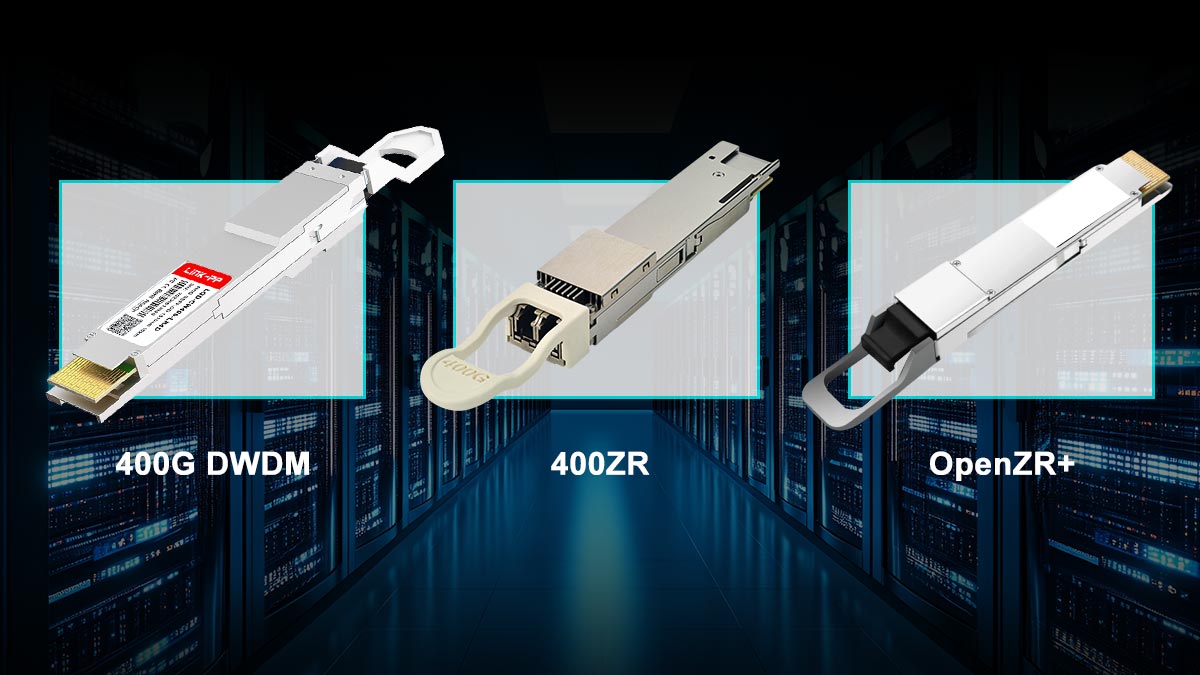
One of the biggest reasons users search for 400G DWDM optics is confusion around three terms that are often used interchangeably in the market:
Although these technologies are closely related, they are not identical, and understanding the difference is essential before selecting coherent modules for DCI, metro, or routed optical transport.
The short answer is this:
400G DWDM optics is the broad product category, while 400ZR and OpenZR+ are two specific coherent implementation standards within that category.
In other words, every 400ZR or OpenZR+ module is a 400G DWDM coherent optic, but not every 400G DWDM optic follows the exact 400ZR or OpenZR+ operating model.
First: What Does “400G DWDM” Actually Mean?
“400G DWDM” is the umbrella engineering term used to describe:
any coherent pluggable optical transceiver capable of transporting approximately 400G client traffic over tunable DWDM wavelengths.
This category may include modules built for:
- short metro coherent transport,
- standard DCI interconnect,
- amplified regional links,
- ROADM transport,
- or extended long-haul optical systems.
Because it is a broad category, vendors may label products as:
- 400G coherent optics,
- 400G DWDM transceivers,
- 400G DCO modules,
- QSFP-DD 400G coherent modules,
- OSFP coherent DWDM optics.
So when buyers search “400G DWDM optics,” they are usually entering the coherent optics market at the highest conceptual level.
The next step is understanding which coherent standard sits underneath the product.
What Is 400ZR?
400ZR is an industry interoperability specification created primarily for point-to-point Data Center Interconnect (DCI) applications.
Its design goal is very specific:
place a coherent 400G wavelength directly into a compact pluggable module that can run in a standard Ethernet switch or router port.
This was a major industry shift because traditional coherent optics used to require large transport chassis.
Core characteristics of 400ZR:
- 400 Gigabit Ethernet host interface
- coherent DWDM tunable wavelength
- optimized for relatively simple DCI spans
- lower power consumption than legacy DCO optics
- strong focus on multi-vendor interoperability
- generally optimized for ~80 km class deployments (depending on line conditions)
400ZR was designed for operators who want:
- simple router-to-router DCI,
- reduced optical transport layers,
- plug-and-play coherent wavelength deployment.
This makes 400ZR the most standardized and operationally straightforward coherent 400G option.
What Is OpenZR+?
As soon as operators began using 400ZR, they realized one limitation:
real optical networks are often more complicated than short point-to-point DCI.
Many deployments require:
- longer reach,
- amplified spans,
- ROADM filtering,
- stronger FEC,
- flexible client rates,
- better tolerance for optical impairments.
This is where OpenZR+ enters.
OpenZR+ is essentially an enhanced coherent pluggable architecture developed to expand beyond the narrower limitations of baseline 400ZR.
OpenZR+ adds greater transport flexibility such as:
- support for 100G / 200G / 300G / 400G operational modes,
- stronger line performance,
- improved OSNR tolerance,
- broader interoperability with optical line systems,
- better support for regional and some long-haul environments,
- more advanced optical management visibility.
In simple language:
400ZR = coherent pluggable for standard DCI
OpenZR+ = coherent pluggable for DCI plus more demanding optical transport scenarios
Because of this, OpenZR+ has become highly attractive for service providers and large cloud operators that need one optic family across multiple reach classes.
Technical Comparison: 400G DWDM vs. 400ZR vs. OpenZR+
| Parameter |
400G DWDM (General Category) |
400ZR |
OpenZR+ |
| Definition |
Broad coherent DWDM optic family |
Standardized interoperable coherent DCI spec |
Enhanced extended coherent pluggable framework |
| Host Rates |
Usually 400G, sometimes multi-rate |
Fixed 400GE host focus |
100G/200G/300G/400G flexibility |
| Typical Reach |
Metro to long-haul depending on design |
Short/medium DCI class |
Metro, regional, extended DCI |
| Power Profile |
Varies widely by DSP generation |
Lower power optimized |
Slightly higher but more capable |
Optical Tolerance Vendor dependent Moderate Higher ROADM / Amplified Span Suitability Some models yes Limited to moderate Stronger compatibility Operational Complexity Broad range Simplest Medium Best Use Case General coherent transport Router direct DCI Flexible IPoDWDM + transport convergence
This comparison is extremely important because many searchers assume “400G coherent” automatically means all products perform the same.
That is not true.
The actual deployment success depends heavily on which coherent profile the module was designed around.
Which One Should You Choose?
The practical buying decision usually comes down to network architecture.
Choose standard 400ZR if:
- your application is mostly point-to-point DCI,
- spans are relatively clean and predictable,
- lowest power coherent insertion is a priority,
- you want simpler multi-vendor interoperability.
Choose OpenZR+ if:
- your network includes ROADMs or amplified spans,
- you need stronger optical margin,
- reach flexibility matters,
- you want one coherent optic type across several transport scenarios.
Choose broader vendor-specific 400G DWDM coherent modules if:
- your network requires specialized long-haul engineering,
- you need non-standard line rates or transport features,
- your optical line system is highly customized.
This is why understanding the standards behind the label matters much more than simply reading “400G DWDM” on a datasheet.
🌐 Reach, Wavelength, and Line-System Requirements
After understanding the differences between 400G DWDM, 400ZR, and OpenZR+, the next critical question is:
How far can 400G DWDM optics transmit, what wavelengths do they use, and what supporting infrastructure is required?
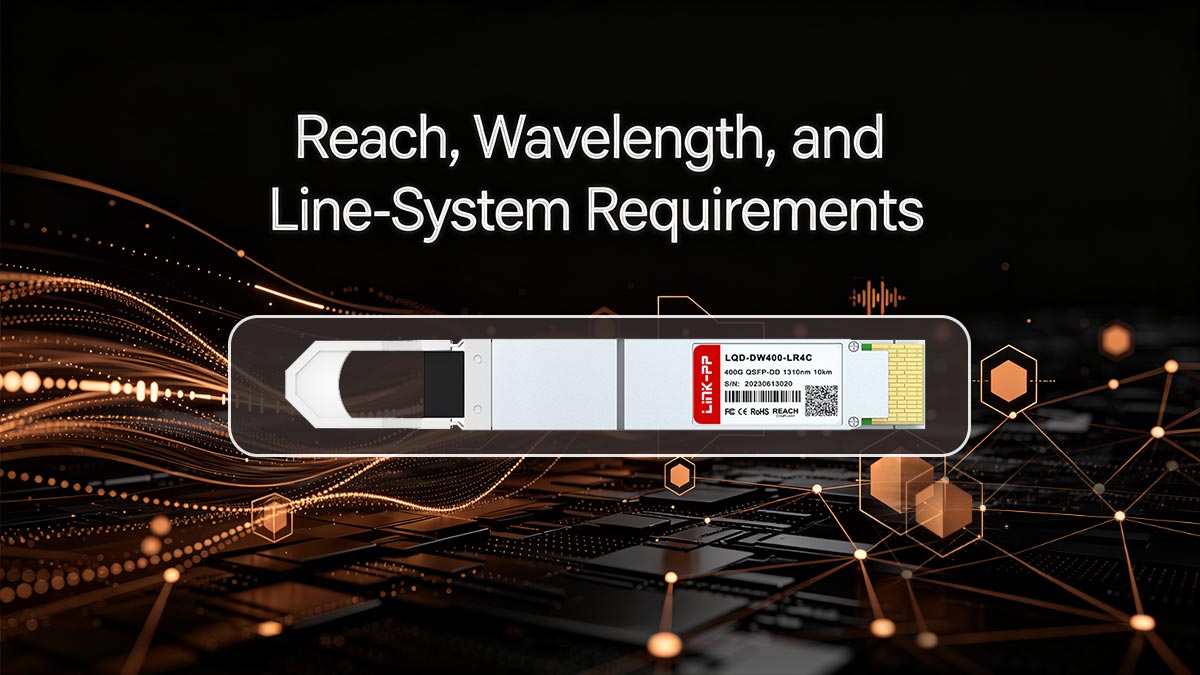
Unlike standard Ethernet optics, the performance of 400G DWDM coherent optics is not fixed. Instead, it depends on the overall optical link design, including fiber quality, amplification, and channel conditions.
How Far Can 400G DWDM Optics Reach?
The transmission distance of 400G DWDM optics varies based on factors such as:
- modulation format and DSP capability
- optical signal-to-noise ratio (OSNR)
- fiber attenuation and span length
- number of ROADM nodes
- amplification strategy (EDFA/Raman)
In real deployments, three typical reach categories are observed:
1. Metro / DCI Reach (10–80 km)
This is the primary use case for 400ZR optics. These links usually involve:
- point-to-point dark fiber
- minimal filtering
- passive mux/demux
Common in data center interconnect (DCI), this scenario offers the simplest deployment with predictable performance.
2. Extended Metro / Regional Reach (80–300+ km)
This range is typically handled by OpenZR+ or enhanced coherent modules.
These links often include:
- one or more EDFAs
- additional insertion loss from filters
- occasional ROADM traversal
Used in metro backbone and regional networks, these deployments require better OSNR tolerance and stronger DSP performance.
3. Long-Haul / Engineered Transport (300 km+)
For longer distances, vendor-specific 400G coherent optics may be deployed with:
- multi-stage amplification
- advanced FEC
- optimized modulation schemes
However, this is no longer plug-and-play. It requires full optical network engineering and careful performance planning.
Key takeaway: Reach is not defined by the optic alone—it is determined by the entire optical system.
What Wavelengths Do 400G DWDM Optics Use?
400G DWDM optics operate on tunable DWDM wavelengths in the C-band, rather than fixed wavelengths like standard Ethernet optics.
This allows each module to:
- tune across ITU DWDM channels
- integrate into existing DWDM systems
- support flexible network expansion
Instead of dedicating one fiber per link, multiple wavelengths can coexist on the same fiber pair.
This enables a single fiber pair to carry dozens of 400G channels, dramatically increasing capacity without new fiber deployment.
Channel Spacing and Spectral Efficiency
Another key factor is how much spectrum each 400G channel consumes.
Typical implementations use:
- 75 GHz or 100 GHz spacing
- flexible grid (Flex-Grid) allocation
Why this matters:
- narrower spacing = more channels per fiber
- higher spectral efficiency = lower cost per bit
For operators, maximizing fiber capacity is often just as important as maximizing reach.
What Line-System Components Are Required?
400G DWDM optics typically operate within a broader optical system that may include:
1. Mux/Demux Units
Combine and separate multiple DWDM wavelengths onto a single fiber.
2. Optical Amplifiers (EDFA)
Compensate for signal loss over distance and maintain OSNR.
3. ROADMs
Enable dynamic wavelength routing in complex networks, but introduce additional loss and filtering constraints.
The Most Important Design Insight
A common mistake is evaluating only the transceiver specifications.
In reality:
The success of a 400G DWDM deployment depends on the interaction between the optic and the optical line system.
Factors such as amplification, filtering, and fiber condition can significantly impact performance.
🌐 Power, Form Factor, and Deployment Considerations
Once network planners understand the reach and optical line requirements of 400G DWDM optics, the next practical concern is hardware deployment:
Can existing switches and routers support these coherent modules, how much power do they consume, and what physical limitations must be considered before installation?
This is a major decision point because coherent pluggables are far more demanding than standard 400G Ethernet optics. Even if the optical link budget works, the deployment can still fail if the host equipment cannot provide enough power, cooling, or firmware support.
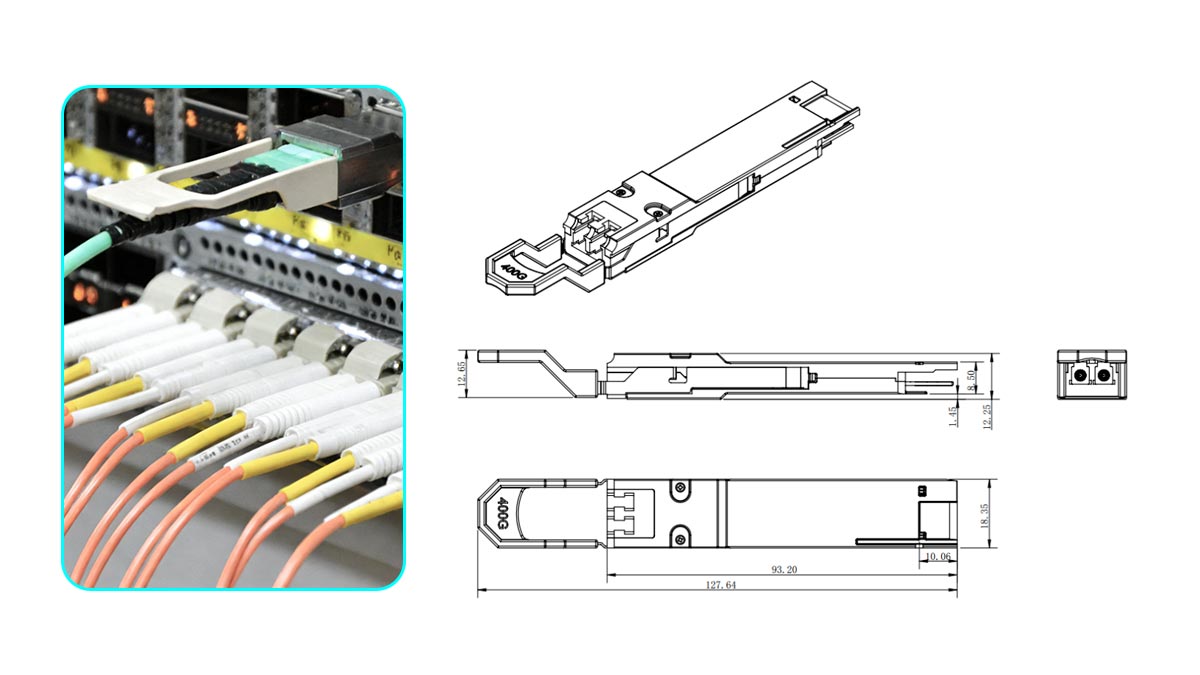
Power Consumption: Why Coherent Optics Need More Than Standard 400G Modules
Traditional 400G Ethernet optics such as SR8, DR4, or FR4 are mainly designed for short-reach data center connections and usually operate at relatively low power.
By contrast, 400G DWDM coherent optics contain an onboard digital signal processor (DSP), tunable laser, and advanced FEC engine, all of which significantly increase energy demand.
Typical power ranges in the market are:
- Standard 400G Ethernet optics: ~8W to 12W
- 400ZR coherent optics: ~15W to 20W
- OpenZR+ / enhanced coherent optics: ~20W to 25W or higher
This difference matters because not every 400G port on a switch is designed to safely support high-power coherent modules.
If the host platform has:
- insufficient cage power budget,
- weak airflow design,
- or thermal throttling limitations,
the coherent optic may not initialize correctly or may operate unstably under full traffic load.
Before selecting a module, always verify the host device’s maximum supported power per QSFP-DD or OSFP port.
Common Form Factors for 400G DWDM Optics
Modern coherent pluggables are mainly available in three form factors:
1. QSFP-DD
QSFP-DD is currently one of the most popular choices because it offers:
- high front-panel density,
- broad switch/router adoption,
- support for 400ZR and many OpenZR+ modules.
It is ideal when operators want to deploy coherent wavelengths directly from high-density Ethernet routing platforms.
2. OSFP
OSFP provides slightly more thermal headroom and is often chosen for:
- higher-power coherent DSP designs,
- advanced OpenZR+ implementations,
- systems where cooling performance is critical.
Although not as universally adopted as QSFP-DD in some routing platforms, OSFP offers stronger future expansion flexibility.
3. CFP2-DCO
CFP2-DCO was the earlier generation of pluggable coherent optics.
It still appears in some transport-oriented applications because it supports:
- mature coherent features,
- stronger standalone optical diagnostics,
- extended long-haul engineering.
However, compared with QSFP-DD and OSFP, CFP2-DCO consumes more space and is less attractive for dense router-based IPoDWDM architectures.
Host Equipment Compatibility Is Not Just About Port Speed
A common misconception is:
“If my switch has a 400G QSFP-DD port, any 400G coherent optic should work.”
In reality, compatibility depends on several deeper layers:
- electrical host interface support,
- coherent module firmware recognition,
- thermal management profile,
- DSP management communication,
- vendor qualification.
Some routers support baseline 400ZR but do not fully support all OpenZR+ diagnostic functions. Others may require software upgrades before coherent pluggables can be recognized.
This means buyers must verify:
- hardware compatibility,
- NOS/firmware support,
- coherent management feature support
before purchasing optics.
Deployment Planning Inside Real Equipment
Because coherent optics generate more heat, dense front-panel deployment requires attention to:
- airflow direction,
- adjacent port derating,
- rack cooling efficiency,
- maximum simultaneous coherent population.
In high-density chassis, it is not always recommended to populate every port with maximum-power coherent optics unless the platform is explicitly designed for that load.
This becomes especially important in:
- hyperscale DCI routers,
- metro aggregation switches,
- edge POP installations with limited cooling.
Practical Deployment Checklist
Before installing 400G DWDM optics, engineers should confirm:
- Does the host port support the module’s power draw?
- Is the form factor QSFP-DD, OSFP, or CFP2-DCO compatible?
- Does the firmware recognize 400ZR/OpenZR+ functions?
- Is front-panel airflow sufficient for continuous coherent operation?
- Can the platform expose coherent optical telemetry for monitoring?
A successful coherent deployment is not only an optical engineering project—it is also a hardware thermal and compatibility project.
🌐 Compatibility, Interoperability, and Vendor Selection Checklist
After confirming reach, power, and deployment conditions, the next real purchasing question is:
Will this 400G DWDM optic work reliably with my switches, routers, and optical line system—and how do I choose the right vendor?
This is where many coherent deployments become risky. A module may look perfect on paper, but if compatibility or interoperability is overlooked, field installation can quickly turn into unstable links, missing diagnostics, or failed wavelength provisioning.

Hardware Compatibility: Verify More Than the Port Type
The first level of compatibility is physical and electrical host support.
Even if a platform offers:
- QSFP-DD 400G ports, or
- OSFP 400G ports,
that does not automatically mean it supports all coherent DWDM modules.
Engineers must confirm:
- maximum power budget per port,
- host electrical lane mapping,
- firmware support for coherent DSP initialization,
- DOM/DDM visibility for advanced optical metrics.
Some devices support standard 400ZR optics but offer only partial support for OpenZR+ management features.
Always validate against the switch or router vendor’s official coherent optic compatibility list—not just the mechanical form factor.
Optical Line-System Interoperability
The second layer is compatibility with the DWDM transport infrastructure.
A 400G DWDM optic must operate cleanly with:
- existing mux/demux filters,
- EDFA amplifiers,
- ROADM passbands,
- channel spacing plans,
- optical supervisory policies.
This matters because different coherent modules can behave differently in terms of:
- launch power,
- OSNR tolerance,
- spectral shaping,
- FEC margin.
A module that works well on a simple point-to-point dark fiber may not perform the same way inside a heavily filtered ROADM network.
So before purchasing, ask:
Has this optic been validated for my exact optical line architecture?
Interoperability: Can Different Vendors Work Together?
Multi-vendor interoperability is one of the biggest reasons buyers look at 400ZR and OpenZR+ optics.
In theory, standardized coherent implementations improve the chance that:
- router A can communicate with router B,
- switch optics can traverse third-party line systems,
- carriers can avoid full vendor lock-in.
However, in real deployments, interoperability still depends on:
- software maturity,
- DSP tuning consistency,
- optical parameter alignment,
- FEC negotiation behavior.
That means “standardized” does not always mean “instant plug-and-play.”
Whenever multi-vendor deployment is planned, request:
- lab interoperability reports, or
- field-proven deployment references.
Vendor Selection: What Actually Matters?
Choosing a vendor should not be based on price alone.
A professional 400G DWDM optic supplier should be evaluated on five key dimensions:
1. Host Compatibility Coverage
Does the vendor support mainstream Cisco, Juniper, Arista, Nokia, Huawei, or white-box platforms?
2. Optical Performance Margin
Can the module provide stable operation under amplified or filtered conditions?
3. Diagnostic Visibility
Does it expose coherent metrics such as OSNR, pre-FEC BER, and wavelength tuning information?
4. Interoperability Validation
Has the optic been tested in third-party DWDM systems or only in the vendor’s own environment?
5. Engineering Support
Can the supplier assist with wavelength planning, power budget review, and deployment troubleshooting?
For coherent optics, engineering support often matters more than with ordinary Ethernet transceivers because the optic is part of a larger optical system.
Quick Vendor Selection Checklist
Before placing an order, confirm the following:
- Is the module fully qualified for my host router or switch?
- Does the power profile match my hardware limits?
- Has it been tested with my mux/EDFA/ROADM environment?
- Is multi-vendor interoperability documented?
- Are coherent diagnostics accessible from the host OS?
- Does the supplier provide pre-sales optical engineering assistance?
- Is there real field deployment experience for this model?
The best 400G DWDM optic is not simply the cheapest or the highest-reach datasheet—it is the module with the highest probability of stable deployment in your actual network.
🌐 Common Questions About 400G DWDM Optics
1. Are 400G DWDM optics the same as 400ZR optics?
Not exactly.
400G DWDM optics is the broad category for coherent 400G pluggable transceivers that operate on tunable DWDM wavelengths.
400ZR is one standardized implementation within that category, mainly designed for point-to-point DCI applications.
In simple terms:
all 400ZR modules are 400G DWDM optics, but not all 400G DWDM optics are limited to 400ZR specifications.
Higher-performance OpenZR+ and vendor-specific coherent modules also belong to the 400G DWDM family.
2. How far can 400G DWDM coherent optics transmit?
There is no single fixed answer because distance depends on the optical line system.
Typical deployment ranges are:
- 10–80 km: standard 400ZR metro DCI
- 80–300+ km: OpenZR+ and amplified metro/regional links
- 300 km+: engineered long-haul coherent systems
Fiber quality, EDFA amplification, OSNR, ROADM count, and spectral filtering all affect the final reach.
The practical rule is: coherent reach is determined by the network, not only by the transceiver datasheet.
3. Do 400G DWDM optics require a DWDM mux or amplifier?
In most cases, yes.
Because these optics operate on tunable DWDM wavelengths, they are typically deployed with:
- DWDM mux/demux filters for wavelength aggregation
- EDFAs for span loss compensation
- ROADMs in dynamic optical networks
For very short direct dark-fiber DCI, amplification may not always be required, but muxing is still usually part of the design if multiple wavelengths share the same fiber.
4. Can I plug 400G DWDM optics directly into a router or switch?
Yes—but only if the host platform supports coherent pluggables.
You must verify:
- QSFP-DD or OSFP coherent compatibility
- sufficient power budget per port
- thermal cooling capability
- firmware support for 400ZR/OpenZR+
Not every 400G Ethernet port automatically supports high-power coherent optics.
5. What is the difference between 400ZR and OpenZR+?
The main difference is deployment flexibility.
- 400ZR is optimized for simpler point-to-point DCI links.
- OpenZR+ offers stronger optical margin, broader reach options, and better support for amplified or ROADM-based transport systems.
If the network is more complex than basic dark fiber DCI, OpenZR+ is often the safer coherent choice.
6. Are 400G DWDM optics suitable for IP over DWDM?
Yes. In fact, this is one of their biggest advantages.
By placing coherent pluggables directly inside routers, operators can build:
router-to-router wavelength transport without separate transponder shelves.
This simplifies network architecture, lowers latency, and reduces optical-electrical-optical conversion costs.
That is why 400G DWDM optics are considered a key enabler of modern IPoDWDM design.
7. What should buyers check before selecting a 400G DWDM optic?
The most important factors are:
- host switch/router compatibility
- coherent standard (400ZR or OpenZR+)
- power consumption
- optical line-system interoperability
- wavelength tuning support
- coherent diagnostics visibility
- supplier engineering support
Choosing based on speed alone is not enough. The optic must match both the host hardware and the optical transport environment.
🌐 How to Design a 400G DWDM Link for DCI and Metro Networks
After understanding the standards, reach limitations, power requirements, and compatibility factors of 400G DWDM optics, the final question becomes:
How should a real 400G coherent link be designed to achieve stable performance in DCI and metro transport?
The answer is that successful deployment is not based on choosing a single optic with the longest advertised distance. It depends on matching the coherent module, host platform, and optical line system into one coordinated architecture.
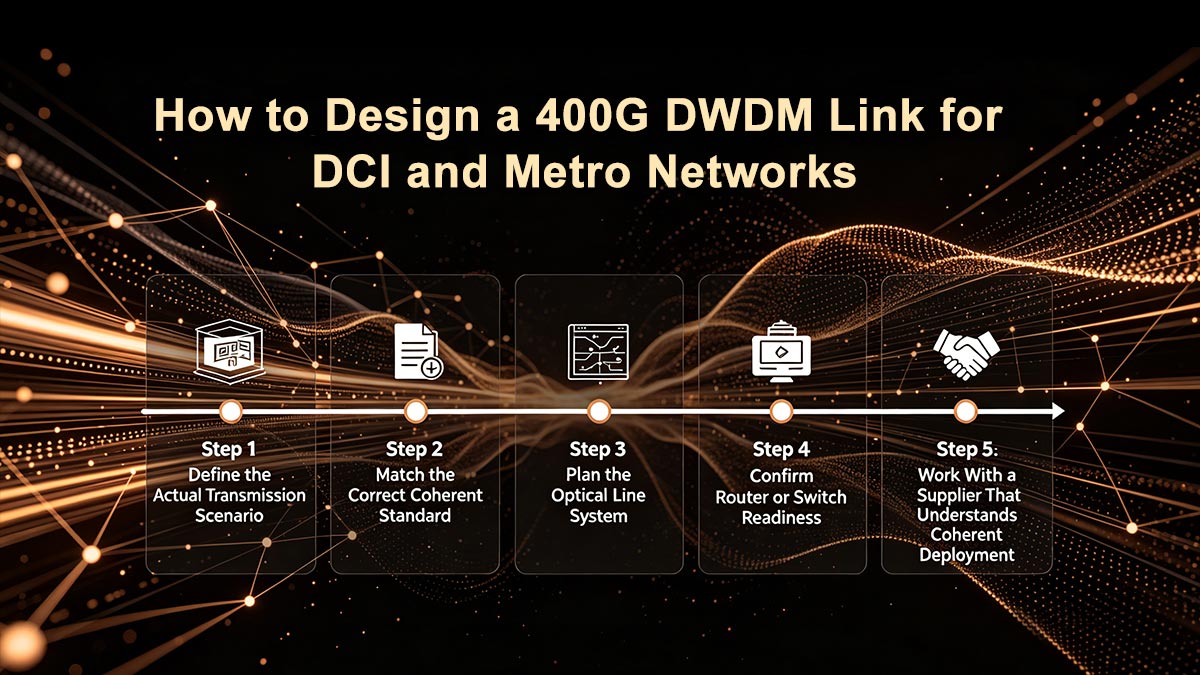
Step 1: Define the Actual Transmission Scenario
Before selecting any 400G DWDM optic, engineers should first identify:
- total fiber distance,
- number of intermediate ROADM nodes,
- whether the link is dark fiber or leased wavelength,
- expected future capacity growth,
- available rack power and cooling at both ends.
A 20 km campus DCI link and a 200 km metro backbone route may both use 400G coherent optics, but they require very different optical margins and hardware planning.
This is why the design process should always begin with the real transport scenario—not the module datasheet alone.
Step 2: Match the Correct Coherent Standard
Once the link environment is clear, the next step is choosing the proper coherent technology.
- For straightforward point-to-point DCI, 400ZR is often sufficient.
- For amplified spans, ROADM traversal, or higher margin requirements, OpenZR+ or enhanced 400G DWDM coherent modules are usually safer.
The goal is not to buy the most expensive optic, but to choose the optic that provides enough line tolerance without wasting unnecessary power budget.
Step 3: Plan the Optical Line System
A stable 400G DWDM link normally includes:
- DWDM mux/demux units,
- EDFA amplification when required,
- wavelength assignment planning,
- OSNR margin verification,
- end-to-end insertion loss calculation.
Many deployment failures happen because buyers focus only on transceiver specifications while underestimating mux loss, connector attenuation, or ROADM filtering impact.
In coherent networking, line-system planning is just as important as module selection.
Step 4: Confirm Router or Switch Readiness
Before ordering optics, verify that the host platforms support:
- QSFP-DD or OSFP coherent modules,
- required power draw,
- airflow dissipation,
- coherent firmware management,
- optical telemetry monitoring.
Even a perfectly engineered optical path can become unstable if the router cannot properly initialize or cool the coherent transceiver.
Step 5: Work With a Supplier That Understands Coherent Deployment
400G DWDM optics are no longer simple plug-and-play Ethernet accessories. They are part of a complete optical transport strategy.
That means choosing a supplier should involve more than checking price and stock.
A qualified supplier should be able to help with:
- host compatibility confirmation,
- wavelength/channel planning,
- power budget review,
- interoperability suggestions,
- deployment troubleshooting.
This is especially important for enterprises and operators moving into IP over DWDM for the first time.
For buyers looking for tested coherent optical modules, professional compatibility guidance, and scalable DCI/metro optical solutions, the LINK-PP Official Store provides a practical source for evaluating 400G coherent optics, DWDM transceivers, and customized optical interconnect products for real deployment environments.
Final Conclusion
As cloud traffic, AI backbone synchronization, and metro Ethernet demand continue to rise, traditional gray optics are no longer enough for high-capacity inter-site transport.
400G DWDM optics offer a far more scalable approach by combining Ethernet bandwidth, coherent transmission, and wavelength multiplexing into one compact pluggable interface.
When properly designed, they allow network operators to:
- maximize fiber utilization,
- simplify IPoDWDM architecture,
- reduce transport cost per bit,
- and prepare for future multi-terabit expansion.
The key is not simply buying a 400G coherent module—it is designing the right coherent system around it.
And that system begins with choosing optics that are validated for your actual DCI or metro network conditions.