As AI workloads, hyperscale cloud computing, and high-performance computing (HPC) continue to surge, traditional network speeds are reaching their limits. Data centers that once relied on 100G, 400G, or even 800G interconnects are now facing unprecedented bandwidth pressure—driven largely by GPU clusters, distributed training models, and east-west traffic explosion.
This is where the 1.6T optical transceiver enters the picture.
A 1.6T optical transceiver represents the next major leap in data center interconnect technology, delivering 1.6 terabits per second of bandwidth in a single module. More importantly, it is not just a speed upgrade—it is a foundational building block for next-generation AI infrastructure, enabling faster data exchange, reduced latency, and improved network efficiency at scale.
What You’ll Learn in This Guide
In this comprehensive guide, you will gain:
- A clear understanding of what a 1.6T optical transceiver is and how it works
- Insights into why 1.6T is critical for AI-driven data centers
- A breakdown of form factors, architectures, and transmission types (DR8, FR4, SR8)
- A practical comparison of 1.6T vs 800G optics
- A step-by-step framework to choose the right 1.6T module for your network
- Real-world considerations including thermal design, compatibility, and deployment challenges
Who This Article Is For
This article is designed for:
- Data center architects planning next-generation network upgrades
- Network engineers evaluating high-speed optical modules
- Procurement teams sourcing cost-effective and compatible 1.6T solutions
- Distributors and OEM buyers looking to understand market trends and product positioning
Why 1.6T Is More Than Just “Faster Optics”
Unlike previous upgrade cycles, the transition to 1.6T is being driven by a structural shift in computing—specifically, the rise of AI and machine learning infrastructure. In modern AI clusters, thousands of GPUs must communicate in real time, creating massive bandwidth demands that legacy optical modules simply cannot sustain efficiently.
As a result, 1.6T optical transceivers are rapidly becoming a strategic requirement rather than an optional upgrade.
In the following sections, we’ll break down the technology, compare key options, and help you determine exactly how—and when—to adopt 1.6T optics in your network.
⏩ What Is a 1.6T Optical Transceiver?
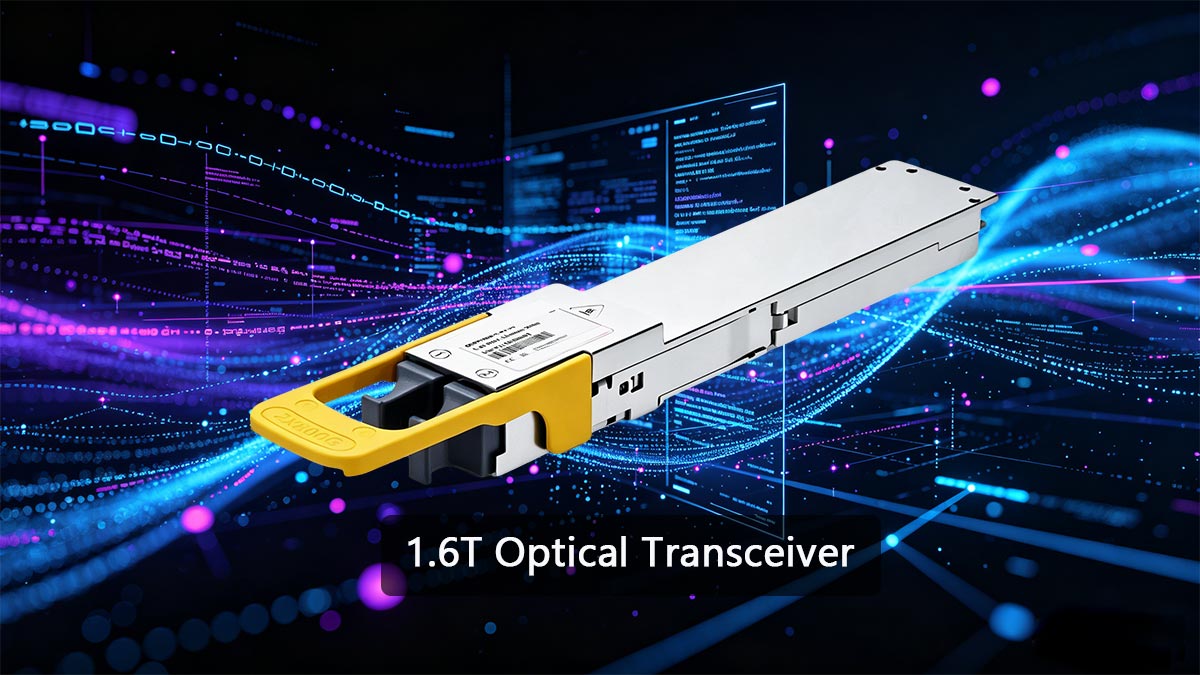
A 1.6T optical transceiver is a high-speed pluggable module designed to transmit and receive data at a total bandwidth of 1.6 terabits per second (Tbps) over optical fiber. It is the next evolutionary step beyond 800G modules, built to support the rapidly increasing data demands of AI-driven and hyperscale data center networks.
At a technical level, a 1.6T transceiver typically achieves this throughput using:
- 8 lanes of 200G PAM4 signaling (8 × 200G)
- Advanced DSP (Digital Signal Processing) chips
- High-performance optical components such as silicon photonics or EML lasers
These modules are commonly deployed in high-density switch environments and are designed to support ultra-fast switch-to-switch, GPU-to-GPU, and data center interconnect (DCI) communications.
How 1.6T Transmission Works in Modern Networks
To deliver 1.6 Tbps of bandwidth, modern optical transceivers rely on a combination of electrical and optical innovations:
1. Multi-Lane Architecture (8×200G)
Instead of sending all data through a single channel, the transceiver splits the signal into eight parallel lanes, each carrying 200G using PAM4 (Pulse Amplitude Modulation 4-level) encoding. This significantly increases data density without requiring proportional increases in physical space.
2. PAM4 Modulation Technology
PAM4 allows each signal to carry 2 bits per symbol, effectively doubling the data rate compared to traditional NRZ signaling. This is essential for reaching 200G per lane within practical power and bandwidth constraints.
3. Optical Interface Types
Depending on the application, 1.6T modules support different transmission standards:
- DR8 – Parallel single-mode fiber for short-reach (typically ≤500m)
- FR4 / 2×FR4 – Wavelength-division multiplexing for longer reach (up to ~2km)
- SR8 – Multimode fiber for very short distances (within racks)
4. DSP and Signal Integrity
A high-performance DSP chip manages signal equalization, error correction, and lane synchronization, ensuring reliable transmission at extremely high speeds—even under challenging thermal and electrical conditions.
Why This Speed Tier Matters Now
The transition to 1.6T is not just about higher bandwidth—it is a direct response to structural changes in how modern data centers operate.
1. AI Workloads Are Driving Bandwidth Explosion
AI training clusters—especially those using GPUs—require massive east-west data exchange. Traditional 400G and even 800G links are becoming bottlenecks, making 1.6T essential for scaling AI infrastructure efficiently.
2. Network Efficiency and Cost per Bit
By doubling the bandwidth of 800G modules, 1.6T transceivers can significantly reduce cost per transmitted bit, improve port density, and lower the total number of required links—simplifying network architecture.
3. Preparing for Future Network Architectures
Hyperscale operators are already planning transitions toward 3.2T and beyond, making 1.6T a critical stepping stone. Deploying 1.6T today helps future-proof infrastructure and aligns with evolving standards in switching silicon and optical interconnects.
4. Industry Momentum and Ecosystem Growth
The rapid development of OSFP and next-generation form factors (such as OSFP-XD), along with advances in silicon photonics, indicates strong industry commitment. As production scales, availability will increase and costs are expected to decline.
In short, the 1.6T optical transceiver is not just a faster module—it is a key enabler of next-generation data center performance, especially in the age of AI and ultra-high-speed networking.
⏩ Why 1.6T Matters for AI and Future Data Centers
The shift toward AI-driven infrastructure is redefining how data centers are designed, scaled, and optimized. As workloads become more data-intensive and latency-sensitive, traditional network speeds can no longer keep up. The 1.6T optical transceiver emerges as a key enabler, delivering the bandwidth and efficiency required to support next-generation AI clusters, hyperscale environments, and high-performance computing. It plays a crucial role in helping operators overcome network bottlenecks while preparing for future growth.

AI Training and Inference Bandwidth Demand
The rapid rise of artificial intelligence—especially large language models (LLMs) and deep learning systems—has fundamentally changed network requirements inside data centers. Modern AI workloads rely on massive GPU clusters that must continuously exchange data during training and inference.
In these environments:
- Thousands of GPUs communicate simultaneously
- Data flows are primarily east-west traffic, not north-south
- Latency and bandwidth directly impact training time and efficiency
Traditional 400G and even 800G interconnects are increasingly becoming bottlenecks. A 1.6T optical transceiver helps alleviate this by doubling available bandwidth per port, enabling faster synchronization between GPUs and reducing overall job completion time.
In practical terms, higher bandwidth means:
- Faster model training cycles
- Improved cluster utilization
- Reduced network congestion
Hyperscale and HPC Upgrade Pressure
Hyperscale data centers and high-performance computing (HPC) environments are under constant pressure to scale infrastructure without exponentially increasing cost and complexity.
Operators face several challenges:
- Limited front-panel space on switches
- Rising power consumption per rack
- Increasing fiber management complexity
By adopting 1.6T optical modules, operators can:
- Increase bandwidth density without adding more ports
- Reduce the total number of interconnects required
- Improve cost efficiency per bit transmitted
For HPC environments, where performance is tightly coupled with interconnect speed, upgrading to 1.6T is not just beneficial—it is becoming necessary to maintain competitive compute performance.
Where 1.6T Fits in the Data Center Roadmap
The evolution of data center optics follows a clear trajectory:
100G → 400G → 800G → 1.6T → 3.2T
Within this roadmap, 1.6T serves as a critical transition point between current deployments and future ultra-high-speed architectures.
Key positioning of 1.6T:
- Acts as the next standard for AI-focused data centers
- Aligns with next-generation switch ASICs supporting 51.2T and beyond
- Bridges the gap before emerging technologies like co-packaged optics (CPO) mature
Importantly, 1.6T is not just about future planning—it is already being evaluated and deployed in early-stage hyperscale environments. Organizations that adopt it strategically can:
- Future-proof their network infrastructure
- Simplify upgrade paths to higher speeds
- Stay aligned with industry innovation cycles
In summary, the importance of 1.6T lies in its ability to support the next wave of compute-intensive applications, particularly AI, while enabling more efficient, scalable, and forward-compatible data center designs.
⏩ 1.6T Optical Transceiver Form Factors, Standards, and Lane Architecture
As 1.6T technology evolves, understanding the underlying form factors, lane design, and optical standards is essential for making the right deployment decisions. These elements directly impact compatibility, power consumption, reach, and overall network architecture.
OSFP vs. OSFP-XD
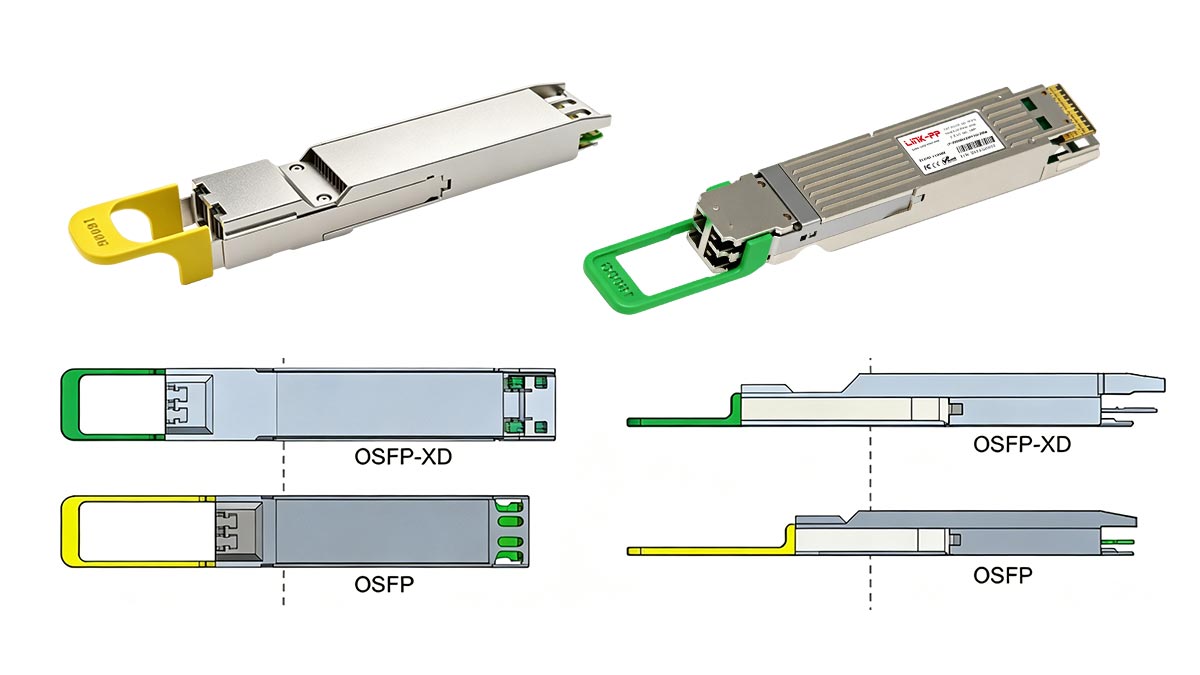
Two primary form factors are emerging for 1.6T deployments: OSFP and OSFP-XD.
- OSFP (Octal Small Form-factor Pluggable)
- Already widely used for 800G deployments
- Designed to support higher power envelopes required for 1.6T
- Offers backward compatibility with existing OSFP ports in some cases
- OSFP-XD (Extended Density)
- A newer, higher-density evolution of OSFP
- Supports more electrical lanes, enabling future scalability beyond 1.6T
- Designed for next-generation switch ASICs with ultra-high bandwidth
In simple terms, OSFP is the current mainstream path, while OSFP-XD is designed for future ultra-high-density deployments.
8×200G Lane Architecture
At the core of every 1.6T optical transceiver is its lane architecture, which determines how data is transmitted internally.
Most 1.6T modules use:
- 8 electrical lanes × 200G per lane
- Based on PAM4 modulation
This design allows the module to reach 1.6 Tbps total throughput while maintaining manageable signal integrity and power consumption.
Key advantages of this architecture:
- Efficient use of existing high-speed electrical interfaces
- Scalable design aligned with next-generation switch chips
- Balanced performance between bandwidth and thermal constraints
By distributing data across multiple lanes, the system achieves high throughput without relying on a single ultra-high-speed channel, which would be significantly harder to stabilize.
DR8, FR4, and SR8 Overview
Different deployment scenarios require different optical interfaces. The most common types for 1.6T transceivers include DR8, FR4 (or 2×FR4), and SR8.
- DR8 (Data Rate 8 lanes)
- Uses parallel single-mode fiber
- Typically supports distances up to 500 meters
- Ideal for intra-data center connections
- FR4 / 2×FR4
- Uses wavelength-division multiplexing (WDM)
- Supports longer reach, typically up to 2 kilometers
- Suitable for data center interconnect (DCI) or campus links
- SR8 (Short Range 8 lanes)
- Uses multimode fiber (MMF)
- Designed for very short distances (within racks or rows)
- Offers cost advantages for short-reach applications
Quick Comparison Table
| Type |
Fiber Type |
Typical Reach |
Use Case |
Key Advantage |
| DR8 |
Single-mode (SMF) |
≤ 500 m |
Data center internal links |
Balanced performance & cost |
| FR4 |
Single-mode (SMF) |
≤ 2 km |
DCI / campus connections |
Longer reach with fewer fibers |
| SR8 |
Multimode (MMF) |
≤ 100 m |
Rack-to-rack / intra-rack |
Lowest cost for short distance |
Each option involves trade-offs between distance, cost, fiber type, and complexity, making it critical to match the transceiver type to your specific network design.
Understanding these form factors and standards ensures that your 1.6T deployment is not only high-performing but also aligned with your infrastructure, scalability goals, and long-term roadmap.
⏩ 1.6T vs. 800G: Performance, Power, and Cost Trade-Offs
As data centers evaluate the transition from 800G to 1.6T, the decision goes beyond simply doubling bandwidth. It involves careful consideration of performance gains, power consumption, and overall cost efficiency. Understanding these trade-offs is essential for making the right upgrade strategy.
Bandwidth Comparison
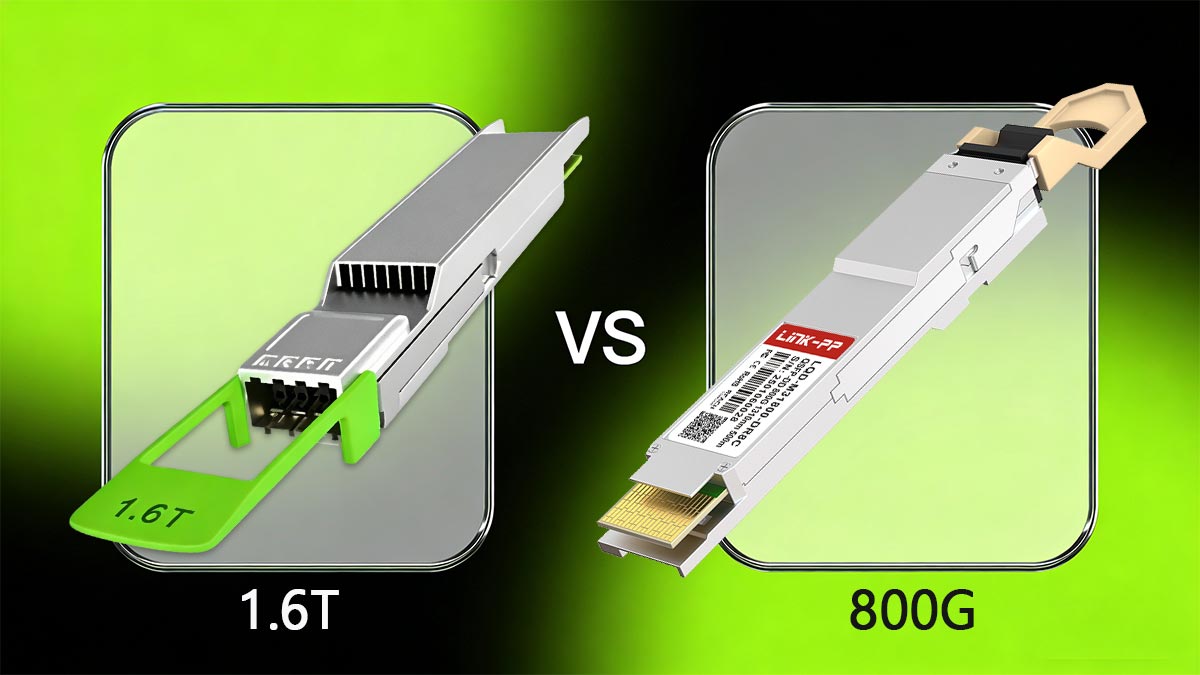
The most obvious difference is throughput:
- 800G transceiver: 800 Gbps total bandwidth
- 1.6T transceiver: 1.6 Tbps total bandwidth
This represents a 2× increase in bandwidth per port, which has several practical implications:
- Fewer physical links required for the same capacity
- Higher switch port density utilization
- Simplified network topology in large-scale deployments
For AI clusters and hyperscale environments, this means faster data exchange between nodes and improved overall system performance.
Power and Thermal Considerations
While 1.6T modules deliver higher bandwidth, they also introduce new challenges in terms of power consumption and heat dissipation.
- 800G modules typically consume ~12–18W
- 1.6T modules can exceed 25–30W per module
This increase is driven by:
- Higher-speed DSP chips
- More complex signal processing
- Increased lane data rates
As a result, deploying 1.6T optics requires:
- Advanced cooling solutions (airflow optimization, liquid cooling in some cases)
- Careful thermal design at the rack and switch level
- Validation of power budgets across high-density ports
Ignoring these factors can lead to performance degradation or hardware instability.
Cost-Per-Bit and Deployment Efficiency
Despite higher upfront costs, 1.6T transceivers often deliver better cost efficiency per bit when deployed at scale.
Key advantages include:
- Lower cost per Gbps compared to 800G over time
- Reduced number of transceivers and fiber links needed
- Lower operational complexity in large networks
However, real-world cost efficiency depends on several factors:
- Existing fiber infrastructure (SMF vs. MMF)
- Compatibility with current switching hardware
- Volume pricing and supplier selection
For organizations planning large-scale upgrades, 1.6T can significantly improve long-term ROI—especially in environments where bandwidth demand is rapidly increasing.
In summary, moving from 800G to 1.6T offers clear performance and scalability benefits, but requires careful planning around power, cooling, and deployment costs. The right choice depends on balancing immediate infrastructure constraints with long-term growth objectives.
⏩ How to Choose the Right 1.6T Module for Your Network
Selecting the right 1.6T optical transceiver is not just about speed—it requires aligning the module with your fiber infrastructure, switching hardware, and real deployment scenario. A well-matched choice can significantly improve performance, reduce cost, and avoid compatibility issues.
Choosing by Reach and Fiber Type
The first and most critical factor is transmission distance and fiber type. Different 1.6T modules are optimized for specific environments:
- SR8 (Multimode Fiber, ≤100m)
Best for short-range connections such as rack-to-rack or within the same row.
Ideal if you already use MMF and want lower cost for short distances
- DR8 (Single-Mode Fiber, ≤500m)
Suitable for most intra-data center links.
A balanced choice for performance, flexibility, and scalability
- FR4 / 2×FR4 (Single-Mode Fiber, ≤2km)
Designed for longer reach, such as campus or DCI connections.
Best when distance and fiber efficiency are key priorities
Key takeaway: Choose based on your existing fiber plant—switching from MMF to SMF (or vice versa) can significantly increase deployment cost.
Choosing by Switch Compatibility
Even the most advanced transceiver will fail if it is not compatible with your switching equipment. Compatibility depends on several factors:
- Form factor support (OSFP or OSFP-XD)
- Switch ASIC bandwidth (e.g., 25.6T vs 51.2T platforms)
- Vendor coding and firmware requirements
Many network vendors enforce strict compatibility checks, which can limit third-party module usage.
To avoid issues:
- Verify your switch vendor’s compatibility list
- Ensure proper EEPROM coding for interoperability
- Test modules in real hardware before large-scale deployment
In practice, compatibility is one of the most common causes of deployment failure.
Choosing by Application Scenario
Different network environments have different priorities. Matching the module to the application ensures optimal performance and cost efficiency.
1. AI / GPU Clusters
- Require ultra-high bandwidth and low latency
- Prefer DR8 or SR8 for high-density, short-range interconnects
- Focus on performance and thermal stability
2. Hyperscale Data Centers
- Need scalable, cost-efficient architectures
- Typically deploy a mix of DR8 and FR4
- Emphasize cost-per-bit and fiber efficiency
3. Data Center Interconnect (DCI)
- Requires longer transmission distances
- Best suited for FR4 / 2×FR4
- Focus on reach and signal reliability
4. Enterprise / Emerging Deployments
- May not fully utilize 1.6T yet
- Should prioritize future-proofing and compatibility
Practical Decision Tip
If you’re unsure where to start:
- Use SR8 for short, cost-sensitive MMF environments
- Use DR8 as a default for most modern data centers
- Use FR4 when distance exceeds standard intra-DC ranges
Choosing the right 1.6T module ultimately comes down to aligning technical requirements with real-world constraints. A thoughtful selection process helps you avoid costly mistakes and ensures your network is ready for the next generation of high-speed connectivity.
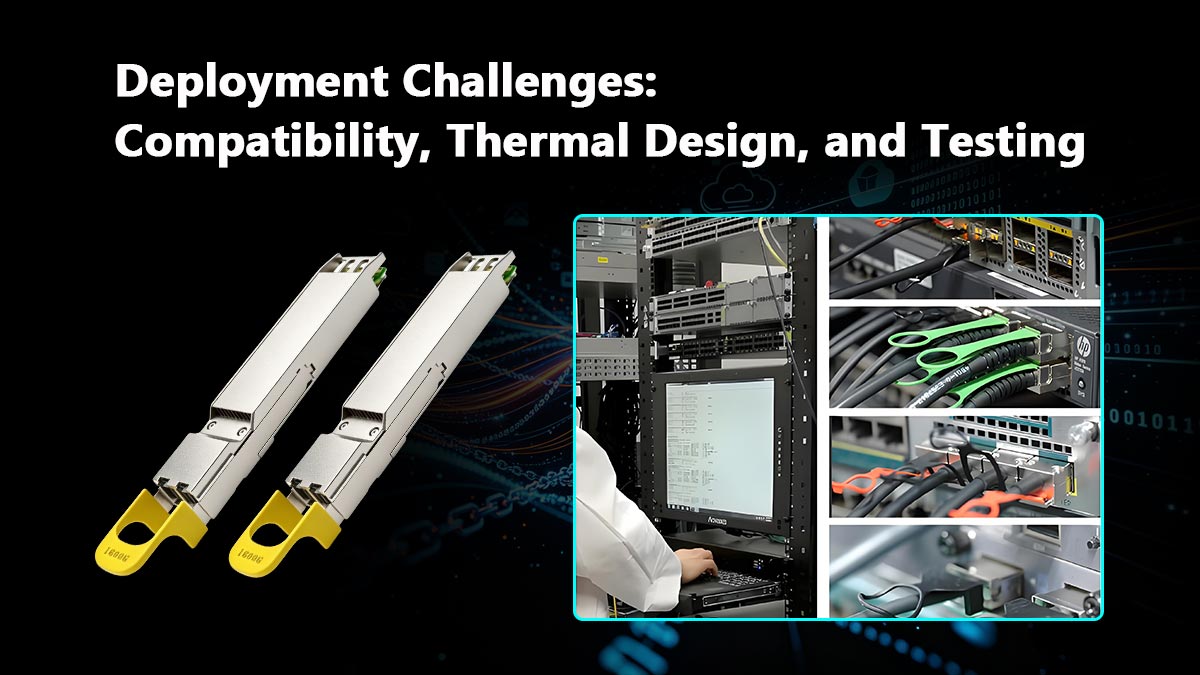
⏩ Deployment Challenges: Compatibility, Thermal Design, and Testing
While 1.6T optical transceivers offer significant performance gains, deploying them in real-world environments introduces several practical challenges. The most critical areas to address are compatibility, thermal management, and proper validation, all of which directly impact network stability and long-term reliability.
Interoperability and Vendor Coding
One of the most common deployment issues is interoperability between transceivers and switching equipment.
Many OEM vendors implement strict firmware checks that only allow approved modules to function properly. This creates challenges when using third-party or cost-optimized alternatives.
Key considerations include:
- EEPROM coding and vendor lock-in mechanisms
- Differences in firmware behavior across switch platforms
- Potential risks of link failure or degraded performance
To mitigate these risks:
- Ensure transceivers are properly coded for your target switch brand
- Work with suppliers that provide compatibility testing reports
- Validate interoperability in a controlled environment before deployment
In high-speed environments like 1.6T, even minor compatibility issues can lead to unstable links or reduced performance.
Heat Management in Dense AI Racks
Thermal management becomes a major concern as bandwidth—and power consumption—increases.
With 1.6T modules often exceeding 25–30W per unit, dense switch configurations can generate substantial heat, especially in AI clusters where port utilization is near 100%.
Common challenges include:
- Limited airflow in high-density switch designs
- Hot spots forming around fully populated ports
- Increased risk of thermal throttling or hardware shutdown
Effective strategies include:
- Optimizing front-to-back airflow design
- Using high-performance heat sinks and advanced cooling systems
- Considering liquid cooling solutions in extreme AI deployments
Proper thermal planning is essential to maintain consistent performance and extend equipment lifespan.
Validation and Lab Testing Before Rollout
Before deploying 1.6T transceivers at scale, thorough validation is critical. Skipping this step can lead to costly downtime and troubleshooting later.
A robust testing process should include:
- Compatibility testing with switches and firmware versions
- Signal integrity and bit error rate (BER) testing
- Thermal stress testing under full load conditions
- Interoperability checks across different vendors
Best practice is to simulate real deployment conditions as closely as possible in a lab environment. This ensures:
- Stable performance under peak traffic
- Early detection of potential issues
- Confidence in large-scale rollout
In summary, while 1.6T technology delivers cutting-edge performance, successful deployment depends on careful attention to compatibility, cooling, and validation processes. Addressing these challenges early will help ensure a smooth transition to next-generation network speeds.
⏩ FAQ About 1.6T Optical Transceivers
Q1: What form factor is most future-proof for 1.6T deployments?
While current deployments mainly use OSFP, newer designs like OSFP-XD are gaining attention due to their higher lane capacity and scalability. If you are planning long-term infrastructure upgrades, choosing platforms that support next-generation form factors can provide better flexibility for future speed transitions.
Q2: Can 1.6T optical transceivers be used in existing 800G networks?
In most cases, 1.6T transceivers are not backward compatible with 800G ports due to differences in electrical lane speed and hardware requirements. However, some network architectures may support breakout or hybrid configurations depending on the switch capabilities.
Q3: What type of fiber connector is used in 1.6T modules?
Most 1.6T transceivers use MPO/MTP connectors, especially for DR8 and SR8 variants, which rely on parallel fiber transmission. FR4-based modules may use LC duplex connectors due to wavelength multiplexing technology.
Q4: Are 1.6T optical transceivers widely available on the market?
As of now, 1.6T modules are in early commercialization stages. Availability is increasing, but most deployments are still limited to hyperscale and advanced data center environments. Broader adoption is expected as the ecosystem matures and production scales.
Q5: What are the typical use cases outside AI data centers?
Although AI is the primary driver, 1.6T transceivers can also be used in:
- High-performance computing (HPC) clusters
- Large-scale cloud infrastructure
- Data center interconnect (DCI) for high-capacity links
These environments benefit from ultra-high bandwidth and improved network efficiency.
Q6: How long will 1.6T remain relevant before the next upgrade cycle?
Based on current industry trends, 1.6T is expected to be a key deployment standard over the next several years, serving as a bridge toward future technologies like 3.2T optics and co-packaged optics (CPO). Its relevance will largely depend on how quickly next-generation switching and optical technologies mature.
⏩ Future Outlook: 1.6T, Co-Packaged Optics, and the Road to 3.2T
As the demand for bandwidth continues to accelerate, 1.6T optical transceivers represent not the final destination, but a critical step in the ongoing evolution of data center networking. Understanding what comes next helps organizations make smarter, future-ready decisions today.
What Comes After 1.6T
The industry roadmap is already moving toward 3.2T optical transceivers, which will again double bandwidth capacity. These next-generation modules are expected to:
- Utilize higher lane speeds (e.g., 400G per lane)
- Require even more advanced DSP technologies
- Push the limits of current pluggable form factors
However, as speeds increase, traditional pluggable optics may face physical and thermal limitations. This is why 1.6T is widely seen as a transition point, bridging current architectures with more radical innovations ahead.
How CPO May Change the Market
One of the most important emerging technologies is Co-Packaged Optics (CPO).
Unlike traditional pluggable transceivers, CPO integrates optical components directly with the switch ASIC on the same package. This approach offers several potential advantages:
- Reduced power consumption by shortening electrical trace lengths
- Improved signal integrity at ultra-high speeds
- Higher overall bandwidth density
At the same time, CPO introduces new challenges:
- Reduced flexibility compared to pluggable modules
- More complex maintenance and replacement processes
- Higher initial deployment costs
While CPO is still in early adoption, it is expected to play a major role in post-1.6T architectures, especially in hyperscale AI environments.
Long-Term Planning for Network Teams
For network architects and decision-makers, the key is to balance current deployment needs with future scalability.
Practical strategies include:
- Adopting 1.6T where bandwidth demand justifies it today
- Ensuring infrastructure supports next-generation form factors and higher power envelopes
- Designing networks with flexibility to adapt to CPO or future optical innovations
Organizations that plan proactively can avoid costly redesigns and stay aligned with the rapid pace of technological change.
Final Insight
The transition from 800G to 1.6T—and eventually to 3.2T—is being driven by a fundamental shift toward AI-centric computing. In this context, choosing the right optical solutions is not just a technical decision, but a strategic one.
👉 If you are evaluating reliable, cost-effective, and fully compatible 1.6T optical transceiver solutions, explore the LINK-PP Official Store to find tested modules designed for modern AI and hyperscale data center deployments.