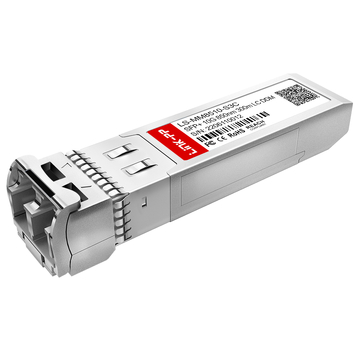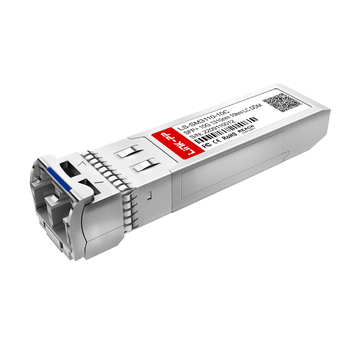
The HPE 455886-B21 is a dedicated 10G SFP+ LR optical transceiver engineered for HPE BladeSystem c-Class networking environments that require reliable long-distance fiber connectivity. Designed to deliver 10 Gigabit Ethernet transmission over single-mode fiber up to 10 kilometers, this module combines the flexibility of a hot-pluggable SFP+ form factor with enterprise-grade optical stability for data center uplinks, inter-switch communication, and blade infrastructure expansion.
As an LR (Long Reach) transceiver, the HPE 455886-B21 operates at a 1310nm wavelength and uses a duplex LC optical connector, making it suitable for installations where standard multimode short-range optics are no longer sufficient. Compared with SR modules used for short in-rack fiber runs, this 10G LR optic is built for longer backbone links that demand lower attenuation and more stable signal transmission across single-mode cabling.
Because optical modules must match not only transmission standards but also host hardware requirements, understanding the exact HPE 455886-B21 SFP 10G LR specs, supported platforms, and deployment conditions is essential before installation. From BladeSystem enclosure networking to Virtual Connect uplinks and enterprise 10Gb optical expansion, choosing the correct LR transceiver can directly affect link stability, compatibility, and long-term network performance.
This guide provides a complete breakdown of HPE 455886-B21 technical specifications, compatible HPE systems, LR vs. SR differences, fiber cabling requirements, and practical selection advice to help you determine whether this 10G SFP+ LR optic is the right choice for your network.
🔶 What Is HPE 455886-B21 SFP+ LR Transceiver?
HPE 455886-B21 is an HPE BladeSystem c-Class 10Gb SFP+ LR transceiver designed for long-reach 10 Gigabit Ethernet transmission over single-mode fiber up to 10 kilometers. As an LR (Long Reach) optical module, it operates at 1310nm wavelength with a duplex LC connector, allowing HPE blade infrastructures and enterprise optical networks to maintain stable high-speed connectivity across much greater distances than standard short-range multimode optics.
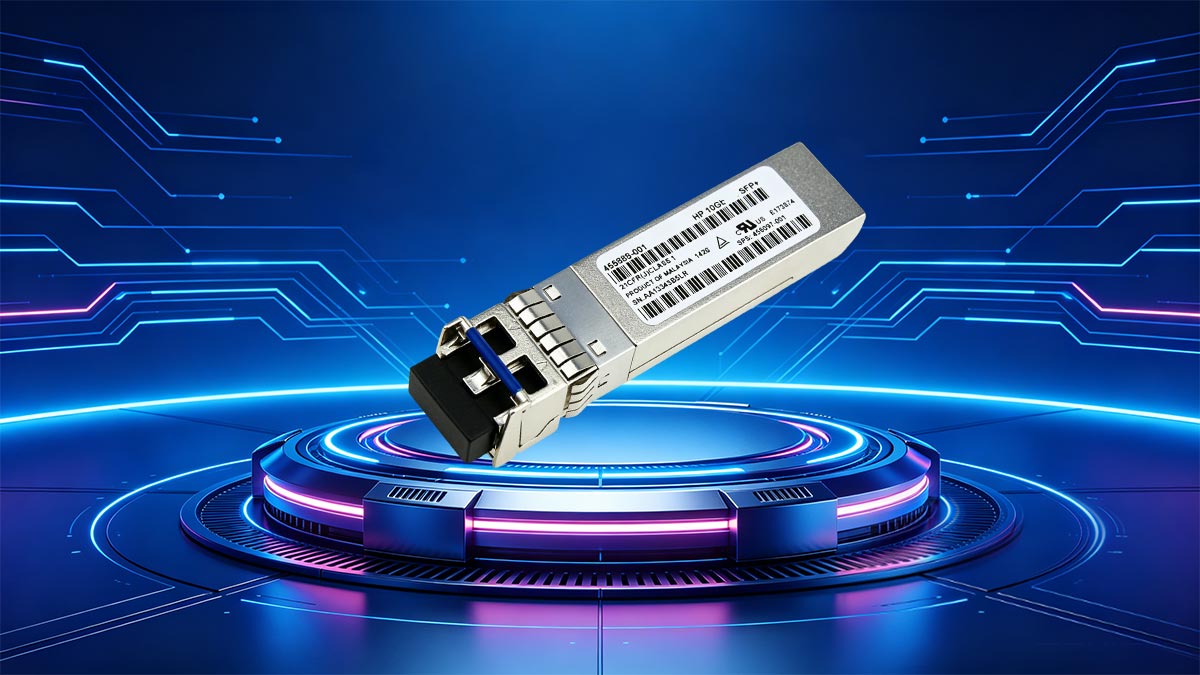
Built in the compact hot-pluggable SFP+ form factor, the HPE 455886-B21 enables flexible deployment in supported HPE BladeSystem c-Class enclosures, Virtual Connect modules, and other 10Gb networking interfaces that require LR optical uplinks. Its primary role is to convert electrical 10Gb Ethernet signals into optical transmission suitable for single-mode fiber backbones, making it a practical solution for data center aggregation, cross-room interconnection, and building-to-building fiber communication.
Unlike SR optics that are limited to short multimode fiber runs, the HPE 455886-B21 SFP+ LR transceiver is specifically engineered for applications where longer reach, lower signal loss, and stronger transmission reliability are required. This makes it one of the standard HPE choices for enterprise environments migrating from short internal fiber links to extended 10Gb optical infrastructure.
🔶 HPE 455886-B21 SFP 10G LR Specs at a Glance
Before deploying any long-range optical module, the first thing network engineers need is a clear understanding of whether the optic’s physical and transmission characteristics match the host environment. The HPE 455886-B21 fiber SFP 10G LR transceiver is designed as a standards-based 10 Gigabit long-reach optical solution, combining enterprise BladeSystem compatibility with stable single-mode fiber performance.
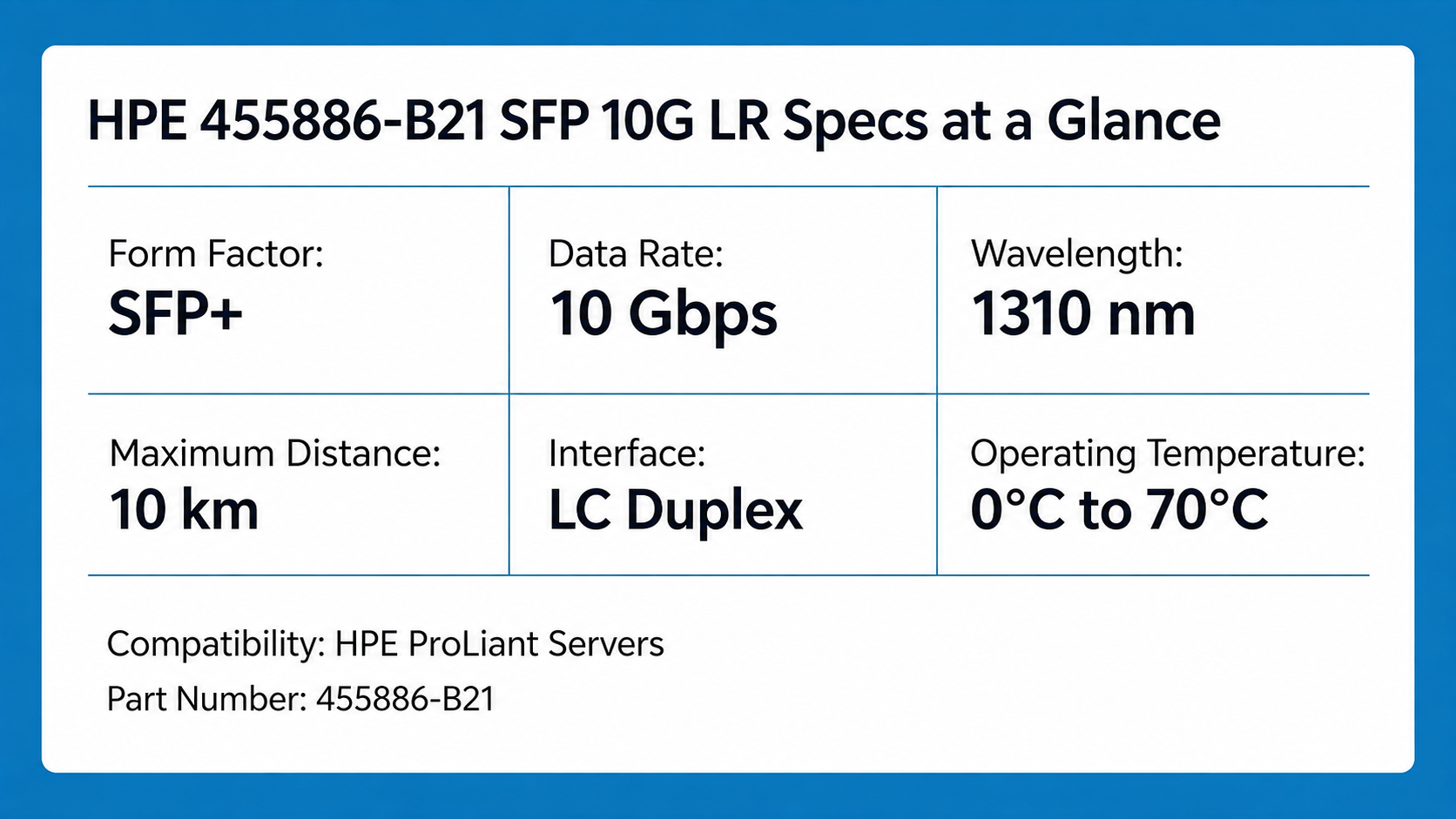
Core Technical Specifications of HPE 455886-B21
|
Specification |
HPE 455886-B21 Details |
|---|---|
|
Product Type |
HPE BladeSystem c-Class 10Gb SFP+ LR Transceiver |
|
Form Factor |
SFP+ |
|
Data Rate |
10Gbps |
|
Optical Standard |
10GBASE-LR |
|
Wavelength |
1310nm |
|
Connector Type |
Duplex LC |
|
Fiber Mode |
Single-Mode Fiber (SMF) |
|
Maximum Transmission Distance |
10 km |
|
Hot Pluggable |
Yes |
|
Typical Power Consumption |
Low Power Design |
|
Application Family |
HPE BladeSystem c-Class |
This specification profile places the HPE 455886-B21 in the category of enterprise LR 10G SFP+ modules intended for longer uplink connections where multimode SR optics cannot provide sufficient distance or optical stability.
Why These Specs Matter in Real 10Gb Deployments
On paper, these numbers may look like standard transceiver data, but each one directly affects whether the module will perform reliably in a production network.
The SFP+ form factor ensures that the module can be inserted or replaced without shutting down the host device, which is especially important in HPE BladeSystem and Virtual Connect environments where minimizing maintenance downtime is critical. The 10Gbps line rate supports full 10 Gigabit Ethernet throughput for server uplinks, storage traffic, and aggregation links without bandwidth bottlenecks.
Its 1310nm long-range optical transmission is the defining feature that separates this module from short-range alternatives. Operating over single-mode fiber, the HPE 455886-B21 can maintain a clean optical signal across distances up to 10 kilometers, making it suitable for cross-data-center runs, equipment room interconnects, and enterprise backbone fiber paths where SR multimode optics would fail due to attenuation limits.
The use of a duplex LC connector also means the module follows one of the most widely deployed enterprise optical cabling standards, simplifying integration with existing patch panels and SMF infrastructure. In addition, the module’s low power consumption helps reduce thermal load in dense blade or switch deployments where multiple optics may be installed simultaneously.
In practical terms, the HPE 455886-B21 is not simply a 10Gb transceiver—it is a purpose-built long-distance 10G optical uplink module for organizations that need a combination of HPE host compatibility, single-mode reach, and dependable enterprise signal performance.
🔶 Which HPE Systems Is HPE 455886-B21 Compatible With?
Optical performance alone does not guarantee successful deployment. In enterprise networking, a transceiver must also be recognized correctly by the host platform, match the required Ethernet optical standard, and maintain stable communication with the connected peer device. The HPE 455886-B21 is engineered primarily for HPE BladeSystem c-Class 10Gb networking architectures, but its actual compatibility extends across several HPE optical networking environments when the host port supports 10GBASE-LR SFP+ operation.
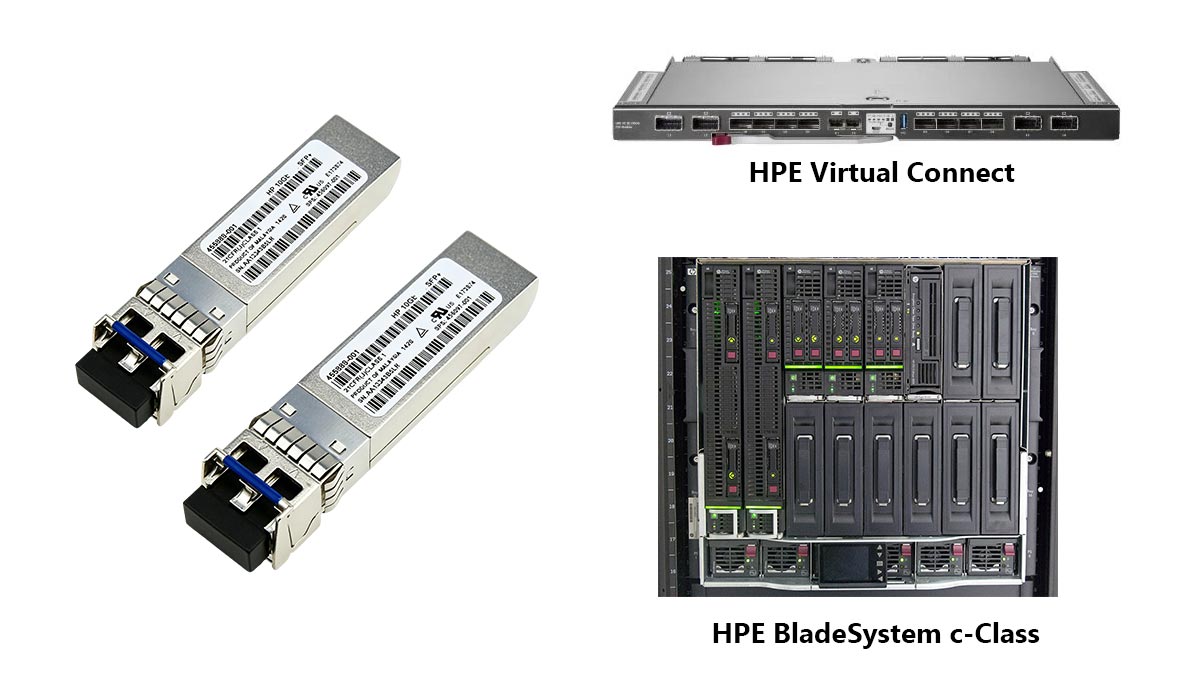
HPE BladeSystem c-Class Supported Platforms
The HPE 455886-B21 SFP+ LR transceiver was originally released as part of the HPE BladeSystem c-Class optical connectivity family, which means it is intended for blade enclosure uplinks, interconnect modules, and long-distance optical Ethernet paths inside HPE converged infrastructures.
In practical deployment, this includes environments where administrators need to extend 10Gb traffic from:
-
Blade server enclosures to aggregation switches
-
c-Class interconnect bays to core network uplinks
-
enclosure-to-enclosure optical backbone connections
-
remote data room or cross-floor enterprise fiber runs
Because it follows the 10GBASE-LR optical standard, the module provides the required signaling format for long-reach single-mode fiber Ethernet communication while maintaining HPE-qualified coding for proper hardware recognition in supported BladeSystem hosts.
HPE Virtual Connect and Network Adapter Compatibility
Beyond the physical c-Class enclosure itself, the HPE 455886-B21 is commonly deployed in HPE Virtual Connect modules, FlexFabric uplinks, and HPE 10Gb SFP+ server adapters that accept HPE-coded LR optics.
This is an important distinction: even if two modules share the same SFP+ shape, not every host will initialize every optic identically. HPE network environments often validate:
-
EEPROM vendor coding
-
optical power parameters
-
digital diagnostics communication
-
supported transceiver ID profiles
For this reason, the HPE 455886-B21 is typically selected when administrators need a native HPE-coded 10G LR transceiver that can integrate cleanly into:
-
HPE BladeSystem Virtual Connect Ethernet modules
-
HPE Flex-10 / FlexFabric interconnects
-
HPE SFP+ server NICs
-
supported HPE storage or switching uplink interfaces
Using an HPE-qualified optic helps reduce common enterprise issues such as transceiver warning messages, port-disable behavior, or unstable optical negotiation during firmware checks.
Will HPE 455886-B21 Work With Non-HPE Switches?
Yes — in most cases, HPE 455886-B21 can establish optical links with non-HPE switches, routers, or aggregation devices, provided that the remote port also supports the 10GBASE-LR standard, uses 1310nm single-mode optics, and is connected through properly matched duplex LC single-mode fiber.
This is because optical interoperability is determined primarily by:
-
identical Ethernet optical standard
-
matching wavelength
-
same fiber mode
-
compatible connector type
-
acceptable optical power budget
As long as both ends are configured as 10GBASE-LR, the optical signal itself can communicate normally even when the peer side is Cisco, Juniper, Dell, Aruba, or another standards-compliant switch.
However, there is one critical compatibility difference that buyers should understand:
Link interoperability and host recognition are not the same thing.
The remote switch may communicate perfectly at the optical layer, but the HPE host side still expects proper transceiver identification and supported coding behavior. That is why HPE-qualified modules such as 455886-B21 are often preferred in production BladeSystem environments where firmware-level hardware validation is stricter than in generic open networking platforms.
In short, the HPE 455886-B21 is best understood as a native HPE 10Gb LR optic built for BladeSystem c-Class and related HPE SFP+ hosts, while still maintaining standards-based interoperability with most third-party 10GBASE-LR network equipment.
🔶 HPE 455886-B21 vs. HPE 455883-B21: LR vs. SR Which Should You Choose?
Among HPE BladeSystem optical modules, the two part numbers most often compared are HPE 455886-B21 and HPE 455883-B21. Although both are 10Gb SFP+ transceivers built for the same HPE c-Class ecosystem, they are designed for completely different transmission distances and fiber infrastructures.
According to HPE QuickSpecs, 455886-B21 is the 10GBASE-LR long-range version, while 455883-B21 is the 10GBASE-SR short-range version. Both share the same SFP+ footprint and duplex LC interface, but their wavelength, supported fiber type, and deployment logic are not interchangeable.
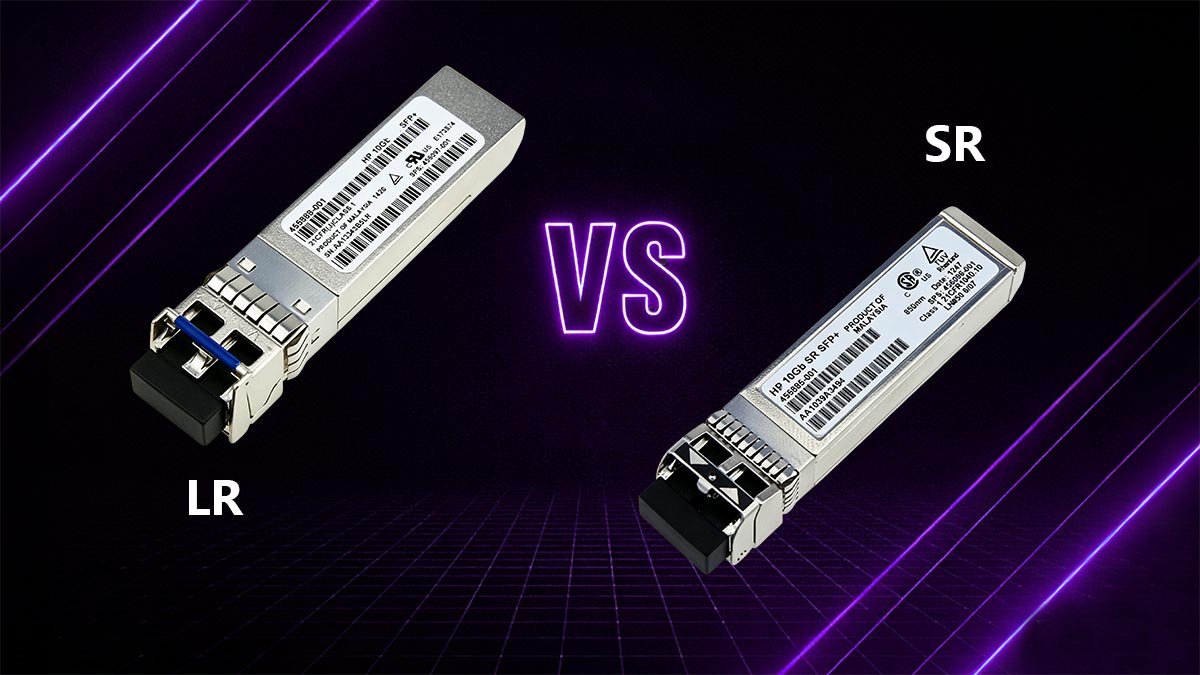
Transmission Distance Comparison
The most obvious difference is optical reach.
The HPE 455886-B21 LR module is designed to carry 10Gb Ethernet traffic across single-mode fiber up to 10 kilometers, making it suitable for longer enterprise backbone links, cross-room aggregation, and campus interconnects.
By contrast, the HPE 455883-B21 SR module is built for short-distance multimode fiber transmission up to 300 meters under HPE’s standard specification. It is intended primarily for short switch-to-server links, top-of-rack aggregation, or compact internal data center runs.
This means the decision is not simply LR versus SR pricing—it is fundamentally a question of required link distance.
|
Comparison Item |
HPE 455886-B21 (LR) |
HPE 455883-B21 (SR) |
|---|---|---|
|
Optical Standard |
10GBASE-LR |
10GBASE-SR |
|
Form Factor |
SFP+ |
SFP+ |
|
Max Distance |
10 km |
300 m |
|
Wavelength |
1310 nm |
850 nm |
|
Fiber Type |
Single-Mode Fiber |
Multi-Mode Fiber |
|
Connector |
Duplex LC |
Duplex LC |
|
Typical Deployment |
Long uplinks / backbone links |
Short rack or room links |
Single-Mode vs. Multi-Mode Fiber Difference
Another critical distinction is the required fiber cabling.
The HPE 455886-B21 uses single-mode fiber (SMF), which has a much narrower core and lower attenuation rate. This allows the optical signal to travel farther with minimal dispersion, making it the standard choice for building-to-building or long in-facility 10Gb links.
The HPE 455883-B21, on the other hand, uses multi-mode fiber (MMF) at 850nm, which is optimized for shorter, lower-cost internal runs. Multimode is common in rack-level or room-level cabling because patch cords are inexpensive and installation is straightforward, but the signal degrades far more quickly over distance.
Community deployment discussions reflect this exact selection logic as well. In one highly engaged r/networking and r/homelab pattern, engineers repeatedly note that if the run is only a few feet or inside the same room, SR or even DAC is usually enough; LR becomes necessary only when distance or existing SMF infrastructure dictates it.
Cost vs. Deployment Scenario
From a pure hardware perspective, the SR version (455883-B21) is usually the lower-cost deployment because:
-
SR optics are generally cheaper than LR optics,
-
multimode patch cables cost less,
-
and short-distance optical budgets are simpler.
That makes 455883-B21 the practical option when all devices are located within the same rack row, server room, or nearby switch cabinet.
The LR version (455886-B21) involves a higher optic cost because it uses 1310nm long-range laser transmission and requires single-mode fiber infrastructure, but it becomes the correct investment when:
-
the link exceeds SR distance limits,
-
the site already runs SMF backbone cabling,
-
or future network expansion may require longer uplink paths.
There is also an operational advantage: deploying LR optics from the beginning often avoids the need to replace modules later if the network grows beyond short multimode limitations.
Which One Should You Choose?
The selection is straightforward:
-
Choose HPE 455883-B21 if your 10Gb connection is short, local, and built on multimode fiber.
-
Choose HPE 455886-B21 if you need long-distance 10Gb transport, single-mode backbone support, or enterprise uplink flexibility.
In other words, these two optics are not competitors in performance—they are solutions for two entirely different physical network layouts. The right choice depends less on the transceiver itself and more on the distance, fiber plant, and long-term expansion plan of your infrastructure.
🔶 When Should You Use HPE 455886-B21 10GBASE-LR SFP Module?
Not every 10Gb optical deployment requires a long-range transceiver, but when the network extends beyond the physical limits of short multimode links, the choice of optic becomes a design decision rather than a simple accessory purchase. The HPE 455886-B21 10GBASE-LR fiber optic SFP module is specifically intended for environments where stable 10Gb throughput, long-distance optical reach, and HPE-qualified host compatibility are all required at the same time. HPE officially positions this module as its BladeSystem c-Class 10Gb SFP+ LR transceiver, supporting 10GBASE-LR transmission up to 10 km on single-mode fiber.
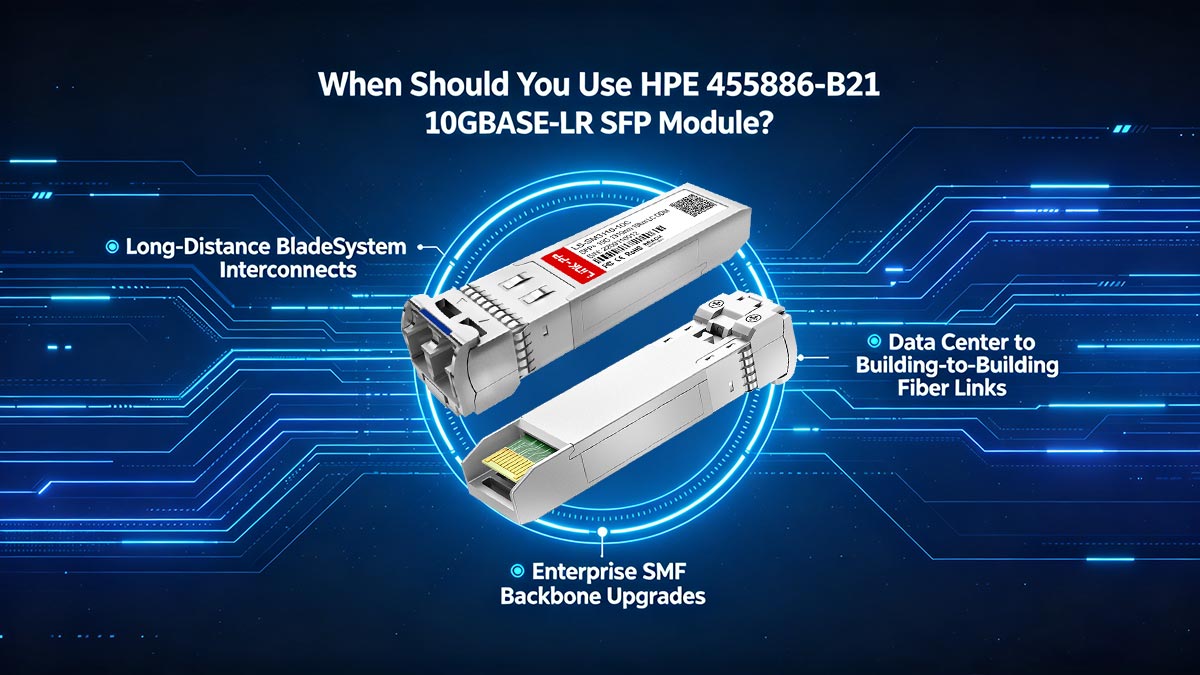
Long-Distance BladeSystem Interconnects
One of the most common deployment scenarios for the HPE 455886-B21 is inside BladeSystem c-Class infrastructures where blade enclosures must uplink to aggregation switches or core network layers that are no longer physically adjacent.
In small racks, SR optics may be enough. But once the enclosure sits:
-
in a separate equipment row,
-
across a large data hall,
-
inside another server room,
-
or on a different floor,
the transmission limitations of multimode optics quickly become restrictive.
Because the 455886-B21 uses 1310nm LR signaling over single-mode fiber, it gives BladeSystem administrators enough optical budget to maintain full 10Gb Ethernet stability without worrying about SR attenuation ceilings or marginal light loss.
This makes it especially suitable for:
-
Blade enclosure to core switch uplinks
-
Virtual Connect to distribution layer interconnects
-
c7000 enclosure long optical pass-through paths
-
high-availability dual-uplink backbone designs
Community deployment discussions around older HPE BladeSystem environments also show that HPE chassis and Flex-10 ecosystems can be particular about optic recognition, which is why many administrators prefer using native HPE-coded LR modules in production uplinks rather than experimenting with random third-party optics on critical chassis links.
Data Center to Building-to-Building Fiber Links
The HPE 455886-B21 10GBASE-LR SFP module becomes the correct choice whenever the network path extends beyond normal internal cabinet distances and enters cross-room, cross-building, or campus-style fiber runs.
Typical examples include:
-
connecting a server room to a disaster recovery room,
-
linking a primary data hall to a secondary switch room,
-
extending HPE blade traffic into a remote MDF/IDF,
-
or carrying 10Gb Ethernet between neighboring buildings.
In these cases, the 10 km single-mode transmission capability provides substantial engineering headroom even if the actual run is only several hundred meters or one to two kilometers. That extra optical margin helps absorb:
-
patch panel insertion loss,
-
connector aging,
-
future rerouting,
-
and environmental signal degradation.
Instead of designing close to the edge of SR limits, LR optics give the network a much safer long-term operating window.
Enterprise SMF Backbone Upgrades
Another strong reason to use the HPE 455886-B21 is when the enterprise has already standardized on single-mode fiber backbone infrastructure.
Many organizations upgrading from older Gigabit optical links to 10Gb Ethernet do not want to replace existing SMF trunks simply to accommodate cheaper short-range multimode modules. In these environments, deploying a native 10GBASE-LR SFP+ optic allows the HPE BladeSystem or SFP+ host to leverage the installed fiber plant immediately.
This creates three practical advantages:
-
no recabling cost,
-
much longer expansion flexibility,
-
and easier future migration to larger optical topologies.
Real-world HPE networking discussions repeatedly show that once enterprises move into qualified SFP+ adapters, BladeSystem uplinks, or supported HPE server interfaces, staying inside HPE-tested optic families reduces troubleshooting time significantly compared with mixing unsupported modules and then chasing firmware recognition issues later.
In simple terms, the HPE 455886-B21 10GBASE-LR SFP module should be used when your 10Gb link is no longer a short in-rack connection, when your infrastructure already relies on single-mode backbone cabling, or when the deployment demands the higher operational confidence of an HPE-qualified long-range optical transceiver.
🔶 Common HPE 455886-B21 Compatibility Problems and How to Avoid Them
Even when the optical specifications appear to match on paper, 10Gb SFP+ deployments can still fail because transceiver compatibility depends on more than wavelength and connector type. In HPE environments, link problems often come from host validation rules, unsupported optic detection, firmware interpretation, or incorrect fiber pairing rather than from a defective module itself. HPE documentation explicitly notes that some platforms will report optics as “unsupported transceivers” if the module is not listed in the validated support matrix or if the software release does not fully recognize the optic profile.
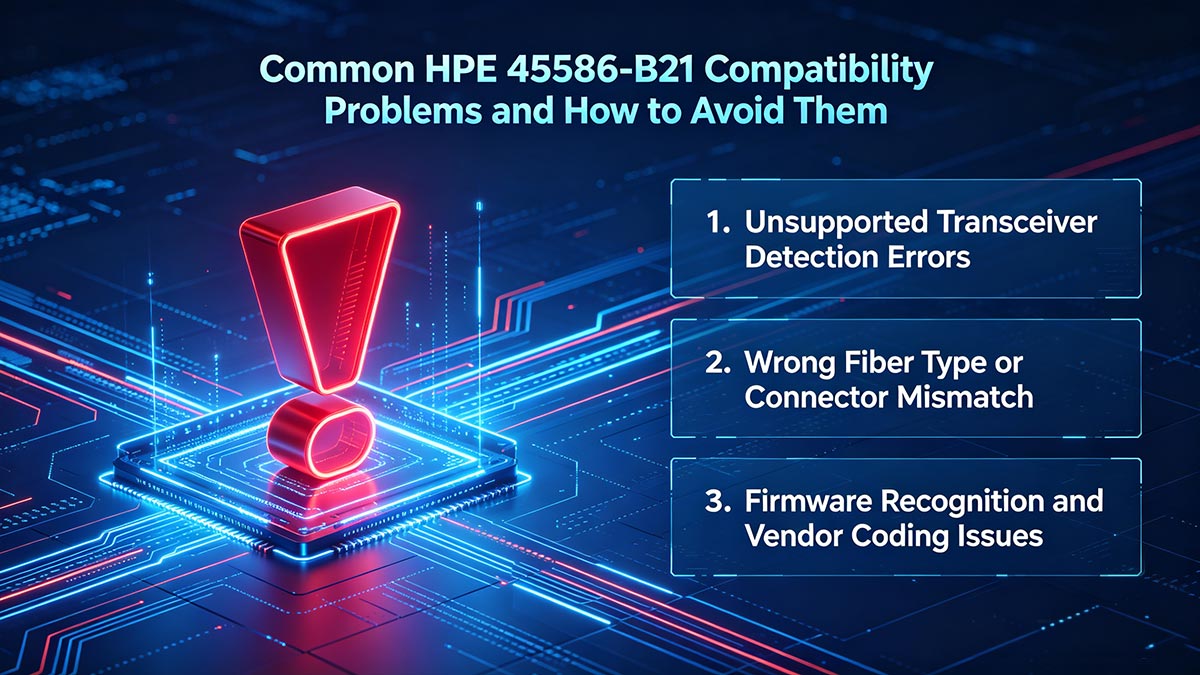
Understanding these common issues before installation can save hours of troubleshooting and prevent unnecessary module replacement.
1. Unsupported Transceiver Detection Errors
One of the most frequently reported deployment failures is the host port refusing to initialize the optic or generating an unsupported SFP+/transceiver warning immediately after insertion.
In practical terms, this may appear as:
-
no link light,
-
port disabled state,
-
system event log warnings,
-
fan speed anomalies,
-
or driver messages indicating unsupported module type.
HPE platforms, Aruba variants, and certain HPE-derived Intel adapters are known to perform transceiver identity checks during initialization. If the optic does not match an approved EEPROM profile, the host may still physically detect the module but refuse stable operation or mark it as unsupported. HPE’s own transceiver support documentation confirms that products outside the supported matrix may operate only on a best-effort basis and are not guaranteed for normal recognition.
A highly engaged r/homelab troubleshooting thread shows the same pattern: the adapter detected the inserted SFP+, but the driver log returned “Unsupported SFP+ or QSFP detected… failed to load because an unsupported SFP+ module type was detected.” The user ultimately had to move toward listed compatible modules such as 455886-B21.
How to avoid it:
Always verify that the host NIC, BladeSystem interconnect, or switch explicitly supports an HPE BladeSystem c-Class 10Gb SFP+ LR Transceiver or an HPE-coded equivalent before insertion.
2. Wrong Fiber Type or Connector Mismatch
Another surprisingly common issue is using the correct transceiver with the wrong optical media.
The HPE 455886-B21 is a 10GBASE-LR single-mode optic built for:
-
1310nm transmission
-
single-mode fiber (SMF)
-
duplex LC connectors
-
up to 10 km optical budget
If it is connected to:
-
multimode fiber,
-
incorrect patch cords,
-
dirty LC ferrules,
-
mismatched polarity,
-
or a peer optic using SR/MMF standards,
the result may be intermittent light, weak optical power, or complete link failure even though both modules appear inserted correctly. HPE lists 455886-B21 specifically as its LR single-mode member of the BladeSystem SFP+ family, separate from the SR multimode version.
How to avoid it:
Confirm that both ends are 10GBASE-LR, both use single-mode duplex LC fiber, and the patch path does not include mixed multimode jumpers.
3. Firmware Recognition and Vendor Coding Issues
Even genuine HPE optics can run into recognition problems if the host firmware is older, the transceiver family has been revised, or the software image expects a different validated transceiver table.
HPE support cases show that administrators sometimes insert an HPE-labeled optic that is physically similar but not fully sensed by the adapter because the firmware only recommends QuickSpecs-listed options. In one HPE community discussion, support explicitly advised users to rely on the exact modules listed in QuickSpecs after the transceiver was “not being sensed” by the server adapter.
This matters because SFP+ compatibility is not only electrical—it is also firmware interpretive. The host checks:
-
vendor identification bytes,
-
laser power class,
-
transceiver family code,
-
and approved product signatures.
If any of these are outside expectation, the optic may initialize unpredictably.
How to avoid it:
-
update NIC / switch / interconnect firmware first,
-
use QuickSpecs-listed supported optics,
-
avoid mixing unknown OEM revisions,
-
and test the optic in a known-supported HPE host before production rollout.
4. Why Some Third-Party Modules Fail in HPE Hosts
Many third-party optics advertise themselves as “HPE compatible,” but compatibility quality varies dramatically depending on how accurately the EEPROM coding emulates HPE’s expected transceiver identity.
A generic MSA-compliant optic may transmit light correctly yet still fail because the host does not recognize:
-
vendor code string,
-
digital diagnostics map,
-
serial ID formatting,
-
or HPE-specific identification behavior.
HPE and Aruba networking documentation openly state that unsupported products may light up physically but are not guaranteed to operate normally or expose full diagnostics.
Recent engineering discussions on r/ArubaNetworks show the same reality: some third-party 10G SFPs can function only when specially programmed, while others still require “allow unsupported transceiver” behavior because AOS and AOS-CX interpret the optic differently.
This is why two visually identical aftermarket optics can behave completely differently in the same HPE port:
-
one initializes instantly,
-
one throws warning logs,
-
one loses DOM support,
-
and one never links at all.
How to avoid it:
Choose either:
-
genuine HPE 455886-B21 modules, or
-
professionally HPE-coded compatible optics from vendors that specifically validate EEPROM programming for HPE BladeSystem and HPE SFP+ adapters.
In short, most HPE 455886-B21 compatibility problems are not caused by optical transmission failure—they are caused by recognition mismatch, wrong media pairing, or unsupported coding behavior before the light signal is ever allowed to pass normally.
🔶 Are Third-Party Compatible Optics a Good Alternative to HPE 455886-B21?
For many enterprise buyers, the biggest hesitation around the HPE 455886-B21 is not the technical specification—it is the OEM price. Genuine HPE-branded long-range transceivers are often significantly more expensive than aftermarket modules that advertise the same 10GBASE-LR, 1310nm, duplex LC, 10km single-mode performance. On the surface, the optical standard looks identical, which naturally raises the question: is a third-party compatible optic a practical replacement, or does OEM coding still matter?
The answer depends on three things: cost savings, host recognition reliability, and the quality of HPE-specific programming inside the replacement module.

OEM vs. Compatible Cost Difference
Original HPE optics carry the premium of:
-
HPE branding,
-
official qualification,
-
support warranty alignment,
-
and guaranteed inclusion inside HPE validated hardware lists.
That OEM assurance is valuable in mission-critical infrastructures, but it also pushes the purchase cost far above the raw component value of a standard 10G LR optical transceiver.
By contrast, many third-party manufacturers now produce HPE 455886-B21 compatible SFP+ LR modules using the same:
-
10Gb Ethernet optical standard,
-
1310nm DFB laser,
-
duplex LC optical interface,
-
single-mode 10km transmission design.
This can reduce procurement cost substantially, especially in deployments requiring:
-
multiple BladeSystem uplinks,
-
redundant dual-fiber paths,
-
spare optic inventory,
-
or large-scale data center optical refreshes.
For organizations managing dozens of SFP+ ports, the total savings from qualified compatible optics can become a significant budget advantage without changing the underlying network architecture.
Coding Reliability
However, the real issue is not whether the optic can transmit light—the real issue is whether the HPE host accepts it as a valid transceiver.
As discussed earlier, HPE BladeSystem modules, server adapters, and related SFP+ interfaces may validate:
-
vendor EEPROM identification,
-
digital diagnostic format,
-
supported transceiver family profile,
-
and firmware-recognized module signatures.
A low-cost generic optic may advertise “HPE compatible” but still fail if the EEPROM is only loosely programmed or cloned from a broad MSA template rather than written specifically for HPE host expectations.
This creates the most common aftermarket risks:
-
unsupported transceiver warnings,
-
unstable DOM readings,
-
port disable behavior,
-
or intermittent initialization failures after firmware upgrades.
This is why the compatible optics market is divided into two very different categories:
Category 1 — generic low-cost MSA optics
Often inexpensive, but host recognition is uncertain.
Category 2 — professionally HPE-coded compatible optics
Engineered with EEPROM programming and host validation specifically targeting HPE hardware.
Only the second category is a serious OEM alternative.
What to Look for in a Safe Replacement Module
A safe third-party replacement for HPE 455886-B21 should not be selected by optical specs alone. Buyers should verify that the module is explicitly built as:
-
HPE 455886-B21 coded
-
10GBASE-LR compliant
-
1310nm single-mode duplex LC
-
10km transmission tested
-
DDM/DOM supported
-
HPE BladeSystem / HPE SFP+ adapter validated
In addition, a reliable compatible supplier should be able to provide:
-
host compatibility test data,
-
EEPROM coding confirmation,
-
DOM diagnostic support,
-
burn-in or interoperability testing,
-
and warranty replacement assurance.
This separates professional compatible optics from anonymous low-end transceivers that only copy the physical shell.
For buyers who need to control hardware budgets without sacrificing network stability, a properly engineered HPE-compatible 455886-B21 replacement module can be a very practical alternative—as long as the compatibility programming is treated as seriously as the optical transmission specifications.
That is also why many enterprise network teams now choose tested compatible solutions from specialized transceiver manufacturers rather than paying full OEM pricing for every long-range SFP+ port.
🔶 FAQs About HPE 455886-B21 SFP 10G LR Specs

Question 1. What is HPE 455886-B21 used for?
HPE 455886-B21 is an HPE BladeSystem c-Class 10Gb SFP+ LR optical transceiver used to provide 10 Gigabit Ethernet connectivity over single-mode fiber for distances up to 10 kilometers. It is typically deployed for long-range uplinks, BladeSystem enclosure interconnects, enterprise backbone fiber links, and HPE Virtual Connect optical networking where short-range SR modules are not sufficient.
Question 2. Is HPE 455886-B21 LR or SR?
HPE 455886-B21 is an LR (Long Reach) transceiver.
It follows the 10GBASE-LR optical standard, operates at 1310nm, and is built for single-mode fiber transmission up to 10 km. The corresponding short-range HPE multimode version is HPE 455883-B21, which is an SR optic designed for much shorter distances.
Question 3. What fiber cable does HPE 455886-B21 use?
The HPE 455886-B21 SFP+ LR module requires:
-
single-mode fiber (SMF)
-
duplex LC optical connectors
-
low metal content fiber compliant with standard single-mode optical transmission specifications
Because it is a 1310nm LR optic, it should not be paired with standard multimode SR patch cords if full signal performance is expected.
Question 4. How far can HPE 455886-B21 transmit?
HPE 455886-B21 supports a maximum transmission distance of 10 kilometers under standard 10GBASE-LR single-mode fiber deployment conditions.
This long optical reach makes it suitable for:
-
data center cross-room uplinks,
-
building-to-building fiber runs,
-
remote switch aggregation,
-
and enterprise backbone interconnects.
Question 5. Can HPE 455886-B21 work with Cisco or other switches?
Yes. In most deployments, HPE 455886-B21 can interoperate with Cisco, Juniper, Dell, Aruba, and other third-party switches as long as the remote device also uses:
-
10GBASE-LR optics
-
1310nm wavelength
-
single-mode duplex LC fiber
Optical interoperability is standards-based, so the light transmission can communicate normally. The main compatibility concern is usually on the HPE host recognition side rather than the remote switch side.
Question 6. Is there a compatible replacement for HPE 455886-B21?
Yes. There are HPE 455886-B21 compatible SFP+ LR optics available from third-party transceiver manufacturers that provide the same:
-
10Gbps data rate,
-
1310nm LR optical standard,
-
duplex LC connector,
-
10km SMF transmission.
However, the replacement module should be specifically HPE-coded and host-validated, not just a generic MSA optic, to avoid unsupported transceiver warnings or firmware recognition problems.
Question 7. Is HPE 455886-B21 hot pluggable?
Yes. The module uses the standard SFP+ hot-pluggable form factor, which means it can be inserted or replaced without powering down the host device, provided the host platform supports normal hot-swap optical operation. This makes maintenance and optic upgrades much easier in dense enterprise blade or switch environments.
🔶 Final Recommendation: Is HPE 455886-B21 the Right 10G LR Optic for Your Network?
The HPE 455886-B21 remains the correct choice when your deployment requires three things at once: 10Gb Ethernet throughput, native HPE SFP+ host compatibility, and stable long-distance single-mode fiber transmission up to 10 km. HPE officially defines it as the BladeSystem c-Class 10Gb SFP+ LR Transceiver, and the optical profile—1310nm, duplex LC, SMF, 10GBASE-LR—is specifically built for enterprise uplinks that exceed the reach of standard SR optics.
In practical buying terms, the selection can be simplified into three deployment paths:
Choose HPE 455886-B21 if You Need 10km Single-Mode Fiber Reach
This module is the best fit when your network includes:
-
BladeSystem enclosure uplinks,
-
long server room to switch room runs,
-
building-to-building 10Gb links,
-
or enterprise SMF backbone infrastructure.
Because it is a true 10GBASE-LR single-mode optic, it gives you the transmission margin and HPE-coded recognition stability needed for production optical links where short multimode modules are simply not enough.
Choose HPE SR Optics Instead if Your Link Is Short and Uses MMF
If your optical path stays within the same rack row, cabinet group, or short internal equipment room distance, then an SR multimode transceiver such as HPE 455883-B21 is usually the more economical solution.
Short-range multimode optics reduce:
-
transceiver cost,
-
fiber patch cost,
-
and overall deployment complexity.
There is no technical benefit in paying for LR capability if the physical run never approaches SR limits.
Choose Professionally Coded Compatible Alternatives if OEM Budget Is Too High
This is where many enterprise buyers are moving now.
OEM HPE optics deliver maximum support confidence, but the price premium can become difficult to justify when deploying:
-
multiple redundant uplinks,
-
large optical refresh projects,
-
or spare inventory batches.
The good news is that there are now many professionally HPE-coded 455886-B21 compatible modules on the market that replicate the same 10GBASE-LR / 1310nm / LC / 10km SMF transmission profile while being specifically programmed for HPE host recognition. Vendors openly market these modules as tested HPE replacements with DOM/DDM support and validated interoperability.
Just as importantly, real-world admin discussions show the same conclusion repeatedly: generic unsupported optics can be hit-or-miss in HPE hardware, while properly coded compatible transceivers are often the practical middle ground between OEM stability and cost control.
Bottom Line
Choose HPE 455886-B21 when you need:
-
10km 10Gb single-mode transmission
-
HPE BladeSystem / HPE SFP+ native compatibility
-
long-term optical reliability in enterprise environments
Choose SR optics when the link is short and multimode.
Choose professionally HPE-coded compatible replacements when OEM procurement cost is the main concern but host stability still matters.
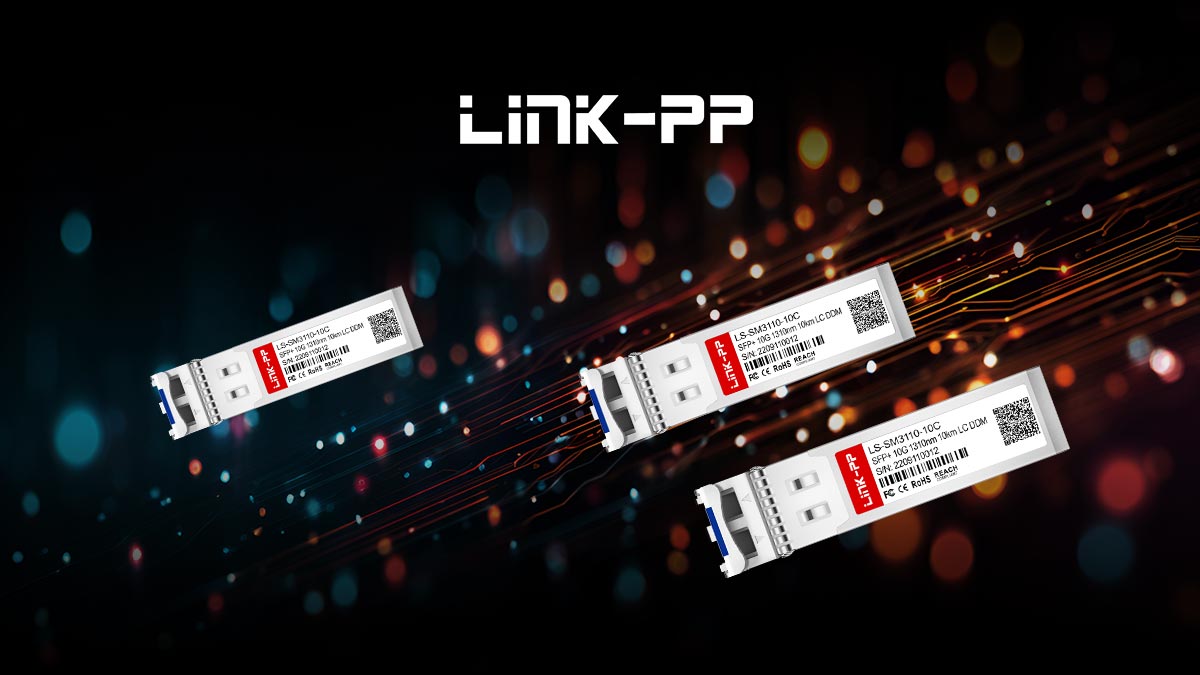
For buyers looking for a cost-effective and deployment-tested replacement, LINK-PP Official Store offers HPE 455886-B21 compatible 10GBASE-LR SFP+ optics engineered for HPE host recognition, 1310nm SMF transmission, and enterprise-grade interoperability without OEM-level pricing.