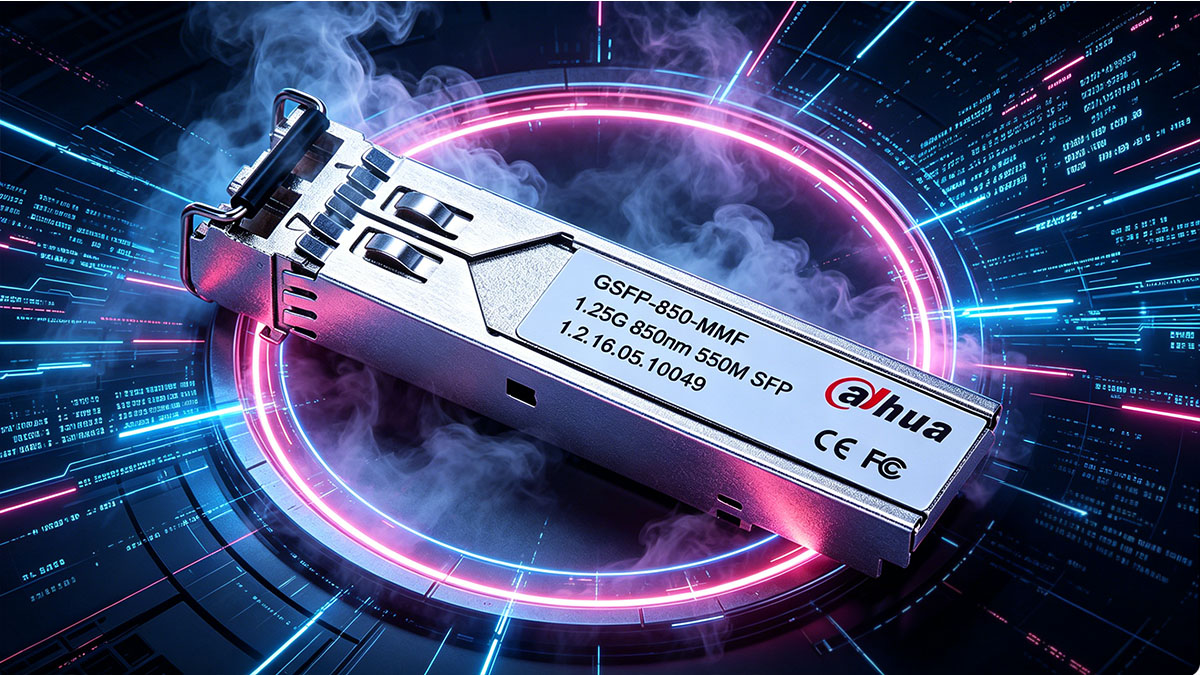
The Dahua GSFP-850-MMF is a 1.25Gbps multimode SFP optical transceiver widely used in surveillance networks and enterprise Ethernet infrastructures. It is designed to provide stable short-range optical connectivity over multimode fiber, typically supporting distances up to 550m depending on fiber grade. In practical deployments, it is most often associated with Dahua networking and CCTV ecosystems where reliable Gigabit data transmission is required.
From a technical standpoint, this module operates at an 850nm wavelength and uses an LC duplex interface, making it compatible with standard multimode fiber types such as OM2 and OM3. Its role is to convert electrical signals into optical signals and vice versa, ensuring efficient data transmission between switches, cameras, and other network devices. This makes it a foundational component in modern IP surveillance and access network architectures.
However, in real-world procurement and deployment scenarios, users often face challenges such as cost constraints, supply limitations, and vendor-specific compatibility restrictions. These factors have significantly increased interest in third-party compatible solutions that meet the same technical requirements while offering greater flexibility. Among these alternatives, LINK-PP has emerged as a widely recognized provider of compatible optical transceivers designed to match or exceed OEM specifications.
For network engineers, integrators, and IT procurement teams, understanding the Dahua GSFP-850-MMF is not only about its specifications, but also about evaluating reliable alternatives that ensure long-term scalability and cost efficiency. This article will explore its technical foundation, limitations, and how LINK-PP compatible modules provide a practical alternative in modern optical network deployments.
⭐ What Is Dahua GSFP-850-MMF?
The Dahua GSFP-850-MMF is a standard 1.25Gbps SFP optical transceiver designed for short-distance data transmission over multimode fiber. It is primarily used to connect network devices such as switches, IP cameras, and optical uplink ports in surveillance and enterprise Ethernet systems. In essence, it serves as a plug-in module that enables reliable Gigabit optical communication within a limited range environment.
In practical networking terms, this module is not just a passive component but a critical interface that ensures stable optical signal conversion and transmission efficiency. It is widely deployed in Dahua-based security infrastructures and other compatible Gigabit Ethernet networks where cost-effective short-reach optical connectivity is required.
Core Definition and Function
The core function of the Dahua GSFP-850-MMF is to convert electrical Ethernet signals into optical signals and transmit them through multimode fiber. This enables high-speed communication between network devices while minimizing electromagnetic interference, which is especially important in surveillance and industrial environments.
To better understand its functional profile, the key characteristics can be summarized as follows:
- Converts electrical signals to optical signals and vice versa
- Supports Gigabit Ethernet transmission (1.25Gbps class)
- Designed for multimode fiber infrastructure
- Enables short-distance interconnects between networking devices
This functional design ensures stable connectivity in environments where copper cabling is limited by distance or interference concerns. It is particularly effective in structured cabling systems where optical uplinks are required for performance stability.
Key Technical Specifications
From a technical perspective, the Dahua GSFP-850-MMF follows standard SFP optical module architecture with well-defined operating parameters. These specifications determine its compatibility and deployment range in real-world networks.
To present the core technical profile clearly, the main specifications are summarized in the table below:
| Parameter |
Specification |
| Data Rate |
1.25Gbps (Gigabit Ethernet) |
| Wavelength |
850nm |
| Fiber Type |
Multimode fiber (MMF, OM2/OM3 supported) |
| Maximum Distance |
Up to 550m (depending on fiber grade) |
| Connector Type |
LC duplex |
| DDM Support |
Typically supported |
These parameters define its role as a short-range optical transceiver optimized for cost-efficient Gigabit networking. The 850nm wavelength is specifically chosen for multimode transmission, allowing efficient signal propagation over short distances without requiring single-mode infrastructure.
In addition to these specifications, the module is generally compliant with industry-standard SFP form factors, ensuring physical compatibility with a wide range of networking equipment.
Typical Deployment Scenarios
The Dahua GSFP-850-MMF is commonly deployed in environments where reliable short-distance optical connectivity is required, particularly in surveillance and access network systems. Its usage is driven by the need to extend network reach beyond the limitations of copper Ethernet cabling.
Typical deployment scenarios include:
- IP surveillance systems connecting cameras to NVRs or switches
- Enterprise LAN uplink connections within buildings or campuses
- Short-range data center interconnects between access switches
- Security monitoring infrastructures in commercial or industrial sites
In surveillance applications, for example, it is often used to connect distributed IP cameras to central management systems over fiber, ensuring stable video transmission without electromagnetic interference. In enterprise environments, it supports backbone or access-layer connections where Gigabit speed is sufficient and cost efficiency is a priority.
Overall, the Dahua GSFP-850-MMF plays a foundational role in short-range optical networking, balancing performance, simplicity, and deployment flexibility in Gigabit Ethernet environments.
⭐ Limitations of Original Dahua GSFP-850-MMF Modules
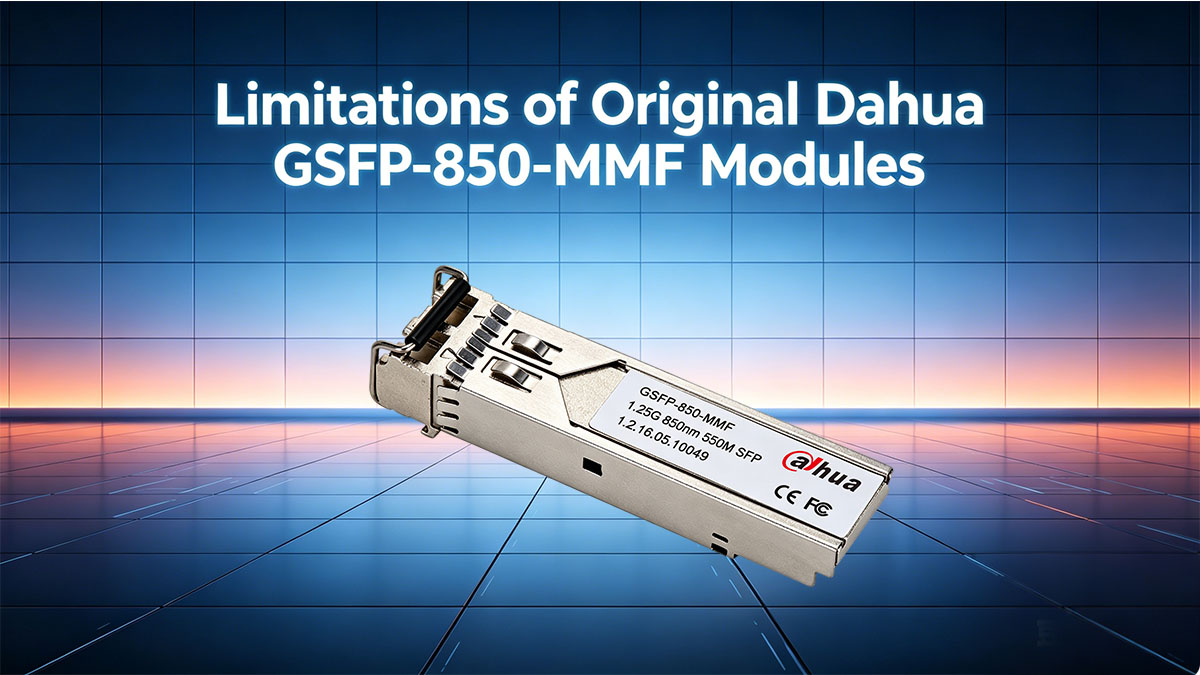
Original Dahua GSFP-850-MMF modules are widely used in surveillance and Gigabit Ethernet networks, but they are not without limitations. While they provide stable performance in Dahua-centric environments, their constraints become more visible in large-scale, multi-vendor, or cost-sensitive deployments where flexibility and supply continuity are critical.
Cost Considerations
One of the most immediate limitations is the relatively high procurement cost compared to third-party alternatives. In practice, this affects both small installations and large infrastructure rollouts where optical modules are required in high volumes.
Key cost-related constraints include:
- Higher unit price compared to compatible SFP modules
- Increased total cost of ownership in large deployments
- Limited pricing flexibility across different distribution channels
- Budget inefficiency for non-brand-critical applications
This pricing structure is often justified by OEM branding and ecosystem alignment, but from a network scaling perspective, it can significantly increase capital expenditure, especially in projects involving hundreds or thousands of ports.
Supply Chain and Availability
Another important limitation is related to sourcing consistency and availability. Dahua-branded optical modules are typically distributed through specific channels, which can introduce procurement delays or regional restrictions.
Common supply-related challenges include:
- Limited stock availability in certain regions
- Longer lead times during high-demand periods
- Dependency on authorized distribution networks
- Reduced flexibility in emergency replacements or expansions
In operational environments such as surveillance systems or enterprise networks, delays in module availability can directly impact deployment schedules and maintenance operations. This makes supply chain predictability a critical concern for system integrators and IT teams.
Vendor Lock-In Challenges
A further limitation is the level of ecosystem dependency associated with OEM modules. Dahua GSFP-850-MMF modules are primarily optimized for Dahua equipment, which can create compatibility constraints in mixed-vendor environments.
Key vendor lock-in effects include:
- Reduced interoperability with non-Dahua networking devices
- Potential compatibility restrictions in firmware or device recognition
- Limited flexibility in heterogeneous network architectures
- Increased reliance on a single vendor ecosystem for expansion
While this ensures optimized performance within Dahua systems, it can restrict network design freedom. In modern enterprise and data center environments, where multi-vendor interoperability is increasingly standard, this limitation becomes more pronounced.
⭐ Understanding LINK-PP Compatible Alternatives
LINK-PP compatible optical transceivers are third-party SFP modules designed to replicate or exceed the performance and specifications of OEM modules like the Dahua GSFP-850-MMF. In practical networking environments, they serve as drop-in replacements that maintain full functional compatibility while offering greater flexibility in cost, availability, and multi-vendor deployment scenarios.
Rather than being generic substitutes, these modules are engineered based on Multi-Source Agreement (MSA) standards, which define the physical form factor, electrical interface, and optical behavior of SFP transceivers. This ensures that LINK-PP modules can operate seamlessly in a wide range of networking devices, including switches, routers, and surveillance systems that support standard SFP interfaces.

What Are Compatible SFP Modules?
Compatible SFP modules are optical transceivers manufactured by third-party vendors but built to match the technical and operational requirements of original equipment manufacturer (OEM) products. In the context of Dahua GSFP-850-MMF alternatives, these modules are designed to deliver equivalent Gigabit performance over multimode fiber.
Their core functional principles include:
- Matching IEEE 802.3 Gigabit Ethernet standards
- Supporting identical optical wavelengths (e.g., 850nm for MMF)
- Maintaining the same physical SFP form factor
- Ensuring plug-and-play compatibility with supported devices
These characteristics allow them to operate transparently within existing network infrastructures, without requiring hardware or configuration changes in most cases. This makes them particularly suitable for large-scale deployments where operational efficiency and procurement flexibility are priorities.
Overview of LINK-PP Solutions
LINK-PP is a specialized manufacturer focused on optical transceivers, copper connectivity modules, and high-speed interconnect solutions. In the SFP category, its product portfolio includes compatible replacements for widely used OEM modules such as Dahua GSFP-850-MMF.
Key characteristics of LINK-PP optical solutions include:
- Compliance with MSA and IEEE networking standards
- Full compatibility testing across major networking platforms
- Broad coverage of Gigabit, 10G, and higher-speed modules
- Support for both industrial and enterprise-grade environments
Unlike OEM-restricted modules, LINK-PP products are designed for cross-platform interoperability, making them suitable for heterogeneous network environments where equipment from multiple vendors coexists. This design philosophy directly addresses the limitations often encountered with brand-locked optical modules.
Key Advantages of LINK-PP Alternatives
In real-world deployments, LINK-PP compatible modules are often selected not only for cost reasons but also for operational flexibility and scalability. Their advantages extend beyond simple replacement functionality.
The most notable benefits include:
- Cost efficiency without compromising core optical performance
- Broader compatibility across multiple switch and router vendors
- Simplified inventory management for large network deployments
- Reduced dependency on single-vendor supply chains
- Scalable replacement strategy for growing infrastructure needs
These advantages make LINK-PP alternatives particularly attractive in environments such as enterprise networks, surveillance systems, and data center access layers, where maintaining consistent uptime and supply flexibility is critical.
In addition, many LINK-PP modules undergo rigorous optical and thermal testing to ensure stable operation under varying environmental conditions. This reliability factor is essential for mission-critical deployments where downtime is not acceptable.
⭐ Technical Comparison: Dahua vs LINK-PP Equivalent
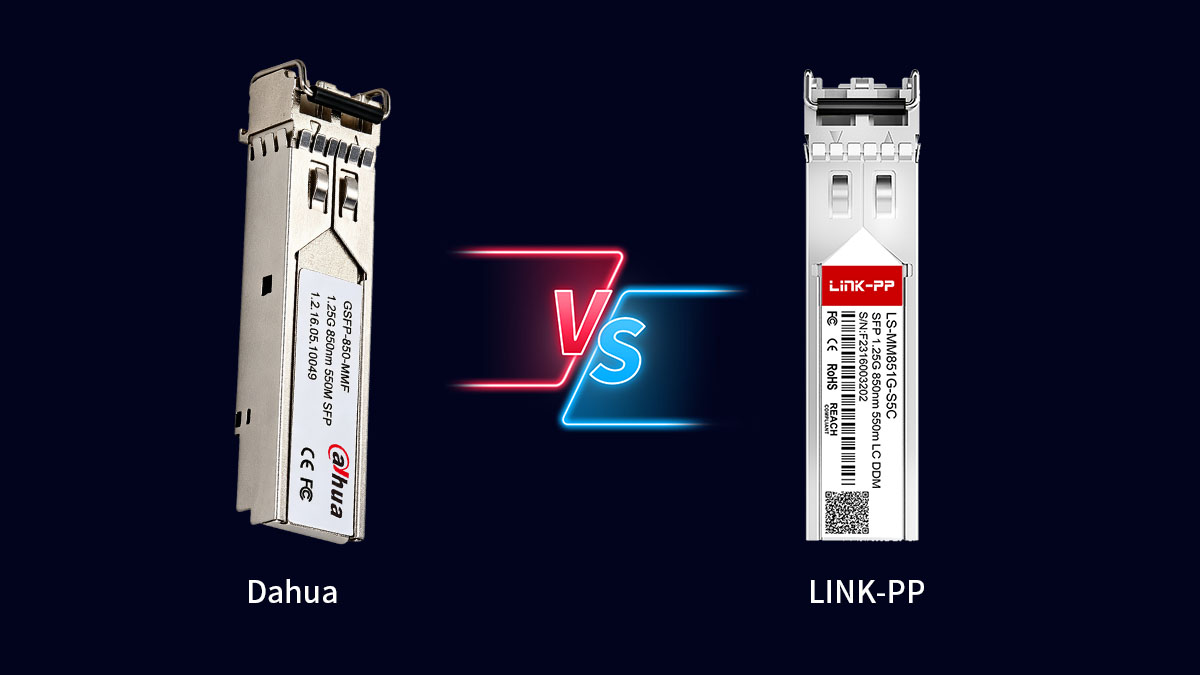
When evaluating Dahua GSFP-850-MMF modules against LINK-PP compatible equivalents, the key focus is not only on basic functionality but also on real-world performance consistency, interoperability, and deployment flexibility. In most Gigabit multimode fiber scenarios, both solutions are designed to achieve the same fundamental goal: stable 1.25Gbps optical transmission over short distances. However, differences emerge in compatibility scope, validation depth, and operational adaptability across diverse network environments.
Performance and Reliability
From a pure transmission standpoint, both Dahua and LINK-PP modules are engineered to deliver equivalent Gigabit Ethernet performance over multimode fiber using an 850nm wavelength. In typical deployments, end users will not observe noticeable differences in throughput or latency when both are correctly installed and matched with appropriate fiber infrastructure.
To better understand their operational behavior, the key performance attributes can be compared as follows:
| Performance Factor |
Dahua GSFP-850-MMF |
LINK-PP Equivalent |
| Data Rate |
1.25Gbps |
1.25Gbps |
| Wavelength |
850nm |
850nm |
| Transmission Distance |
Up to 550m |
Up to 550m |
| Operating Stability |
Optimized for Dahua ecosystem |
Tested across multi-vendor systems |
| Environmental Tolerance |
Standard commercial range |
Broader industrial-grade options available |
This comparison highlights that while core optical performance remains functionally equivalent, LINK-PP modules often provide a broader operational tolerance range, especially in mixed or industrial environments where temperature stability and long-term reliability are critical.
In addition, LINK-PP typically emphasizes extended stress testing and multi-platform validation, which helps ensure consistent performance even when deployed outside a single-vendor ecosystem.
Compatibility and Interoperability
Compatibility is one of the most significant differentiators between OEM and third-party optical modules. Dahua GSFP-850-MMF modules are primarily optimized for use within Dahua networking and surveillance devices, ensuring seamless integration but limiting flexibility in heterogeneous environments.
In contrast, LINK-PP equivalents are designed with cross-vendor interoperability in mind.
Key differences include:
- Dahua modules are primarily validated within Dahua switch and surveillance ecosystems
- LINK-PP modules support broader compatibility across multiple networking vendors
- Third-party modules are typically programmed for multi-platform recognition
- OEM modules may enforce tighter firmware or vendor identification controls
In real deployment scenarios, this means LINK-PP modules are more suitable for networks that combine equipment from different manufacturers, such as mixed surveillance and enterprise IT infrastructures.
This interoperability advantage reduces dependency on a single vendor ecosystem and simplifies long-term network expansion strategies.
Quality Assurance and Testing
Quality assurance plays a critical role in ensuring stable optical performance, especially in environments where downtime or signal degradation is unacceptable. Both Dahua and LINK-PP follow structured manufacturing and testing processes, but their validation scope differs.
A structured comparison of quality assurance approaches is shown below:
| QA Aspect |
Dahua GSFP-850-MMF |
LINK-PP Equivalent |
| Compliance Standard |
IEEE 802.3 / SFP MSA |
IEEE 802.3 / SFP MSA |
| Functional Testing |
OEM system validation |
Multi-vendor system testing |
| Optical Power Calibration |
Factory calibrated |
Factory calibrated with extended validation |
| Stress Testing |
Standard operating conditions |
Extended temperature and load testing |
| Burn-in Testing |
Limited batch validation |
Broader batch-level consistency testing |
To interpret this comparison, Dahua modules are typically validated within a controlled OEM environment, ensuring optimal performance in their native ecosystem. LINK-PP, on the other hand, places stronger emphasis on cross-platform testing and long-duration stability checks, which are particularly important for heterogeneous network infrastructures.
This difference does not imply a performance gap in normal conditions, but rather reflects a broader validation philosophy focused on interoperability and deployment diversity.
⭐ How to Choose the Right LINK-PP Replacement
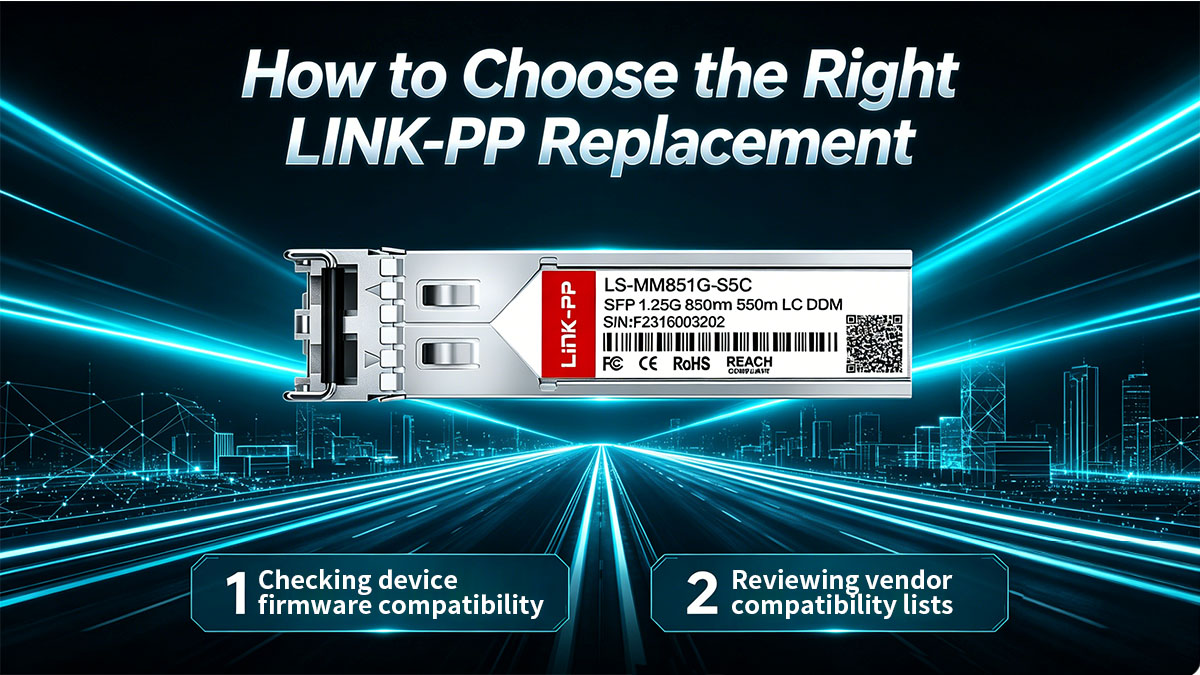
Selecting the right LINK-PP compatible replacement for Dahua GSFP-850-MMF is mainly about matching technical specifications, ensuring device compatibility, and aligning the module with real deployment conditions. While most 1.25Gbps multimode SFP modules share similar core parameters, small mismatches in fiber type, distance requirements, or device recognition can impact network stability.
In practice, a structured selection approach helps ensure the replacement behaves identically to the original module while improving flexibility and deployment efficiency.
Key Selection Criteria
The first step in choosing a suitable LINK-PP replacement is verifying that the optical and physical specifications align with the intended network environment. This ensures the module can operate reliably without link instability or performance degradation.
The most important criteria include:
- Data rate compatibility: Must support 1.25Gbps Gigabit Ethernet
- Wavelength matching: 850nm for multimode fiber environments
- Fiber type support: OM2, OM3, or OM4 multimode fiber depending on distance needs
- Transmission distance: Typically up to 550m for short-range links
- Connector type: LC duplex interface compatibility with existing cabling
To help visualize how these parameters influence selection, consider the comparison below:
| Selection Factor |
What to Confirm |
Why It Matters |
| Wavelength |
850nm |
Ensures correct optical transmission in MMF |
| Fiber Grade |
OM2 / OM3 / OM4 |
Affects maximum reach and signal quality |
| Distance |
≤550m typical |
Prevents signal loss or link instability |
| Interface |
LC duplex |
Guarantees physical compatibility |
After reviewing these parameters, the next step is to ensure the module aligns with the actual physical infrastructure rather than just theoretical specifications.
Verification and Compatibility Checks
Even when specifications match, real-world compatibility must still be verified at the device level. This step is critical because network equipment may implement vendor-specific identification or firmware restrictions.
To ensure smooth deployment, the following checks are recommended:
- Confirm switch or NVR SFP port supports standard MSA-compliant modules
- Verify firmware compatibility with third-party transceivers
- Check whether the device requires vendor coding or allows generic SFP recognition
- Review LINK-PP compatibility listings for tested equipment models
In many cases, LINK-PP modules are pre-coded for broad compatibility, but validation against actual hardware models remains essential. This is especially important in surveillance systems where uplink stability directly affects video transmission quality.
A practical approach is to test one module in a live environment before scaling deployment across the entire network.
Common Mistakes to Avoid
Incorrect module selection often leads to issues such as link failure, unstable connectivity, or reduced optical performance. These problems are usually not caused by the module itself but by mismatched assumptions during planning.
The most common mistakes include:
- Selecting the wrong wavelength (e.g., mixing single-mode and multimode optics)
- Ignoring fiber grade limitations, leading to unexpected distance reduction
- Overlooking device-side compatibility restrictions or firmware locks
- Assuming all SFP modules are universally interchangeable without validation
- Deploying without initial pilot testing in real network conditions
Among these, the most critical issue is fiber mismatch. Even when the module is technically compatible, using the wrong fiber type can significantly reduce transmission distance or introduce signal instability.
Another frequent oversight is skipping compatibility validation with the actual switch or surveillance device, which can lead to unnecessary troubleshooting later in deployment.
⭐ Deployment Best Practices for GSFP-850-MMF Alternatives
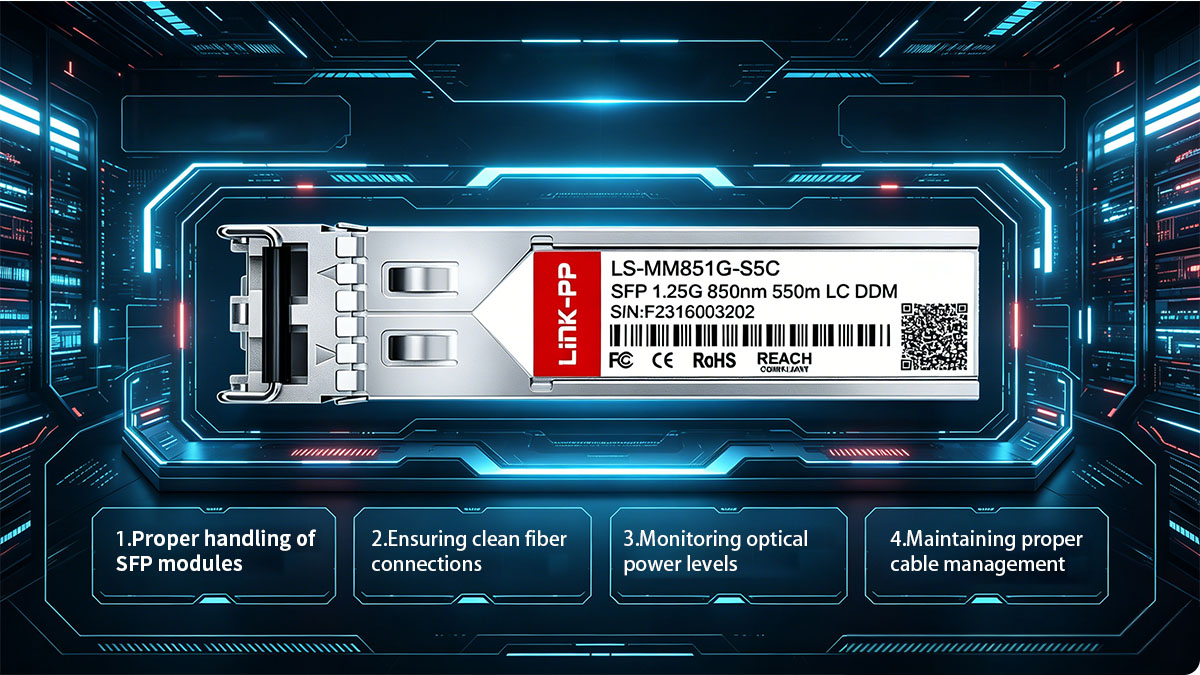
Deploying LINK-PP compatible replacements for the Dahua GSFP-850-MMF requires more than just physical installation. Although these modules are designed as plug-and-play optical transceivers, network stability and long-term performance still depend heavily on correct installation practices, fiber hygiene, and ongoing monitoring. In real-world environments such as surveillance systems and enterprise networks, small deployment mistakes can lead to intermittent link loss or degraded optical performance.
A structured deployment approach helps ensure that compatible modules perform consistently at the same level as OEM components while supporting scalable and maintainable network architecture.
Installation Guidelines
Proper installation is the foundation of stable optical performance. Even high-quality SFP modules can underperform if handling or connection practices are incorrect.
To ensure reliable deployment, follow these core installation principles:
- Insert the SFP module firmly into the SFP slot until it is fully seated
- Avoid excessive force during insertion or removal to prevent port damage
- Ensure LC duplex connectors are correctly aligned before plugging in fiber cables
- Always remove dust caps only when ready to connect fiber
- Use proper ESD (electrostatic discharge) protection during handling
To better illustrate the impact of installation quality, consider the following comparison:
| Installation Factor |
Best Practice Outcome |
Poor Practice Impact |
| Fiber insertion |
Stable optical link |
Intermittent signal loss |
| Dust protection |
Clean signal path |
Increased attenuation |
| Module seating |
Full compatibility |
Port recognition failure |
Once the physical installation is completed correctly, attention should shift toward fiber cleanliness and signal integrity.
Performance Optimization Tips
After installation, optimizing optical performance ensures that the GSFP-850-MMF alternative operates at its full potential. Even minor optical losses can accumulate in larger deployments, especially in surveillance networks with multiple hops.
Key optimization practices include:
- Regularly inspect and clean LC connectors using fiber cleaning tools
- Monitor optical power levels through DDM (if supported)
- Ensure fiber bends do not exceed minimum bend radius specifications
- Use consistent fiber grades (OM2/OM3/OM4) within the same link
- Avoid mixing new and degraded fiber cables in the same channel
These practices help maintain stable signal strength and reduce the risk of gradual performance degradation. In particular, connector cleanliness plays a critical role, as dust or contamination can significantly increase insertion loss even in short-distance links.
In larger deployments, optical power monitoring becomes especially valuable for early detection of potential degradation before it impacts network availability.
Troubleshooting Common Issues
Even with correct installation and optimization, occasional issues may still arise. Most problems with GSFP-850-MMF alternatives are not related to the module itself but to environmental or configuration factors.
Common issues and their typical causes include:
- No link detected
- Module not fully seated or incompatible SFP port configuration
- Intermittent connectivity
- Dirty connectors or poor fiber alignment
- Reduced transmission distance
- Incorrect fiber type (e.g., OM1 used instead of OM3/OM4)
- Device not recognizing module
- Firmware restrictions or vendor coding mismatch
- High error rates
- Excessive bending or damaged fiber cable
A structured troubleshooting approach is recommended:
- Verify physical connections first before checking configuration
- Replace or clean fiber patch cords to eliminate contamination issues
- Test the module in a different port or device to isolate the issue
- Review device logs for SFP detection or compatibility warnings
In many cases, resolving fiber cleanliness or seating issues restores full performance without requiring module replacement.
⭐ Conclusion
The Dahua GSFP-850-MMF remains a widely used 1.25Gbps multimode SFP optical transceiver for short-distance Gigabit Ethernet and surveillance networks, but its limitations in cost, supply flexibility, and vendor dependency have driven increasing interest in LINK-PP compatible alternatives. In most deployment scenarios, LINK-PP replacement modules can deliver equivalent optical performance while offering broader interoperability and improved procurement flexibility for modern network infrastructures.
To consolidate the most important insights from this article, the essential points can be summarized as follows:
- Equivalent performance: LINK-PP modules match Dahua GSFP-850-MMF in 1.25Gbps speed, 850nm wavelength, and multimode fiber transmission capability
- Improved flexibility: Compatible solutions reduce vendor lock-in and support multi-device environments
- Deployment efficiency: Easier sourcing and scalable inventory management for large networks
- Technical alignment: Fully compliant with MSA and IEEE standards for stable interoperability
- Best-use scenario: Ideal for surveillance systems, enterprise LANs, and short-range optical links
These points highlight that the decision is not about replacing performance, but about optimizing cost structure, supply stability, and network flexibility.
For organizations planning to scale or optimize their optical network infrastructure, evaluating LINK-PP compatible modules as an alternative to Dahua GSFP-850-MMF can significantly improve long-term operational efficiency without sacrificing reliability or performance.
To explore tested and standards-compliant optical transceivers designed for real-world deployment scenarios, you can refer to the LINK-PP Official Store, where a full range of compatible SFP solutions is available to support diverse networking requirements and infrastructure upgrades.