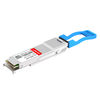
As data center interconnect (DCI), metro transport, and cloud backbone traffic continue moving toward 400G Ethernet, network operators are facing a new design challenge: how to deliver long-distance coherent transmission without the cost, space, and power burden of traditional DWDM transponder systems. This is exactly where 400G ZR+ modules have become one of the most discussed optical transport solutions in modern IP over DWDM architecture.
A 400G ZR+ module is a high-performance coherent pluggable transceiver designed to transmit 400Gbps Ethernet signals across metro, regional, and extended long-haul fiber links far beyond the standard reach of basic 400ZR optics. Compared with standard 400ZR modules that mainly target short DCI spans, 400G ZR+ coherent optics provide greater optical budget flexibility, enhanced forward error correction, broader modulation adaptability, and stronger compatibility with amplified transport networks.
In simple terms, 400G ZR+ allows engineers to move coherent DWDM intelligence directly into routers, switches, and transport hosts through compact QSFP-DD or OSFP pluggables—making it possible to simplify network layers while reducing separate line system equipment in many scenarios.
However, selecting the right 400G ZR+ coherent pluggable is not as simple as reading the advertised transmission distance on a datasheet.
Real-world deployment feedback from transport engineers shows that factors such as OSNR margin, host platform interoperability, amplifier design, thermal constraints, and OpenZR+ compatibility often determine whether a 400G ZR+ link performs like a true long-haul solution or becomes an unstable high-cost experiment. In many technical discussions, engineers specifically question whether vendor-labeled “500 km” or “1000 km” coherent pluggables can consistently achieve those numbers once fiber attenuation, ROADM nodes, and live network penalties are introduced.
That is why users searching for 400G ZR+ are usually not looking for a simple product description—they are trying to answer a much bigger engineering question:
Is 400G ZR+ the right coherent pluggable architecture for my long-distance network, and how do I choose a module that performs reliably in production?
This guide will explain what 400G ZR+ modules are, how they differ from standard 400ZR optics, what practical deployment limitations engineers should understand, and how to select the most suitable long-haul coherent solution for metro, regional, and DCI environments.
🟢 What Is a 400G ZR+ Module?
A 400G ZR+ module is a high-capacity coherent optical transceiver designed to transmit 400Gbps Ethernet traffic across metro, regional, and extended long-haul DWDM fiber networks. It is typically built in compact pluggable form factors such as QSFP-DD or OSFP, allowing coherent transport to be installed directly inside routers, switches, and packet-optical systems.
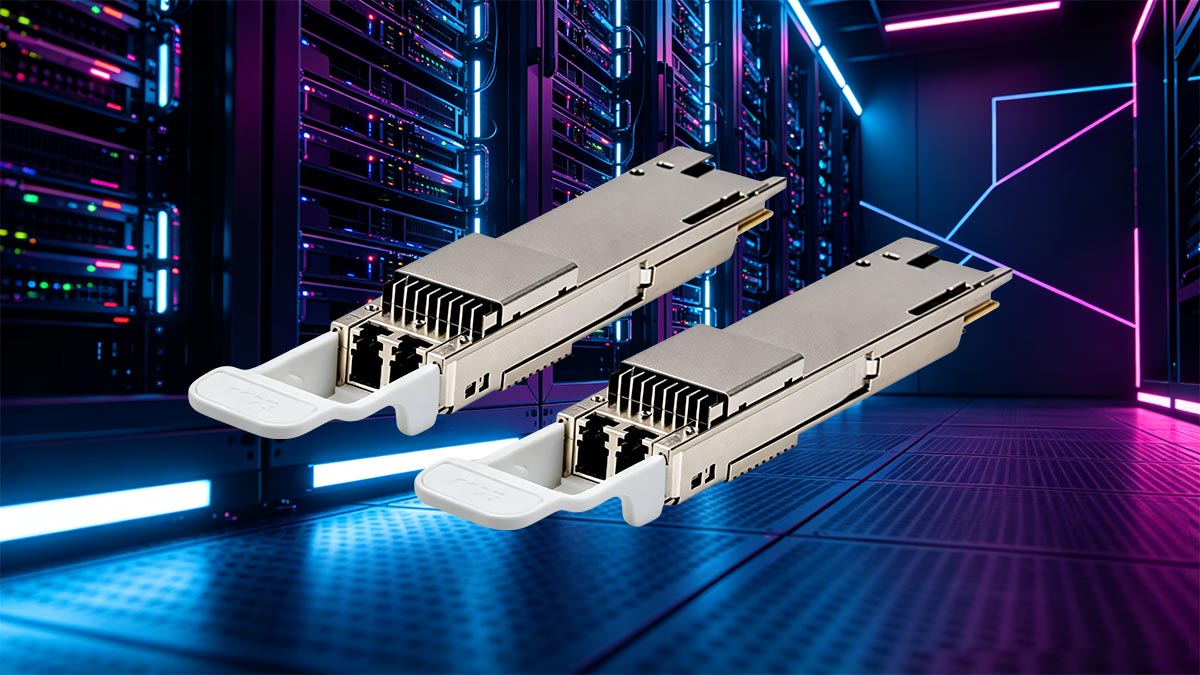
Unlike standard 400G Ethernet optics that only support short or medium distances, a 400G ZR+ coherent pluggable integrates:
-
coherent digital signal processing (DSP)
-
tunable DWDM wavelength capability
-
advanced forward error correction (FEC)
-
optical impairment compensation for long-distance transmission
These built-in technologies allow the module to maintain stable 400G signal delivery over amplified fiber spans where ordinary gray optics cannot operate.
In simple terms: 400G ZR+ combines Ethernet client transport and long-haul coherent DWDM transmission into a single pluggable module.
This makes it a critical component in modern IP over DWDM (IPoDWDM) networks, where operators want to reduce standalone transponder hardware, save rack space, and simplify backbone architecture.
Where 400G ZR+ Fits in the Coherent Optics Stack
400G ZR+ sits between standard short-reach coherent pluggables and traditional carrier transport systems:
|
Optics Type
|
Typical Reach
|
Main Use
|
|
400ZR
|
~80–120 km
|
basic DCI
|
|
400G ZR+
|
metro to regional / long reach
|
enhanced coherent transport
|
|
CFP2-DCO or transponder
|
long-haul carrier transport
|
dedicated optical shelves
|
This means 400G ZR+ offers significantly more transmission flexibility than standard 400ZR while keeping the density and simplicity advantages of a pluggable optic.
Common Deployment Scenarios for 400G ZR+
Because 400G ZR+ modules are designed to work across amplified and longer-distance DWDM environments, they are commonly deployed in the following network scenarios:
1. Metro Data Center Interconnect Beyond Standard 400ZR Reach
When 80 km DCI optics are no longer sufficient but operators still want to avoid deploying a full transponder shelf, ZR+ becomes a practical extension.
2. Regional Backbone Aggregation
Service providers use 400G ZR+ coherent pluggables to connect metro cores, aggregation hubs, and edge transport nodes with fewer standalone optical layers.
3. Router-to-Router IPoDWDM Architectures
By placing coherent pluggables directly inside packet routers, operators can bypass external muxponder equipment and simplify backbone topology.
4. Open Optical Transport Networks
Open ROADM and disaggregated optical line systems increasingly use OpenZR+ compatible pluggables to support multi-vendor coherent interoperability.
5. Capacity Upgrade on Existing DWDM Infrastructure
Many carriers use 400G ZR+ modules as a lower-footprint path to add 400G wavelengths without rebuilding the full optical transport stack.
🟢 400G ZR vs. 400G ZR+: What Is the Real Difference?
Although 400ZR and 400G ZR+ modules look similar in form factor, they are designed for very different network roles.
Standard 400ZR was created primarily for short-distance point-to-point data center interconnect (DCI), typically supporting around 80 km to 120 km under relatively clean optical conditions. Its main goal is to provide simple, interoperable coherent transport for straightforward DCI links without requiring the complexity of traditional optical transport hardware.
By contrast, 400G ZR+ is an enhanced coherent pluggable architecture developed to push 400G transmission beyond standard ZR limitations. It introduces stronger forward error correction, more flexible modulation profiles, improved optical tolerance, and broader compatibility with amplified DWDM line systems. As a result, ZR+ can operate across metro, regional, and in some designs even extended long-haul transport environments.
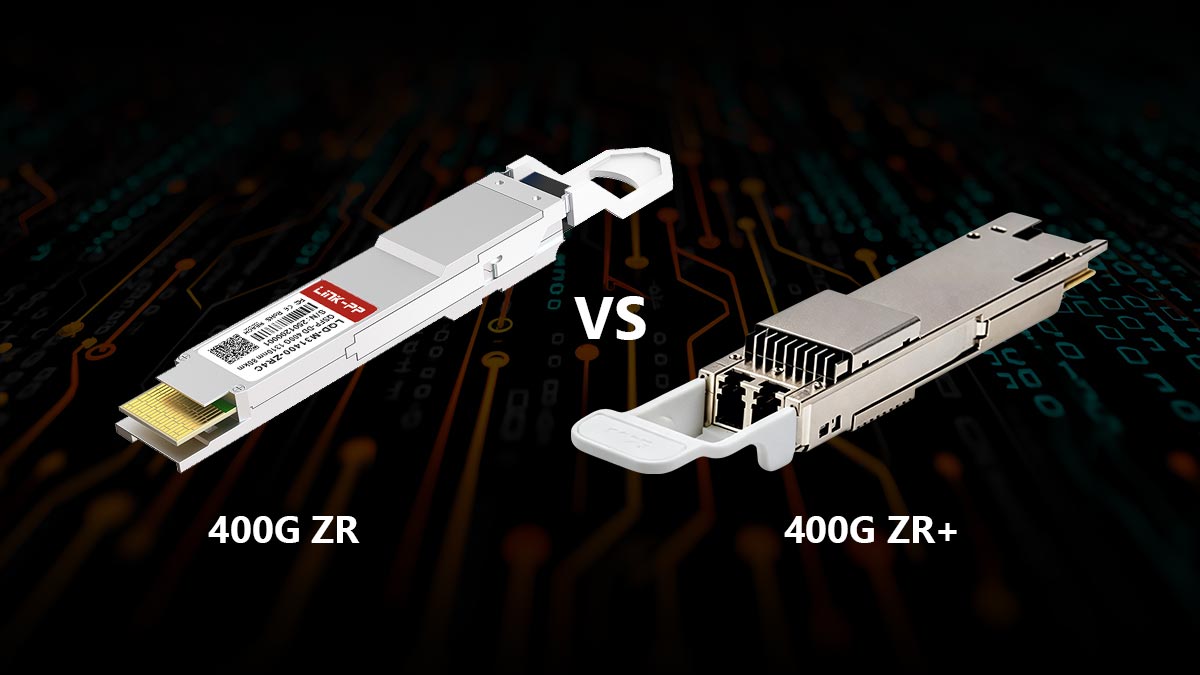
In practical deployment terms: 400ZR is built for simplified DCI, while 400G ZR+ is built for more demanding real-world transport networks where optical loss, noise, and amplification become part of the equation.
Key Technical Differences Between 400ZR and 400G ZR+
|
Feature
|
400ZR
|
400G ZR+
|
|
Typical Reach
|
~80–120 km
|
metro, regional, extended long-haul
|
|
Optical Environment
|
relatively simple point-to-point
|
amplified and more complex DWDM spans
|
|
Modulation Flexibility
|
limited standardized profile
|
more adaptive vendor-defined profiles
|
|
Forward Error Correction
|
standard coherent FEC
|
stronger enhanced FEC options
|
|
OSNR Tolerance
|
lower
|
higher
|
|
Network Role
|
DCI interconnect
|
metro/regional/backbone transport
|
|
Host Deployment
|
routers/switches
|
routers, switches, transport hosts
|
|
Cost per Module
|
lower
|
higher but more versatile
|
1. Transmission Distance Is the Most Visible Difference
The most obvious distinction is transmission reach.
400ZR was standardized for short coherent DCI applications, making it ideal for direct data center links where fiber spans are controlled and optical impairments are limited.
400G ZR+, however, is engineered for networks where:
This gives ZR+ a much broader deployment envelope than standard ZR optics.
However, buyers should understand that: ZR+ “long reach” is not a fixed universal number—it depends heavily on fiber condition, amplifier quality, host tuning profile, and optical margin.
2. Modulation and DSP Flexibility Are More Advanced in ZR+
A standard 400ZR module generally follows a more tightly defined coherent profile for interoperability.
A 400G ZR+ coherent pluggable often introduces vendor-optimized DSP settings and adjustable modulation behaviors that allow the module to trade spectral efficiency for improved reach or better line tolerance.
This extra flexibility is one reason ZR+ can survive in more complex transport environments where standard ZR may fail to maintain a clean link.
3. Enhanced FEC and OSNR Tolerance Improve Stability
Forward error correction (FEC) is one of the hidden but critical differences.
400G ZR+ modules usually include stronger correction capability to recover data under noisier optical conditions. This gives them:
-
higher tolerance to attenuation
-
better resilience in amplified systems
-
improved performance across imperfect field fiber
In real transport networks, this often matters more than the headline distance rating.
Because a coherent link that reaches 120 km in theory may still fail if OSNR margin is weak, while a stronger ZR+ module can maintain service continuity under the same physical span.
4. Power Consumption and Cost Are Higher for ZR+
The tradeoff is that 400G ZR+ modules generally consume more power and cost more than standard 400ZR optics because of:
So for simple short DCI spans, deploying ZR+ may be unnecessary.
But for operators trying to avoid standalone transponders in metro or regional networks, the additional cost can be justified by reducing external transport equipment.
5. Use-Case Selection: Which One Should You Choose?
The simplest way to understand the choice is this:
Choose 400ZR when:
-
the link is short and relatively clean
-
you need standardized DCI interoperability
-
cost and power are the top priorities
Choose 400G ZR+ when:
-
the span exceeds standard DCI limits
-
the network uses amplified DWDM systems
-
optical margin is uncertain
-
router-based coherent transport is preferred
-
you need more engineering flexibility
In short:
That is why many engineers do not compare them as simple optics—they compare them as two different coherent deployment strategies.
🟢 Where 400G ZR+ Modules Fit in Metro, Regional, and Long-Haul Networks
The real value of 400G ZR+ modules is not simply that they offer longer reach than standard 400ZR optics. Their real advantage is that they allow network operators to push coherent transport directly into packet equipment while reducing dependence on large standalone optical transport shelves.
But this benefit only becomes meaningful in the right network architecture.
Some fiber environments are ideal for ZR+, while others still favor traditional transponder-based systems.
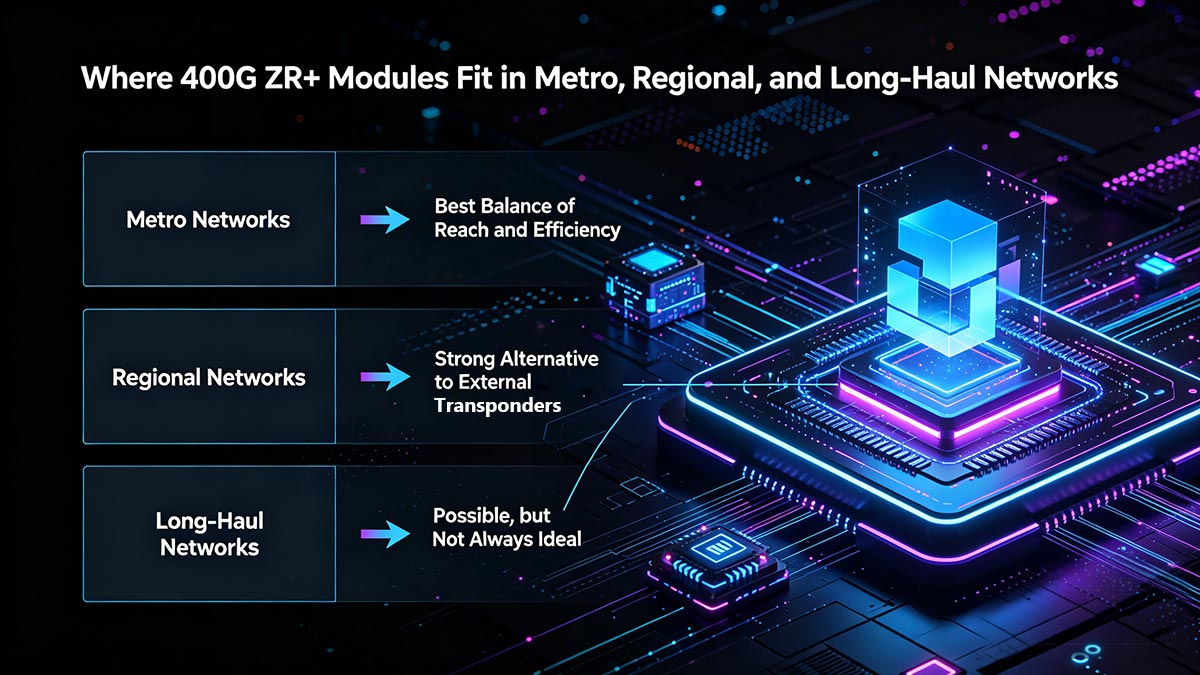
Metro Networks: Best Balance of Reach and Efficiency
Metro transport is one of the most practical environments for 400G ZR+ coherent pluggables.
These links often exceed the reach of standard 400ZR optics but still operate within manageable optical conditions, allowing ZR+ modules to deliver:
-
direct 400G wavelength transport from router ports
-
reduced rack space and power usage
-
simpler packet-optical integration
For operators building metro IPoDWDM links, ZR+ often provides the best balance between performance and hardware simplification.
Regional Networks: Strong Alternative to External Transponders
Regional backbone routes introduce longer spans, amplification, and tighter OSNR margins—conditions where ordinary 400ZR can become limited.
Because 400G ZR+ offers stronger FEC and broader coherent tolerance, it can support many regional packet transport links without requiring standalone transponder systems at every node. This helps reduce:
Long-Haul Networks: Possible, but Not Always Ideal
Some vendors position 400G ZR+ for extended long-distance transmission, but real performance depends on:
-
fiber attenuation
-
amplifier quality
-
ROADM loss
-
available optical margin
In cleaner amplified systems, ZR+ can reach well beyond metro distances. However, once the line becomes heavily impairment-sensitive, dedicated coherent transponders usually provide deeper monitoring, more tuning control, and safer long-term stability.
When a Traditional Transponder Still Makes More Sense
A dedicated transponder remains the better choice when the network requires:
In these high-complexity routes, pluggable ZR+ optics may not offer the same transport margin as carrier-grade optical shelves.
In short: 400G ZR+ works best where operators want packet-optical convergence and lower hardware overhead, while traditional transponders remain stronger for highly engineered long-haul transport.
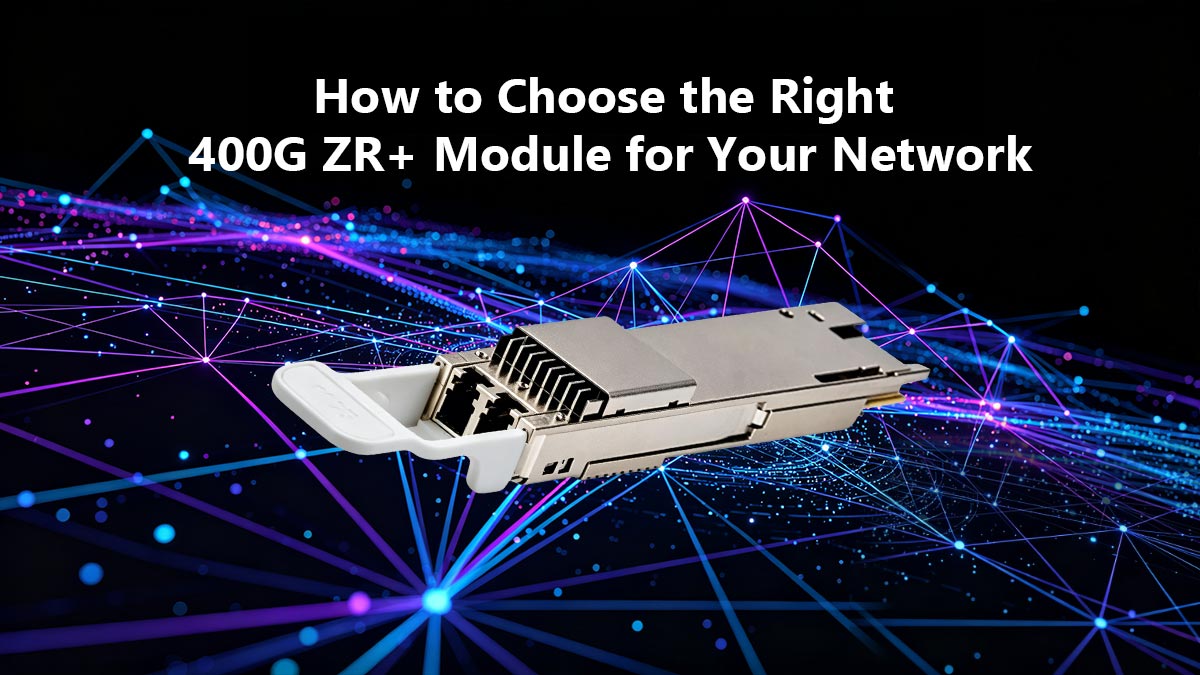
🟢 How to Choose the Right 400G ZR+ Module for Your Network
Not all 400G ZR+ modules perform the same in live transport environments.
Even when two optics advertise similar transmission distances, actual deployment success can vary significantly depending on host compatibility, coherent DSP tuning, line-system interoperability, and network management support.
That is why choosing a 400G ZR+ coherent pluggable should be based on more than just the headline reach specification.
1. Confirm Host Platform Compatibility First
The first requirement is whether the module can operate reliably inside your target router, switch, or packet-optical host.
Because 400G ZR+ optics draw more power and require deeper DSP communication than standard Ethernet transceivers, buyers should verify:
-
supported hardware platforms
-
NOS/firmware recognition
-
CMIS or management compatibility
-
thermal handling capability
-
vendor coding or third-party interoperability policy
A module that is optically capable but poorly recognized by the host can create unstable links, alarm mismatches, or incomplete diagnostics.
2. Match the Form Factor to Your Equipment Design
Most 400G ZR+ coherent pluggables are offered in:
Both support high-density coherent transport, but platform slot design, airflow direction, and thermal budgets can make one form factor more practical than the other.
The form factor decision should therefore align with:
3. Evaluate Real Reach Instead of Marketing Reach
A common buyer mistake is assuming all “long-haul” labeled ZR+ modules will perform equally across any DWDM path.
In reality, usable reach depends on:
This means buyers should ask not just: “What distance is printed on the datasheet?”
but: “Under what optical conditions was that distance validated?”
A well-tested metro/regional coherent module with stable optical margin is often more valuable than an aggressively advertised reach number.
4. Check Vendor Interoperability and OpenZR+ Support
Many networks today operate in mixed-vendor optical environments.
For this reason, buyers should verify whether the 400G ZR+ module supports:
-
OpenZR+ interoperability
-
open line system compatibility
-
common coherent management standards
-
multi-vendor wavelength operation
This is especially important when the module must interact with ROADMs, amplifiers, or packet platforms from different manufacturers.
Better interoperability reduces vendor lock-in and makes future capacity upgrades much easier.
5. Review Management and Diagnostic Visibility
Long-distance coherent optics are not simple plug-and-play Ethernet modules.
Operators need access to meaningful telemetry such as:
Without sufficient management visibility, troubleshooting coherent span degradation becomes much harder after deployment.
For production backbone networks, strong diagnostic transparency is often just as important as transmission reach.
In short: the right 400G ZR+ module is the one that matches your host platform, optical line conditions, and interoperability requirements—not simply the one claiming the longest distance.
A properly selected coherent pluggable should deliver both transport reach and operational predictability.
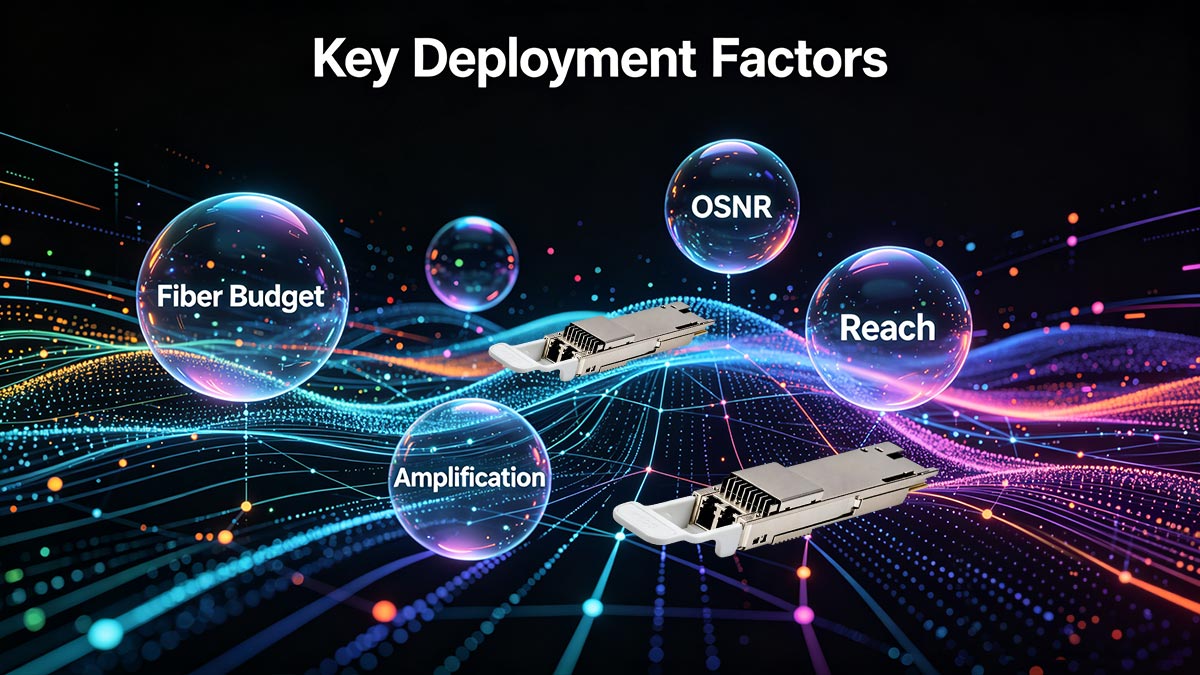
🟢 Key Deployment Factors: Fiber Budget, OSNR, Amplification, and Reach
One of the most common misunderstandings about 400G ZR+ modules is assuming that the advertised transmission distance on the datasheet automatically reflects real deployment reach.
In coherent optical transport, actual performance is determined less by the labeled kilometer rating and more by the quality of the optical path itself.
1. Fiber Budget Determines Whether the Span Is Even Viable
Fiber budget refers to the total optical loss the coherent signal must overcome between endpoints.
This includes:
Even a high-performance 400G ZR+ coherent pluggable can become unstable if cumulative loss consumes too much of the available optical margin.
2. OSNR Often Matters More Than Raw Distance
Optical signal-to-noise ratio (OSNR) is one of the most critical indicators in coherent transmission.
A 200 km amplified path with strong OSNR may perform better than a shorter but noisier route with poor amplifier conditions. If OSNR is weak, pre-FEC errors rise quickly and the coherent DSP has less room to recover signal integrity.
This is why two networks with the same physical distance can produce very different ZR+ results.
3. Amplifier Design Changes Real Reach Significantly
For metro and regional DWDM systems, EDFAs or other optical amplifiers are often required to support 400G coherent wavelengths.
However, amplification does not simply “extend distance.” Poor gain balancing, excess ASE noise, or uneven wavelength loading can reduce coherent stability instead of improving it.
A properly engineered amplified line system is often the difference between a stable ZR+ deployment and an unreliable one.
4. Host Tuning and Coherent Profiles Also Affect Results
Many 400G ZR+ modules use adjustable DSP settings, FEC modes, or modulation profiles to optimize either reach or spectral efficiency.
That means field performance is influenced not only by the fiber path, but also by:
Two similar modules can therefore behave differently on the same route depending on how well the host manages the coherent engine.
In short: 400G ZR+ reach is never defined by distance alone—it is defined by the combined optical margin of fiber loss, OSNR quality, amplifier engineering, and host-side coherent tuning.
That is why successful deployment requires line-system evaluation, not just module selection.
🟢 Common Questions About 400G ZR+ Modules

Q1. What Is 400G ZR+?
400G ZR+ is an enhanced coherent optical pluggable designed to transmit 400Gbps Ethernet traffic across metro, regional, and extended long-distance DWDM networks. Compared with standard 400ZR, it offers stronger forward error correction, greater optical tolerance, and broader compatibility with amplified transport systems, making it more suitable for complex real-world coherent deployments.
Q2. What Is the Difference Between ZR and ZR+ Optics?
The main difference is transmission flexibility.
Standard 400ZR is primarily intended for short point-to-point data center interconnect links, usually around 80 km to 120 km. 400G ZR+ extends coherent transport beyond those limits by using enhanced DSP profiles, stronger FEC, and better OSNR tolerance, allowing operation in metro, regional, and some longer amplified DWDM environments. In simple terms, 400ZR focuses on basic DCI interoperability, while 400G ZR+ focuses on broader transport adaptability.
Q3. Can 400G ZR+ Modules Replace Traditional DWDM Transponders?
In many metro and regional packet-optical networks, yes.
400G ZR+ modules allow operators to place coherent wavelengths directly inside routers or switches, reducing the need for separate transponder shelves. However, for ultra-long-haul or highly engineered optical routes, dedicated transponders may still provide better monitoring depth and larger optical performance margins.
Q4. How Far Can a 400G ZR+ Module Really Reach?
There is no single universal reach number.
Actual distance depends on fiber attenuation, amplifier design, OSNR quality, ROADM loss, and host coherent tuning. In optimized amplified systems, 400G ZR+ can operate well beyond standard 400ZR spans, but real deployment reach should always be evaluated through line-system conditions rather than vendor marketing distance alone.
Q5. What Should You Check Before Buying a 400G ZR+ Module?
The most important factors include
- host platform compatibility,
- QSFP-DD or OSFP form factor support,
- validated coherent reach profile,
- OpenZR+ or multi-vendor interoperability,
- coherent diagnostics and management visibility
A reliable 400G ZR+ solution should fit both the optical line design and the packet host environment.
🟢 Conclusion: Choosing the Right 400G ZR+ for Real Long-Haul Performance
As coherent transport continues moving out of dedicated optical shelves and into packet networking platforms, 400G ZR+ modules are becoming one of the most practical solutions for operators that need higher bandwidth, longer reach, and lower hardware complexity at the same time.
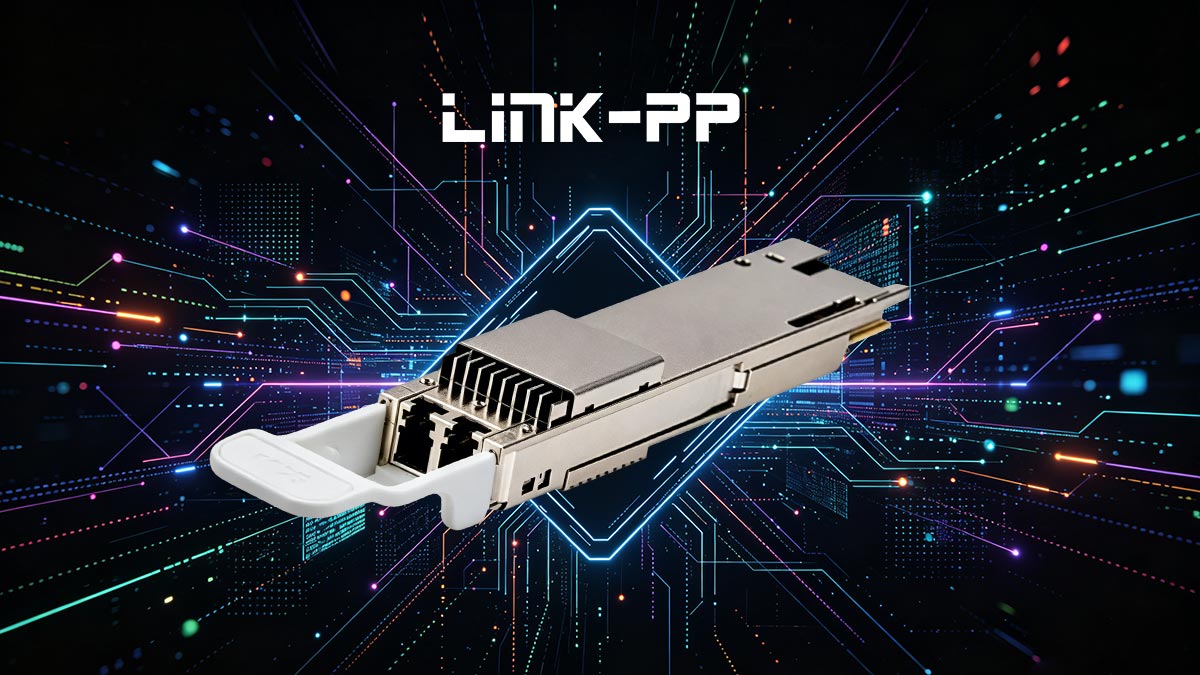
Compared with standard 400ZR optics, 400G ZR+ offers stronger coherent tolerance, broader deployment flexibility, and better suitability for metro, regional, and amplified DWDM environments. But the right choice is never based on advertised transmission distance alone. Successful deployment depends on host compatibility, optical line quality, OSNR margin, and whether the module can deliver stable performance under real network conditions.
In other words, selecting a 400G ZR+ coherent pluggable is not simply about buying a 400G optic—it is about choosing a long-distance transport architecture that balances reach, cost, and operational reliability.
For network builders, ISPs, and data center operators looking for validated 400G ZR+ compatible coherent optics, interoperable OpenZR+ solutions, and performance-matched long-haul pluggables, the LINK-PP provides a wide range of field-tested coherent modules designed for modern packet-optical deployments.
Whether you are planning metro DCI expansion, regional backbone upgrades, or higher-density IPoDWDM integration, choosing a deployment-ready module from the LINK-PP Official Store can help reduce interoperability risk and accelerate 400G transport rollout.