As high-density data centers evolve, balancing cost-efficiency with uncompromising performance remains a top priority for network architects. The Cisco SFP-H10GB-CU3M stands as a cornerstone of 10G connectivity, offering a 3-meter passive Direct Attach Copper (DAC) solution designed for low-latency, short-range links. Known for its reliability in Top-of-Rack (ToR) deployments, this twinaxial cable provides a robust alternative to optical transceiver modules by eliminating power consumption and reducing complexity.
In this technical overview, we will analyze the Cisco SFP-H10GB-CU3M through the lens of signal integrity and optical interoperability, exploring how its physical construction influences data transmission and how it integrates seamlessly into modern, mixed-media Cisco environments.
💨 Introduction to the Cisco SFP-H10GB-CU3M 10G DAC Cable
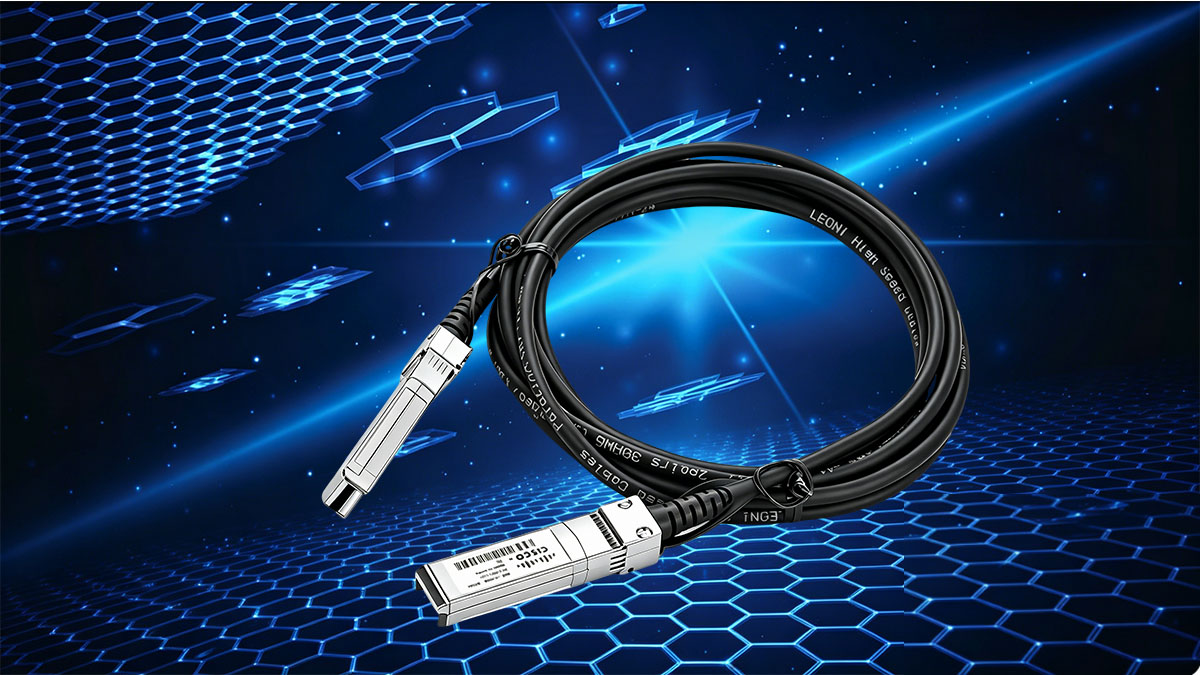
The Cisco SFP-H10GB-CU3M is a high-performance, 3-meter Twinax copper cable designed for 10-Gigabit Ethernet connectivity. As a passive Direct Attach Copper (DAC) solution, it provides a cost-effective, plug-and-play method for linking SFP+ ports without the need for additional transceivers or fiber optic cabling.
Defining the Technical Role of the 3-Meter Passive Copper Cable
The Cisco SFP-H10GB-CU3M functions as a fixed assembly featuring SFP+ connectors permanently attached to each end of a twinaxial copper cable. Being "passive," it does not contain active electronics for signal amplification; instead, it relies on the host system's hardware to manage signal integrity across its 3-meter length.
This 3-meter distance represents the optimal threshold for passive copper technology at 10Gbps. It provides enough reach to span multiple rack units while maintaining a low signal-to-noise ratio, ensuring that data is transmitted with minimal degradation and without the power consumption required by active optical alternatives.
Why the Cisco SFP-H10GB-CU3M is a Data Center Staple
The ubiquity of the Cisco SFP-H10GB-CU3M in enterprise environments stems from its "zero-power" footprint and extreme reliability. Unlike optical modules that utilize lasers and sensitive photodiodes, the DAC cable uses a direct electrical path, which significantly reduces the Mean Time Between Failures (MTBF) and simplifies thermal management within high-density racks.
Furthermore, its cost-effectiveness makes it the default choice for large-scale deployments. By eliminating the expense of two transceivers and a separate fiber patch cord, network engineers can drastically reduce their Capital Expenditure (CapEx) while benefiting from the simplified inventory management of a single-part-number solution.
Target Use Cases: Top-of-Rack (ToR) vs. End-of-Row (EoR)
The primary deployment model for the Cisco SFP-H10GB-CU3M is Top-of-Rack (ToR) switching. In this architecture, the 3-meter length is ideal for connecting servers within the same rack or adjacent racks to a central access switch. Its low latency makes it particularly valuable for clustering and high-performance computing (HPC) environments where every microsecond of port-to-port delay matters.
In contrast, the cable is rarely used for End-of-Row (EoR) configurations, as the distances between rows typically exceed the 3-meter limit of passive copper. For EoR or Middle-of-Row (MoR) setups, engineers generally pivot to Active Optical Cables (AOC) or structured fiber cabling, leaving the SFP-H10GB-CU3M to excel in its specialized role of short-range, high-speed server-to-switch interconnects.
💨 Physical Build Quality of the Cisco SFP-H10GB-CU3M
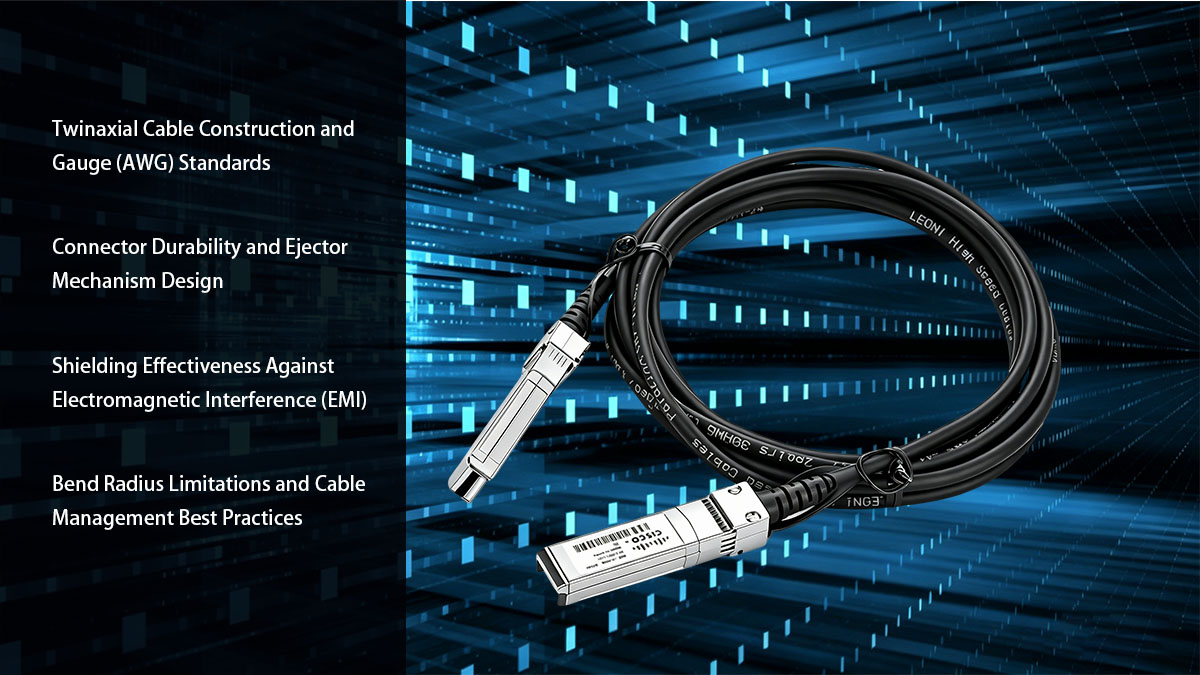
The Cisco SFP-H10GB-CU3M is built with a focus on mechanical reliability and long-term stability in demanding networking environments. Its construction balances heavy-duty shielding with the flexibility required to navigate the tight spaces of a standard server rack.
Twinaxial Cable Construction and Gauge (AWG) Standards
The internal wiring of the Cisco SFP-H10GB-CU3M utilizes high-quality twinaxial copper conductors, typically adhering to the 30AWG or 28AWG standard. This specific gauge is chosen to ensure that the 3-meter span can carry 10G signals without excessive attenuation, providing a stable 100Ω differential impedance across the entire length of the cable.
The twinax design features two shielded copper strands per channel, which are precision-wrapped to maintain consistent electrical characteristics. This meticulous construction is essential for preventing the signal "skew" that can occur when data travels across longer passive copper distances, ensuring that both bits of the differential pair arrive at the receiver simultaneously.
Connector Durability and Ejector Mechanism Design
The SFP+ connectors on either end are encased in a die-cast metal housing that provides a secure interface for high-speed ports. This metal casing acts as a physical protector for the internal PCB and the gold-plated contact pins, ensuring that the electrical connection remains seated firmly despite the physical weight of the 3-meter copper wire.
To facilitate easier maintenance, Cisco incorporates a pull-tab ejector mechanism. This design allows for a smooth, straight-line release in high-density switch configurations where port access is limited, ensuring that the locking latches are fully disengaged before the cable is withdrawn, thus preventing mechanical stress on the switch chassis or the cable assembly.
Shielding Effectiveness Against Electromagnetic Interference (EMI)
Given that data centers are filled with high-frequency electronic noise, the Cisco SFP-H10GB-CU3M features a multi-layered shielding approach. It combines individual foil wrapping for the signal pairs with an overall braided shield, which serves as a barrier against both external Electromagnetic Interference (EMI) and Radio Frequency Interference (RFI).
This comprehensive shielding is critical for maintaining a clean signal path. By isolating the internal copper conductors from the "crosstalk" of adjacent cables and power supplies, the cable ensures that the data remains intact, preventing the packet loss that often plagues lower-quality, unshielded copper transceivers.
Bend Radius Limitations and Cable Management Best Practices
While the outer jacket of the Cisco SFP-H10GB-CU3M is flexible, it has a defined minimum bend radius that must be respected to avoid internal damage. Bending the cable too sharply can deform the twinaxial geometry, leading to impedance spikes and signal reflections that degrade the overall link performance.
Proper cable management involves providing adequate strain relief to prevent the weight of the 3-meter assembly from pulling on the SFP+ port. Utilizing wider cable managers and avoiding tight zip ties helps maintain the structural integrity of the copper pairs, ensuring the cable provides a reliable 10Gbps connection throughout its operational lifespan.
💨 Signal Integrity Performance of Cisco SFP-H10GB-CU3M
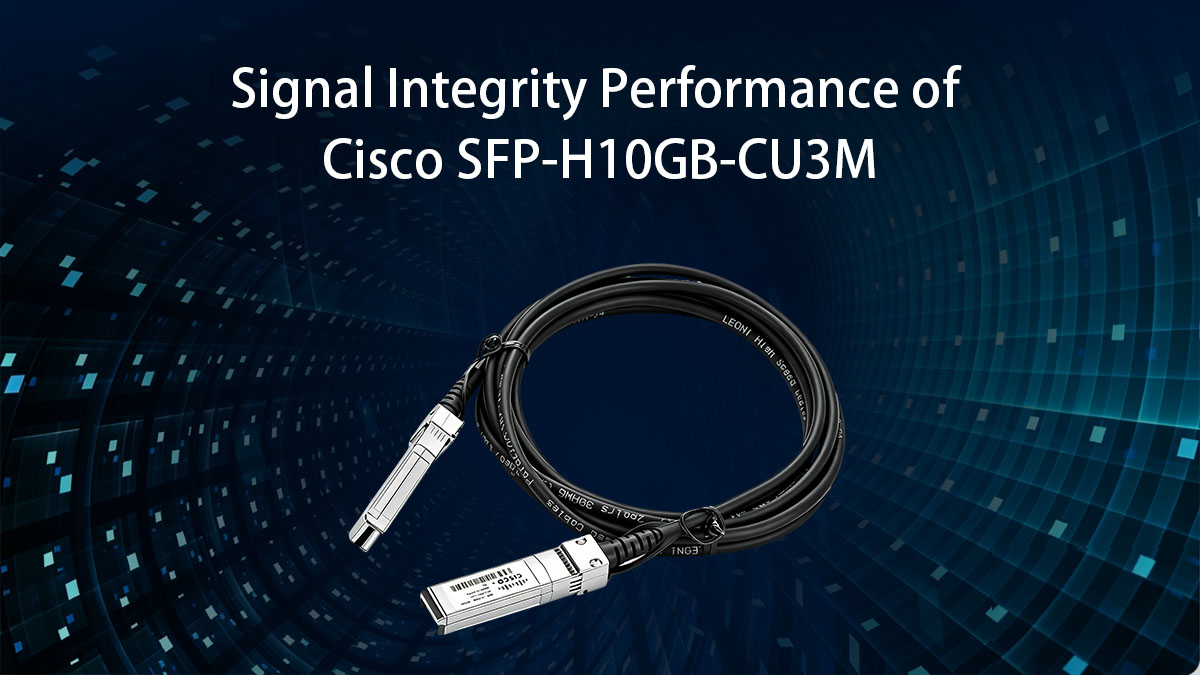
The signal integrity of the Cisco SFP-H10GB-CU3M is the primary benchmark of its performance, determining how accurately data is transmitted over its 3-meter copper span. Because it lacks active equalization, the cable relies on precision engineering to manage electrical degradation and maintain high-speed data transitions without errors.
Analyzing Bit Error Rate (BER) in 3-Meter Copper Links
Bit Error Rate (BER) is the ultimate metric for measuring the reliability of a 10G link. For the Cisco SFP-H10GB-CU3M, maintaining a BER of better than 10⁻¹² is the standard requirement. At a 3-meter length, the challenge is ensuring that the electrical "pulses" representing bits do not smear into one another, which would lead to dropped packets or CRC errors on the switch port.
To achieve this level of accuracy, the cable design minimizes jitter — the timing deviations in the signal. By keeping jitter within strict tolerances, the Cisco SFP-H10GB-CU3M ensures that the receiving SFP+ port can consistently sample the incoming data stream at the correct intervals, providing a stable and error-free connection for mission-critical traffic.
Insertion Loss and Cross-Talk (NEXT/FEXT) Metrics
Insertion loss and cross-talk are two critical parameters affecting signal quality in copper cables. Insertion loss refers to the reduction in signal strength as it travels through the cable, while Near-End Cross Talk (NEXT) and Far-End Cross Talk (FEXT) describe interference caused by adjacent signal paths. The Cisco SFP-H10GB-CU3M is optimized to minimize these effects through high-quality materials and shielding.
To better understand these parameters, the following table summarizes their roles and impact:
| Metric | Definition | Impact on Performance | Mitigation in SFP-H10GB-CU3M |
| Insertion Loss | Signal attenuation over distance | Reduced signal amplitude, potential errors | Short cable length, optimized copper gauge |
| NEXT (Near-End Cross Talk) | Interference measured at the transmitter side | Increased noise, signal distortion | Tight pair twisting and shielding |
| FEXT (Far-End Cross Talk) | Interference measured at the receiver side | Data corruption at receiving end | Advanced cable geometry and shielding layers |
Eye Diagram Testing: Interpreting Signal Clarity
Eye diagram testing is a visual diagnostic tool used to verify the health of a 10G signal. By overlaying multiple waveforms, an "eye" shape is formed on an oscilloscope; the wider the "eye opening," the cleaner the signal. For the SFP-H10GB-CU3M, a wide eye opening indicates that the cable is successfully managing noise and distortion over its 3-meter reach.
If the eye appears "closed" or blurred, it suggests excessive attenuation or timing jitter, which would likely result in link instability. Cisco ensures that each SFP-H10GB-CU3M meets strict mask requirements, meaning the signal stays within defined boundaries to guarantee that the host switch can distinguish between a logical "0" and "1" with absolute clarity.
The Impact of Passive Components on Signal Attenuation
As a passive component, the Cisco SFP-H10GB-CU3M does not use integrated circuits to "boost" the signal. Consequently, the signal's strength is entirely dependent on the quality of the copper and the precision of the physical terminations. This lack of active components means the cable follows a linear attenuation model, where the loss is directly proportional to the frequency and the 3-meter length.
This passive nature is actually an advantage for signal integrity in short-reach applications, as it avoids the "additive noise" that active electronic amplifiers can sometimes introduce. However, it also means the cable is sensitive to physical damage; any significant crushing or over-bending will immediately increase attenuation beyond the host system's ability to compensate, highlighting the importance of proper handling.
💨 Understanding Cisco SFP-H10GB-CU3M Optical Interoperability
Optical interoperability explores how the Cisco SFP-H10GB-CU3M functions within a broader network ecosystem that includes fiber-based solutions. While the cable itself is copper-based, its ability to coexist and communicate with optical infrastructure is vital for maintaining a unified 10G fabric.
Can Passive Copper Interoperate with Active Optical Cables (AOC)?
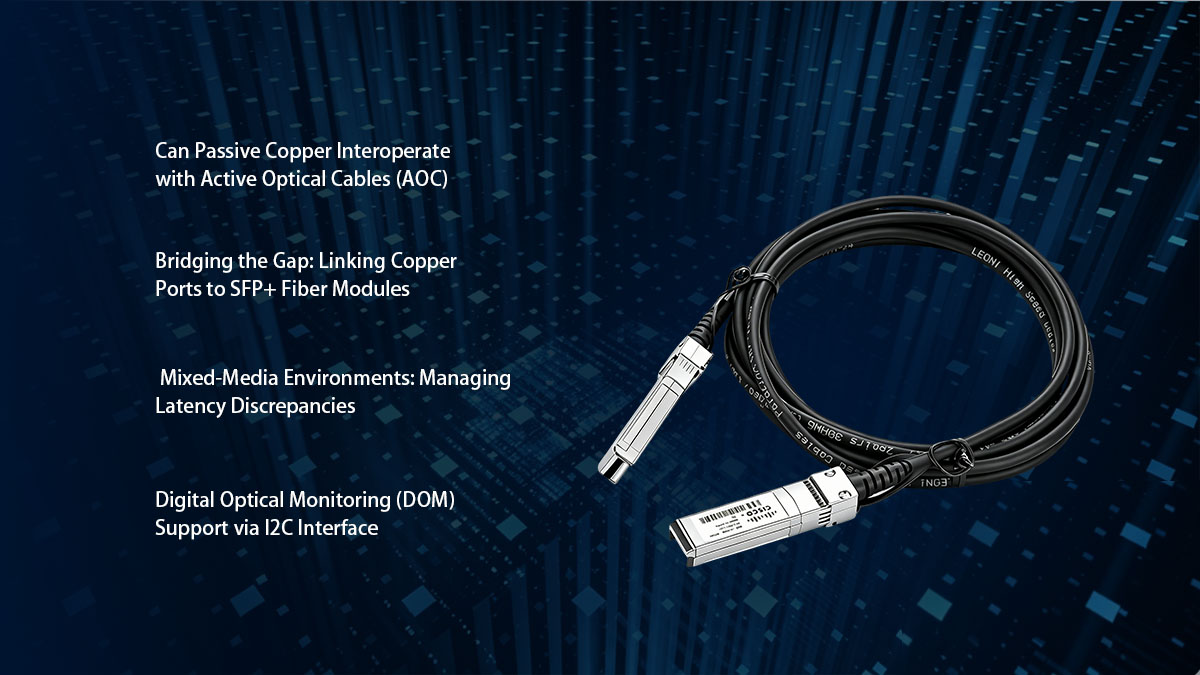
At the protocol level, passive copper cables like the SFP-H10GB-CU3M are fully compatible with environments using Active Optical Cables (AOC). Since both follow the SFF-8431 electrical interface specifications for SFP+, a switch can host a DAC cable on one port and an AOC on the adjacent port without conflict. The switch's internal ASIC handles the conversion between the electrical signals of the DAC and the optical signals of the AOC seamlessly.
However, direct "end-to-end" interoperability is impossible — you cannot physically connect a copper DAC cable to an optical cable. Their "interoperability" refers to their ability to work side-by-side in the same switch fabric, allowing network designers to use copper for short-reach server connections and AOCs for slightly longer intra-rack spans without any software-level incompatibility.
Bridging the Gap: Linking Copper Ports to SFP+ Fiber Modules
The Cisco SFP-H10GB-CU3M often acts as the "first mile" of connectivity that eventually bridges into a fiber backbone. In a typical scenario, a server is connected to a Top-of-Rack (ToR) switch using the 3-meter DAC cable; that switch then uses SFP-10G-SR (Short Range) or SFP-10G-LR (Long Range) fiber transceiver modules to uplink to the core network. This hybrid approach allows for localized high-speed copper links while maintaining long-distance optical connectivity.
Because the SFP-H10GB-CU3M uses the same SFP+ form factor as fiber modules, it ensures a consistent management experience. Network administrators do not need to change port configurations or interface types when transitioning from copper to fiber across different layers of the network hierarchy, as the 10GbE standard remains the common denominator.
Mixed-Media Environments: Managing Latency Discrepancies
In environments where DAC cables and optical links coexist, slight latency differences may arise due to the nature of signal transmission. Passive copper cables like the Cisco SFP-H10GB-CU3M typically offer lower latency because they avoid optical-electrical conversions and additional processing.
While these differences are usually minimal, they can become relevant in latency-sensitive applications such as high-frequency trading or real-time analytics. Proper network design — such as aligning similar link types within critical paths — helps maintain consistent performance across mixed-media deployments.
Digital Optical Monitoring (DOM) Support via I2C Interface
A common misconception is that passive copper cables do not support monitoring because they lack lasers. However, the Cisco SFP-H10GB-CU3M includes an EEPROM that communicates with the switch via the I2C interface. While it does not provide "Optical" monitoring (like laser bias current or receiver power), it does provide essential identification data and link status information.
Through this interface, the Cisco IOS or NX-OS can identify the cable as a genuine Cisco product, read its part number, and monitor the link for physical layer errors. This provides a level of visibility that, while not as granular as the digital optical monitoring (DOM) found in fiber modules, is sufficient for basic telemetry and ensuring the 3-meter link is performing within specified electrical parameters.
💨 Cisco SFP-H10GB-CU3M Compatibility Across Cisco Platforms
The Cisco SFP-H10GB-CU3M is designed for seamless integration across a wide range of Cisco networking platforms, ensuring consistent performance and reliability. Its compliance with Cisco standards allows for plug-and-play deployment without complex configuration. This broad compatibility makes it a versatile choice for enterprise, data center, and server environments.
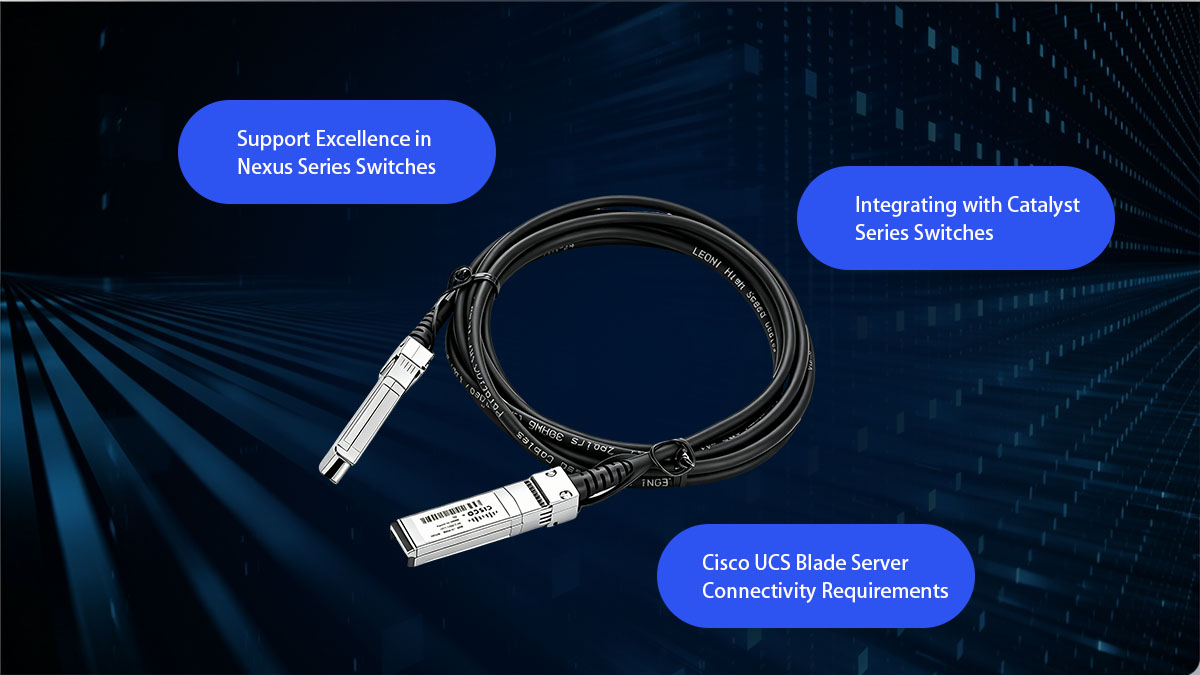
Support Excellence in Nexus Series Switches
In the data center environment, the SFP-H10GB-CU3M is a primary interconnect for the Cisco Nexus 9000, 7000, and 5000 Series switches. These platforms are optimized for the low-latency, high-performance profile of passive copper, allowing the NX-OS software to automatically tune port parameters for the 3-meter length. Whether used for vPC (Virtual Port Channel) peer links or direct server-to-switch access, the cable ensures consistent throughput across high-density 10GbE fabrics.
Integrating with Catalyst Series Switches
The Cisco SFP-H10GB-CU3M extends its utility to the campus core and distribution layers, maintaining full compatibility with the Catalyst 9000 and legacy 3850 Series switches. On these platforms running Cisco IOS-XE, the cable is recognized as a native transceiver, which simplifies management by providing real-time inventory visibility. This compatibility makes it an ideal solution for stacking switches or connecting high-speed storage arrays directly to the campus backbone without the overhead of optical transceivers.
Cisco UCS Blade Server Connectivity Requirements
For Unified Computing System (UCS) environments, the SFP-H10GB-CU3M is the standard choice for connecting Fabric Interconnects (6200/6300/6400 Series) to both blade chassis and rack-mount C-Series servers. Its 3-meter reach is perfectly suited for the physical dimensions of a UCS domain, providing the high-bandwidth electrical path necessary for FCoE (Fibre Channel over Ethernet) and converged traffic. The cable’s low-power profile is particularly beneficial in UCS deployments, where minimizing the heat load of hundreds of 10G ports is critical for maintaining overall system efficiency.
💨 Comparing Cisco SFP-H10GB-CU3M vs. Active Optical Cables (AOC)
Choosing between the Cisco SFP-H10GB-CU3M and Active Optical Cables (AOC) involves a trade-off between transmission distance and physical efficiency. While AOCs excel in longer spans and cable flexibility, the 3-meter passive copper DAC offers distinct advantages in latency and power management for short-range interconnects.
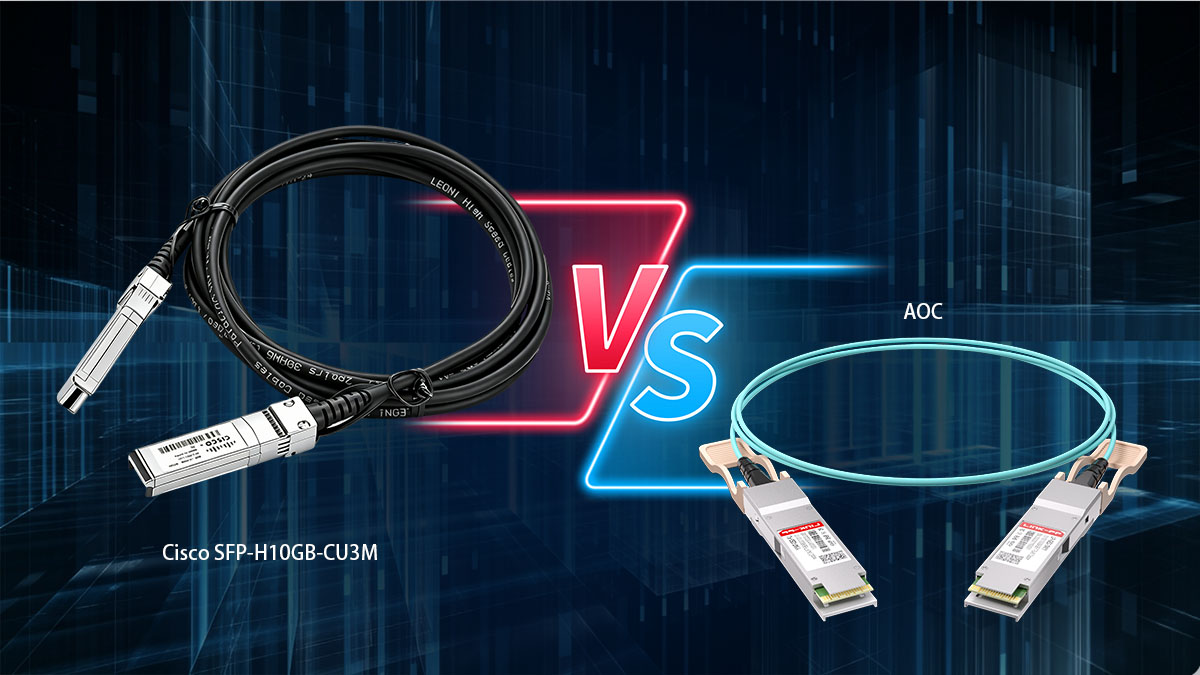
Latency Comparison: Why Passive Copper Wins for High-Frequency Trading
The Cisco SFP-H10GB-CU3M provides the lowest possible latency for 10G links because it operates purely on an electrical level without the need for signal conversion. In contrast, AOCs must convert electrical signals into light at the transmitter and back into electricity at the receiver, a process that introduces a slight delay of approximately 100 to 300 nanoseconds. For high-frequency trading (HFT) and ultra-low-latency clustering, these nanoseconds are cumulative across multiple hops, making the "wire-speed" performance of the passive copper DAC the superior choice for time-critical data paths.
Power Consumption Analysis: Zero-Power Copper vs. Laser-Driven Fiber
One of the most compelling reasons to deploy the SFP-H10GB-CU3M is its near-zero power consumption profile. Because it is a passive copper assembly, it does not contain lasers or optical engines that draw power from the switch chassis, typically consuming less than 0.1W per port (mostly for the EEPROM). AOCs, however, require active components to drive the internal lasers, resulting in a power draw of roughly 0.6W to 1W per end. In a high-density rack with dozens of 10G connections, switching to passive copper can significantly reduce the overall thermal load and electricity costs.
Cost-Efficiency Breakdown for Short-Range 10G Links
From a budgetary perspective, the SFP-H10GB-CU3M is the most economical solution for 10GbE connectivity within a 3-meter radius. The manufacturing process for twinaxial copper is inherently less expensive than the production of the VCSEL lasers and multi-mode fiber used in AOCs. When comparing the total cost of ownership (TCO) for Top-of-Rack deployments, passive DACs like the SFP-H10GB-CU3M often cost a fraction of the price of AOCs or discrete transceiver-and-fiber combinations, allowing organizations to scale their server access layers with minimal capital expenditure.
Weight and Airflow Considerations in High-Density Racks
While the SFP-H10GB-CU3M wins on latency and cost, it is physically heavier and thicker than its AOC counterparts. The 3-meter copper cable has a larger diameter, which can impede airflow in extremely congested cable management arms if not properly organized. However, for most standard server-to-switch applications, the 3-meter length is short enough that the weight does not put undue strain on the ports, and the cable's rigidity can actually help in maintaining a "clean" structured cabling look within the rack compared to the more "spaghetti-like" behavior of thinner fiber cables.
💨 Troubleshooting Common Cisco SFP-H10GB-CU3M Issues
Even with the inherent simplicity of passive copper technology, the Cisco SFP-H10GB-CU3M can occasionally encounter connectivity or performance hurdles. Effective troubleshooting requires a systematic approach to differentiate between physical media defects, configuration mismatches, and software-level security restrictions.
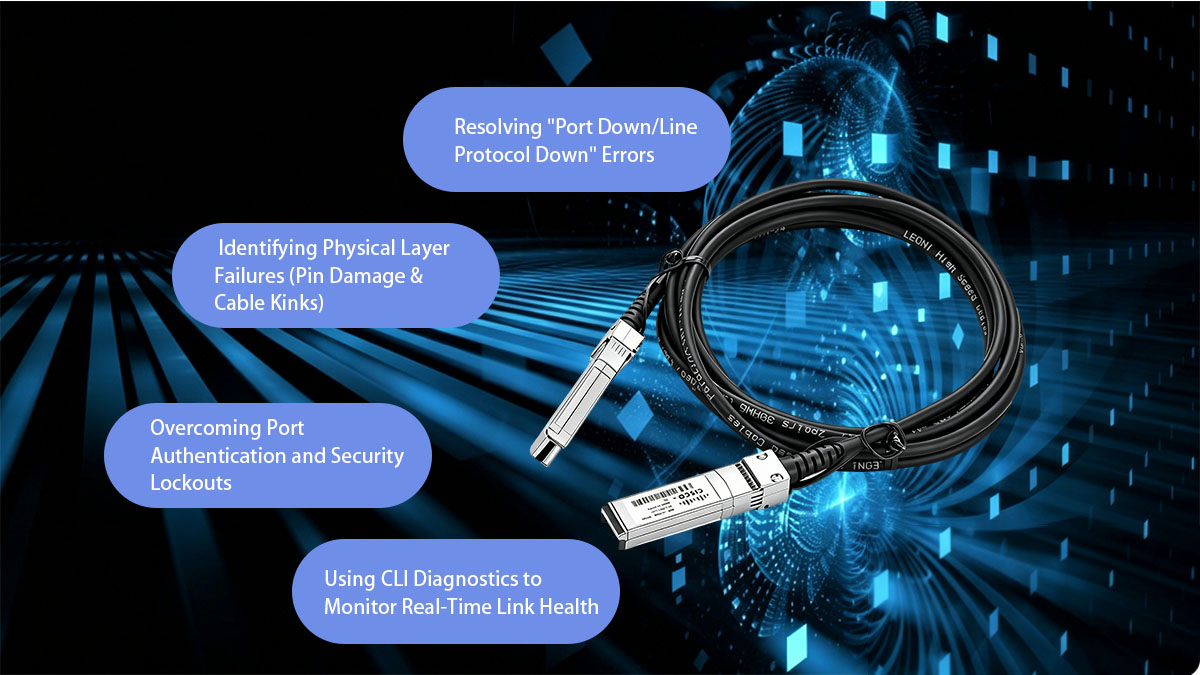
Resolving "Port Down/Line Protocol Down" Errors
When a port remains in a "down/down" state after inserting the SFP-H10GB-CU3M, it usually indicates a failure to establish the initial electrical handshake. This can often be resolved by checking the administrative state and the speed/duplex settings of the connected devices.
- Speed Auto-Negotiation: While 10G SFP+ ports often default to a fixed speed, some modern multi-gigabit ports may require explicit configuration. Ensure that both the switch and the Network Interface Card (NIC) are set to 10Gbps, as passive cables do not always support auto-negotiation to lower speeds like 1Gbps.
- Administrative Reset: Sometimes a port enters an "error-disabled" state due to repeated flapping. Use the "shutdown" followed by the "no shutdown" command on the Cisco interface to clear the port status and force a fresh link detection.
Identifying Physical Layer Failures (Pin Damage & Cable Kinks)
The physical integrity of the 3-meter copper span and its SFP+ connectors is critical for maintaining a stable link. Physical damage is often subtle but can be identified by inspecting the cable's exterior and the connector's interface.
- Internal Conductor Damage: Check the length of the cable for "kinks" or sharp 90-degree bends. Since the SFP-H10GB-CU3M relies on precise twinaxial geometry, a permanent deformation in the jacket can cause impedance mismatches that prevent the line protocol from staying "up."
- Connector Pin Inspection: Examine the gold-plated contact pads on the SFP+ module. Scratches, dust buildup, or bent pins inside the switch port can lead to intermittent connectivity or high error rates.
Overcoming Port Authentication and Security Lockouts
Some Cisco platforms enforce strict transceiver validation and may reject cables that are not recognized as certified. Although the SFP-H10GB-CU3M is fully Cisco-compatible, firmware mismatches or security policies can still trigger authentication issues.
To address this, consider the following:
- Check Compatibility Matrix: Ensure the cable is supported on the specific platform and software version.
- Disable Strict Checking (if allowed): Commands like "service unsupported-transceiver" may help in certain environments (use with caution).
- Firmware Updates: Upgrade device OS to ensure proper recognition of supported DAC cables.
These steps help restore normal operation while maintaining compliance with platform policies.
Using CLI Diagnostics to Monitor Real-Time Link Health
Cisco CLI tools provide valuable insights into the operational status of the SFP-H10GB-CU3M and connected interfaces. Regular monitoring helps detect early signs of degradation or instability before they escalate into failures.
Useful commands include:
- show interface status – Verifies link state and speed.
- show interface counters – Identifies errors such as CRC or input/output drops.
- show inventory – Confirms cable recognition and identification.
- show controllers ethernet-controller – Provides low-level hardware diagnostics.
By combining these commands with systematic troubleshooting, network administrators can maintain optimal link performance and quickly resolve issues in production environments.
💨 Final Verdict on the Cisco SFP-H10GB-CU3M for Modern Networks
The Cisco SFP-H10GB-CU3M remains a definitive standard for short-range 10-Gigabit Ethernet connectivity. By combining a zero-power consumption profile with ultra-low latency, it addresses the most critical requirements of modern Top-of-Rack architectures. Its robust physical shielding and consistent signal integrity ensure that data centers can maintain peak performance without the complexity or cost associated with optical transceivers.
While the 3-meter limitation defines its specific niche, the cable’s seamless compatibility across the Cisco Nexus, Catalyst, and UCS platforms makes it an indispensable tool for network engineers. Whether you are optimizing a high-frequency trading environment or scaling a standard enterprise rack, the SFP-H10GB-CU3M provides the reliability and structural durability necessary to sustain mission-critical uptime.
Looking to optimize your network with high-quality interconnect solutions? Beyond passive copper cables, choosing the right optical modules is essential for extending your network's reach and flexibility. Explore a comprehensive range of high-performance SFP+ modules and compatible networking accessories at the LINK-PP Official Store, your trusted partner for reliable, cost-effective connectivity.