



































As global data traffic continues to skyrocket, modern core networks are facing an urgent need for higher density and smarter Bandbreite aggregation. The QDD 2x100G LR4 optischer Transceiver has emerged as a groundbreaking solution to this challenge, packing dual-channel 100G capabilities into a single QSFP-DD slot. By delivering a total of 200G Durchsatz over a 10km reach, this next-generation module allows network architects to scale capacity without expanding their physical footprint.
Traditionally, upgrading network capacity meant dealing with crowded front panels and complex cable management. The shift to a dual-channel architecture directly addresses these bottlenecks by maximizing throughput per rack unit and streamlining fiber infrastructure. Whether deployed in Hyperscale-Rechenzentrum interconnects (DCIs) or enterprise core layers, this innovative form factor lays the groundwork for a highly efficient, future-proof network.
❇️ Die Rolle von QDD 2x100G LR4 in modernen Kernnetzen verstehen
Modern core networks serve as the backbone of global data distribution, bearing the weight of massive traffic loads from Cloud Computing, AI, and streaming media. As traditional architectures struggle to keep pace with these exploding demands, hardware infrastructure must evolve to deliver higher throughput without multiplying operational complexity. Integrating higher-density form factors into the network core ensures that data pipelines remain fast, stable, and scalable.
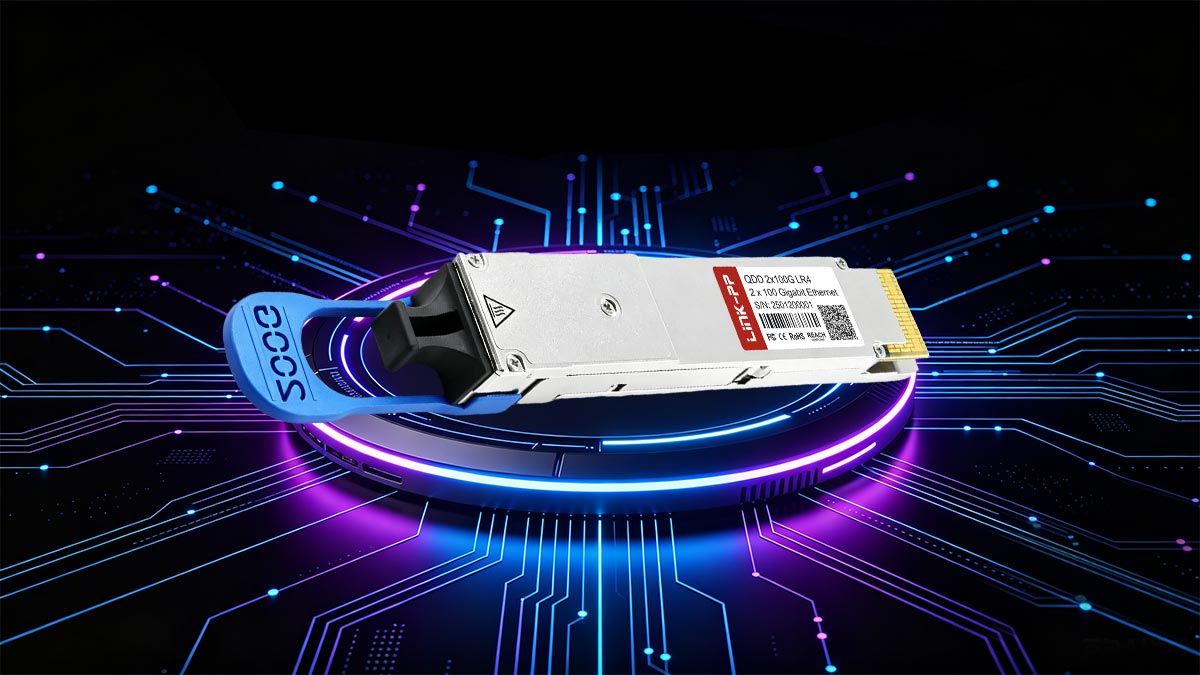
Die Entwicklung der Kernnetzwerkarchitektur und des Bandbreitenbedarfs
In recent years, core network architectures have shifted from rigid, multi-layered hierarchies to highly distributed, flat leaf-spine topologies. This transition is primarily driven by the exponential growth of Ost-West-Verkehr innerhalb Rechenzentren and a surge in high-bandwidth user applications. To prevent severe data bottlenecks, operators must continuously upgrade their link capacities at the aggregation and core layers.
Die bloße Verlegung zusätzlicher Kabel ist aufgrund von Platz- und Kostenbeschränkungen nicht mehr praktikabel. Netzwerkarchitekten fordern daher optische Lösungen, die die Bandbreite in der bestehenden Infrastruktur optimal nutzen, anstatt neue Infrastruktur aufzubauen. Dieser Druck hat den Weg für kompakte Mehrkanal-Transceiver geebnet, die hohe Aggregationslasten effizient verarbeiten.
Was ist QDD 2x100G LR4? Technische Daten im Überblick
The QDD 2x100G LR4 represents a major leap forward in optical design, functioning essentially as two independent 100G LR4 optical transceivers packed into a single physical module. It operates over standard Single-Mode-Faser (SMF) using a dual-channel architecture to deliver a combined throughput of 200Gbps. By relying on highly precise LAN-WDM wavelengths, it cleanly separates data signals to achieve reliable, long-distance transmission.
Um Ihnen das Verständnis der wichtigsten operativen Fähigkeiten dieses Moduls zu erleichtern, werden in der folgenden Tabelle die wichtigsten technischen Parameter aufgeführt, die die Leistung dieses Moduls definieren.
| Parameter | Normen |
| Formfaktor | QSFP-DD (Quad Small Form-factor Pluggable Double Density) |
| Datenrate | 200 Gbit/s (zwei 100-Gbit/s-Kanäle) |
| Wellenlänge | LAN-WDM-Grid (1295 nm, 1300 nm, 1304 nm, 1309 nm) |
| Max. Reichweite | Bis zu 10 km über Singlemode-Glasfaser (SMF) |
| Anschlusstyp | Doppel-CS-Anschluss |
Wie Dual-Channel-200G-Formfaktoren die optische Effizienz optimieren
Dual-channel 200G modules optimize optical efficiency by doubling the port density on standard network Switches und Router. By grouping two separate 100G links into a single QSFP-DD slot, network operators can significantly lower the total number of physical ports required to aggregate core traffic. This consolidation drastically slashes hardware footprints and reduces total power consumption compared to running multiple independent modules.
Darüber hinaus verbessert dieser Zweikanalansatz die spektrale Effizienz bestehender Singlemode-Glasfasernetze. Rechenzentren können so ihre vorhandenen Glasfaserinvestitionen optimal nutzen, indem sie über dieselbe 10-km-Strecke mehr Daten übertragen, ohne teure Verstärkung zu benötigen. Das Ergebnis ist eine hocheffiziente optische Schicht mit geringeren Gesamtkosten pro Gigabit.
Umstellung von älteren QSFP28-Modulen auf QDD-Module der nächsten Generation
The transition from legacy QSFP28 modules to next-generation QSFP-DD (QDD) form factors marks a crucial upgrade path for expanding networks. Standard QSFP28 modules are limited to a single 100G port per slot, which quickly consumes valuable front-panel space on high-capacity switches. The QDD architecture introduces a second row of electrical pins, doubling the system's interface capacity while remaining backward compatible.
Die Migration zu QDD-Modulen ermöglicht Netzbetreibern einen nahtlosen Übergang von 100G- zu 200G- oder 400G-Infrastrukturen ohne aufwändige, umfassende Hardware-Umstellung. Dieser evolutionäre Schritt beseitigt die räumlichen Engpässe, die herkömmliche Systeme plagen, und verschafft Kernnetzen den nötigen Spielraum für eine effiziente Skalierung.
❇️ Warum QDD 2x100G LR4 für die Aggregation hoher Dichte unerlässlich ist
Mit dem rasanten Anstieg des Datenvolumens müssen Netzwerktechniker immer mehr Bandbreite auf engstem Raum unterbringen, ohne die Betriebskosten in die Höhe zu treiben. Hochdichte Aggregation erfordert Hardwarelösungen, die die Porteffizienz deutlich steigern und gleichzeitig die physische Vernetzung vereinfachen. Der Übergang zu fortschrittlichen Dual-Channel-Modulen begegnet diesen Herausforderungen direkt und bietet einen strategischen Entwurf für skalierbare und hocheffiziente Kernarchitekturen.
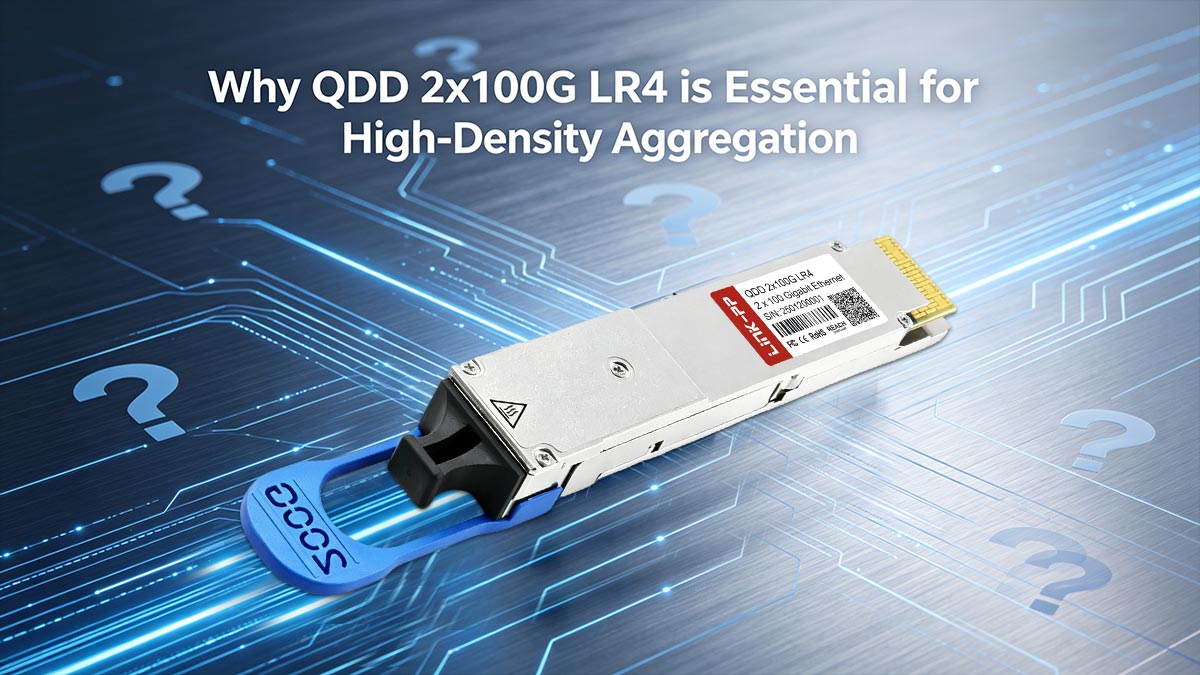
Lösung des Platzproblems auf der Frontplatte in Leaf-Spine-Architekturen von Rechenzentren
Moderne Leaf-Spine-Architekturen benötigen eine immense Anzahl an Verbindungen, um ein Hochgeschwindigkeits-Fabric-Mesh-Netzwerk über Rechenzentren hinweg aufrechtzuerhalten. Herkömmliche Switches stoßen jedoch an eine physikalische Grenze hinsichtlich der Anzahl standardmäßiger optischer Transceiver, die auf einer Standard-1HE-Frontplatte Platz finden. Dieser Platzmangel zwingt Betreiber häufig zum Einsatz zusätzlicher Switches, was die Investitionskosten erhöht und die Netzwerkschicht verkompliziert.
Durch den Einsatz des QDD 2x100G LR4 können Rechenzentren ihre Portdichte auf demselben physischen Switch-Panel effektiv verdoppeln. Dank dieses innovativen Designs kann ein einzelner Port zwei unabhängige 100G-Verbindungen verarbeiten und so die Auslastung des Frontpanels sofort reduzieren. Netzwerktechniker können dadurch ihre Leaf-Spine-Architektur weiter skalieren, ohne in zusätzliche Gehäuse investieren zu müssen.
Maximierung des Durchsatzes pro Höheneinheit (HE) mit 2x100G Breakouts
Die Maximierung des Datendurchsatzes pro Höheneinheit hat höchste Priorität für eine schlanke und effiziente Rechenzentrumsstruktur. Herkömmliche 100G-Systeme benötigen für jede Verbindung einen eigenen Steckplatz, wodurch die verfügbare Kapazität eines Netzwerk-Racks schnell erschöpft ist. Durch die Verwendung eines Dual-Channel-Designs können Betreiber mehrere Hochgeschwindigkeitspfade auf engstem Raum unterbringen.
Die 2x100G-Breakout-Funktion ermöglicht die nahtlose Aufteilung eines einzelnen QSFP-DD-Ports in zwei separate 100G-LR4-Kanäle. Dadurch kann ein Standard-Switch mit 36 Ports plötzlich 72 unabhängige 100G-Verbindungen unterstützen, was die Bandbreitenkapazität pro Höheneinheit (HE) erheblich erhöht. Netzwerkteams können diese Dichte nutzen, um große Datenaggregations-Workloads zu bewältigen und gleichzeitig den Platzbedarf im Rack minimal zu halten.
Optimierung des Glasfaserkabelmanagements in Aggregationsschichten
Umfangreiche Netzwerkaggregationsschichten leiden häufig unter einem komplexen Kabelgewirr, das den notwendigen Luftstrom behindert und die routinemäßige Wartung erschwert. Die Verwaltung hunderter einzelner Glasfaser-Patches kann bei Installation, Fehlersuche oder Port-Upgrades zu menschlichen Fehlern führen. Die Reduzierung der gesamten Anzahl physischer Kabel ist daher entscheidend für einen übersichtlichen und hochfunktionalen Rechenzentrumsboden.
The integration of QDD 2x100G LR4 modules helps streamline infrastructure by consolidating multiple links into high-density connector interfaces. Because the module splits two separate 100G channels through a single port, it drastically cuts down on the physical bulk of fiber Patchkabel running through the racks. This organized approach creates a much cleaner patching environment, improves internal chassis cooling, and simplifies long-term fiber management.
Reduzierung der Komponentenanzahl zur Verbesserung der Netzwerkzuverlässigkeit
In großflächigen Netzwerken stellt jede zusätzliche aktive Komponente eine weitere potenzielle Fehlerquelle dar, die kritische Datenströme unterbrechen kann. Der Einsatz einer übermäßigen Anzahl einzelner Transceiver erhöht die statistische Wahrscheinlichkeit von Hardwarefehlfunktionen und Betriebsunterbrechungen. Die Konsolidierung von Hardwarefunktionen in integrierten Komponenten macht das Gesamtsystem hingegen deutlich robuster.
Das QDD 2x100G LR4 verbessert die Netzwerkzuverlässigkeit insgesamt, indem die interne Schaltung zweier unabhängiger Module in einem einzigen, kompakten Gehäuse zusammengeführt wird. Diese Konsolidierung reduziert die Anzahl der Komponenten in der Aggregationsschicht erheblich, während die Leistungsstandards unverändert bleiben. Da weniger einzelne Module überwacht, gekühlt und ausgetauscht werden müssen, profitieren Netzwerkbetreiber von einer deutlich robusteren Architektur und einem geringeren Wartungsaufwand.
❇️ Wichtigste technische Merkmale und optische Leistung von QDD 2x100G LR4
Für die Übertragung über große Entfernungen und bei hoher Dichte sind hochentwickelte optische Komponenten und ein robustes Wärmemanagement erforderlich. Das QDD 2x100G LR4 nutzt präzise Laserraster, kompakte Steckverbinder und fortschrittliche Fehlerkorrektur, um auch über große Distanzen eine hervorragende Signalqualität zu gewährleisten. Das Verständnis dieser Kernmerkmale verdeutlicht, wie das Modul höchste Datenübertragungsrate mit hoher struktureller Effizienz vereint.
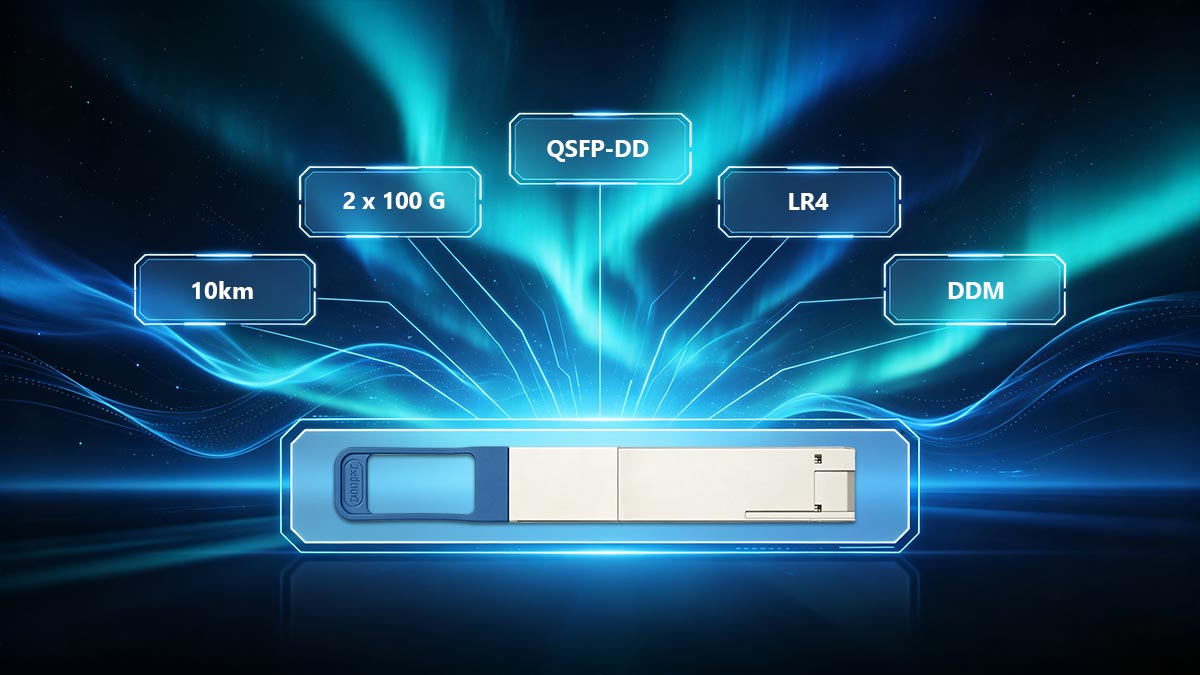
LAN-WDM-Grid-Laser und ihre Vorteile für Reichweiten bis zu 10 km
LAN-WDM-Gitterlaser sind für Langstreckenübertragungen von bis zu 10 km unerlässlich, da sie auf schmalen, präzise regulierten Wellenlängenkanälen arbeiten. Im Gegensatz zu groben Gittern weisen diese Kanäle über Singlemode-Fasern eine minimale chromatische Dispersion auf, wodurch sichergestellt wird, dass die Datensignale auch über große Entfernungen scharf und klar bleiben. Diese Präzision ermöglicht eine hochzuverlässige Datenübertragung ohne aufwändige optische Verstärkung.
Die folgende Liste hebt die spezifischen Vorteile hervor, die diese Speziallaser für die Netzwerkarchitektur mit sich bringen:
- Extrem niedrige Dispersion: Sorgt für scharfe optische Signale über Entfernungen von bis zu 10 km.
- Geringer Kanalabstand: Ermöglicht präzises Multiplexing von vier Wellenlängen pro Kanal.
- Keine Verstärkung erforderlich: Spart Kosten durch direkte Übertragung über passive Glasfaserverbindungen.
CS-Stecker vs. Standard-LC-Stecker für hochdichte Patching-Systeme
To double the port capacity without increasing the Sender-Empfänger size, standard physical connections had to be re-engineered. Regular LC-Duplex connectors are simply too large to fit two separate channels into a single QSFP-DD module faceplate. The adoption of the smaller CS connector format solves this physical spacing issue entirely.
Die wichtigsten Vergleichspunkte zeigen, warum das CS-Steckverbinderformat für hochdichte Layouts überlegen ist:
- 40 % Größenreduzierung: Benötigt deutlich weniger Platz als ein Standard-LC-Duplexkabel.
- Zweikanal-Anschluss: Ermöglicht zwei unabhängige Faserpaarungen an einer einzigen Modulfront.
- Passender Rasterabstand: Passt perfekt zum Zweikanal-Layout der internen Optik.
- Einfaches Drücken und Ziehen: Vereinfacht die Installation und Demontage in stark frequentierten Patchpanels.
Leistungsaufnahme und Wärmeabfuhreffizienz von QSFP-DD
Der Betrieb zweier unabhängiger 100G-Glasfaserleitungen in einem einzigen Transceiver erzeugt konzentrierte Wärmeenergie, die effektiv abgeführt werden muss. Der QSFP-DD-Formfaktor nutzt ein optimiertes Strukturdesign, um diese erhöhte Wärme zu bewältigen. Dabei kommen fortschrittliche Gehäusematerialien und integrierte Kühlrippen zum Einsatz. Eine effiziente Wärmeableitung verhindert eine Überhitzung der Optik und trägt somit direkt zur Verlängerung der Lebensdauer der Hardware bei.
Das Modul verfügt über mehrere wichtige technische Merkmale, um Leistung und Temperatur innerhalb sicherer Betriebsgrenzen zu halten:
- Geringer Stromverbrauch pro Gigabit: Verbraucht insgesamt weniger Energie als zwei eigenständige 100G QSFP28-Module.
- Integrierte Kühlkörper: Leiten die Wärmeenergie von den internen optischen Komponenten ab.
- Optimiertes Innengehäuse: Maximiert den Luftstrom über die integrierten Schaltkreiskomponenten.
Anforderungen an die Vorwärtsfehlerkorrektur (FEC) und Linkbudgetunterstützung
Operating at high data rates over 10km requires built-in mechanisms to combat signal degradation and potential Paketverlust. Forward Error Correction (FEC) acts as a digital safety net, identifying and correcting transmission errors on the host platform automatically. This error-checking process guarantees that data remains flawless even when the optical link budget is pushed near its physical limits.
Das System ist auf strenge FEC-Parameter angewiesen, um ein zuverlässiges, leistungsstarkes optisches Budget aufrechtzuerhalten:
- Host-side FEC reliance: Depends on the switch or router ASIC to fix bit errors.
- Robustes Linkbudget: Bietet ausreichend Spielraum, um Signalverluste von Patchpanels auszugleichen.
- Flawless data integrity: Keeps bit error rates (BER) safely within enterprise-grade limits.
- Stabile Langstreckenverbindungen: Gewährleistet durchgängig klare Kommunikationswege über die gesamte Reichweite von 10 km.
❇️ Kernnetzwerkarchitektur: Integration von QDD 2x100G LR4 in Ihre Infrastruktur
Die erfolgreiche Integration von QDD 2x100G LR4-Modulen in ein Kernnetz erfordert eine sorgfältige Abstimmung mit bestehenden Vermittlungsstrukturen und Verkabelungsanlagen. Durch den Einsatz dieser Zweikanal-Transceiver können Betreiber die Verbindungskapazität reibungslos skalieren und gleichzeitig ihre bestehenden Hardwareinvestitionen erhalten. Indem sie diese hochdichte Lösung strategischen Aggregationspunkten zuordnen, können Unternehmen eine hochverfügbare und ausgewogene Netzwerktopologie aufbauen.
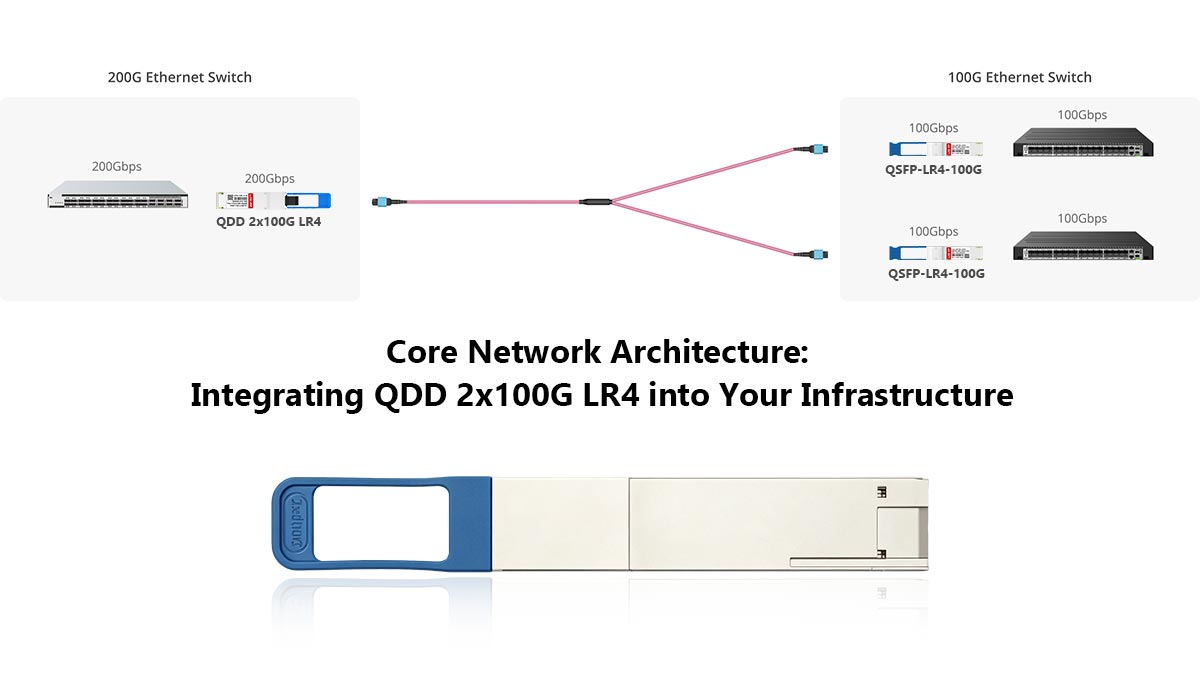
Nutzung von QSFP-DD-Steckplätzen für 2x100G Dense Core Aggregation
Durch den Einsatz des QDD 2x100G LR4 in Standard-QSFP-DD-Steckplätzen können Netzwerktechniker ohne Gehäuseerweiterungen sofort eine hohe Aggregationsdichte auf der Kernschicht erreichen. Der Host-Switch behandelt den einzelnen physischen Steckplatz effektiv als zwei unabhängige 100G-Schnittstellen und maximiert so die Auslastung des aktiven Switching-Chips. Diese Konfiguration verdoppelt die Dichte der 100G-Eingangspfade und verhindert eine frühzeitige Portüberlastung bei schnellem Datenverkehrsanstieg.
Verbindung von Aggregationsroutern und Core-Switches mit hoher Kapazität
Die Verbindung von leistungsstarken Core-Switches mit verteilten Aggregationsroutern erfordert extrem zuverlässige Verbindungen mit hohem Durchsatz, die auch plötzliche Verkehrsspitzen abfangen können. Die QDD 2x100G LR4-Architektur bietet hierfür die optimale Lösung, indem sie separate Uplink-Pfade in einer kompakten physischen Infrastruktur zusammenfasst. Diese Konsolidierung minimiert die Portbelegung teurer Core-Router und gewährleistet gleichzeitig, dass die Datenübertragung zwischen den kritischen Netzwerkschichten reibungslos verläuft.
Sicherstellung der Abwärtskompatibilität mit der bestehenden 100G LR4-Infrastruktur
A major operational benefit of the QDD 2x100G LR4 module is its native Rückwärtskompatibilität with older, standard 100G LR4 hardware already running in the data center. By utilizing a simple CS-to-LC breakout patch cable, this dual-channel module can easily split and talk directly to two separate legacy 100G QSFP28 slots. This seamless Interoperabilität protects existing capital investments and allows for a gradual, risk-free migration to higher-density switch chassis.
Verwaltung des optischen Budgets und der Verluste entlang eines 10 km langen Campus-Verbindungsnetzes
Maintaining a healthy optical link budget across a 10km campus footprint requires strict management of attenuation when deploying the QDD 2x100G LR4 over legacy single-mode fiber. Because the module utilizes a precise LAN-WDM laser grid, it provides a robust power margin capable of overcoming common physikalische Schicht obstructions like splices and patch panels. Network teams must calculate cumulative connector loss during deployment to ensure the received signal stays well within compliant limits for flawless data transmission.
❇️ Anwendungsfall 1: Data Center Interconnect (DCI) basierend auf QDD 2x100G LR4
Data Center Interconnect (DCI) architectures require robust, high-density optical links to seamlessly bridge the gap between geographically separated facilities. Deploying the QDD 2x100G LR4 allows operators to aggregate massive amounts of metro traffic while bypassing the spatial and financial constraints of traditional optics. This makes it an ideal driver for hyperscale data centers that need to expand their interconnect capacity rapidly and efficiently.
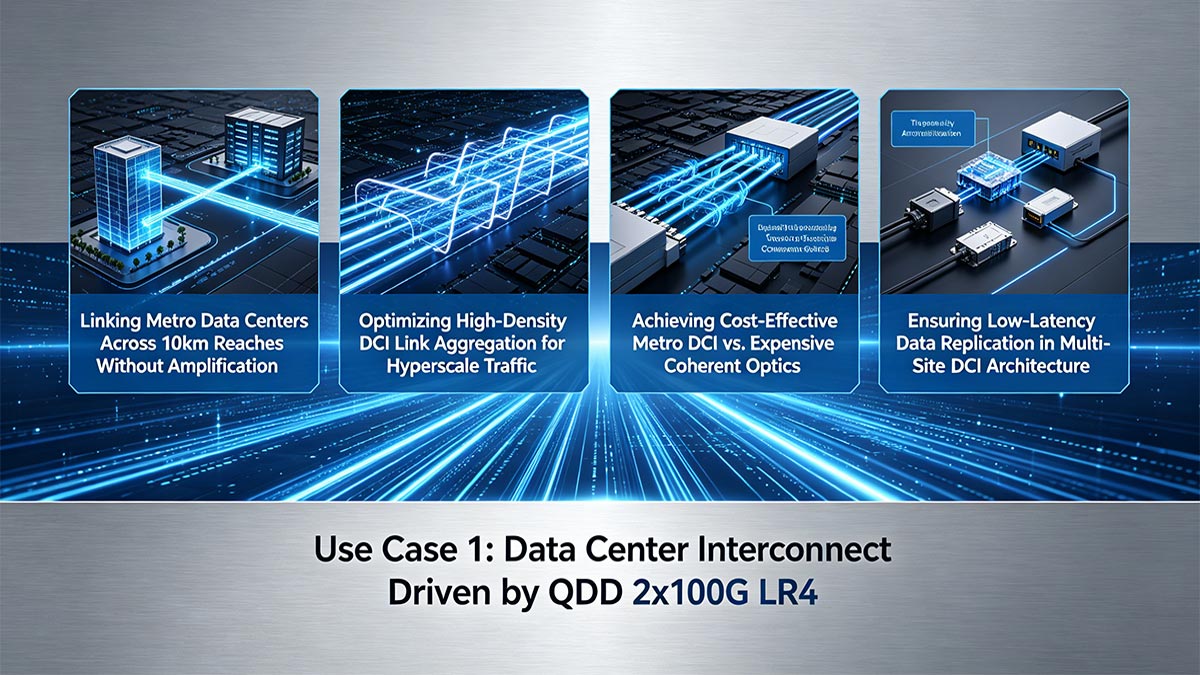
Verbindung von Metro-Rechenzentren über 10 km Entfernung ohne Verstärkung
Das QDD 2x100G LR4 bietet eine äußerst zuverlässige Lösung zur Verbindung von Metro-Rechenzentren mit einer Entfernung von bis zu 10 Kilometern über Standard-Singlemode-Glasfaser. Dank seines leistungsstarken LAN-WDM-Laserrasters überwindet das Modul problemlos die übliche Signaldämpfung, ohne dass teure optische Inline-Verstärker oder aktive Transponder erforderlich sind.
Optimierung der DCI-Linkaggregation mit hoher Dichte für Hyperscale-Datenverkehr
Hyperscale data centers generate immense east-west traffic that can quickly overwhelm standard interconnect pathways and exhaust valuable switch ports. By deploying the QDD 2x100G LR4, network engineers can combine dual 100G channels into unified Link Aggregation Groups (LAGs), maximizing throughput across a heavily consolidated physical footprint.
Kosteneffiziente Metro-DCI vs. teure kohärente Optik
Für mittlere Entfernungen bis zu 10 km bietet der QDD 2x100G LR4 eine deutlich wirtschaftlichere Alternative zu komplexen und energieintensiven kohärenten optischen Transceivern. Er liefert den exakt benötigten hohen Durchsatz für Metro-DCI-Verbindungen und senkt gleichzeitig die anfänglichen Investitionskosten sowie die laufenden Betriebskosten drastisch.
Sicherstellung latenzarmer Datenreplikation in einer Multi-Site-DCI-Architektur
Multi-site data replication demands ultra-low Latenz to keep critical database clusters synchronized and prevent active-active storage bottlenecks. Because the QDD 2x100G LR4 uses a simple, direct NRZ mapping without heavy internal digital signal processing (DSP), it keeps transmission latency at an absolute minimum across the entire DCI fabric.
❇️ Anwendungsfall 2: Enterprise Core Aggregation über QDD 2x100G LR4
Großflächige Unternehmensnetzwerke benötigen leistungsstarke Verteilungsschichten, um den hohen Datenverkehr über weitläufige Firmengelände zu bewältigen. Der Einsatz des QDD 2x100G LR4 ermöglicht es IT-Abteilungen, heterogene Datenpfade nahtlos in einem zentralen Netzwerk-Backbone zu konsolidieren, ohne die gesamte physische Chassis-Infrastruktur aufrüsten zu müssen. Dies bietet Unternehmensnetzwerken eine zuverlässige Lösung mit hoher Dichte, um anspruchsvolle interne Workloads mit minimalem Aufwand zu bewältigen.
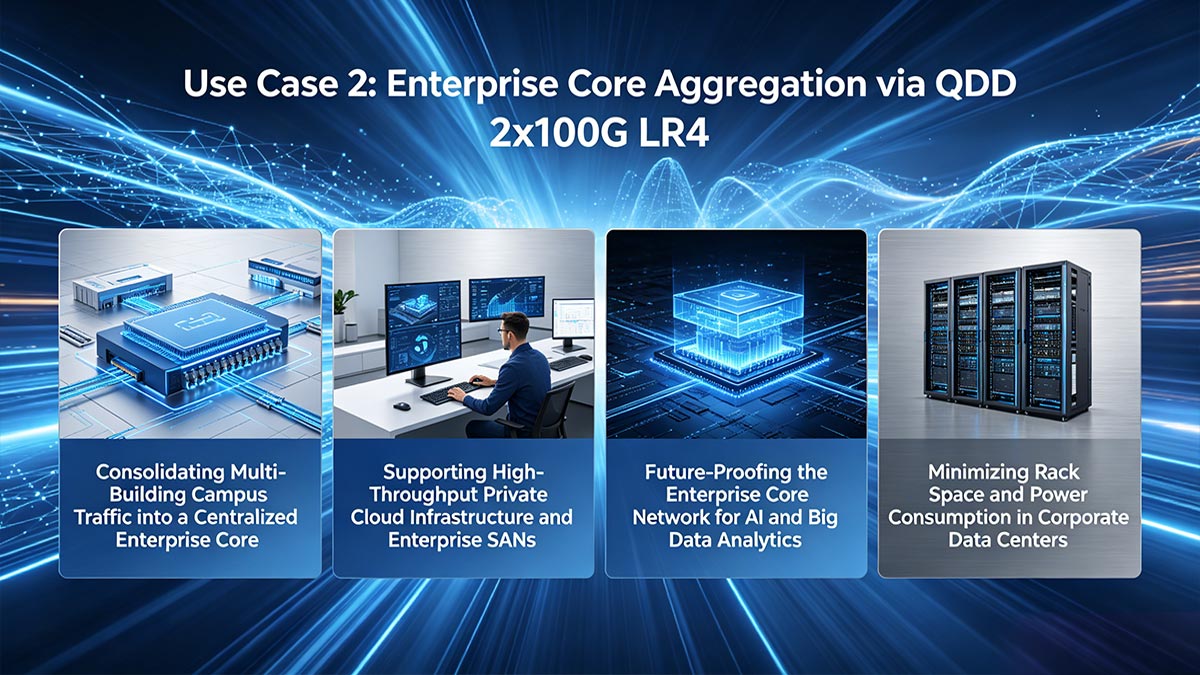
Zusammenführung des Datenverkehrs auf dem Campus mit mehreren Gebäuden in einem zentralen Unternehmenskern
Der QDD 2x100G LR4 ist äußerst effizient, um große Datenmengen von mehreren über den Campus verteilten Gebäuden direkt in einen zentralen Core-Switch zu leiten. Dank seiner Übertragungsreichweite von 10 km können Unternehmen Campus-weite Strecken mühelos über Singlemode-Glasfaser überbrücken und dabei auf jedem unabhängigen Kanal die volle 100-Gbit/s-Durchsatzrate gewährleisten.
Unterstützung von Private-Cloud-Infrastrukturen mit hohem Durchsatz und Enterprise-SANs
Moderne private Clouds und lokale Speichernetzwerke (SANs) erzeugen dichten, stoßartigen Datenverkehr, der herkömmliche Verteilungshardware leicht überlasten kann. Durch die Nutzung der Dual-Channel-Kapazität des QDD 2x100G LR4 können Unternehmensadministratoren stabile, isolierte Hochgeschwindigkeitsverbindungen direkt zu kritischen Flash-Speicherarrays und Rechenclustern bereitstellen.
Zukunftssichere Gestaltung des Unternehmenskernnetzwerks für KI- und Big-Data-Analysen
Da Unternehmensnetzwerke zunehmend auf lokale KI-Modelle und fortschrittliche Big-Data-Analyse-Engines setzen, steigt der Bedarf an dauerhaft leistungsstarken Pipelines mit hoher Bandbreite exponentiell. Die Implementierung des QDD 2x100G LR4 gewährleistet, dass die Kernschicht des Unternehmensnetzwerks über die notwendige Kapazität verfügt, um massive Datenmengen ohne Paketverluste oder Netzwerkverzögerungen zu verarbeiten.
Minimierung von Rackplatzbedarf und Stromverbrauch in Unternehmensrechenzentren
On-premise corporate data centers frequently operate under strict spatial limitations and tight Strombudgets. The compressed form factor of the QDD 2x100G LR4 provides a massive efficiency boost by delivering 200G of aggregated connectivity per slot, which significantly lowers the total number of active switches required and drops cooling demands.
❇️ Bewährte Vorgehensweisen für die Bereitstellung und Fehlerbehebung für QDD 2x100G LR4
Korrekte Installationsprotokolle und systematische Diagnoseüberwachung sind unerlässlich für die langfristige Stabilität optischer Hardware mit hoher Dichte. Der Einsatz des QDD 2x100G LR4 erfordert die sorgfältige Berücksichtigung der Host-Kompatibilität, der Faserreinheit und der präzisen Portkonfiguration, um die Verbindungsverfügbarkeit zu maximieren. Die Einhaltung bewährter Betriebsrichtlinien ermöglicht es den Entwicklungsteams, Probleme auf der physikalischen Schicht schnell zu beheben und einen optimalen Datendurchsatz zu gewährleisten.
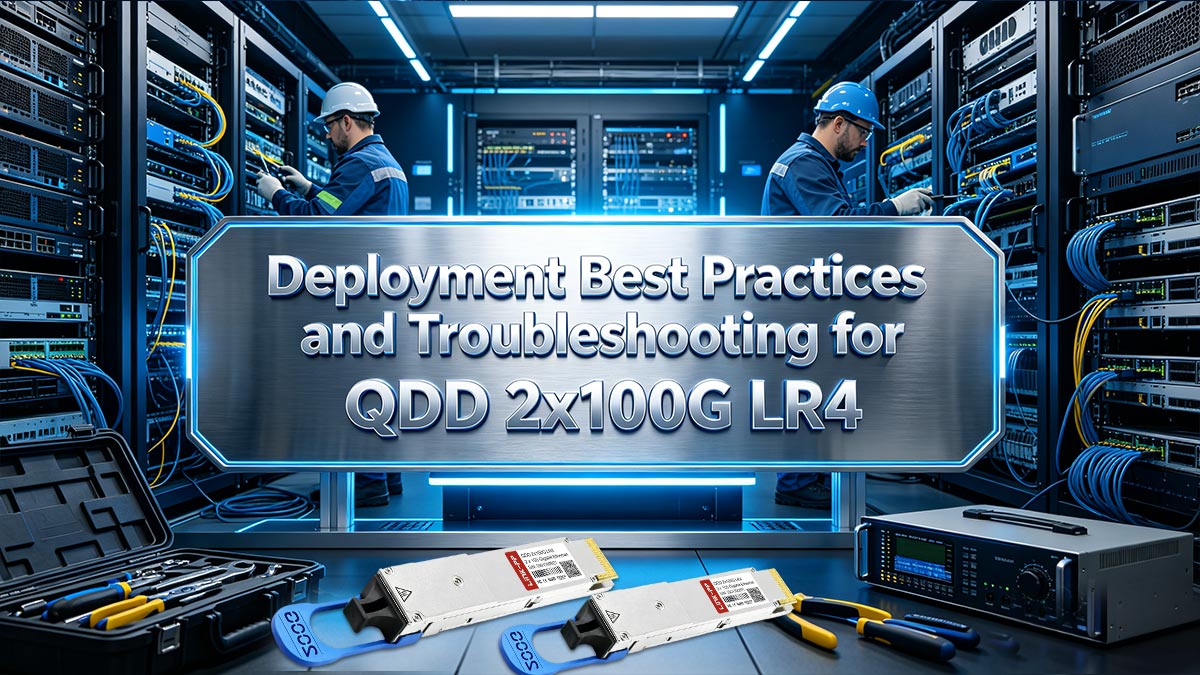
Überprüfung der Kompatibilität der Host-Plattform und der Firmware-Unterstützung
Vor der Hardwareinstallation müssen die Techniker überprüfen, ob der Ziel-Switch oder -Router die Dual-Channel-Konfiguration des QDD 2x100G LR4 vollständig unterstützt. Da das Modul zwei unabhängige 100G-Verbindungen auf einen einzigen physischen Port abbildet, muss das Host-Betriebssystem aktualisiert werden, um die Schnittstellen-Siliziumstruktur korrekt zu erkennen und zu partitionieren.
Die Überprüfung der folgenden Schritte zur Funktionsprüfung hilft, anfängliche Startfehler und Systemportfehler zu vermeiden:
- Prüfen Sie die Hardware-Kompatibilitätsmatrix: Bestätigen Sie die Zulassung des jeweiligen Switch-Modells.
- Aktualisieren Sie die Firmware des Host-Betriebssystems: Installieren Sie die neuesten Softwareversionen für eine korrekte Portzuordnung.
- Überprüfen Sie die Port-Breakout-Konfiguration: Stellen Sie sicher, dass der Steckplatz für den Betrieb im 2x100G-Modus konfiguriert ist.
- Überprüfen Sie die Leistungsbeschränkungen: Stellen Sie sicher, dass der Switch-Port die Nennleistung des Moduls liefern kann.
Aufrechterhaltung der Sauberkeit von Glasfasern für CS-Steckverbinder
Die kompakte Bauweise des CS-Steckers macht ihn sehr empfindlich gegenüber Staub, Öl und Verunreinigungen aus der Luft, die den Lichtweg blockieren können. Verschmutzte Stirnflächen eines QDD 2x100G LR4 können zu starker Signaldämpfung, hohen Bitfehlerraten oder einem vollständigen Verbindungsabbruch führen.
Die Einhaltung standardisierter Glasfaserreinigungs- und Inspektionsprotokolle gewährleistet eine absolut saubere und hochstabile Verbindung:
- Vor dem Anschließen prüfen: Verwenden Sie ein spezielles CS-Faserendoskop, um die Aderendhülse zu betrachten.
- Verwenden Sie spezielle CS-Reinigungswerkzeuge: Tragen Sie ein trockenes Tuch auf, das für 1.25-mm-Rasterungen ausgelegt ist.
- Vermeiden Sie es, die Anschlussspitzen zu berühren: Verhindern Sie die Übertragung von natürlichen Hautfetten während der Handhabung.
- Unbestückte Ports sofort verschließen: Freiliegende Optiken vor Staub aus dem offenen Rechenzentrum schützen.
Überwachung des Transceiver-Zustands in Echtzeit mittels digitaler Diagnoseüberwachung (DDM)
Digitales Diagnosemonitoring (DDM) allows network administrators to track the vital real-time operating metrics of the QDD 2x100G LR4. This telemetry data provides immediate insight into internal module performance, helping teams identify early signs of fiber degradation before a complete link outage occurs.
Die kontinuierliche Überwachung dieser spezifischen DDM-Parameter ermöglicht eine hocheffektive, proaktive Netzwerkfehlersuche:
- Optische Sende-/Empfangsleistung überwachen: Leitungsdämpfung oder defekte Senderlaser identifizieren.
- Überwachung der Transceiver-Temperatur: Erkennen interner Überhitzungsprobleme, die durch blockierten Luftstrom verursacht werden.
- Modulversorgungsspannung beachten: Sicherstellen, dass die Host-Plattform eine stabile und konforme elektrische Spannung liefert.
- Protokollieren Sie historische Fehlermeldungen: Überprüfen Sie die Warnschwellenwerte, um vorbeugende Wartungsarbeiten zu planen.
Gängige Link-Aggregation-Gruppen (LAG)-Konfigurationen für Dual-Channel-Ports
Die Konfiguration von Link-Aggregation-Gruppen (LAGs) über die beiden Kanäle eines QDD 2x100G LR4 gewährleistet eine optimale Lastverteilung und Linkredundanz. Da ein einzelnes Modul zwei unabhängige 100G-Datenströme enthält, müssen Techniker die logische Bündelung korrekt konfigurieren, um ein nahtloses Failover des Datenverkehrs sicherzustellen.
Durch die Anwendung der folgenden Konfigurationsregeln werden Routing-Schleifen vermieden und die Effizienz logischer Portgruppen maximiert:
- LACP-Protokolle einsetzen: Link Aggregation Control Protocol für die dynamische Verbindungsüberwachung verwenden.
- Verteilen Sie die Mitgliedsverbindungen: Verbinden Sie die Kanäle nach Möglichkeit über verschiedene physische Leitungskarten hinweg.
- Einstellungen für die Portgeschwindigkeit anpassen: Erzwingen, dass beide aggregierten Kanäle mit identischen 100G-Parametern betrieben werden.
- Ausrichtung der Hash-Algorithmen: Gleichmäßige Verteilung der Verkehrslasten über den optischen Zweikanalpfad.
❇️ Fazit: Zukunftssichere Kernnetzwerkarchitektur mit QDD 2x100G LR4
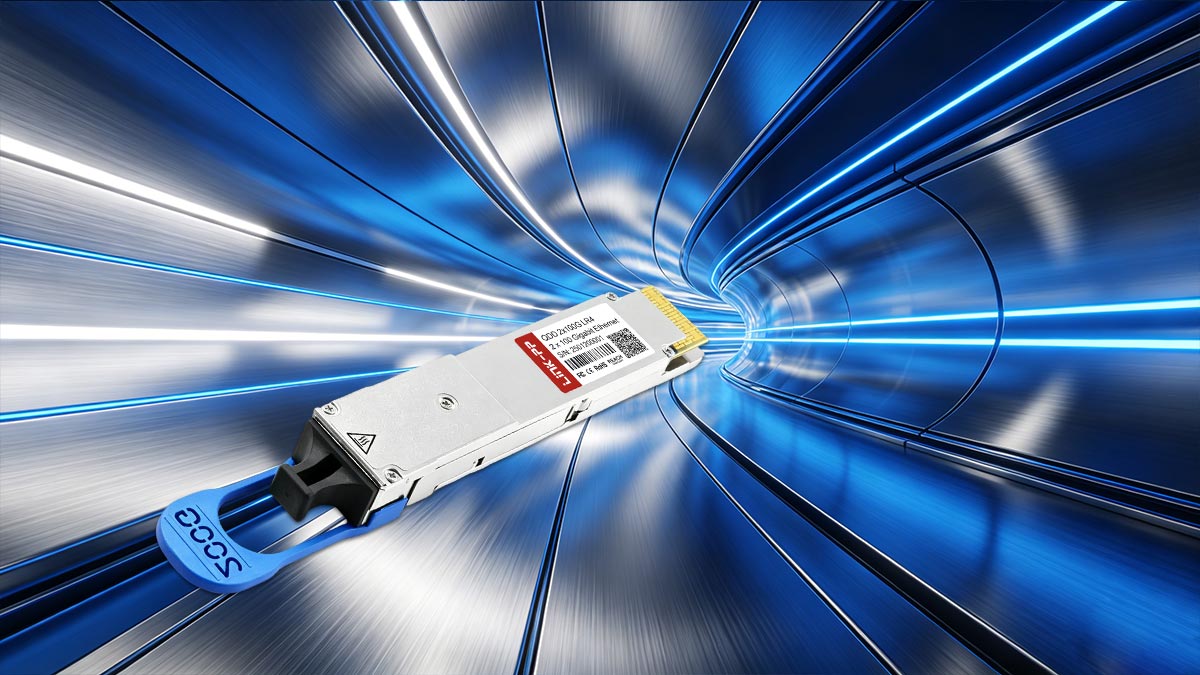
Embracing the QDD 2x100G LR4 optisches Transceivermodul is a highly strategic step toward building a scalable, high-density core network that easily handles skyrocketing bandwidth demands. By effectively doubling port capacity and maximizing rack-unit throughput without expensive infrastructure overhauls, this dual-channel technology offers an ideal balance of performance and operational economy.
Wenn Sie die Einschränkungen der Frontpanel-Technologie beseitigen und Ihre Campus- oder Rechenzentrumsaggregationsschichten optimieren möchten, ist die Wahl hochwertiger optischer Hardware entscheidend für eine langfristige Verbindungszuverlässigkeit. Entdecken Sie leistungsstarke Transceiver auf der Website [Website-Adresse einfügen]. LINK-PP Offizieller Shop um die perfekten QSFP-DD-Module in Unternehmensqualität zu finden, die auf Ihre Netzwerkarchitektur zugeschnitten sind.







