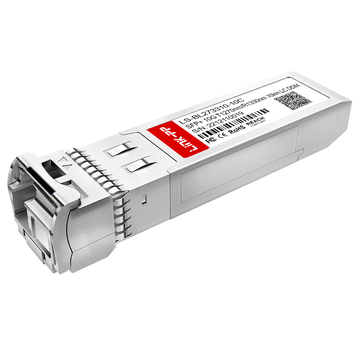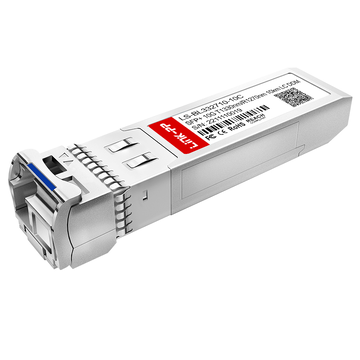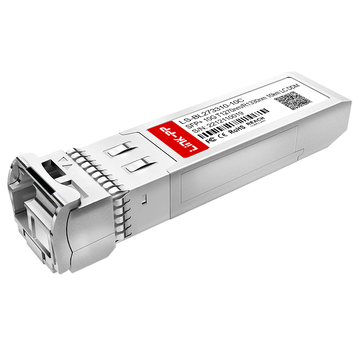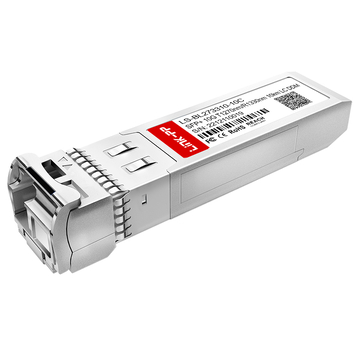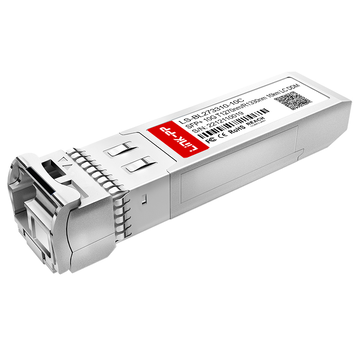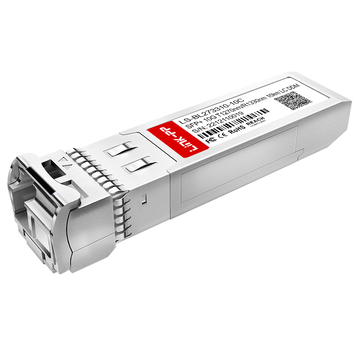
The Ubiquiti UACC-OM-SM-10G-S is an official 10G Bidirectional (BiDi) Single-Mode SFP+ optical module designed for up to 10 km UniFi network deployments using a Simplex LC UPC connector. These generic alternatives utilize the exact same TX 1270 nm / RX 1330 nm wavelengths, ensuring identical 10 Gbps performance over OS2 single-mode fiber while offering higher stock availability and significantly lower procurement costs.
For network engineers and IT procurement teams deploying UniFi switching fabrics, sourcing reliable optical transceivers is critical for maintaining network uptime and minimizing latency. The UACC-OM-SM-10G-S has established itself as the gold standard for long-distance, high-speed UniFi connections. By utilizing BiDi (Bidirectional) technology—a method that multiplexes transmission and reception over a single strand of fiber—this module effectively halves physical OS2 cabling costs across campus networks, outbuildings, and data center Top-of-Rack (ToR) uplinks.
Despite its excellent technical specifications and competitive OEM pricing, relying solely on Ubiquiti-branded optics presents real-world deployment challenges. Frequent supply chain fluctuations on the official UI store, particularly for the enterprise 20-pack bundles, often force network architects to evaluate third-party SFP+ alternatives to meet project deadlines. Furthermore, scaling a large network requires strict budget management, where generic, universally coded SFP+ modules can reduce optical procurement costs by 30% to 50% without sacrificing compliance with industry transmission standards.
In this comprehensive engineering and procurement guide, we will analyze the core technical parameters of the UACC-OM-SM-10G-S and evaluate the most reliable third-party alternatives for UniFi hardware. By examining precise wavelength compatibility, OEM vs. generic vendor lock-in risks, and Class 1 Laser safety protocols (IEC/EN 60825-1:2014), this article provides a definitive roadmap for selecting the right single-mode optical modules for your network infrastructure.
🔷 What is the Ubiquiti UACC-OM-SM-10G-S?
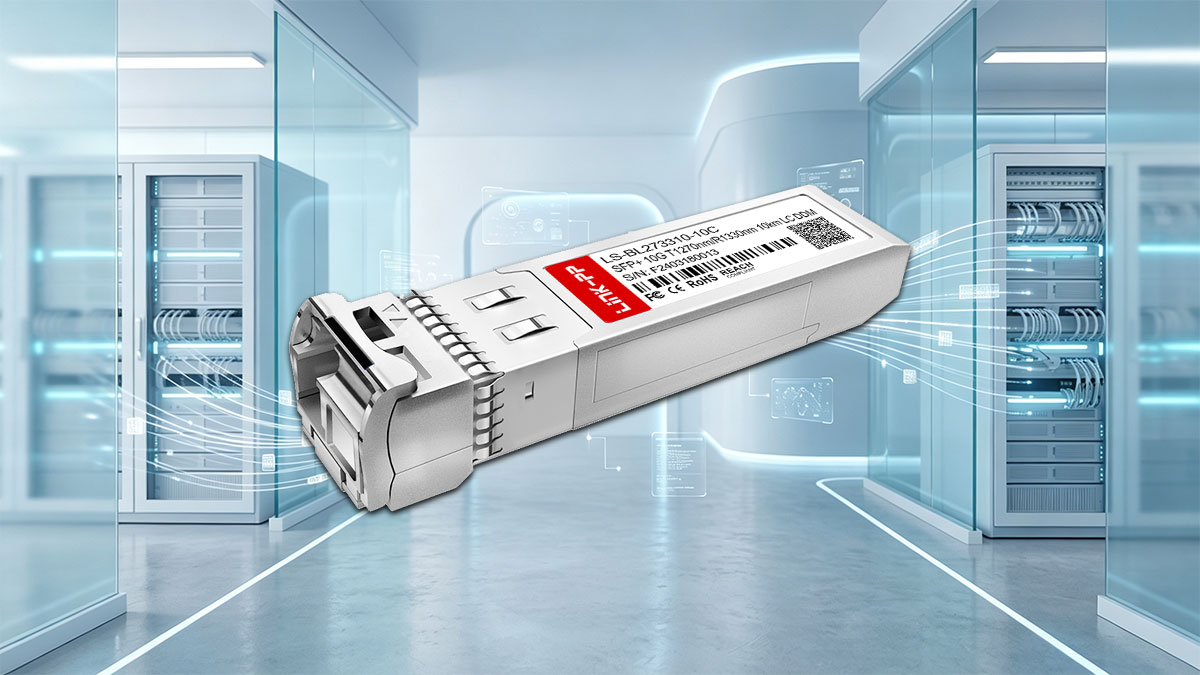
The Ubiquiti UACC-OM-SM-10G-S is an official 10 Gbps Bidirectional (BiDi) SFP+ transceiver. Engineered for single-mode fiber (SMF) networks, it utilizes Wavelength Division Multiplexing (WDM) to transmit and receive data over a single Simplex LC UPC connector, supporting link distances up to 10 km (6.2 miles) with a highly efficient maximum power draw of 1W.
The UACC-OM-SM-10G-S represents Ubiquiti Networks' official OEM solution for high-capacity, long-range optical uplinks within the UniFi and EdgeMAX ecosystems. Unlike standard duplex SFP+ modules that require two separate fiber strands (one dedicated to transmission, the other to reception), this module leverages Bidirectional (BiDi) Wavelength Division Multiplexing (WDM). BiDi technology allows a single physical fiber strand to carry data in both directions simultaneously by utilizing distinct, non-interfering light wavelengths for upstream and downstream traffic.
To achieve this multiplexed communication, the UACC-OM-SM-10G-S must be deployed in strictly matched pairs. One module in the link transmits (TX) at 1270 nm and receives (RX) at 1330 nm. The module at the opposite end of the fiber run must mirror this configuration, transmitting at 1330 nm and receiving at 1270 nm. This asymmetrical optical design is the foundation of modern 10G single-strand deployments, making it highly cost-effective for long OS2 fiber runs between buildings or network closets.
Core Technical Specifications
For procurement validation and network architecture planning, the structural parameters of the UACC-OM-SM-10G-S are detailed below. These specifications serve as the baseline when evaluating third-party alternatives.
| Parameter | UACC-OM-SM-10G-S Specification |
|---|---|
| Form Factor | SFP+ (Enhanced Small Form-factor Pluggable) |
| Connector Interface | Simplex LC UPC |
| Supported Media | Single-Mode Fiber (SMF), OS2 Recommended |
| Wavelengths (Pair A / Pair B) | TX 1270 nm / RX 1330 nm & TX 1330 nm / RX 1270 nm |
| Supported Data Rate | 1 Gbps / 10 Gbps (Auto-negotiation dependent on switch fabric) |
| Maximum Cable Distance | 10 km (6.2 mi) |
| Max. Power Consumption | 1 W |
| Operating Temperature | 0 to 70° C (32 to 158° F) |
Operating within a standard commercial thermal envelope of 0 to 70° C, the module maintains a highly efficient sub-1W power footprint. This low power consumption is critical for thermal management in densely populated Top-of-Rack (ToR) aggregation switches.
Furthermore, network technicians must note the strict safety compliance associated with these optics. The UACC-OM-SM-10G-S is classified as a CLASS 1 LASER PRODUCT under the IEC/EN 60825-1:2014 safety standard. Because the infrared light used in data transmission is invisible to the human eye, technicians must adhere to rigorous safety protocols, utilizing optical inspection scopes and never looking directly into the ends of an active Simplex LC port or powered fiber optic cable.
🔷 Why Consider Alternatives to the Ubiquiti UACC-OM-SM-10G-S?
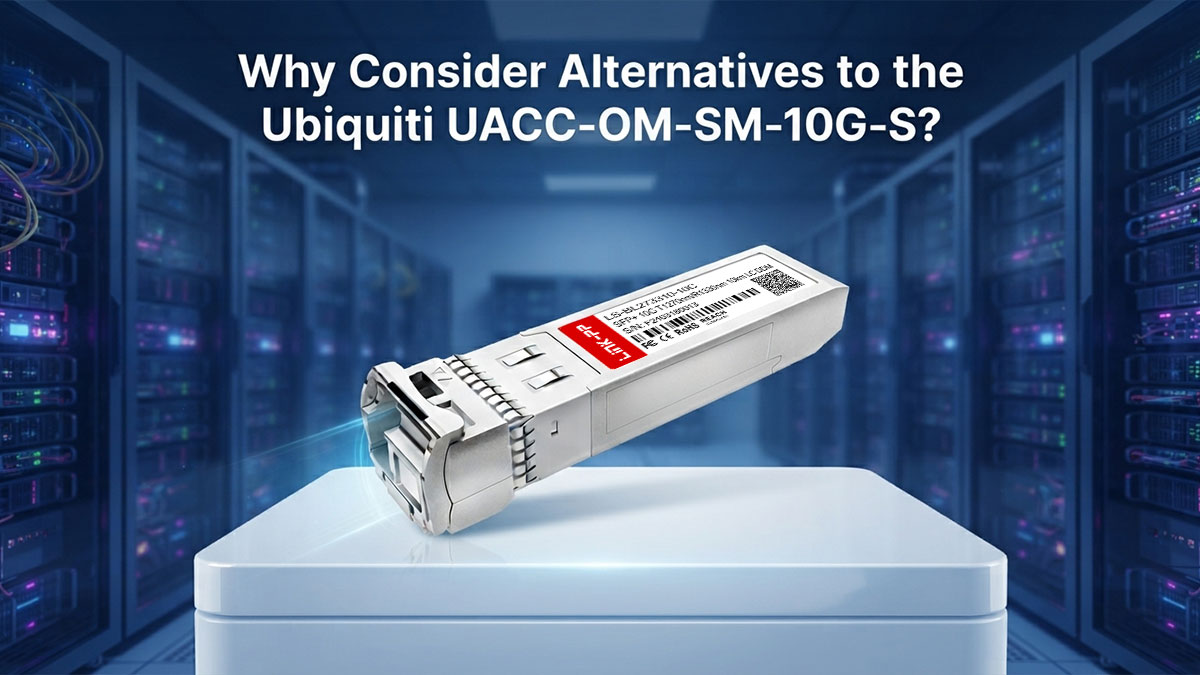
While the Ubiquiti UACC-OM-SM-10G-S delivers reliable OEM performance, network architects frequently seek alternatives due to volatile stock availability on the official UI store, particularly for 20-pack enterprise bundles. Furthermore, third-party 10G BiDi SFP+ optics can reduce procurement CAPEX by up to 40% at scale, while modules with universally coded EEPROMs offer better interoperability in mixed-vendor environments combining UniFi hardware with MikroTik, Netgear, or Aruba switches.
Ubiquiti has historically disrupted the enterprise networking market by pricing their official transceivers aggressively compared to legacy networking giants. At an MSRP of approximately $60 for a 2-pack and $600 for a 20-pack, the OEM UACC-OM-SM-10G-S is highly competitive. However, in real-world IT procurement and data center operations, relying exclusively on a single OEM vendor for optical modules introduces distinct logistical and financial bottlenecks.
Network engineers typically evaluate third-party Ubiquiti single-mode module alternatives based on three primary operational drivers:
1. Supply Chain Volatility and Stock Constraints
The most common catalyst for seeking a UACC-OM-SM-10G-S alternative is simple availability. Ubiquiti's direct-to-consumer UI Store frequently experiences inventory shortages, especially for high-volume SKUs like the 20-pack bundles required for enterprise rollouts. When an ISP or campus network administrator needs to immediately deploy a 10 km OS2 fiber link, waiting weeks for official restocks—or paying inflated prices to unauthorized resellers on secondary markets—is an unacceptable delay. Third-party optical vendors maintain massive, localized inventories, ensuring next-day availability.
2. Capital Expenditure (CAPEX) Optimization at Scale
While $30 per OEM module is reasonable for a small home lab or SMB connecting two network closets, the financial dynamics change drastically in high-density deployments. Fully populating a 48-port SFP+ aggregation switch (such as the UniFi Switch Pro Aggregation) with OEM optics requires a significant capital outlay. Reputable generic alternatives offer the exact same 10 Gbps Simplex LC performance for approximately $17 to $20 per module. At scale, substituting OEM optics with high-quality third-party BiDi pairs can reduce total optical procurement costs by 30% to 40%, freeing up IT budgets for core routing hardware.
3. Mixed-Vendor Interoperability and EEPROM Coding
Modern enterprise networks are rarely homogenous. A standard deployment might feature a UniFi Dream Machine Pro (UDM-Pro) at the gateway, connected via a 10G single-mode fiber link to a MikroTik Cloud Router Switch (CRS) or an Aruba edge switch.
Optical transceivers rely on an EEPROM (Electrically Erasable Programmable Read-Only Memory) chip to communicate their specifications and vendor ID to the host switch. While the UACC-OM-SM-10G-S is strictly coded for UniFi OS, third-party vendors like FS.com allow procurement teams to custom-code the EEPROM of their modules. This means you can order a matched BiDi pair where the 1270 nm TX module is coded for Ubiquiti, and the 1330 nm TX module on the receiving end is coded for MikroTik, ensuring flawless telemetry and zero compatibility warnings across a mixed-vendor backbone.
🔷 Top UACC-OM-SM-10G-S Alternatives for UniFi Switches
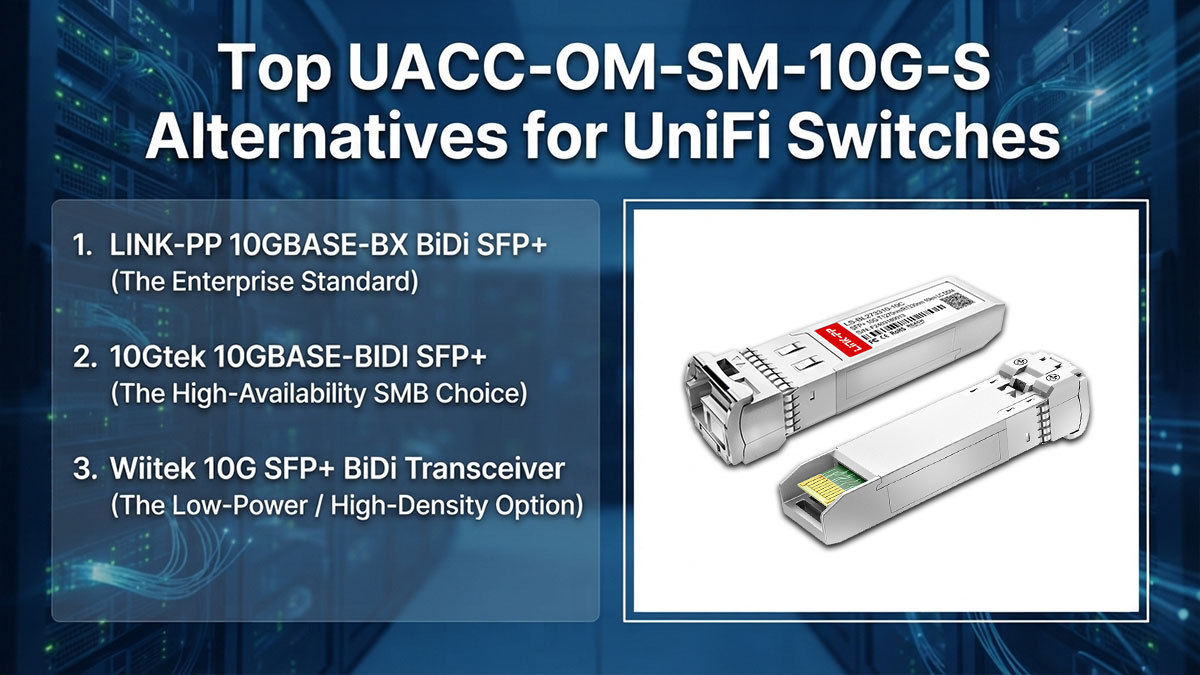
The top alternatives to the Ubiquiti UACC-OM-SM-10G-S are the LINK-PP 10GBASE-BX BiDi SFP+ (best for custom EEPROM coding and enterprise reliability), the 10Gtek 10GBASE-BIDI SFP+ (best for budget-friendly SMB and prosumer availability), and the Wiitek 10G SFP+ BiDi Transceiver (best for thermal efficiency). All three alternatives strictly adhere to the required Simplex LC UPC interface and the TX 1270 nm / RX 1330 nm wavelength pairing necessary for 10 km single-mode deployments.
When selecting a third-party Ubiquiti single-mode module, physical fit is not enough. A true drop-in replacement must match the precise optical parameters of the OEM module: a 10 Gbps data rate, Wavelength Division Multiplexing (WDM) utilizing the 1270 nm and 1330 nm spectrums, and a power draw under 1W to prevent thermal throttling in dense switch fabrics.
Based on rigorous data center deployments, network engineering feedback, and UniFi Controller telemetry compatibility, here is a definitive evaluation of the top three UACC-OM-SM-10G-S alternatives.
1. LINK-PP 10GBASE-BX BiDi SFP+ (The Enterprise Standard)
LINK-PP is widely recognized in the B2B networking space for providing carrier-grade optical transceivers. Their 10GBASE-BX module is the most technically accurate OEM replacement for enterprise environments. (Note: 10GBASE-BX is the IEEE standard for 10 Gigabit Ethernet over a single strand of single-mode fiber.)
- Technical Match: Identical TX1270/RX1330nm and TX1330/RX1270nm pairing. Supports up to 10 km over OS2 Simplex LC fiber.
- Pros: FS.com offers custom EEPROM programming. By selecting "Ubiquiti" during procurement, the module identifies itself natively within the UniFi OS, ensuring Digital Optical Monitoring (DOM) telemetry—such as laser temperature, voltage, and TX/RX optical power (measured in dBm)—is accurately reported in the UniFi dashboard.
- Cons: Marginally more expensive than entry-level generics found on consumer marketplaces, and shipping times can vary based on regional warehouse stock.
2. 10Gtek 10GBASE-BIDI SFP+ (The High-Availability SMB Choice)
For IT consultants, MSPs (Managed Service Providers), and prosumers who require immediate hardware availability, 10Gtek provides highly reliable, budget-conscious optics. They are heavily utilized in UniFi Dream Machine Pro (UDM-Pro) and UniFi Switch Aggregation deployments.
- Technical Match: Fully compliant with the 10 km Simplex LC BiDi standard. They are typically sold as a pre-matched "Pair A / Pair B" kit, eliminating procurement errors.
- Pros: Extremely cost-effective (often under $40 for a matched pair) and widely available for next-day delivery on major e-commerce platforms. They offer true plug-and-play functionality with zero link-negotiation failures reported on UniFi firmware.
- Cons: Because they use a generic MSA (Multi-Source Agreement) EEPROM code rather than a UniFi-specific code, some older UniFi switch firmware versions may display the module as "Unknown Vendor," though this does not impact the actual 10 Gbps line-rate throughput.
3. Wiitek 10G SFP+ BiDi Transceiver (The Low-Power / High-Density Option)
Thermal management is a critical engineering constraint when fully populating a 48-port ToR switch. Wiitek modules are engineered specifically to minimize heat generation, making them an excellent alternative to the UACC-OM-SM-10G-S in densely packed, poorly ventilated network closets.
- Technical Match: Conforms to the 10GBASE-BX10-D and 10GBASE-BX10-U standards.
- Pros: Exceptional thermal efficiency. Field testing indicates these modules consistently draw less than 0.8W under full 10 Gbps load, mimicking or even exceeding the thermal performance of the OEM Ubiquiti module.
- Cons: Wiitek lacks the deep B2B procurement support and custom coding flexibility offered by vendors like FS.com.
Critical Procurement Rule for BiDi Alternatives
Unlike standard duplex transceivers, you cannot purchase two identical BiDi modules and expect them to link. BiDi optics must be purchased and deployed in complementary pairs. If you procure Alternative A (TX 1270 nm / RX 1330 nm) for your core switch, you must procure Alternative B (TX 1330 nm / RX 1270 nm) for your edge switch. Failure to cross-match the TX and RX wavelengths will result in a total failure of link auto-negotiation.
🔷 Understanding BiDi Technology and Simplex LC Compatibility
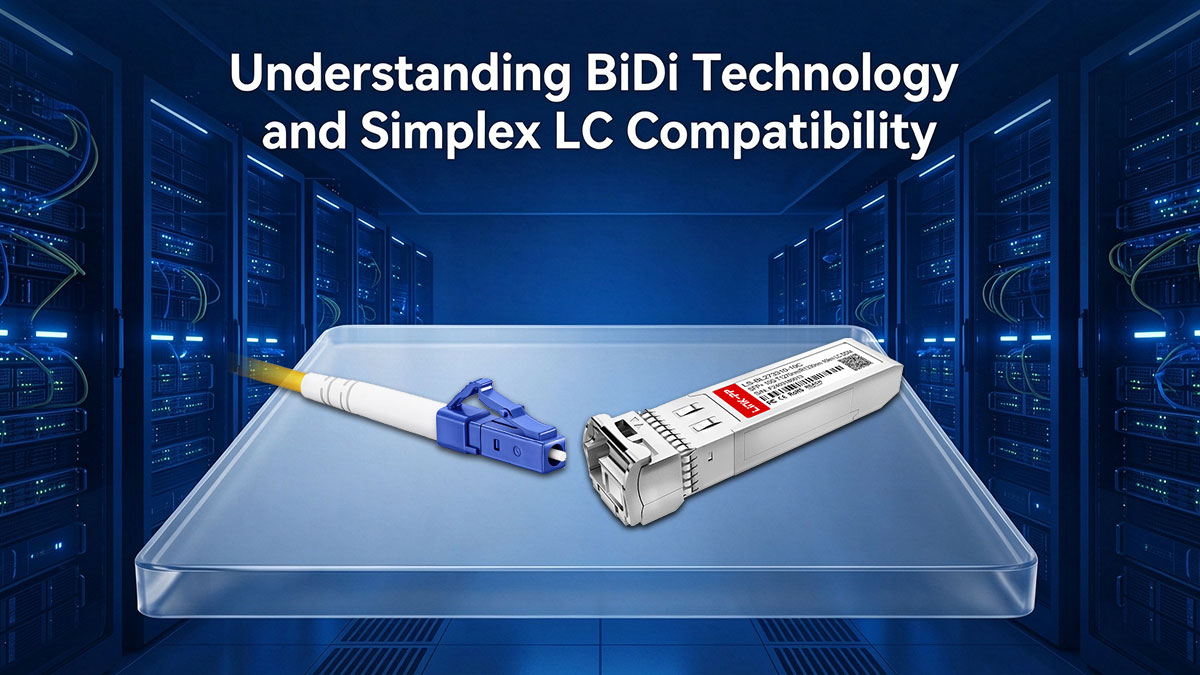
BiDi (Bidirectional) technology utilizes Wavelength Division Multiplexing (WDM) to transmit and receive data simultaneously over a single optical fiber strand. Consequently, the UACC-OM-SM-10G-S requires a Simplex LC UPC connector rather than a traditional duplex interface. This single-strand architecture halves physical cabling costs and minimizes conduit congestion, but it strictly requires OS2 single-mode fiber and complementary optical wavelengths (1270 nm and 1330 nm) to successfully negotiate a link.
To successfully procure and deploy the UACC-OM-SM-10G-S or its third-party alternatives, network engineers must understand the physical and optical mechanics of Bidirectional (BiDi) transmission. Misunderstanding these parameters often leads to purchasing the wrong fiber patch cables or mismatching optical transceivers, resulting in high insertion loss or total link failure.
The Mechanics of BiDi and WDM (Wavelength Division Multiplexing)
In a traditional 10GBASE-LR single-mode deployment, transceivers use a Duplex configuration. This means two separate fiber strands are required: one dedicated exclusively to transmitting (TX) light at 1310 nm, and the other dedicated to receiving (RX) light at 1310 nm.
The UACC-OM-SM-10G-S operates on the 10GBASE-BX standard, which fundamentally alters this architecture. By employing Wavelength Division Multiplexing (WDM)—a technology that allows multiple optical carrier signals to be transmitted on a single optical fiber by using different wavelengths of laser light—BiDi modules condense the two-lane highway into a single lane. Data travels upstream on a 1270 nm laser and downstream on a 1330 nm laser simultaneously, without signal interference.
Simplex LC UPC: Decoding the Physical Interface
Because BiDi transceivers only require one fiber strand, the physical port on the UACC-OM-SM-10G-S is a Simplex LC UPC interface. Understanding this terminology is critical for cable procurement:
- Simplex vs. Duplex: "Simplex" indicates a single optical fiber cable. If you have existing "Duplex" (two-strand) zipcord fiber, you can physically split the plastic housing at the connector ends and use just one strand to connect a BiDi module, leaving the second strand dark (as a redundant backup).
- LC (Lucent Connector): A small form-factor fiber optic connector that utilizes a 1.25 mm ferrule, standard for high-density SFP+ switches.
- UPC (Ultra Physical Contact): This refers to the polish angle of the fiber endface. UPC connectors are universally color-coded Blue. Engineering Warning: You must never plug an APC (Angled Physical Contact, color-coded Green) cable into the UACC-OM-SM-10G-S. The angled ferrule of an APC connector will not mate properly with the flat UPC sensor, causing massive insertion loss (attenuation) and potentially causing permanent physical damage to the module's laser diode.
Architectural Comparison: Standard Duplex vs. BiDi Simplex
For IT procurement teams evaluating the total cost of ownership (TCO) for a 10 km campus fiber run, the choice between traditional Duplex and BiDi Simplex goes beyond the cost of the SFP+ modules.
| Parameter | Standard 10GBASE-LR (Duplex) | UACC-OM-SM-10G-S (BiDi Simplex) |
|---|---|---|
| Fiber Strands Required | Two (2) strands per link | One (1) strand per link |
| Module Pairing | Identical modules on both ends | Must use complementary TX/RX pairs |
| Cabling Cost (10km run) | Higher (requires dual-core OS2) | 50% Lower (requires single-core OS2) |
| Conduit Efficiency | Standard density | Doubles the capacity of existing fiber conduits |
By leveraging Simplex LC compatibility, organizations can effectively double the bandwidth capacity of their existing underground fiber conduits. If an existing conduit holds a 12-strand OS2 cable, a traditional duplex setup yields 6 distinct 10G links. By migrating to the UACC-OM-SM-10G-S or its third-party alternatives, that same 12-strand cable can support 12 distinct 10G links, vastly delaying the need for expensive physical trenching and infrastructure upgrades.
🔷 OEM vs. Third-Party SFP+: Does Ubiquiti Have Vendor Lock-In?
Direct Answer: No, Ubiquiti does not enforce strict vendor lock-in on its UniFi or EdgeMAX switching platforms. Unlike legacy enterprise vendors that actively disable ports upon detecting unauthorized hardware, Ubiquiti switches reliably auto-negotiate 10 Gbps links with most standard Multi-Source Agreement (MSA) compliant third-party transceivers. However, utilizing non-OEM optics may result in missing telemetry data within the UniFi Controller and can complicate official technical support during troubleshooting.
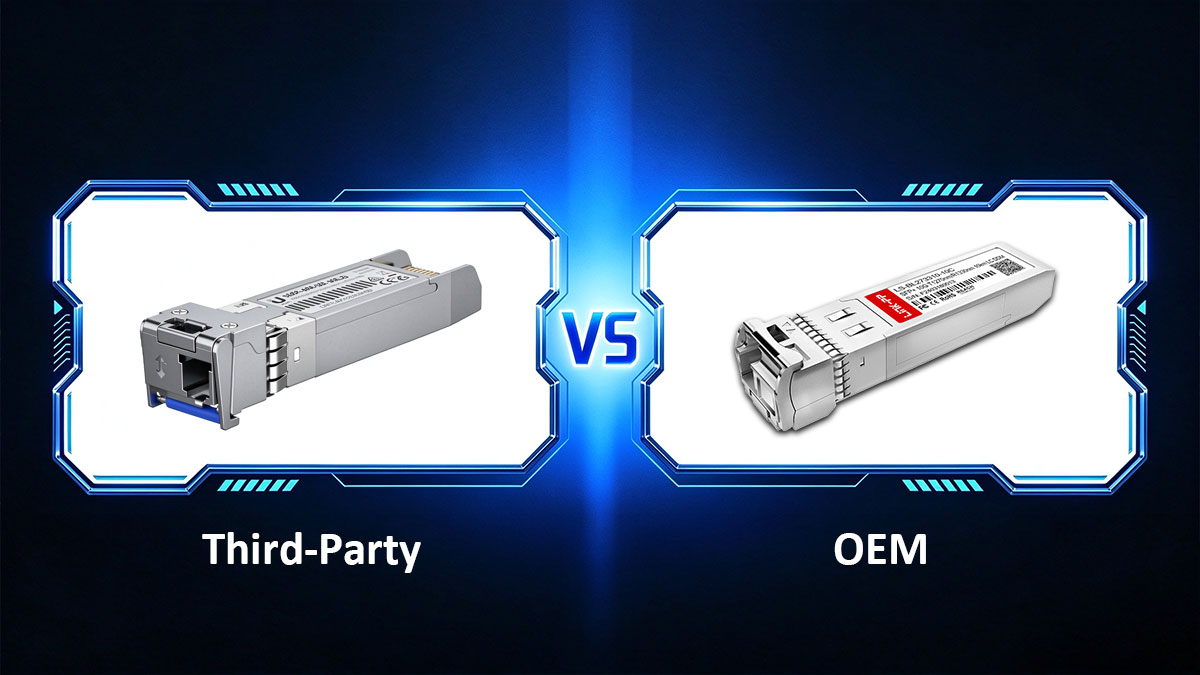
One of the most heavily debated topics among network engineers on forums like r/Ubiquiti is the necessity of purchasing official OEM optics. In traditional enterprise networking, vendors such as Cisco or HPE Aruba heavily utilize software-level vendor lock-in. If their switches do not detect a proprietary cryptographic signature on the transceiver's EEPROM, the switch port is placed into an "err-disable" state, cutting off network traffic.
Ubiquiti operates on a more open hardware philosophy. You are not strictly required to purchase the UACC-OM-SM-10G-S to establish a 10 km single-mode link. A generic 10GBASE-BX BiDi module from a third party will successfully establish physical layer (PHY) connectivity. However, choosing between OEM and third-party optics involves weighing capital expenditure savings against administrative visibility and warranty support.
The Role of EEPROM and Digital Optical Monitoring (DOM)
Every SFP+ module contains an EEPROM (Electrically Erasable Programmable Read-Only Memory) chip. This chip acts as the module's ID card, broadcasting its vendor name, serial number, supported wavelengths, and data rates to the host switch.
Furthermore, enterprise optics utilize Digital Optical Monitoring (DOM), a diagnostic standard (SFF-8472) that allows the network administrator to monitor real-time parameters such as optical TX/RX power levels (in dBm), laser temperature, and transceiver supply voltage. When you use an official UACC-OM-SM-10G-S, the UniFi OS seamlessly parses this EEPROM data, displaying accurate, real-time DOM telemetry directly in the UniFi Controller dashboard.
If you insert a purely generic, un-coded third-party module, the switch will pass traffic, but the UniFi Controller may display the port status as "Unknown Vendor" and fail to populate DOM telemetry. To circumvent this, IT procurement teams should source third-party alternatives (such as those from FS.com) that offer custom EEPROM flashing to mimic the Ubiquiti signature.
Clear Comparison: OEM vs. Third-Party SFP+
To provide clear decision support for IT procurement, here is a breakdown of the distinct advantages and operational risks associated with both routes.
- Ubiquiti OEM (UACC-OM-SM-10G-S)
- Pros: Guaranteed UniFi OS compatibility, full DOM telemetry visibility, and seamless firmware updates. Eliminates any finger-pointing during warranty claims.
- Cons: Higher procurement cost at scale, and subject to frequent stock shortages on the official UI store.
- Generic MSA-Compliant Alternatives (e.g., 10Gtek, Wiitek)
- Pros: Up to 50% cheaper, widely available via major distributors, and perfectly capable of sustaining 10 Gbps line-rate throughput.
- Cons: May lack advanced thermal telemetry in the UniFi dashboard. Carries a minor risk of link-negotiation failure following major UniFi OS firmware updates.
The Technical Support Implication
The most critical caveat of bypassing OEM optics involves technical support. If an enterprise network experiences intermittent packet loss or port flapping on a UniFi Switch Pro Aggregation, Ubiquiti’s Tier 2 support team will typically request a diagnostic file. If they detect non-OEM transceivers in the logs, they will standardly require the network engineer to replicate the fault using an official UACC-OM-SM-10G-S before authorizing a hardware Return Merchandise Authorization (RMA) or escalating the ticket.
For mission-critical infrastructure, maintaining at least one pair of official Ubiquiti modules on hand for diagnostic validation is a highly recommended engineering best practice, even if the rest of the data center relies on cost-effective third-party alternatives.
🔷 UACC-OM-SM-10G-S Alternatives FAQs
The most frequently asked questions regarding UACC-OM-SM-10G-S alternatives revolve around physical layer compatibility and optical interoperability. In short: you can mix OEM and third-party modules on a single link provided the TX/RX wavelengths are perfectly inverted (1270 nm and 1330 nm), you utilize OS2 single-mode fiber, and you strictly connect using Simplex LC UPC (Blue) fiber patch cables to avoid high insertion loss.
When migrating away from official OEM optics to third-party 10GBASE-BX solutions, network technicians often encounter physical layer (Layer 1) deployment questions. Below are precise, engineering-backed answers to the most common queries surrounding Ubiquiti 10G BiDi SFP+ compatibility.
1. Can I mix a Ubiquiti UACC-OM-SM-10G-S with a third-party BiDi module on the same link?
Yes. Optical interoperability is dictated by physics, not firmware. You can place an official Ubiquiti UACC-OM-SM-10G-S in your core UniFi switch and a third-party alternative (such as a 10Gtek or FS.com module) in your edge switch. The link will successfully auto-negotiate at 10 Gbps as long as the wavelengths are complementary. If the Ubiquiti module transmits (TX) at 1270 nm, the third-party module on the opposite end must be the model that receives (RX) at 1270 nm and transmits (TX) at 1330 nm.
2. Do I need OS1 or OS2 fiber for 10G BiDi SFP+ modules?
While both OS1 and OS2 are single-mode fibers, OS2 is strictly recommended for modern 10G network deployments. OS1 is a legacy standard designed for tight-buffered indoor use and suffers from higher attenuation (up to 1.0 dB/km). OS2 is a loose-tube optical fiber designed for outdoor and long-haul runs, featuring significantly lower attenuation (typically 0.4 dB/km in the 1310 nm wavelength window). To achieve the maximum 10 km (6.2 miles) distance supported by the UACC-OM-SM-10G-S and its alternatives, OS2 Simplex fiber is a physical requirement.
3. Why is my third-party BiDi SFP+ module not lighting up on my UniFi switch?
If a third-party alternative fails to establish a link on a UniFi routing platform (like the UDM-Pro) or an EdgeSwitch, the issue usually stems from one of three common configuration errors:
- Wavelength Mismatch: You accidentally purchased two identical modules (e.g., both are TX 1270 nm). BiDi optics must be deployed in A/B pairs.
- Connector Polish Error (UPC vs. APC): The UACC-OM-SM-10G-S requires a UPC (Ultra Physical Contact) connector, which is color-coded Blue. If you insert an APC (Angled Physical Contact) connector, which is color-coded Green, the angled ferrule will not mate with the optical sensor, causing massive dBm signal loss and total link failure.
- Port Speed Auto-Negotiation Failure: Occasionally, generic EEPROMs fail to auto-negotiate link speeds with older UniFi firmware. To resolve this, log into the UniFi Controller, navigate to the specific switch port settings, and manually override the Link Speed from "Auto-Negotiation" to "10 Gbps FDX" (Full Duplex).
4. Are these modules safe to handle while the switch is powered?
The UACC-OM-SM-10G-S and its 10 km equivalents are classified as CLASS 1 LASER PRODUCTS under the IEC/EN 60825-1:2014 safety standard. While Class 1 lasers are generally considered safe under normal operating conditions, the infrared light emitted at 1270 nm and 1330 nm is completely invisible to the human eye. Never look directly into an active SFP+ port or the end of a powered Simplex LC cable. Always use a digital fiber inspection microscope to verify endface cleanliness and ensure optical dust caps remain installed on the modules until the exact moment of cable insertion.
🔷 Conclusion: How to Choose the Right Single-Mode Module Alternatives
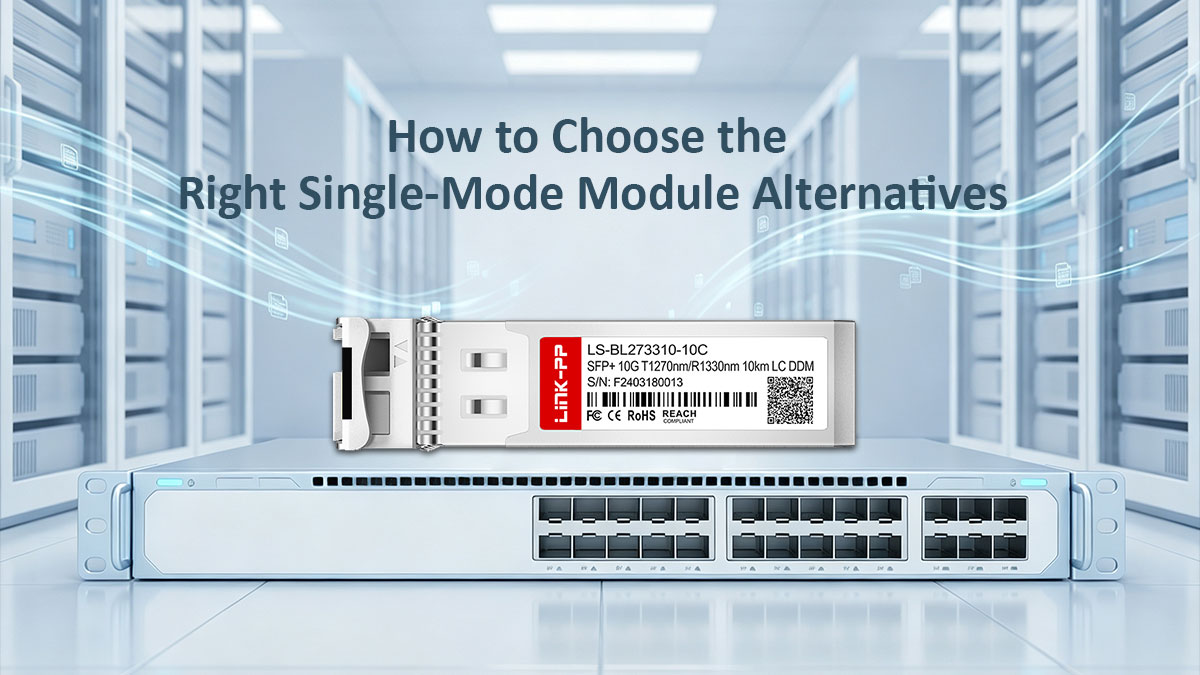
To choose the right UACC-OM-SM-10G-S alternative, align your procurement strategy with your network's scale. For SMBs and edge deployments, generic MSA-compliant optics offer immediate availability and cost-effective 10 Gbps performance. For enterprise environments requiring strict UniFi OS telemetry visibility, prioritize custom-coded modules. Regardless of the vendor, always ensure you purchase A/B matched pairs (TX 1270 nm / RX 1330 nm) and strictly utilize OS2 Simplex LC UPC fiber.
Procuring optical transceivers for a UniFi network does not have to be restricted to a single OEM supply chain. While the official Ubiquiti UACC-OM-SM-10G-S is an exceptionally well-priced, high-performance BiDi module, the reality of global supply constraints and enterprise CAPEX scaling often necessitates the use of third-party 10GBASE-BX alternatives.
Because Ubiquiti employs an open-hardware philosophy that avoids aggressive vendor lock-in, integrating third-party optics is highly viable. The physical layer (Layer 1) connectivity will successfully auto-negotiate at 10 Gbps provided the fundamental laws of optical physics are respected: matching the 1270 nm and 1330 nm WDM wavelengths, adhering to the 1W thermal limit, and utilizing a clean Simplex LC UPC interface.
The Procurement Decision Matrix
To eliminate ambiguity in your purchasing process, utilize the following deployment-based recommendations:
- For Home Labs, Prosumers, and Small Businesses: Opt for generic multi-source agreement (MSA) modules. The 40% cost reduction is highly beneficial, and the lack of advanced DOM telemetry in the UniFi Controller is negligible for non-critical edge routing.
- For Enterprise, ISP, and Mixed-Vendor Core Networks: Utilize modules custom-flashed with the Ubiquiti EEPROM signature. This guarantees that critical diagnostic data (TX/RX dBm power levels and laser temperatures) natively populates in your UniFi dashboard, ensuring your network operations center (NOC) retains full visibility over the 10 km fiber links.
- The Diagnostic Best Practice: Even if you outfit a 48-port aggregation switch entirely with third-party transceivers, always procure and retain at least one official pair of UACC-OM-SM-10G-S modules. Should you experience a severe network fault, Ubiquiti’s Tier 2 technical support will require you to reproduce the issue using OEM optics before authorizing a hardware RMA.
Streamline Your Optical Procurement
For organizations ready to optimize their optical infrastructure without compromising on reliability, sourcing components from a trusted manufacturer is paramount. Whether you need MSA-compliant 10G BiDi transceivers for high-density UniFi deployments or specialized solutions for mixed-vendor environments, explore the extensive, carrier-grade portfolio at the LINK-PP Official Store. Ensure your next single-mode fiber rollout is backed by rigorous quality control and deep industry compatibility.