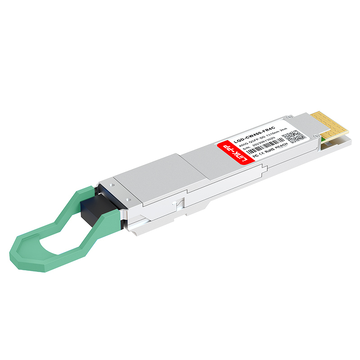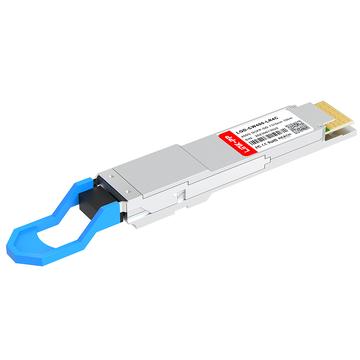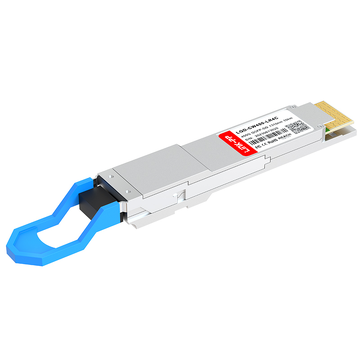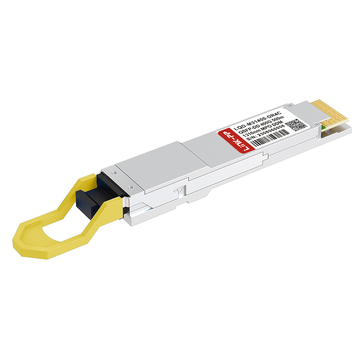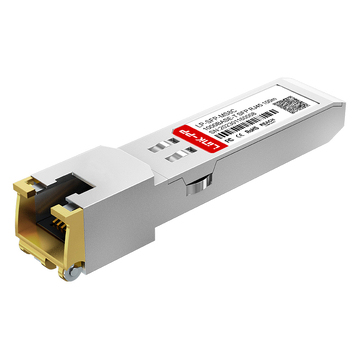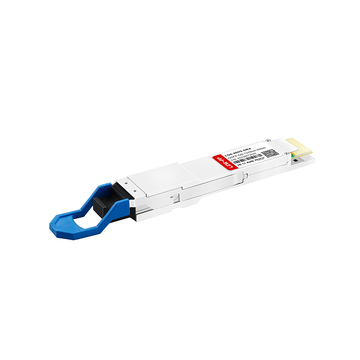
Are you looking to scale your data center interconnects or campus core without blowing your budget? Deploying the QDD-400G-LR4-S optical transceiver provides a high-density 400G link over 10km of standard single-mode fiber. However, is the initial hardware price the only metric you should consider when calculating your network upgrade?
Have you factored in hidden expenses like cabling upgrades, switch power draw, and ongoing cooling demands? Understanding the true total cost of ownership (TCO) helps you avoid common deployment pitfalls and prevent overspending. What strategic decisions can you make today to maximize the long-term ROI of your 400G infrastructure?
🔶 What Is the QDD-400G-LR4-S Optical Transceiver?
Evaluating total cost begins with understanding the core hardware driving your long-reach connectivity. The QDD-400G-LR4-S optical transceiver delivers carrier-grade 400G throughput across standard single-mode fiber for high-density modern networks.
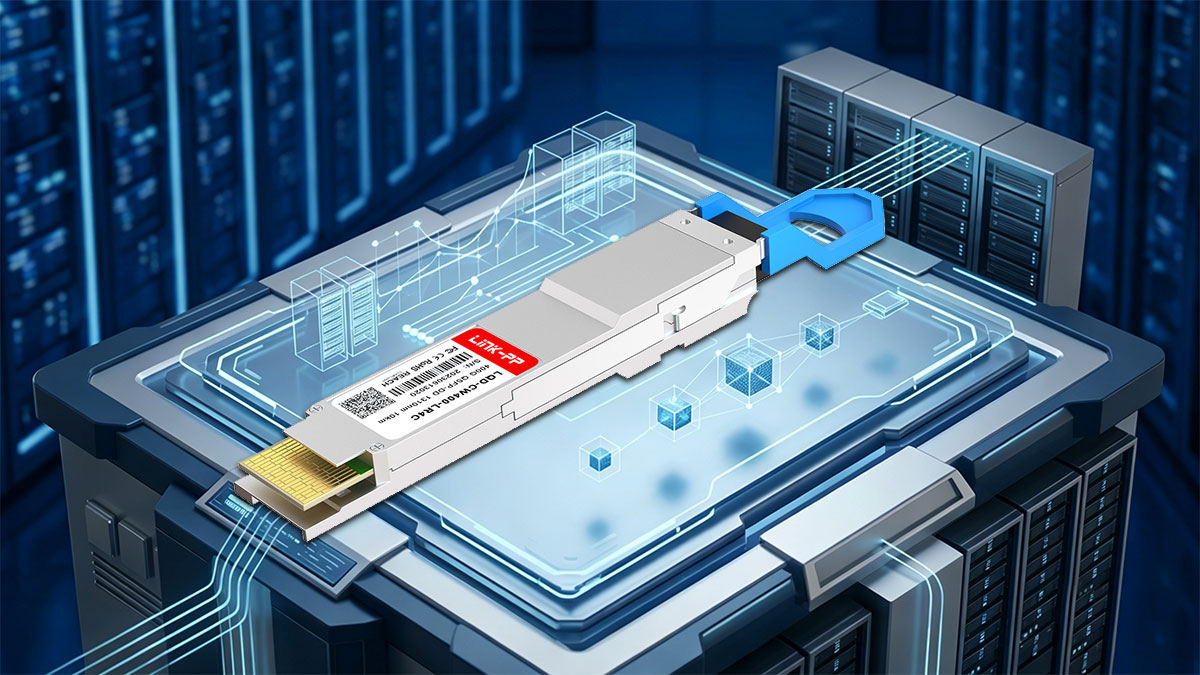
Core Specifications and the QSFP-DD Form Factor Advantage
The QDD-400G-LR4-S module operates on an 8-lane electrical interface utilizing PAM4 modulation to achieve an aggregate data rate of 400Gbps. Its Quad Small Form Factor Pluggable Double Density (QSFP-DD) housing doubles port density compared to legacy form factors without consuming extra rack real estate. This high mechanical density directly lowers floor-space CapEx while maintaining backward compatibility with standard QSFP28 modules.
By packing double the electrical channels into an ultra-compact footprint, network operators can significantly consolidate their switch fabric. Using a 10km QSFP-DD transceiver eliminates the need for bulky proprietary chassis in high-bandwidth aggregation layers. Consequently, you achieve maximum port efficiency and lower cost-per-bit metrics right out of the box.
How CWDM4 Enables 400G Over 10km Single-Mode Fiber
To span up to 10km without costly optical amplifiers, the module utilizes coarse wavelength division multiplexing technology over duplex LC fiber. It multiplexes four distinct optical channels — typically spaced around 1271nm, 1291nm, 1311nm, and 1331nm — each carrying 100Gbps PAM4 optical signals. This multiplexed architecture ensures that massive aggregate bandwidth transmits cleanly through a single pair of SMF strands.
Transmitting over existing duplex single-mode cabling avoids the massive capital expense of installing multi-fiber MPO ribbon infrastructure. The integrated optical receiver efficiently demultiplexes these 4 wavelengths and converts them back into high-speed electrical signals with low bit-error rates. This reliable wavelength division makes the QDD-400G-LR4-S QSFP-DD transceiver an optimal, budget-conscious choice for long-span inter-building uplinks.
Power Consumption Profiles and Thermal Limits
Deploying high-speed optics requires careful balancing of power supply limits and heat dissipation in dense rack environments. A typical QDD-400G-LR4-S module operates within a maximum power envelope of 10W to 12W depending on the host switch cooling design. Managing these thermal boundaries is essential because excessive operational heat directly accelerates module degradation and spikes ongoing cooling OpEx.
Advanced built-in Digital Optical Monitoring (DOM) constantly tracks internal temperature, supply voltage, and laser bias current in real time. Maintaining the module within its specified commercial temperature window prevents signal degradation and costly emergency link downtime. Efficient thermal management at the transceiver level ultimately protects long-term infrastructure health and minimizes overall total cost of ownership.
🔶 Key Cost Drivers in QDD-400G-LR4-S Total Cost of Ownership
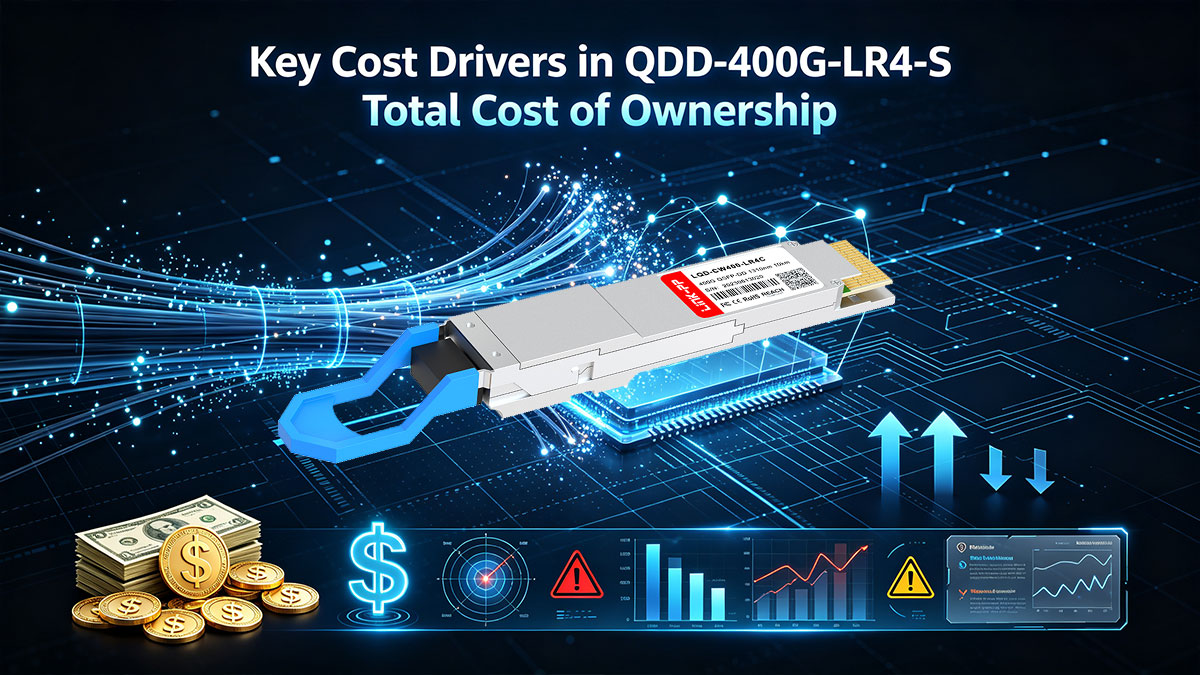
Calculating overall network expenditure requires looking far beyond the upfront unit price of optical hardware. Analyzing how CapEx and OpEx interact ensures a realistic economic forecast when deploying the QDD-400G-LR4-S transceiver module across critical infrastructure.
Initial Optics Hardware Procurement (CapEx)
Initial transceiver procurement forms the most visible portion of the capital budget for 400G upgrades. Optical components like cooled CWDM EML lasers, optical multiplexers, and DSP chips inherently carry higher manufacturing costs than short-reach optical modules. However, choosing fully compliant and tested QDD-400G-LR4-S modules balances premium optical performance with competitive volume pricing.
Procurement strategies must also account for bulk discounts, vendor lead times, and compatibility assurance across mixed hardware environments. Overpaying for proprietary branded modules significantly inflates switch population expenses without delivering performance gains. Making strategic vendor choices at the hardware purchase stage establishes a lean foundation for your long-term TCO.
Fiber Plant and LC Cabling Expenses
Cabling infrastructure represents an essential capital investment that directly impacts deployment viability over long spans. The QDD-400G-LR4-S drastically lowers cabling expenses by utilizing existing standard OS2 single-mode fiber rather than demanding new structured cabling.
Upgrading to this module delivers distinct cabling cost advantages across your physical plant:
- Duplex LC Reuse: Leverages existing legacy 2-strand fiber patches directly.
- Zero MPO Conversion: Eliminates expensive 8-fiber or 12-fiber MPO trunks.
- Low Patching Overhead: Uses affordable, standard LC patch cords and bulkheads.
- Reduced Panel Footprint: Maximizes optical distribution frame (ODF) tray density.
By utilizing standard duplex single-mode architecture, operators sidestep both the capital outlay for new physical cabling and the recurring operating expenses for leasing extra dark-fiber strands. Preserving the installed physical cabling plant protects historical infrastructure investments while enabling a fourfold leap in bandwidth.
Ongoing Power Draw and Facility Cooling Costs (OpEx)
Operational expenditure in high-density facilities is heavily governed by daily energy draw and thermal dissipation. The QDD-400G-LR4-S features a maximum power consumption rating of 10W to 12W, though typical run-state consumption is often noticeably lower. Accurately modeling this peak electrical ceiling prevents over-provisioning power distribution units (PDUs) and switch power supply units (PSUs).
Every watt of electricity drawn by the transceivers generates ambient heat that facility HVAC and liquid-cooling systems must continuously remove. Opting for power-efficient modules equipped with advanced low-power DSPs keeps steady-state thermal output well below maximum limits. Controlling this continuous thermodynamic footprint lowers recurring utility bills and ensures predictable long-term OpEx.
🔶 High-Value Network Use Cases for QDD-400G-LR4-S to Reduce TCO
Targeted architectural deployment is the most effective way to unlock the true economic value of high-speed optics. Strategically positioning the QDD-400G-LR4-S optical transceiver across specific topologies optimizes bandwidth utilization while driving down capital and operational spending.
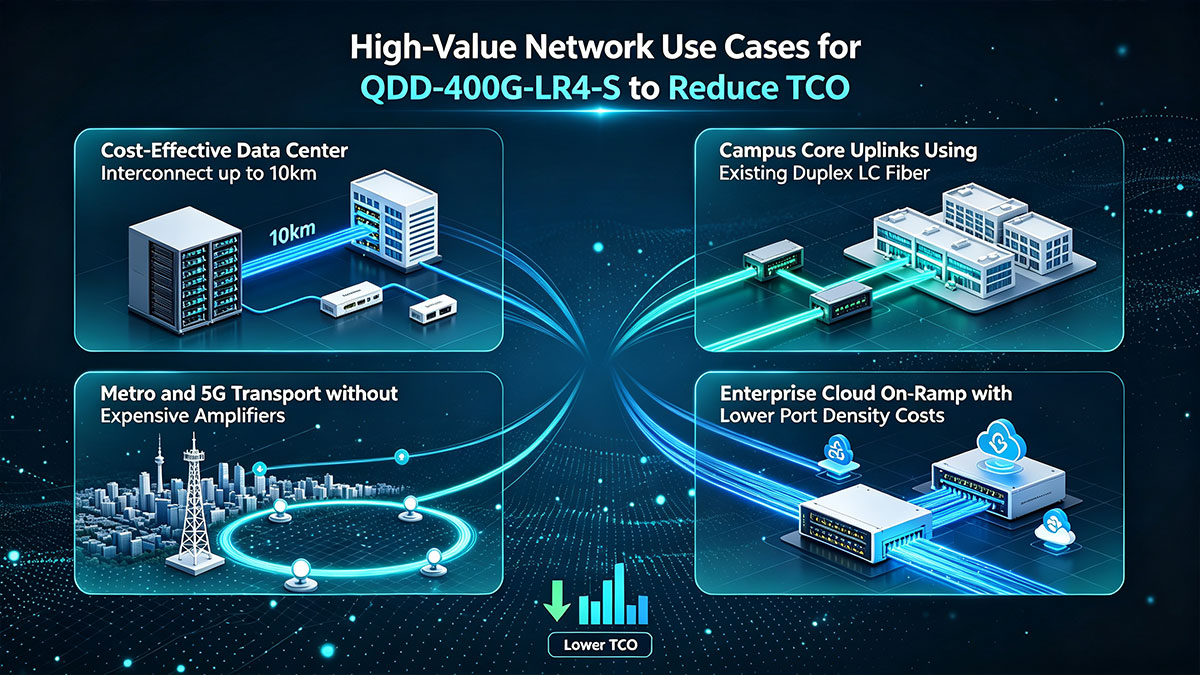
Cost-Effective Data Center Interconnect (DCI) up to 10km
Connecting geographically adjacent data halls or availability zones requires massive bandwidth without the complexity of transponder shelves. The QDD-400G-LR4-S establishes point-to-point links across metro spans up to 10km directly from spine switches. This direct-pluggable approach bypasses expensive open line systems and complex optical transponders, drastically lowering the initial interconnect investment.
Eliminating intermediary optical gear also removes multiple points of operational failure and reduces end-to-end latency for synchronized clusters. Data center operators can scale inter-facility data replication and live virtual machine migrations seamlessly. Delivering 400G capacity straight across dark fiber ensures a lean, ultra-responsive DCI architecture with minimal ongoing maintenance costs.
Campus Core Uplinks Using Existing Duplex LC Fiber
Modern university and corporate campuses face severe traffic congestion as smart buildings, Wi-Fi 6/7 access points, and private cloud services expand. Deploying the QDD-400G-LR4-S enables network administrators to upgrade aggregation-to-core uplinks to 400G immediately. Because the module operates over standard duplex single-mode strands, institutions modernize their backbone without digging trenches or pulling new physical cables.
Upgrading to 400G uplinks also eliminates messy link aggregation groups (LAG) made of multiple fragmented 40G or 100G links. This structural consolidation simplifies spanning-tree protocols, routing tables, and overall network configuration management. Campus IT teams achieve high-throughput backbone performance while protecting legacy physical investments and curbing support overhead.
Metro and 5G Transport without Expensive Amplifiers
Telecommunication service providers expanding 5G mobile networks must handle massive data aggregation from distributed cell sites to centralized aggregation hubs. The QDD-400G-LR4-S satisfies these mid-haul and aggregation backhaul requirements by carrying unamplified signals across metro fiber loops up to 10km. Avoiding external optical amplifiers, such as Erbium-Doped Fiber Amplifiers (EDFAs), significantly reduces power draw and equipment footprint at remote edge shelters.
Fewer active optical components along the fiber path translates directly into superior network reliability and lower field-technician dispatch rates. The module handles high-capacity subscriber traffic without introducing dispersion penalties or requiring optical dispersion compensation modules. Telecom operators can aggressively expand 5G cellular coverage while keeping base-station construction and operational budgets strictly controlled.
Enterprise Cloud On-Ramp with Lower Port Density Costs
Enterprises connecting to regional carrier hotels and public cloud peering exchanges often encounter severe edge router bottlenecks. By provisioning a single QDD-400G-LR4-S interface, enterprises consolidate multiple lower-speed uplinks into a single high-capacity pipe. This port concentration maximizes throughput per front-panel slot and prevents premature, costly hardware chassis replacements.
Consolidating cloud traffic into high-capacity 400G uplinks also frees up valuable faceplate real estate on core routing gear. Network engineers can reserve remaining switch ports for future tenant expansions rather than deploying supplemental line cards. Streamlining traffic paths directly simplifies hybrid-cloud routing policies while delivering a significantly lower cost-per-gigabit over time.
🔶 QDD-400G-LR4-S vs. Other 400G Optics: Which Offers the Best TCO?
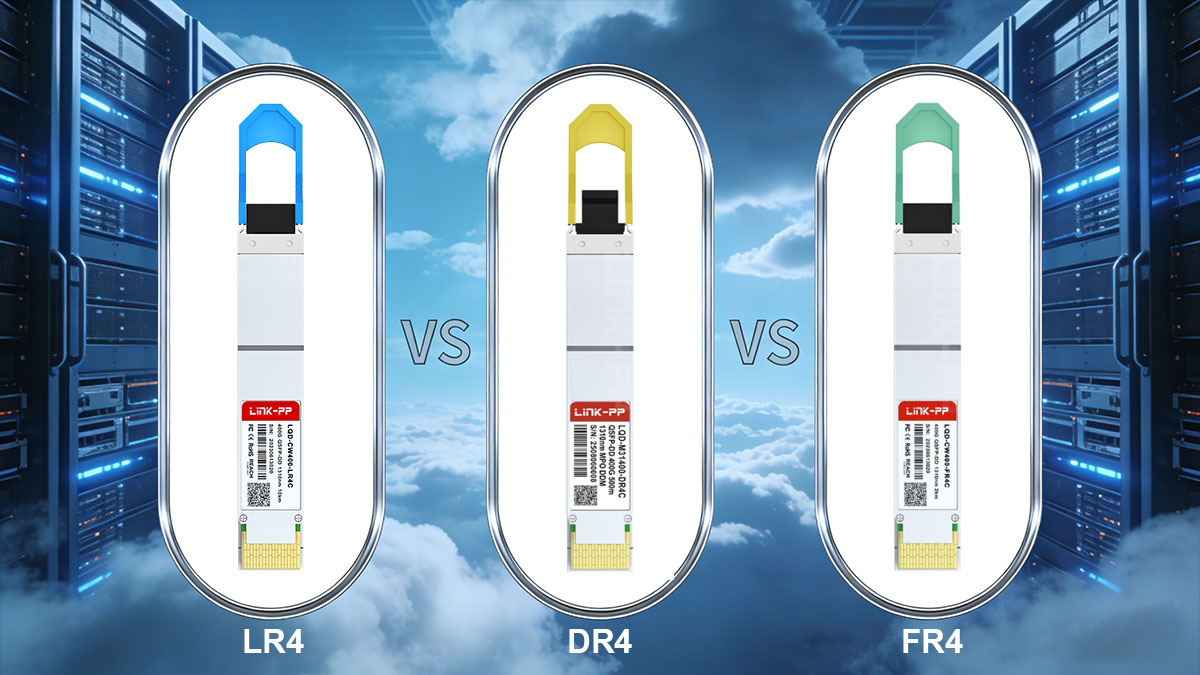
Determining the most cost-effective 400G QSFP-DD transceivers depends on how module pricing interacts with your transmission distance and cabling infrastructure. While short-reach transceiver options like 400G-DR4 and 400G-FR4 feature lower upfront unit costs, the QDD-400G-LR4-S delivers superior total cost efficiency across extended 10km campus and metro spans. Comparing these optical standards side-by-side reveals which transceiver provides the best long-term return on investment without triggering hidden network expenses.
The following comparison illustrates how different QSFP-DD transceivers impact both physical infrastructure design and overall deployment budgets:
| QSFP-DD Transceiver | 400G-DR4 | 400G-FR4 | QDD-400G-LR4-S |
| Max Reach | 500m | 2km | 10km |
| Connector Type | MPO-12/APC | Duplex LC | Duplex LC |
| Fiber Count & Media | 8-fiber Single-Mode | 2-fiber Single-Mode | 2-fiber Single-Mode |
| Key TCO Advantage | Lowest initial module CapEx; higher cabling overhead | Reuses duplex fiber; optimized for intra-campus spans | Maximum reach on duplex fiber; eliminates optical amplifiers |
Comparing LR4 (10km) with DR4 and FR4 (500m to 2km)
The 400G-DR4 module standard uses four parallel optical lanes over an 8-fiber MPO interface, making it ideal for data center switch-to-switch short links. However, the required multi-fiber ribbon cabling significantly increases physical plant expenditure over medium and long runs.
In contrast, 400G-FR4 and the QDD-400G-LR4-S use optical wavelength multiplexing to transmit four channels across a single duplex LC fiber pair. While FR4 is cost-effective for spans under 2km, only the QDD-400G-LR4-S delivers the optical power budget required for campus and metro distribution up to 10km.
Choosing between these options depends on whether your priority is minimal module unit cost or lower physical cabling complexity over distance. Deploying LR4 optics provides the necessary reach buffer to support future network expansion without requiring mid-span hardware upgrades.
Why Using MPO vs. Duplex LC Affects Cabling Budget
Parallel optics transceivers like 400G-DR4 rely on MPO connectors that require dedicated multi-strand ribbon cables for every active connection. Across high-density fiber plants, purchasing and managing complex 8-fiber or 12-fiber trunks rapidly inflates procurement and installation expenses.
Conversely, the QDD-400G-LR4-S operates seamlessly over existing duplex LC single-mode infrastructure using just two fiber strands. This architectural reuse eliminates the need to pull expensive new trunk assemblies through congested conduits and pathways.
Standard LC connectors also feature simpler termination, lower sensitivity to dust, and faster field inspection than multi-fiber MPO interfaces. Reducing physical layer cleaning and troubleshooting time directly lowers ongoing operational maintenance labor.
Matching Link Distance to Optical Budget to Prevent Overspending
Deploying high-powered optical modules across short runs may require optical attenuation at the receiver to prevent signal distortion, adding minor but unnecessary deployment costs. Conversely, stretching short-reach transceivers beyond their engineered loss budget causes high bit error rates and intermittent link drops.
The QDD-400G-LR4-S features an optimized link insertion loss budget designed specifically for 10km single-mode spans. This dedicated power margin easily accommodates standard patch panel connections and optical splices without requiring supplemental amplifiers.
Aligning transceiver capabilities directly with your actual span distance prevents both unnecessary hardware over-engineering and premature link failures. Strategic distance matching guarantees stable link performance while keeping initial CapEx and long-term OpEx strictly controlled.
🔶 Common QDD-400G-LR4-S Pitfalls That Increase Your Total Cost
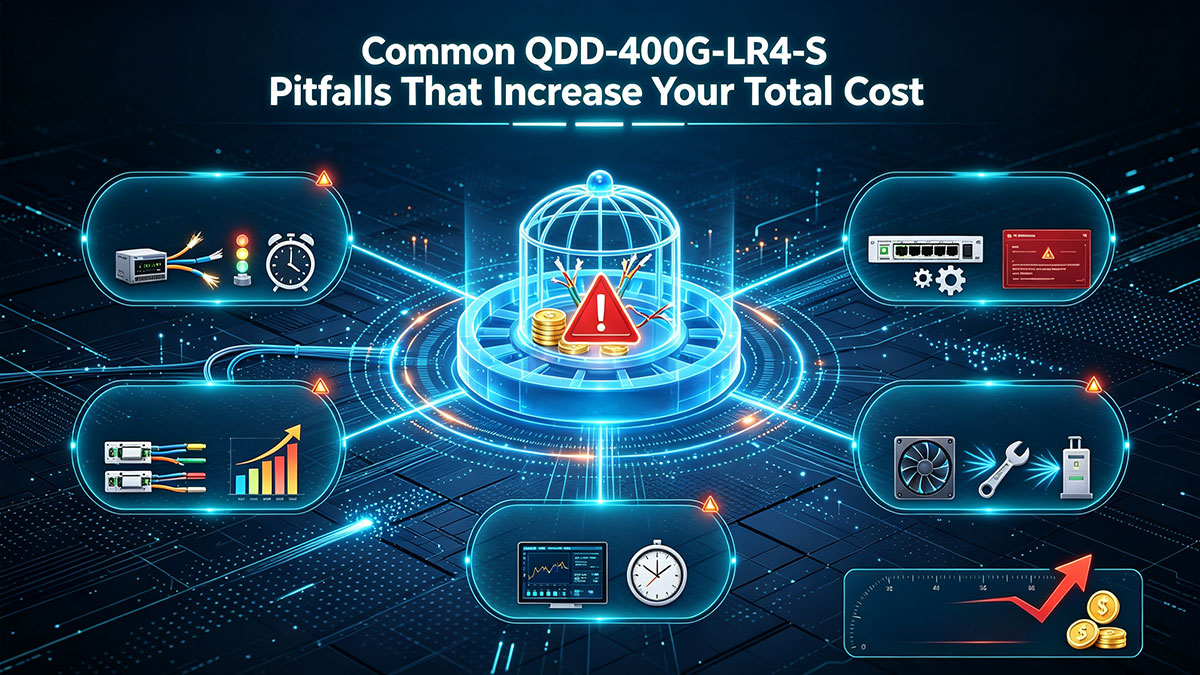
Even well-planned 400G network deployments can suffer from unexpected budget overruns if operational blind spots are overlooked. Overspending on branded hardware, miscalculating switch thermal envelopes, and neglecting fiber loss margins can quickly erode expected return on investment. Identifying and avoiding these frequent pitfalls ensures your QDD-400G-LR4-S deployment remains financially lean and technically reliable over its entire service life.
Overpaying for OEM Optics Instead of Tested Third-Party Modules
Procuring original equipment manufacturer (OEM) branded optics often incurs massive price markups without providing measurable performance or reliability advantages. These inflated unit prices consume substantial capital budgets that could otherwise be allocated to strategic network expansion.
Deploying proven third-party compatible alternatives, such as the LINK-PP LQD-CW400-LR4C 400G QSFP-DD Transceiver, provides seamless Cisco switch interoperability at a fraction of the OEM cost. Rigorously tested third-party QDD-400G-LR4-S compatible optics strictly adhere to IEEE 802.3bs and QSFP-DD MSA standards, ensuring enterprise-grade 10km link performance.
Opting for high-quality third-party compatible optical transceivers eliminates vendor lock-in while maintaining total protocol and physical layer compatibility. This procurement choice drastically reduces initial procurement CapEx and maximizes long-term deployment ROI.
Ignoring Host Switch Power and Thermal Budgets
Failing to evaluate the aggregate power and thermal density across switch faceplates can rapidly degrade hardware and trigger costly cooling demands. High-density QSFP-DD deployments require strict attention to chassis-level environmental constraints:
- Thermal Throttling: Elevated ambient heat forces switch fans to run at maximum RPM, increasing facility power draw.
- Premature Laser Wear: Operating transceivers beyond recommended thermal envelopes shortens laser diode operational lifespan.
- Chassis Overload: Dense port populations can exceed switch power supply unit (PSU) output capacities during peak traffic.
- Port Bumping Failures: Uneven rack airflow creates localized hot spots that trigger sudden link instability.
Carefully planning per-slot airflow and selecting energy-efficient QDD-400G-LR4-S modules prevents facility cooling spikes and extends switch chassis longevity.
Underestimating Fiber Loss on 10km Links Leading to Link Failure
Assuming a pristine 10km optical path without auditing cumulative real-world insertion loss frequently leads to intermittent link drops and packet degradation. Across long metro spans, dirty optical end-faces, tight fiber bend radii, and unrecorded fusion splices quickly erode the optical power margin.
Deploying the QDD-400G-LR4-S across unverified single-mode fiber risks falling outside the module’s receiver operating range (either too much loss or excessive input power), necessitating costly emergency troubleshooting. Performing comprehensive Optical Time-Domain Reflectometer (OTDR) testing prior to turn-up guarantees that total channel loss remains well within the module's engineered budget.
Validating passive optical loss before commissioning prevents post-deployment truck rolls and protects against service-level agreement (SLA) penalty costs. Proactive physical plant verification ensures resilient 400G connectivity across maximum rated transmission distances.
Skipping DOM Monitoring and Preventive Maintenance
Neglecting built-in Digital Optical Monitoring (DOM) leaves network engineers blind to gradual link degradation and environmental stress.
- Laser Bias Drift: Overlooking rising laser bias currents prevents IT teams from detecting aging optical transmitters before a sudden hard failure occurs.
- Rx Power Fluctuations: Failing to monitor received optical power thresholds allows contaminated connector end-faces to cause silent packet loss and retransmissions.
- Temperature Spikes: Unmonitored internal module heat buildup leads to uncorrectable Forward Error Correction (FEC) errors and unstable link flapping.
Automating DOM telemetry alerts across all active QDD-400G-LR4-S ports enables proactive, scheduled maintenance rather than disruptive emergency repairs.
🔶 Strategic Ways to Lower Long-Term QDD-400G-LR4-S Operating Costs
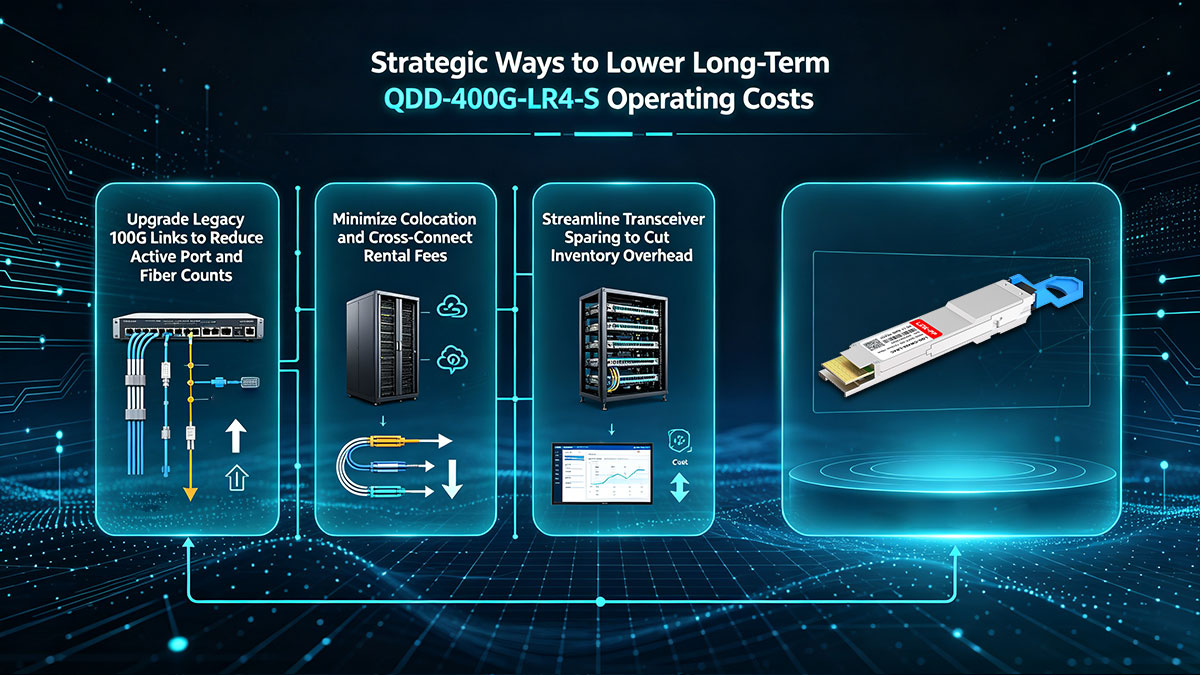
Keeping ongoing network expenses down requires practical planning rather than just buying efficient hardware up front. Long-term savings come from consolidating physical links, cutting recurring facility fees, and keeping spare inventory lean. Applying these straightforward operational practices helps you get the lowest running cost out of every QDD-400G-LR4-S link.
Upgrade Legacy 100G Links to Reduce Active Port and Fiber Counts
Running multiple 100G optics in link aggregation groups quickly burns through switch ports and fills up cable trays. Swapping four 100G links (each using a 100GBASE-LR4 optical module) for a single QDD-400G-LR4-S module delivers the same aggregate 400G capacity while freeing up three switch ports. This reduction immediately drops per-gigabit power draw and clears crowded rack space for future network expansion.
Fewer physical cables and transceiver interfaces also mean fewer components to inspect, clean, and troubleshoot during routine checks. Network teams spend far less time managing tangled fiber bundles across distribution racks. Moving directly to 400G simplifies switch management and cuts the day-to-day labor needed to keep links running.
Minimize Colocation and Cross-Connect Rental Fees
Third-party colocation facilities and carrier hotels bill monthly recurring fees for every single cross-connect port you light up. Running the QDD-400G-LR4-S lets you push 400G of traffic through a single duplex LC patch pair instead of renting multiple fiber runs. This consolidation directly shrinks your monthly facility bill while providing plenty of bandwidth headroom.
Over multi-year colocation contracts, these recurring savings quickly add up to tens of thousands of dollars. You can expand site-to-site capacity without paying for additional patch panel terminations or higher rack tiers. Squeezing maximum throughput out of fewer physical connections keeps recurring data center lease costs under tight control.
Streamline Transceiver Sparing to Cut Inventory Overhead
Stocking separate backup optics for every specialized link length ties up working capital and clutters your storage room. Standardizing long-reach campus, metro, and data center interconnect runs on the QDD-400G-LR4-S lets your team rely on a single, shared pool of spare modules. This unified inventory strategy lowers the total number of backup units you need to purchase up front.
Having a single, consistent optic on hand also simplifies technician workflows during urgent hardware swap-outs. Field engineers do not have to waste critical troubleshooting time searching for niche, application-specific optics during a link failure. Keeping a leaner, standardized spare inventory cuts holding costs and prevents excess modules from gathering dust on warehouse shelves.
🔶 Final Thoughts: Maximizing ROI with QDD-400G-LR4-S Solutions
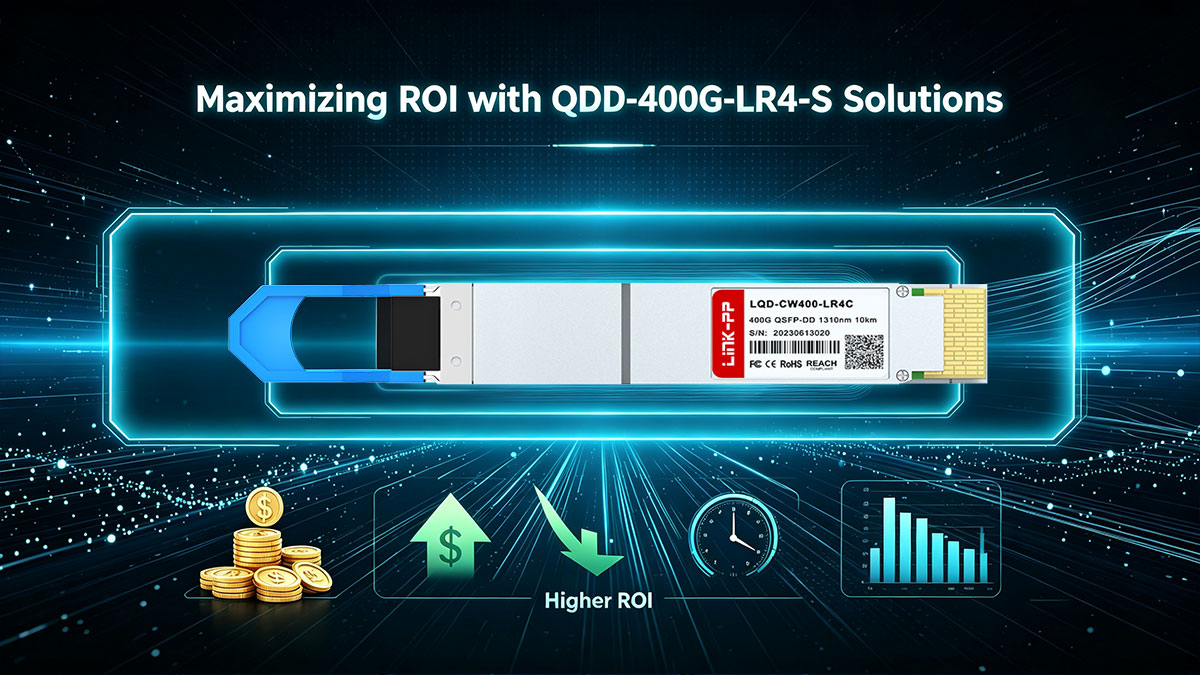
Maximizing ROI with 400G networking requires more than high throughput — it demands long-term cost efficiency. The QDD-400G-LR4-S delivers 10km reach while preserving your existing single-mode fiber plant. To extract the greatest value from your deployment, focus on these practical ROI drivers:
- Leverage Existing Duplex Fiber: Eliminate expensive ribbon cabling overhauls by running 400G over standard LC patch plants.
- Reduce Port and Power Footprints: Replace four legacy 100G links with a single module to slash per-gigabit power draw.
- Avoid Intermediate Line Gear: Span up to 10km directly between switches without buying dedicated optical amplifiers.
- Prevent Premature Failures: Utilize built-in DOM telemetry to catch optical drift before it causes costly network downtime.
- Source Tested Compatible Hardware: Lower initial procurement expenses by choosing fully verified compatible alternatives.
Aligning hardware capability with your actual link distance ensures your network scales reliably without draining your multi-year budget. Find fully verified, cost-effective QDD-400G-LR4-S optical modules to boost your deployment economics at the LINK-PP Official Store.