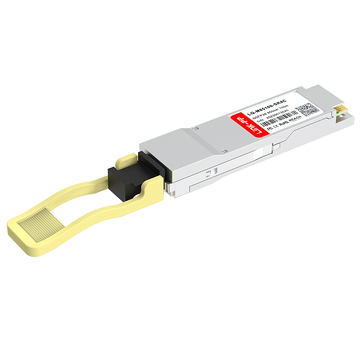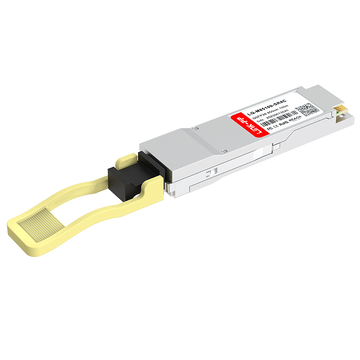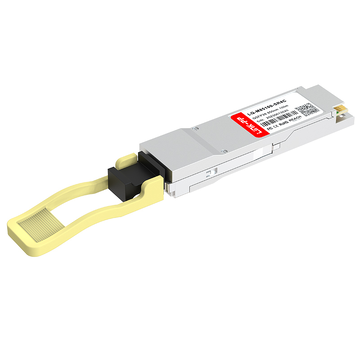


























The Avago AFBR-89CDDZ is widely recognized in enterprise networking and data center environments where stable, high-speed optical connectivity is essential. As organizations expand bandwidth capacity and modernize network infrastructure, selecting the right optical transceiver becomes increasingly important for ensuring interoperability, reliable performance, and long-term operational efficiency. Engineers, system integrators, and IT procurement teams often evaluate this module based on its technical specifications, platform compatibility, and deployment suitability rather than considering only the original part number.
Understanding the Avago AFBR-89CDDZ involves more than reviewing a datasheet. Factors such as optical characteristics, electrical interface, supported standards, vendor compatibility, lifecycle status, and replacement options all influence whether the module is appropriate for a particular networking environment. A comprehensive evaluation helps reduce compatibility risks, simplifies future maintenance, and supports informed decisions throughout the deployment lifecycle.
This guide provides a practical overview of the Avago AFBR-89CDDZ by covering the following topics:
- Product features and intended applications
- Technical specifications and performance characteristics
- Industry standards and platform compatibility
- Typical deployment scenarios
- Evaluation criteria before procurement
- OEM and compatible module comparison
- Product lifecycle and replacement considerations
By bringing these topics together, this article serves as a technical reference that helps readers quickly understand the module's capabilities and determine whether it aligns with their network requirements and long-term infrastructure plans.
💹 What Is the Avago AFBR-89CDDZ?
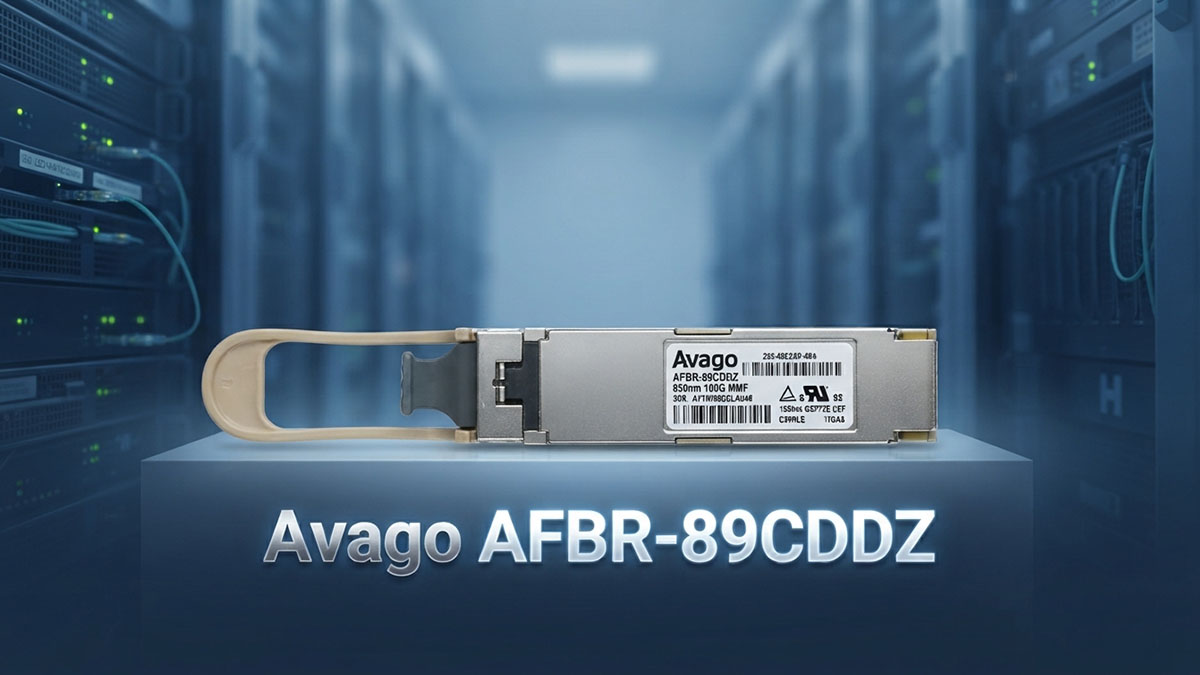
The Avago AFBR-89CDDZ is a 100GBASE-SR4 QSFP28 optical transceiver designed for high-speed, short-reach data communication over multimode fiber (MMF). It integrates four independent transmit and four receive channels operating at 25.78125Gbps each, providing an aggregate bandwidth of approximately 100Gbps for Ethernet applications. Designed to comply with IEEE 802.3bm and the QSFP28 Multi-Source Agreement (MSA), the module is widely deployed in enterprise data centers, cloud infrastructure, and high-performance computing environments where reliable 100GbE connectivity is required.
Product Overview
The AFBR-89CDDZ is engineered to deliver reliable short-distance optical connectivity while maintaining interoperability with industry-standard 100GbE networking equipment. Its combination of high bandwidth, compact QSFP28 form factor, and MPO optical interface makes it suitable for dense network deployments.
- Supports 100GBASE-SR4 Ethernet transmission over multimode fiber.
- Utilizes an 850nm VCSEL laser and PIN photodetector technology for stable optical performance.
- Operates with four parallel transmit lanes and four parallel receive lanes at 25.78125Gbps per lane.
- Uses an MPO-12 connector with eight active fibers (4Tx + 4Rx).
- Supports transmission distances of up to 70m on OM3 fiber and 100m on OM4 fiber.
- Features a hot-pluggable QSFP28 form factor for simplified installation and maintenance.
- Includes a two-wire serial interface for module management and digital monitoring functions.
These characteristics make the AFBR-89CDDZ a practical solution for organizations seeking high-density 100GbE optical interconnections without the complexity of long-reach single-mode deployments.
Key Features
The AFBR-89CDDZ combines standardized hardware with proven optical technology to support stable operation in demanding networking environments. Its feature set focuses on interoperability, reliability, and simplified deployment.
- Delivers an aggregate data rate of approximately 100Gbps for Ethernet applications.
- Complies with IEEE 802.3bm 100GBASE-SR4 and CAUI-4 electrical interface specifications.
- Meets QSFP28 MSA and SFF-8636 management interface requirements.
- Supports Digital Diagnostic Monitoring (DDM/DOM) through the integrated two-wire serial interface.
- Uses low-power VCSEL technology to improve energy efficiency in high-density installations.
- Supports hot-swappable installation, minimizing service interruptions during maintenance.
- Operates within a commercial case temperature range of 0°C to 70°C.
- Incorporates Class 1 laser safety compliance for secure operation in enterprise environments.
Together, these features enable the Avago AFBR-89CDDZ to provide dependable short-range optical connectivity for switches, routers, servers, and storage platforms that require standards-compliant 100GbE performance while maintaining flexibility for future network expansion.
💹 Avago AFBR-89CDDZ Technical Specifications
The Avago AFBR-89CDDZ is built around the IEEE 100GBASE-SR4 standard and combines parallel optical transmission with a QSFP28 electrical interface to deliver reliable 100GbE connectivity over multimode fiber. Understanding its optical, electrical, and mechanical specifications helps engineers verify compatibility, estimate transmission performance, and select the appropriate infrastructure for deployment.
Optical Specifications
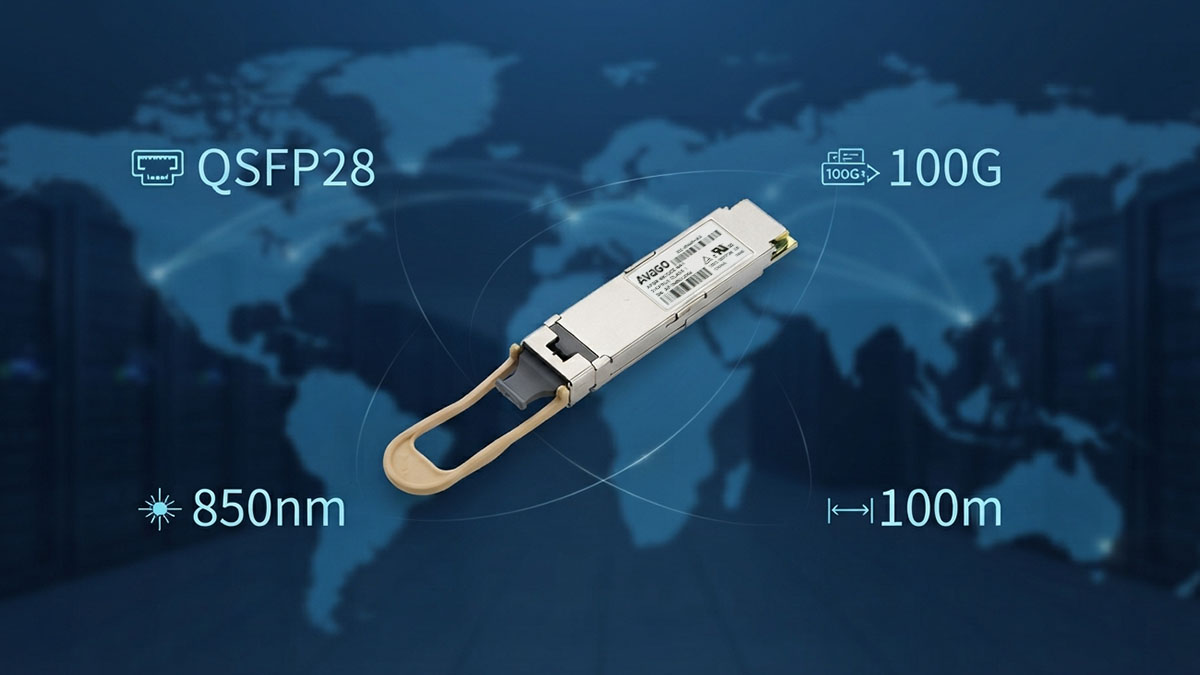
The optical characteristics determine the transmission capability of the AFBR-89CDDZ. As a short-reach QSFP28 module, it uses parallel multimode optics and is optimized for high-density data center interconnects.
The following table summarizes its primary optical specifications.
| Parameter | Specification |
|---|---|
| Ethernet Standard | 100GBASE-SR4 |
| Optical Wavelength | 850nm |
| Fiber Type | OM3/OM4 Multimode Fiber (MMF) |
| Optical Connector | MPO-12 (12 active fibers) |
| Transmit Lanes | 4×25.78125Gbps |
| Receive Lanes | 4×25.78125Gbps |
| Aggregate Data Rate | 103.125Gbps |
| Maximum Distance (OM3) | 70m |
| Maximum Distance (OM4) | 100m |
| Optical Technology | VCSEL Laser + PIN Photodiode |
These specifications make the AFBR-89CDDZ well suited for short-distance, high-bandwidth links between switches, servers, and storage systems. Using the recommended OM3 or OM4 multimode fiber ensures compliance with the specified transmission distances while maintaining signal integrity.
Electrical Specifications
The electrical interface enables seamless communication between the host equipment and the optical transceiver. Compliance with standardized electrical specifications allows the module to interoperate with a wide range of QSFP28 networking platforms.
The key electrical characteristics include:
| Parameter | Specification |
|---|---|
| Host Interface | CAUI-4 |
| Form Factor | QSFP28 |
| Per-Lane Signaling Rate | 25.78125Gbps |
| Supported Legacy Rate | 10.3125Gbps per lane (bypass mode) |
| Electrical Connector | 38-pin Edge Connector |
| Power Supply | 3.3V |
| Maximum Power Consumption | Typically ≤3.5W |
| Management Interface | Two-Wire Serial (I²C), SFF-8636 |
The relatively low power consumption helps improve energy efficiency in high-density switch deployments, while the standardized management interface enables monitoring of module operating status through supported network equipment.
Mechanical and Environmental Specifications
The mechanical design allows the AFBR-89CDDZ to be deployed in standard QSFP28 ports while supporting reliable operation in enterprise and data center environments.
Its primary mechanical and environmental characteristics include:
| Parameter | Specification |
|---|---|
| Form Factor | QSFP28 Hot-Pluggable |
| Optical Interface | MPO-12 Receptacle |
| Operating Case Temperature | 0°C to 70°C |
| Storage Temperature | -40°C to 85°C |
| Laser Safety | Class 1 |
| Compliance | QSFP28 MSA, SFF-8636, RoHS |
These specifications ensure that the module can be installed, replaced, and serviced without powering down the host equipment. Compliance with industry standards also improves interoperability across networking platforms that support QSFP28 optical transceivers.
💹 Supported Standards and Protocol Compatibility
The Avago AFBR-89CDDZ is designed to comply with widely adopted optical networking standards, enabling consistent interoperability across 100GbE platforms from multiple equipment vendors. Adherence to recognized IEEE and MSA specifications simplifies deployment, improves compatibility between network devices, and helps ensure reliable operation in enterprise and data center environments.
IEEE and MSA Compliance
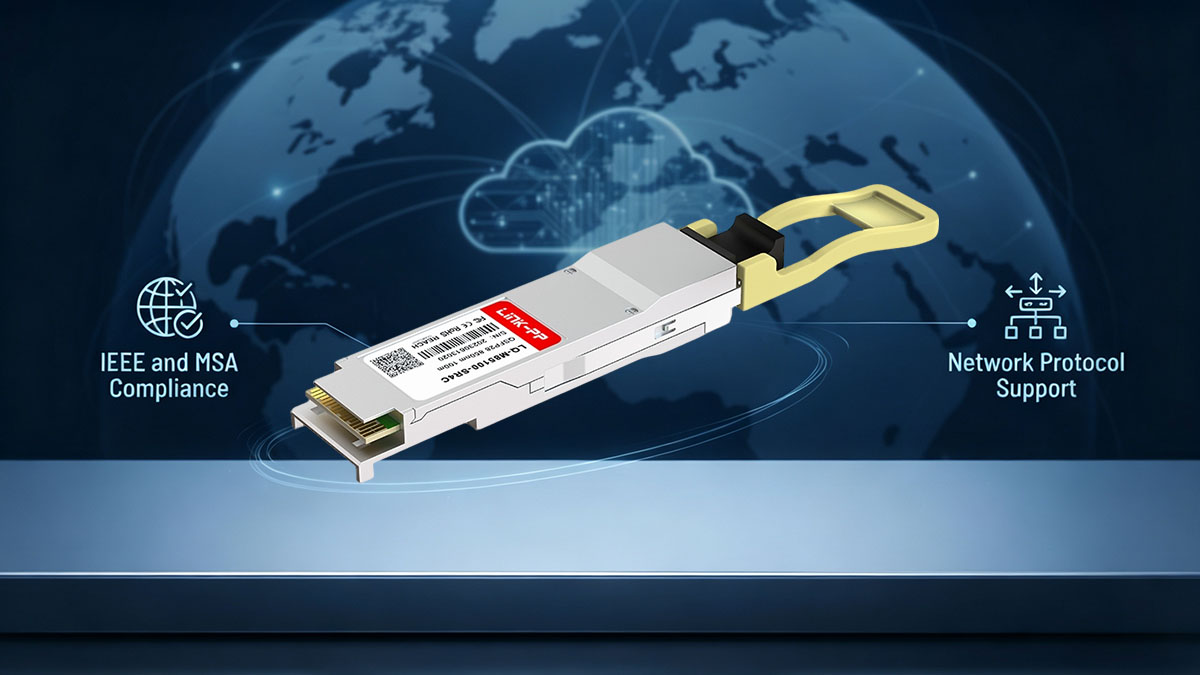
Compliance with industry standards provides a common framework for electrical interfaces, optical performance, management functions, and mechanical dimensions. This allows the AFBR-89CDDZ to operate with networking equipment that follows the same specifications.
The module supports the following major standards:
| Standard | Purpose |
|---|---|
| IEEE 802.3bm 100GBASE-SR4 | Defines 100GbE transmission over multimode fiber using four parallel optical lanes |
| QSFP28 Multi-Source Agreement (MSA) | Standardizes the QSFP28 form factor, mechanical dimensions, and electrical interface |
| SFF-8636 | Defines the digital management interface, memory map, and diagnostic monitoring functions |
| RoHS Directive | Restricts the use of hazardous substances in electronic equipment |
| IEC 60825-1 Class 1 | Specifies laser safety requirements for optical transceivers |
Compliance with these standards allows network administrators to deploy the module with greater confidence, particularly in environments where equipment from multiple manufacturers must operate together. It also simplifies future upgrades by maintaining consistency with established industry specifications.
Network Protocol Support
Beyond hardware compliance, the AFBR-89CDDZ is designed to support networking protocols commonly used in modern data centers and enterprise infrastructures. Its standardized optical interface enables seamless integration into high-speed Ethernet environments.
Typical protocol and application support includes:
- 100 Gigabit Ethernet (100GbE): Supports high-bandwidth switch-to-switch, switch-to-server, and spine-leaf interconnections based on the 100GBASE-SR4 standard.
- Data Center Networking: Provides short-reach optical connectivity for high-density server clusters, virtualization platforms, and cloud computing infrastructure.
- Enterprise Backbone Networks: Supports aggregation and core network links that require reliable 100Gbps transmission within campus or enterprise facilities.
- High-Performance Computing (HPC): Delivers the bandwidth and low latency required for compute clusters, AI training environments, and scientific computing workloads.
- Storage Network Interconnection: Can be deployed in storage infrastructures that utilize 100GbE Ethernet connectivity for high-speed data exchange between storage arrays and network switches.
Because the module follows standardized Ethernet specifications rather than proprietary communication methods, it can be integrated into a broad range of networking architectures. Actual protocol availability ultimately depends on the capabilities of the host switch, router, server, or storage platform, as well as the corresponding firmware and software configuration.
💹 Platform Compatibility Considerations
The Avago AFBR-89CDDZ is designed according to open industry standards, but successful deployment depends on more than matching the QSFP28 form factor. Hardware compatibility, firmware validation, EEPROM recognition, and vendor-specific coding policies all influence whether a module will be accepted and operate reliably. Verifying these factors before deployment helps minimize interoperability issues and reduces network downtime.
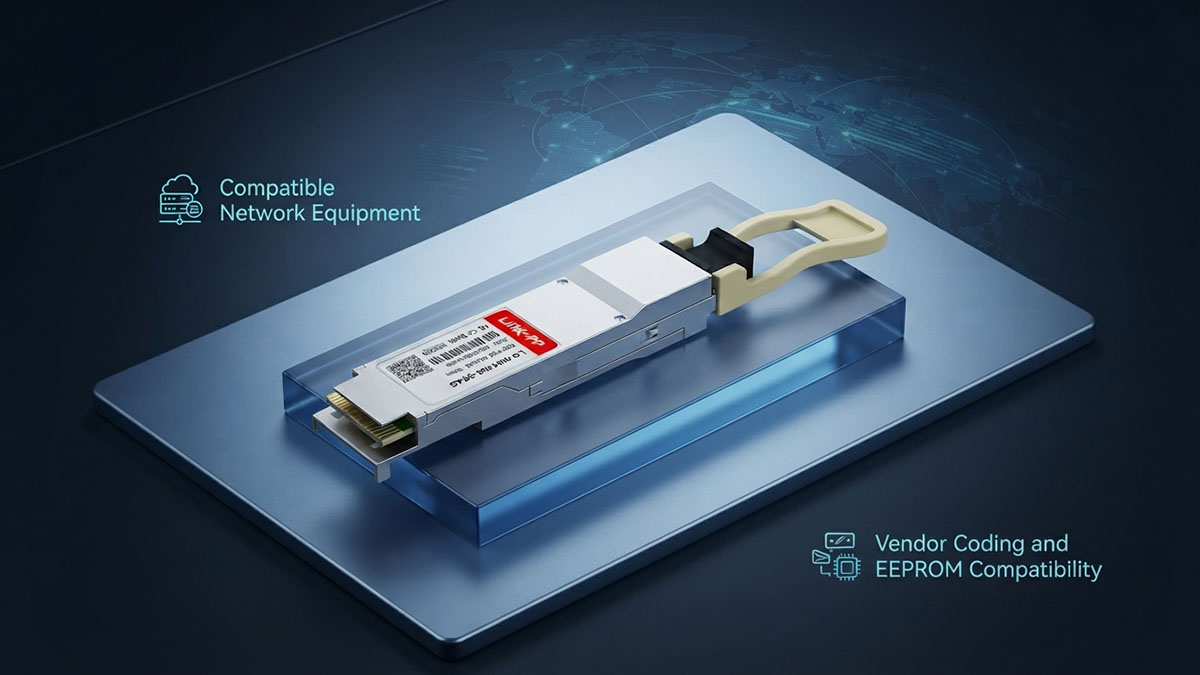
Compatible Network Equipment
The AFBR-89CDDZ can be deployed across a wide range of networking platforms that support 100GBASE-SR4 QSFP28 optical transceivers. However, compatibility should always be confirmed against the equipment vendor's hardware compatibility list (HCL) or transceiver support matrix.
Typical compatible equipment categories include:
- Data center switches
- Leaf and spine switches supporting QSFP28 interfaces
- High-density aggregation switches
- Core switching platforms
- Enterprise switches
- Campus core switches
- Distribution layer switches
- High-bandwidth backbone infrastructure
- Routers
- Edge routers with QSFP28 uplink ports
- Core routing platforms supporting 100GbE optical interfaces
- Storage networking equipment
- Ethernet-based storage switches
- High-speed storage gateways
- Network-attached storage infrastructure using 100GbE connectivity
- Servers and network adapters
- Servers equipped with QSFP28 network interface cards (NICs)
- High-performance computing (HPC) clusters
- AI and cloud computing platforms requiring short-reach 100GbE connections
Although the optical interface follows IEEE standards, some manufacturers implement proprietary validation mechanisms. Therefore, confirming platform support before installation remains an important step, particularly in mixed-vendor environments.
Vendor Coding and EEPROM Compatibility
Many network equipment manufacturers verify information stored in the transceiver's EEPROM before enabling optical ports. As a result, EEPROM programming and vendor coding can be just as important as the module's optical specifications.
The following comparison highlights the primary compatibility considerations.
| Compatibility Factor | Why It Matters |
|---|---|
| Vendor Coding | Some switches require vendor-specific identification before enabling the port. |
| EEPROM Programming | Stores module identification, supported features, and diagnostic information used during initialization. |
| Firmware Validation | Newer firmware versions may introduce stricter transceiver authentication or expanded compatibility. |
| Digital Diagnostic Monitoring (DDM/DOM) | Proper EEPROM configuration enables accurate monitoring of temperature, voltage, optical power, and laser bias current. |
| Third-Party Module Support | Acceptance depends on the equipment vendor's policy regarding compatible optical modules. |
When evaluating compatibility, it is recommended to verify:
- Whether the target platform accepts standards-compliant third-party QSFP28 modules.
- Whether the module is programmed for the intended equipment vendor.
- Whether the installed firmware version has updated transceiver validation policies.
- Whether Digital Diagnostic Monitoring (DDM/DOM) functions are fully supported by the host system.
- Whether the optical specifications match the required fiber type, connector, and transmission distance.
Considering these factors together helps ensure that the Avago AFBR-89CDDZ operates as expected after installation. A thorough compatibility review not only reduces deployment risk but also simplifies future maintenance, module replacement, and network expansion across enterprise and data center infrastructures.
💹 Typical Deployment Scenarios
The Avago AFBR-89CDDZ is primarily deployed in environments that require high-bandwidth, short-reach optical connectivity with low latency and high port density. Its support for 100GBASE-SR4 over multimode fiber makes it well suited for modern enterprise and data center infrastructures where links are typically less than 100m. Selecting the appropriate deployment scenario helps maximize network performance while maintaining cost-effective cabling.
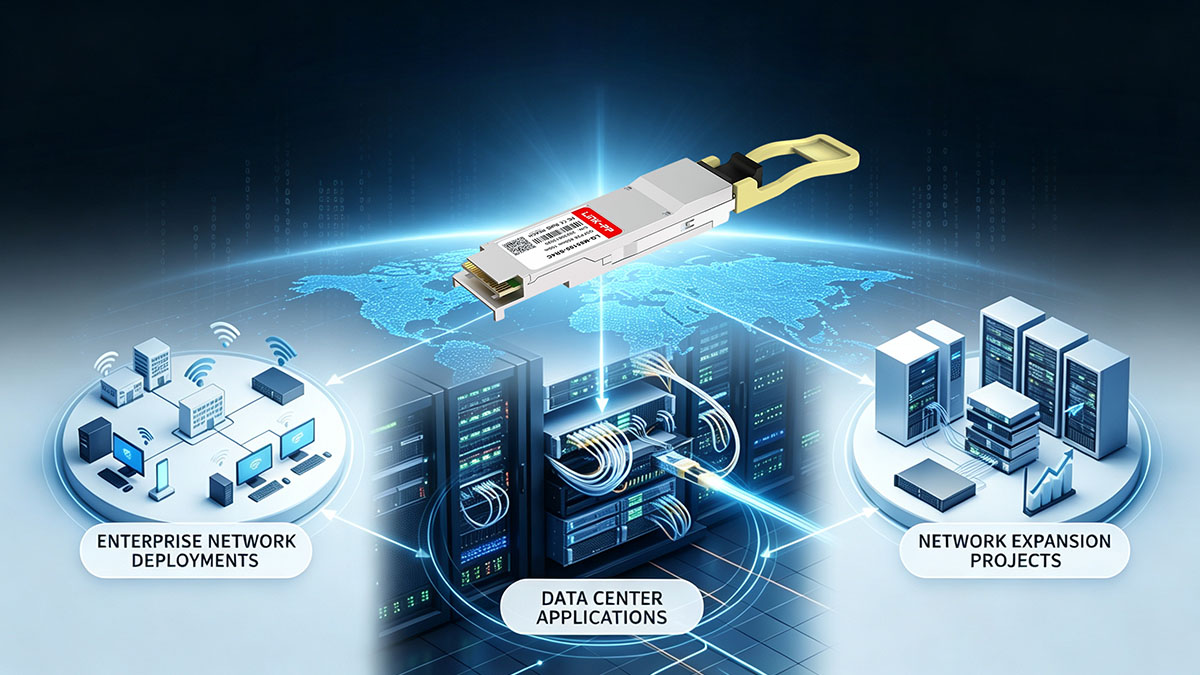
Enterprise Network Deployments
Within enterprise networks, the AFBR-89CDDZ is commonly used to provide high-speed backbone connectivity between critical networking devices. Its QSFP28 form factor enables organizations to increase network capacity without significantly increasing rack space or power consumption.
Typical enterprise deployment scenarios include:
- Core-to-distribution connectivity
- Connects core switches with aggregation or distribution switches.
- Supports high-throughput traffic across the enterprise backbone.
- Campus backbone networks
- Links multiple buildings through multimode fiber infrastructure.
- Provides sufficient bandwidth for converged voice, video, and data services.
- Network modernization projects
- Replaces lower-speed 10GbE or 40GbE uplinks.
- Supports gradual migration toward 100GbE architectures.
- Virtualized enterprise environments
- Handles increased east-west traffic generated by virtualization platforms.
- Supports bandwidth-intensive business applications.
These deployment scenarios allow enterprises to improve network scalability while maintaining compatibility with existing multimode fiber installations where transmission distances remain within SR4 specifications.
Data Center Applications
Data centers represent the most common deployment environment for the AFBR-89CDDZ. The module is optimized for short optical links between networking equipment located within the same rack, adjacent racks, or neighboring rows.
Common data center applications include:
- Leaf-spine architectures
- High-speed connections between leaf and spine switches.
- Supports predictable low-latency forwarding across the data center fabric.
- Server aggregation
- Connects top-of-rack (ToR) switches to aggregation switches.
- Accommodates increasing traffic from virtualization and cloud workloads.
- Storage networking
- Provides 100GbE connectivity between storage arrays and Ethernet switches.
- Supports high-performance storage traffic for enterprise applications.
- Cloud infrastructure
- Enables scalable optical interconnects for private and public cloud environments.
- Supports dynamic resource allocation and workload migration.
- High-performance computing (HPC)
- Delivers high-bandwidth links for compute clusters handling AI, machine learning, and scientific workloads.
Because most optical links inside data centers are relatively short, the AFBR-89CDDZ provides an efficient balance between transmission performance, installation density, and operational efficiency.
Network Expansion Projects
The AFBR-89CDDZ is also well suited for organizations expanding existing network infrastructure or planning future capacity growth. Its standards-based design simplifies integration into established 100GbE environments while reducing compatibility concerns.
Typical expansion projects include:
- Increasing backbone bandwidth
- Upgrading congested uplinks to 100GbE.
- Supporting growing application traffic without redesigning the entire network.
- Adding new switch capacity
- Expanding leaf-spine fabrics.
- Connecting additional server racks or network segments.
- Equipment refresh initiatives
- Replacing aging optical modules during hardware upgrades.
- Standardizing on QSFP28 interfaces across multiple platforms.
- Infrastructure consolidation
- Reducing cable complexity by replacing multiple lower-speed links with fewer 100GbE connections.
- Improving overall network efficiency and port utilization.
- Future-ready network planning
- Building scalable infrastructures capable of supporting increasing bandwidth requirements.
- Simplifying future expansion by adopting standardized QSFP28 optical interfaces.
By supporting these deployment scenarios, the Avago AFBR-89CDDZ offers a flexible solution for organizations seeking reliable short-reach 100GbE connectivity. Whether used in enterprise campuses, cloud data centers, or infrastructure expansion projects, the module provides standardized performance that aligns with modern high-speed networking requirements.
💹 How to Evaluate an Avago AFBR-89CDDZ Before Procurement
Evaluating an Avago AFBR-89CDDZ before procurement helps ensure that the selected module matches both the technical requirements of the network and the capabilities of the target equipment. Rather than focusing solely on the part number, organizations should verify compatibility, optical performance, manufacturing quality, and long-term support to reduce deployment risks and avoid unnecessary replacement costs.
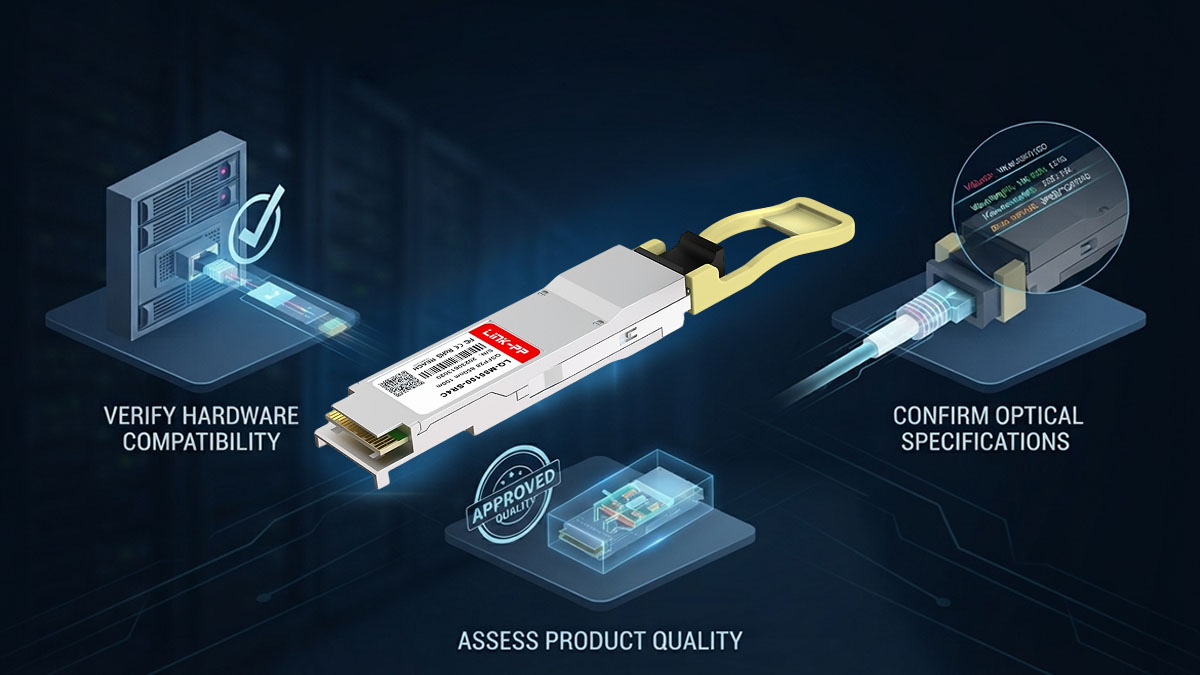
Verify Hardware Compatibility
The first step is confirming that the transceiver is supported by the intended networking platform. Although the AFBR-89CDDZ follows industry standards, individual equipment vendors may implement different firmware validation policies or module qualification requirements.
Before selecting a module, verify the following:
- Switch compatibility
- Confirm that the switch supports QSFP28 100GBASE-SR4 transceivers.
- Review the vendor's hardware compatibility list (HCL).
- Router compatibility
- Ensure the router supports the required optical interface and Ethernet standard.
- Check for any platform-specific transceiver restrictions.
- Firmware version
- Verify that the installed firmware recognizes the intended module.
- Review release notes for any recent changes to transceiver validation.
- Port configuration
- Confirm the QSFP28 port is configured for 100GbE operation.
- Verify breakout configurations if applicable.
- Management feature support
- Check whether the host platform supports Digital Diagnostic Monitoring (DDM/DOM).
- Confirm alarm and monitoring functions are available if required.
Completing these checks before deployment significantly reduces the likelihood of compatibility issues and minimizes troubleshooting during installation.
Confirm Optical Specifications
Matching the optical characteristics of the transceiver to the existing cabling infrastructure is equally important. Even fully compatible network equipment cannot compensate for mismatched fiber types or unsupported transmission distances.
The following table summarizes the key optical parameters that should be verified.
| Verification Item | Recommended Check |
|---|---|
| Ethernet Standard | Confirm support for 100GBASE-SR4 |
| Fiber Type | Verify OM3 or OM4 multimode fiber is installed |
| Optical Connector | Ensure both ends use MPO-12 connectors |
| Transmission Distance | Confirm the link length is within the supported range |
| Optical Path | Verify proper polarity and fiber cleanliness |
| Cabling Infrastructure | Check that patch panels and trunks support parallel optics |
Carefully validating these optical parameters helps achieve stable signal transmission while reducing insertion loss, link failures, and unnecessary maintenance activities.
Assess Product Quality
Beyond compatibility and optical specifications, overall product quality has a direct impact on network reliability and service life. A thorough evaluation should include manufacturing consistency, testing procedures, and documentation rather than relying solely on appearance or labeling.
Important quality indicators include:
- Manufacturing consistency
- Precision optical assembly.
- Stable component sourcing.
- Reliable production processes.
- Performance testing
- Optical power verification.
- Receiver sensitivity testing.
- Bit Error Rate (BER) validation.
- Functional interoperability testing.
- Compliance verification
- IEEE and MSA compliance.
- RoHS conformity.
- Laser safety certification.
- Quality assurance
- Individual module testing before shipment.
- Serialized traceability.
- Inspection records and documentation.
- Warranty and technical support
- Clearly defined warranty terms.
- Availability of technical documentation.
- Responsive engineering support for deployment questions.
Evaluating these factors together provides a more complete understanding of the module's long-term reliability. A well-qualified AFBR-89CDDZ can help reduce operational interruptions, simplify maintenance planning, and provide consistent performance throughout the lifecycle of enterprise and data center networks.
💹 OEM vs Compatible Avago AFBR-89CDDZ Modules
Choosing between an OEM Avago AFBR-89CDDZ module and a compatible alternative requires evaluating more than the product label. Both options are designed around the same 100GBASE-SR4 QSFP28 specifications, but differences may exist in vendor coding, availability, testing procedures, warranty support, and overall deployment flexibility. Understanding these differences helps organizations select the most suitable option for their network environment. The original AFBR-89CDDZ specification defines it as a QSFP28 100GbE optical module using 850nm VCSEL technology, multimode fiber, and MPO connectivity for short-range data center applications.
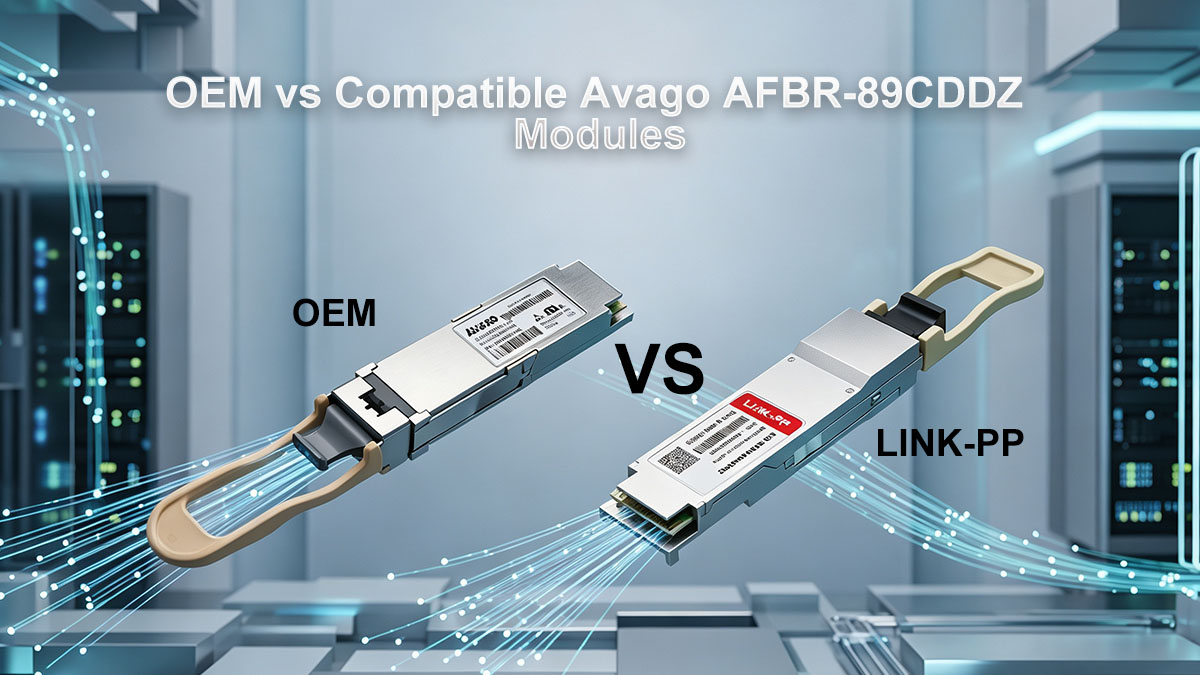
OEM Modules
OEM AFBR-89CDDZ modules are original manufacturer-supplied transceivers designed and validated according to the manufacturer's internal quality standards. They are typically selected for environments where strict vendor support policies, official qualification, and standardized maintenance procedures are priorities.
Key characteristics of OEM modules include:
- Original manufacturer validation
- Developed and tested according to the original product specifications.
- Usually included in official vendor compatibility programs.
- Guaranteed hardware recognition
- EEPROM information matches the original module identification.
- Designed to work with supported networking platforms without additional coding requirements.
- Vendor-supported lifecycle management
- May include official technical documentation.
- Easier integration into environments with strict hardware approval processes.
- Consistent performance characteristics
- Maintains the original optical specifications, including 850nm operation, QSFP28 interface, and 100GBASE-SR4 transmission capability.
However, OEM modules may also have limitations:
- Availability may decrease as products approach end-of-life.
- Original manufacturer pricing can be higher.
- Replacement sourcing may become more difficult for older network platforms.
For organizations operating highly standardized environments or requiring direct manufacturer support, OEM modules can provide a straightforward deployment path.
Compatible Modules
Compatible AFBR-89CDDZ modules are third-party optical transceivers engineered to match the technical requirements of the original module while supporting specific network equipment platforms. Many compatible versions are programmed with customized EEPROM coding to ensure recognition by different switch, router, or server vendors.
Common characteristics of compatible modules include:
- Standards-based design
- Follow the same optical specifications as the original AFBR-89CDDZ.
- Support 100GBASE-SR4 Ethernet over multimode fiber.
- Maintain QSFP28 mechanical and electrical compatibility.
- Flexible vendor compatibility
- Can be coded for different networking platforms.
- Suitable for mixed-vendor data center environments.
- Alternative sourcing options
- Helps organizations maintain legacy equipment.
- Provides additional availability when OEM inventory is limited.
- Quality validation options
- Professional compatible suppliers typically perform optical testing, interoperability testing, and performance verification before shipment.
When selecting compatible modules, organizations should verify:
- Whether the module is coded for the intended switch or router brand.
- Whether optical parameters match the original specification.
- Whether Digital Diagnostic Monitoring (DDM/DOM) is supported.
- Whether the supplier provides testing documentation and technical support.
Comparison Between OEM and Compatible Modules
The main differences between OEM and compatible AFBR-89CDDZ modules are related to sourcing approach, vendor support, and deployment flexibility rather than basic transmission capability.
| Comparison Factor | OEM AFBR-89CDDZ Module | Compatible AFBR-89CDDZ Module |
|---|---|---|
| Manufacturer | Original equipment supplier | Third-party optical manufacturer (like LINK-PP) |
| Optical Standard | 100GBASE-SR4 QSFP28 | 100GBASE-SR4 QSFP28 |
| Fiber Support | OM3/OM4 Multimode Fiber | OM3/OM4 Multimode Fiber |
| Vendor Coding | Original vendor identification | Customized coding options |
| Platform Flexibility | Depends on OEM support policy | Often available for multiple platforms |
| Availability | May decrease with product lifecycle | Usually supported by alternative suppliers |
| Cost Structure | Typically higher | Often provides more sourcing flexibility |
| Testing Process | Original manufacturer validation | Supplier-specific qualification testing |
Both options can support reliable 100GbE connectivity when the module meets the required optical specifications and platform compatibility requirements. The appropriate choice depends on factors such as network policy, equipment vendor restrictions, maintenance strategy, and long-term infrastructure planning.
💹 Product Lifecycle and Replacement Planning
The Avago AFBR-89CDDZ product lifecycle should be considered as part of long-term network planning, especially for organizations operating large-scale 100GbE infrastructures. As optical technologies evolve and networking equipment is refreshed, understanding availability status, maintenance requirements, and replacement strategies helps prevent unexpected service interruptions and supports continuous network operation.
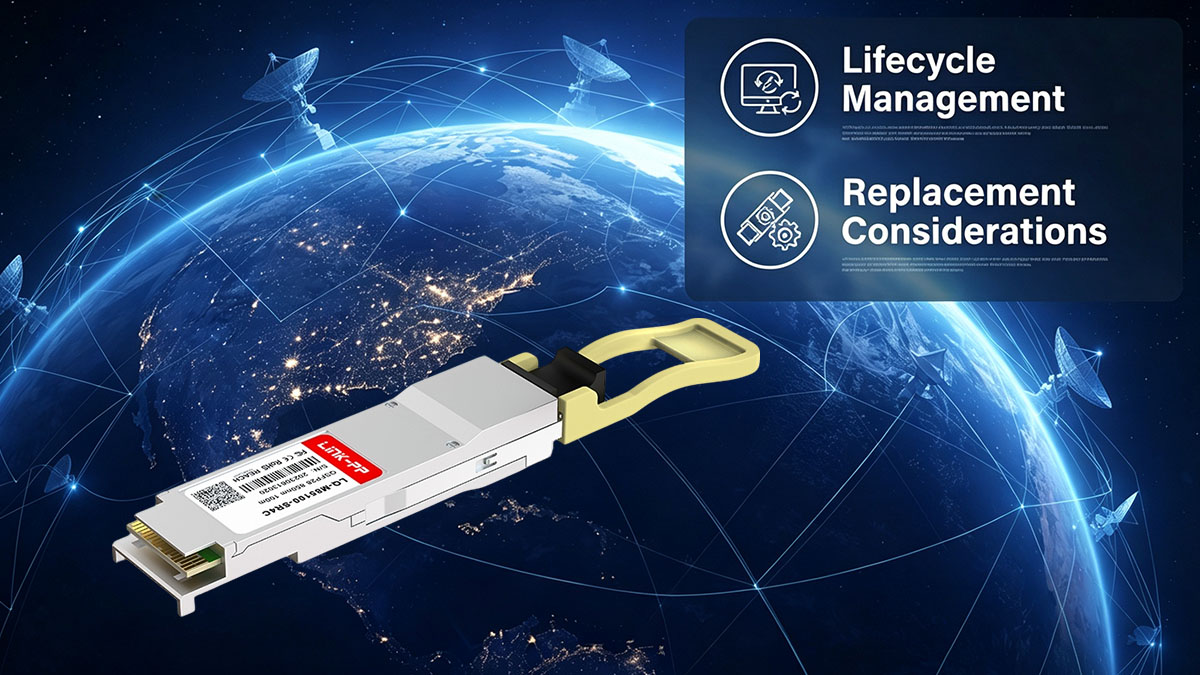
Lifecycle Management
Effective lifecycle management ensures that organizations can maintain reliable optical connectivity throughout the operational period of their networking equipment. For modules such as the AFBR-89CDDZ, lifecycle planning involves monitoring product availability, evaluating future requirements, and preparing alternative solutions before supply limitations affect operations.
Key lifecycle management considerations include:
- Product availability monitoring
- Track the availability of AFBR-89CDDZ modules from original and compatible suppliers.
- Maintain visibility into product status changes and supply conditions.
- Network inventory planning
- Keep sufficient spare modules for critical network links.
- Standardize optical module inventory where possible to simplify maintenance.
- Technology migration planning
- Evaluate future transitions from 100GbE to higher-speed technologies such as 200GbE, 400GbE, or beyond.
- Consider whether existing QSFP28 infrastructure can support future network strategies.
- Maintenance strategy development
- Define replacement procedures for failed optical modules.
- Document compatibility requirements for future module selection.
- Infrastructure documentation
- Maintain records of installed transceiver models, vendor coding, fiber types, and deployment locations.
- Improve troubleshooting efficiency during network incidents.
Proactive lifecycle management allows organizations to reduce dependency risks and maintain predictable network performance, particularly in environments where optical connectivity supports critical applications.
Replacement Considerations
When replacing an Avago AFBR-89CDDZ module, the replacement option must match both the technical specifications and the operational requirements of the existing network. A replacement module should not only fit the QSFP28 port but also provide equivalent optical performance and platform compatibility.
Important replacement evaluation factors include:
- Optical specification matching
- Confirm support for 100GBASE-SR4 transmission.
- Verify 850nm wavelength operation.
- Ensure compatibility with OM3 or OM4 multimode fiber.
- Match MPO-12 connector requirements.
- Network equipment compatibility
- Verify support from the target switch, router, or server platform.
- Confirm appropriate vendor coding and EEPROM configuration.
- Check firmware recognition requirements.
- Performance verification
- Review optical transmit power and receiver sensitivity.
- Confirm transmission distance requirements.
- Validate error performance and link stability.
- Physical compatibility
- Ensure the replacement uses the same QSFP28 form factor.
- Confirm hot-pluggable functionality.
- Verify proper mechanical fit within the equipment chassis.
- Supplier qualification
- Evaluate manufacturing quality standards.
- Confirm testing procedures and technical support availability.
- Review warranty and replacement policies.
Selecting a suitable replacement requires balancing technical equivalence, availability, and long-term support. A properly qualified AFBR-89CDDZ replacement can extend the usable life of existing 100GbE infrastructure while minimizing network disruption during maintenance or expansion projects.
💹 Conclusion
The Avago AFBR-89CDDZ remains a reliable 100GBASE-SR4 QSFP28 optical transceiver solution for short-reach data center and enterprise network applications requiring high-bandwidth multimode fiber connectivity. Understanding its optical specifications, electrical characteristics, platform compatibility, deployment scenarios, and lifecycle considerations is essential for selecting the right module and maintaining stable network performance.
Key points to consider when evaluating the AFBR-89CDDZ include:
- Supports 100GbE transmission using 850nm VCSEL technology and parallel multimode fiber.
- Requires careful verification of QSFP28 compatibility, vendor coding, and network platform support.
- Fits a wide range of applications, including data centers, enterprise backbones, and high-performance computing environments.
- Should be evaluated based on optical performance, quality validation, and long-term replacement availability.
- Compatible module options can provide additional flexibility for network maintenance and infrastructure expansion when properly tested and qualified.
For organizations planning new deployments or maintaining existing 100GbE networks, selecting a dependable optical transceiver source is an important part of ensuring long-term connectivity and operational efficiency. The LINK-PP Official Store provides a wide range of compatible optical transceivers with solutions designed for enterprise networking, data center connectivity, and equipment replacement needs, helping customers find suitable options based on their specific platform requirements.