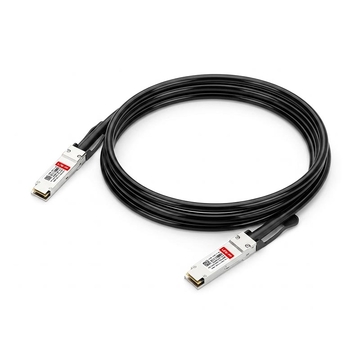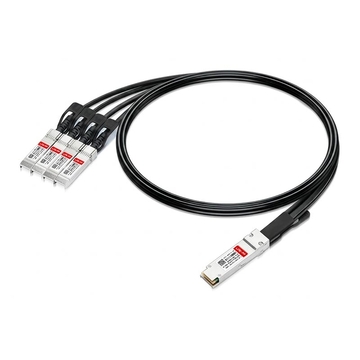
As 100GbE networking becomes increasingly common in enterprise data centers, cloud platforms, and AI computing environments, efficient server connectivity has become a key factor in achieving high performance and operational efficiency. Among the available interconnect options, breakout direct attach copper (DAC) cables provide a practical solution for connecting one 100GbE QSFP28 port to four independent 25GbE SFP28 ports without requiring separate optical transceivers or fiber patch cords. The QSFP-4SFP25G-CU3M is one of the most widely deployed examples for short-range, high-density networking.
Understanding whether the QSFP-4SFP25G-CU3M is the right choice requires more than reviewing its specifications. Network engineers often need to evaluate transmission performance, cable quality, platform compatibility, deployment flexibility, and how it compares with alternatives such as active optical cables (AOCs) and optical transceiver-based solutions. A comprehensive review helps determine where this breakout DAC delivers the greatest practical value.
This article provides an in-depth evaluation of the QSFP-4SFP25G-CU3M from multiple technical perspectives, including:
- Product architecture and technical specifications
- Real-world transmission and mechanical performance
- Compatibility across different networking platforms
- Comparisons with AOCs, optical modules, and other breakout cable lengths
- Advantages, limitations, and deployment recommendations
- Practical guidance for selecting the appropriate breakout cable
By the end of this guide, you will have a clear understanding of the cable's capabilities, suitable deployment scenarios, and the key factors to consider before integrating it into a modern 100GbE network.
📡 What Is the QSFP-4SFP25G-CU3M?
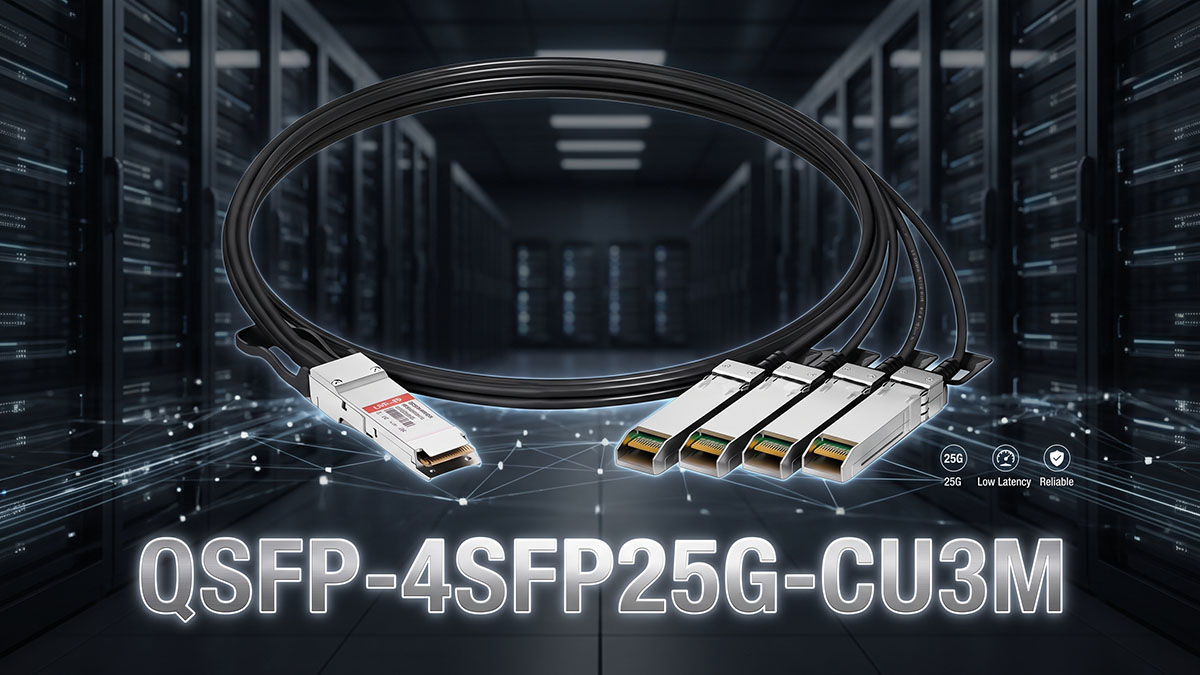
The QSFP-4SFP25G-CU3M is a passive breakout Direct Attach Copper (DAC) cable designed to split a single 100GbE QSFP28 port into four independent 25GbE SFP28 connections. It provides a simple, low-latency, and power-efficient solution for short-range networking, making it a common choice in modern data centers, cloud infrastructures, and high-density server deployments. Unlike optical solutions, it integrates the cable and connectors into a single assembly, eliminating the need for separate transceivers and fiber jumpers.
Product Overview
The QSFP-4SFP25G-CU3M is specifically designed for 100GbE breakout applications where a high-speed uplink needs to connect multiple 25GbE devices. One end of the cable features a QSFP28 connector, while the opposite end splits into four individual SFP28 connectors, allowing a single switch port to communicate with four independent servers or network interfaces. This architecture helps maximize port utilization while simplifying rack cabling.
Key characteristics include:
- QSFP28 to 4×SFP28 passive breakout cable
- Supports one 100GbE interface divided into four 25GbE links
- Fixed 3m Twinax copper cable
- Integrated cable and connectors in a single assembly
- Designed for short-distance, high-bandwidth interconnections
- Requires no external power because of its passive design
These characteristics make the QSFP-4SFP25G-CU3M particularly suitable for Top-of-Rack (ToR) switching environments where low latency, simple deployment, and reliable connectivity are priorities.
Typical Technical Specifications
The technical specifications of the QSFP-4SFP25G-CU3M define its compatibility, transmission capability, and deployment limitations. The following table summarizes the most important parameters commonly found across compliant implementations.
| Specification | Value | Purpose |
|---|---|---|
| Connector Type | QSFP28 to 4×SFP28 | 100G breakout connectivity |
| Cable Type | Passive Twinax DAC | Low-power copper interconnect |
| Maximum Aggregate Data Rate | 100Gbps (4×25Gbps) | Ethernet breakout applications |
| Cable Length | 3m | Short-range rack connectivity |
| Ethernet Standard | 100GbE to 4×25GbE | High-speed server access |
| Power Consumption | Near zero (passive cable) | Reduced switch power usage |
| Operating Temperature | 0°C to 70°C | Standard commercial environments |
| Compliance | QSFP28 MSA, SFP28 MSA, SFF specifications | Multi-vendor interoperability |
These specifications demonstrate why the QSFP-4SFP25G-CU3M is widely deployed inside data centers, where most server-to-switch connections remain within a few meters and minimizing power consumption is an important operational objective.
Typical Deployment Scenarios
The QSFP-4SFP25G-CU3M is best suited for short-distance environments where high bandwidth, low latency, and efficient port utilization are more important than long transmission reach. Its breakout architecture allows organizations to connect multiple 25GbE endpoints from a single 100GbE switch interface while keeping cabling simple and cost-effective.
Common deployment scenarios include:
- Top-of-Rack (ToR) switches connecting multiple 25GbE servers
- Spine-leaf architectures requiring high-density breakout connectivity
- Cloud computing infrastructure with large-scale server clusters
- AI and HPC environments demanding low-latency communication
- Enterprise data centers consolidating 100GbE uplinks into multiple access links
- Storage networks supporting high-speed Ethernet connectivity
Because the cable is limited to a maximum distance of 3m, it is primarily intended for equipment located within the same rack or between adjacent racks. For longer distances, Active Optical Cables (AOCs) or optical transceiver solutions generally provide greater flexibility while maintaining high-speed performance.
📡 QSFP-4SFP25G-CU3M Technical Performance Review
The QSFP-4SFP25G-CU3M is engineered to deliver reliable 100GbE to 4×25GbE connectivity over short distances with minimal latency and power consumption. As a passive Twinax breakout DAC, its performance depends on cable quality, signal integrity, connector design, and compliance with industry specifications rather than onboard electronics. When deployed within its intended 3m range, it provides stable, high-bandwidth communication for demanding data center workloads.
Transmission Performance
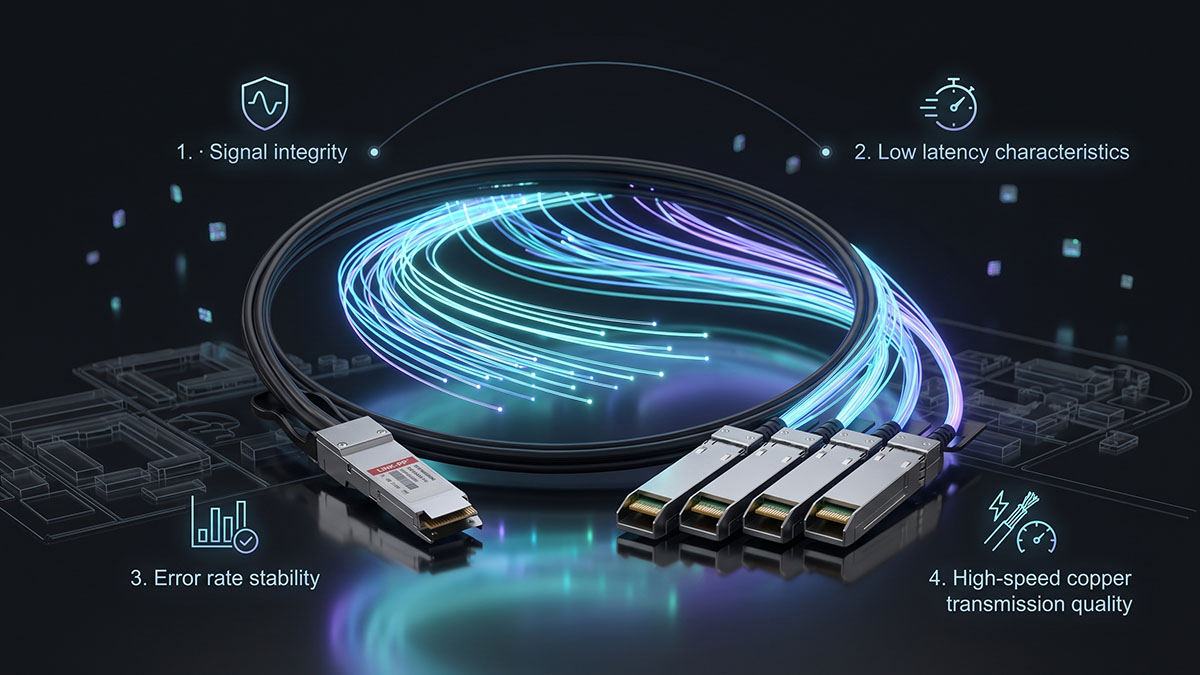
For in-rack and adjacent-rack deployments, the QSFP-4SFP25G-CU3M offers consistent transmission performance while avoiding the additional latency introduced by optical conversion. Its passive architecture enables direct electrical communication between network devices, making it well suited for latency-sensitive applications.
Key transmission characteristics include:
- Supports an aggregate bandwidth of 100Gbps through four independent25Gbps channels
- Passive electrical transmission without signal conversion
- Extremely low end-to-end latency
- Stable signal integrity within the specified3m transmission distance
- Designed to achieve industry-standard Bit Error Rate (BER) performance
- Suitable for continuous operation under high network utilization
These characteristics make the cable particularly effective for server-to-switch connectivity, storage networking, virtualization platforms, and AI clusters where short-distance performance is a higher priority than transmission reach. Standard-compliant passive breakout DACs are typically specified for BER performance up to 10⁻¹² under normal operating conditions.
Mechanical Design and Build Quality
Mechanical construction plays an important role in long-term reliability, especially in high-density racks where cables are frequently installed, removed, or rerouted. The QSFP-4SFP25G-CU3M combines durable connectors with a robust Twinax cable to withstand repeated deployment while maintaining stable electrical performance.
Its primary mechanical features include:
- Integrated QSFP28 and SFP28 connectors permanently attached to the cable
- Secure pull-to-release latching mechanism for reliable installation
- Twinax copper construction with durable insulation
- Flexible cable design for improved rack organization
- Compact breakout structure that reduces cable clutter
- Compliance with industry mechanical specifications for connector dimensions
The 3m version generally uses a thicker wire gauge than shorter variants to preserve signal quality across the longer copper distance. Although this slightly increases cable diameter and weight, it helps maintain transmission stability and mechanical durability during long-term operation.
Thermal and Power Performance
One of the biggest advantages of the QSFP-4SFP25G-CU3M is its excellent thermal efficiency. Because it is a passive DAC, the cable contains no active optical components or signal-processing circuitry, resulting in extremely low power consumption and minimal heat generation.
Its thermal and power characteristics include:
- Passive design requiring virtually no additional operating power
- Significantly lower heat output than Active Optical Cables (AOCs)
- Reduced cooling requirements inside high-density racks
- Stable operation throughout the commercial operating temperature range
- Improved overall energy efficiency for large-scale deployments
Lower power consumption becomes increasingly valuable as network density grows. In environments containing hundreds or thousands of high-speed connections, passive breakout DACs can reduce cumulative power usage while simplifying thermal management compared with optical interconnect solutions. These benefits contribute to lower operational overhead without compromising short-range network performance.
📡 QSFP-4SFP25G-CU3M Compatibility Evaluation
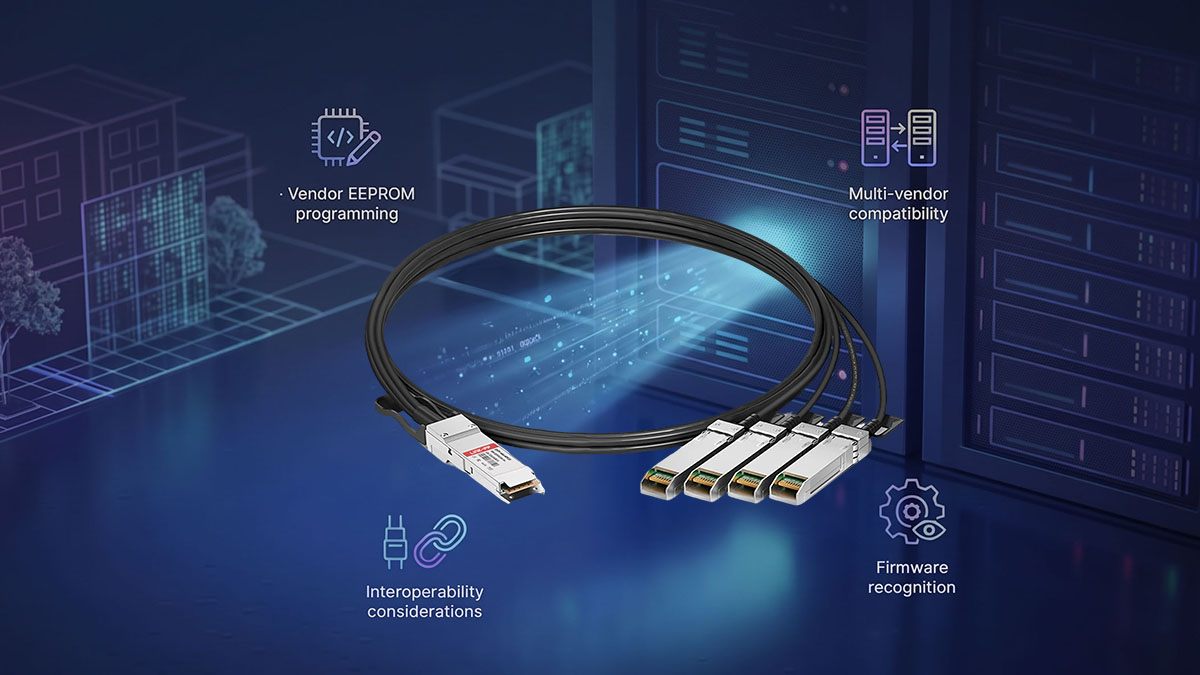
The QSFP-4SFP25G-CU3M is designed to provide broad interoperability across modern networking platforms by complying with QSFP28 and SFP28 Multi-Source Agreements (MSAs). However, successful deployment depends not only on physical compatibility but also on factors such as EEPROM coding, firmware validation, and switch vendor policies. Verifying compatibility before installation helps ensure stable operation and avoids unnecessary troubleshooting.
Compatible Network Platforms
The QSFP-4SFP25G-CU3M supports a wide range of Ethernet switches, servers, and storage systems that provide QSFP28 breakout functionality. Most standards-compliant platforms recognize the cable without requiring additional hardware, provided the host device supports 100GbE breakout into four independent25GbE lanes.
Typical compatible platforms include:
- Cisco Nexus and Catalyst switches with QSFP28 breakout support
- Juniper QFX series switches
- Arista data center switches
- NVIDIA Mellanox Ethernet switches and adapters
- Dell PowerSwitch platforms
- Intel Ethernet adapters supporting SFP28 interfaces
- Enterprise storage and high-performance computing platforms
- Generic MSA-compliant networking equipment
These platforms commonly support passive breakout DAC cables for short-range interconnections. Before deployment, administrators should verify that both the switch operating system and hardware model support 4×25GbE breakout mode, since breakout capability varies between product families and software releases.
EEPROM Coding and Vendor Recognition
Although the physical interfaces follow MSA standards, vendor-specific EEPROM coding plays an important role in device recognition. When the cable is inserted, the host reads identification data stored in the EEPROM through the I²C management interface. Some vendors perform only basic validation, while others apply stricter compatibility checks before enabling the port.
Important compatibility considerations include:
- EEPROM stores vendor name, part number, serial number, and capability information
- Vendor-coded cables are optimized for specific switch platforms
- MSA compliance ensures electrical and mechanical interoperability but does not guarantee firmware acceptance
- Certain network operating systems validate EEPROM information during initialization
- Proper coding can improve plug-and-play deployment across supported platforms
- Firmware upgrades may introduce stricter compatibility verification on some devices
For multi-vendor environments, selecting a cable with appropriate EEPROM coding significantly improves deployment success. Many compatible cable manufacturers provide vendor-specific coding options that emulate the expected identification data while maintaining full MSA compliance.
Installation Experience
Installing the QSFP-4SFP25G-CU3M is generally straightforward because the cable is factory-terminated and requires no optical cleaning, fiber polarity verification, or transceiver installation. Proper breakout configuration on the switch is typically the most important deployment step.
A successful installation usually includes the following:
- Verify that the switch port supports QSFP28 breakout mode.
- Configure the QSFP28 interface as four independent25GbE ports if required by the operating system.
- Insert the QSFP28 connector into the switch and connect each SFP28 end to the target devices.
- Confirm that all four links are detected and negotiate the expected25GbE speed.
- Validate interface status, error counters, and link stability using network management tools.
After installation, administrators should monitor interface statistics for CRC errors, link flaps, and port status during initial operation. If a link does not come online, the most common causes include unsupported breakout configuration, incompatible EEPROM coding, outdated firmware, or hardware platforms that do not support passive breakout DACs. Addressing these configuration issues typically resolves compatibility problems without requiring changes to the physical cabling.
📡 QSFP-4SFP25G-CU3M vs Other Connectivity Solutions
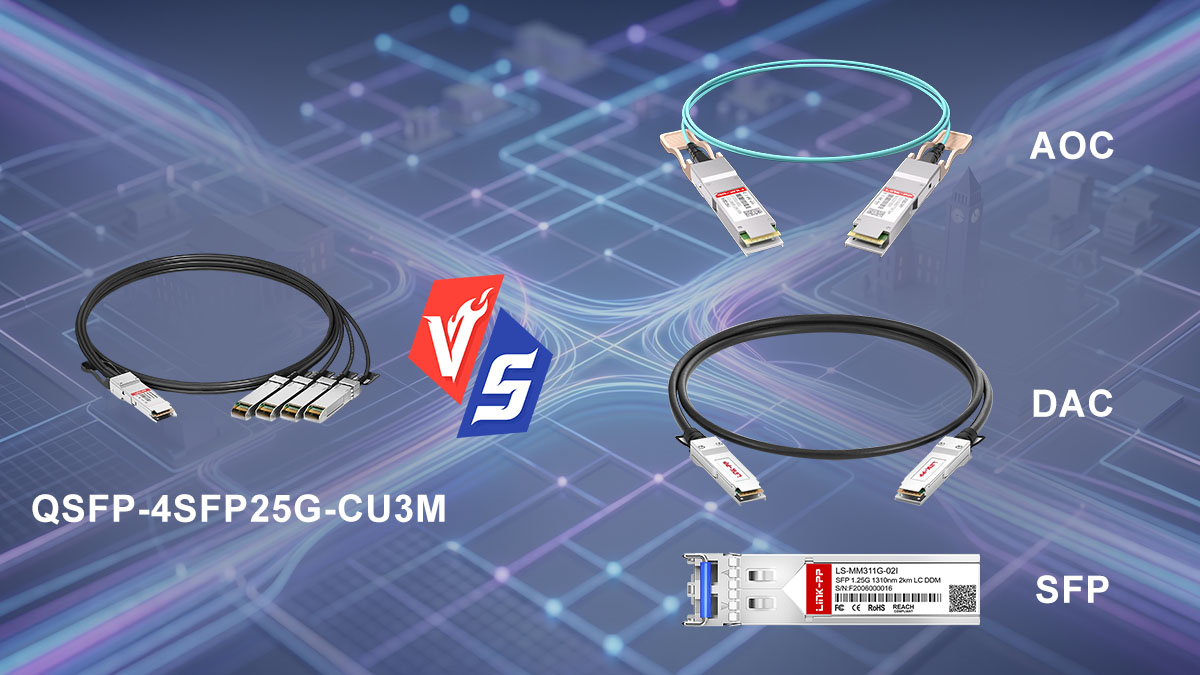
The QSFP-4SFP25G-CU3M is optimized for short-range 100GbE breakout connections, but it is not the ideal solution for every networking environment. Factors such as transmission distance, cable management, power consumption, and infrastructure flexibility should all be considered when selecting between a passive DAC, an Active Optical Cable (AOC), or optical transceivers with fiber. Understanding these differences helps network administrators deploy the most suitable interconnect for each application.
QSFP-4SFP25G-CU3M vs Active Optical Cable (AOC)
For short in-rack connections, the QSFP-4SFP25G-CU3M generally provides lower latency and lower power consumption than an AOC. However, once transmission distances extend beyond the practical limits of passive copper, AOCs become the more appropriate solution because they offer longer reach, lighter cabling, and stronger immunity to electromagnetic interference (EMI).
| Feature | QSFP-4SFP25G-CU3M (Passive DAC) | Active Optical Cable (AOC) |
|---|---|---|
| Transmission Medium | Twinax copper | Optical fiber |
| Typical Distance | Up to 3m | Up to 100m (model dependent) |
| Power Consumption | Near zero | Higher due to active electronics |
| Latency | Extremely low | Slightly higher because of electrical-to-optical conversion |
| EMI Resistance | Moderate | Excellent |
| Cable Weight | Heavier | Lighter |
| Best Deployment | Same rack or adjacent racks | Cross-rack and longer intra-data-center links |
The passive DAC remains the preferred option for short-distance server connectivity because it minimizes operational power while providing excellent electrical performance. AOCs become increasingly advantageous as distance, routing flexibility, and EMI resistance become higher priorities.
QSFP-4SFP25G-CU3M vs Optical Transceiver + Fiber
Compared with modular optical transceivers and fiber patch cables, the QSFP-4SFP25G-CU3M offers a much simpler deployment model for short-reach links. Optical solutions, however, provide significantly greater flexibility because transceivers and fiber cables can be replaced independently to support different transmission distances or future network upgrades.
The main differences include:
- Passive DAC integrates connectors and cable into one assembly.
- Optical transceivers allow independent replacement of modules and fiber.
- DAC deployment requires no fiber cleaning or polarity verification.
- Fiber solutions support transmission ranging from a few meters to many kilometers, depending on the optical module.
- Optical infrastructure is more adaptable to future network expansion and changing rack layouts.
- Passive DAC typically requires less power and less maintenance for short-distance installations.
For organizations with fixed rack layouts and predominantly in-rack connections, the QSFP-4SFP25G-CU3M offers an efficient and straightforward solution. In contrast, environments expecting frequent infrastructure changes or longer cable runs often benefit from the flexibility provided by optical transceiver-based architectures.
QSFP-4SFP25G-CU3M vs Other Breakout DAC Lengths
The 3m version strikes a balance between installation flexibility and signal integrity, but other cable lengths may better suit different rack configurations. Selecting the shortest practical cable generally improves cable management while avoiding unnecessary slack inside the rack.
| Cable Length | Typical Application | Main Advantage | Consideration |
|---|---|---|---|
| 1m | Devices within the same rack | Best airflow and cable management | Limited routing flexibility |
| 2m | Adjacent equipment inside one rack | Balanced installation | Suitable for most ToR deployments |
| 3m | Same rack or neighboring racks | Greater installation flexibility | Slightly thicker cable |
| 5m | Larger cabinets or adjacent racks | Longer copper reach | Increased cable weight and reduced flexibility |
The appropriate cable length depends on equipment placement rather than simply selecting the longest available option. Proper cable sizing reduces congestion, improves airflow, and simplifies ongoing maintenance, while maintaining the reliable low-latency performance expected from passive breakout DAC solutions.
📡 Advantages and Limitations of QSFP-4SFP25G-CU3M
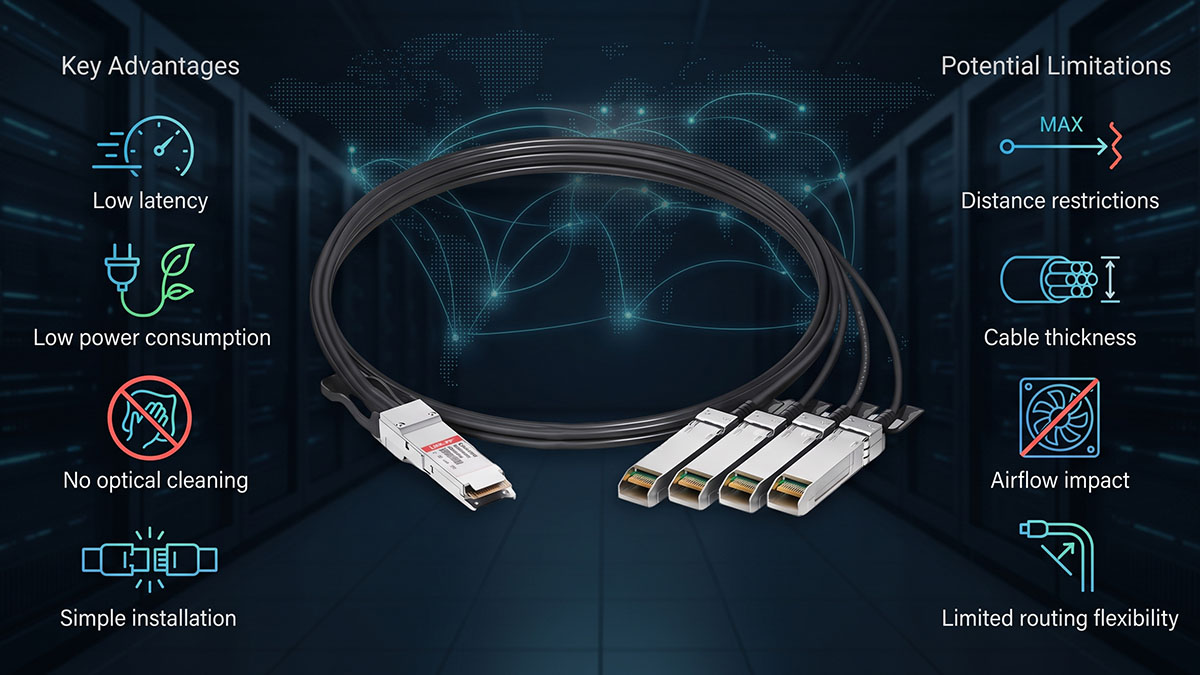
The QSFP-4SFP25G-CU3M is designed for high-density, short-range networking where low latency, minimal power consumption, and simplified deployment are priorities. While it performs exceptionally well within its intended operating range, it is important to recognize both its strengths and its practical limitations. Evaluating these factors helps determine whether a passive breakout DAC is the most appropriate solution for a specific network architecture.
Key Advantages
The QSFP-4SFP25G-CU3M offers several technical and operational benefits that make it a preferred choice for server-to-switch connectivity inside modern data centers. Its passive Twinax design eliminates active electronics, resulting in a simple, reliable interconnect with very low operational overhead.
Its primary advantages include:
- Extremely low latency due to direct electrical transmission
- Near-zero cable power consumption because no active components are required
- Minimal heat generation, helping improve rack-level thermal efficiency
- Plug-and-play installation without separate optical transceivers or fiber patch cords
- Stable 100GbE breakout into four independent25GbE connections
- High reliability resulting from a simple passive cable structure
- Reduced maintenance, as there are no optical connectors to clean or inspect
- Broad compatibility with many MSA-compliant switches, servers, and network adapters when properly coded
These advantages make the QSFP-4SFP25G-CU3M particularly effective for Top-of-Rack (ToR) deployments, virtualization clusters, cloud infrastructure, and AI computing environments where equipment is located within the same rack or neighboring racks. In these scenarios, passive DAC cables often provide an excellent balance between performance, simplicity, and operational efficiency.
Potential Limitations
Despite its strengths, the QSFP-4SFP25G-CU3M is not suitable for every networking environment. As a passive copper cable, its performance is inherently constrained by transmission distance and physical cable characteristics, making alternative technologies more appropriate for certain deployments.
The most important limitations include:
- Maximum supported distance is typically limited to3m for optimal signal integrity
- Thicker Twinax construction occupies more cable management space than fiber
- Heavier cable weight may affect organization in very high-density racks
- Lower routing flexibility because the cable and connectors form a fixed assembly
- Host devices must support QSFP28 breakout functionality
- Vendor-specific EEPROM compatibility may require appropriate cable coding
- Less suitable for cross-room or long-distance interconnects
These limitations do not reduce the cable's effectiveness within its intended application. Instead, they define the deployment boundaries where technologies such as Active Optical Cables (AOCs) or optical transceivers become more practical. Understanding these constraints allows network designers to select the most appropriate medium based on distance, infrastructure layout, and future scalability.
When It Is the Best Choice
The QSFP-4SFP25G-CU3M delivers the greatest value when network devices are located close together and require high-bandwidth, low-latency communication without the complexity of optical infrastructure. In these environments, passive breakout DACs provide an efficient and dependable interconnect while keeping deployment straightforward.
It is the best choice for the following scenarios:
- Connecting Top-of-Rack switches to multiple25GbE servers
- High-density data center racks with short cable runs
- Leaf-spine architectures requiring100GbE breakout connections
- Hyperconverged infrastructure and virtualization platforms
- AI and HPC clusters with latency-sensitive east-west traffic
- Enterprise storage systems using25GbE Ethernet connectivity
- Cloud computing environments where reducing power consumption is an operational objective
When transmission distances remain within the passive copper range and both endpoints support breakout operation, the QSFP-4SFP25G-CU3M provides an effective combination of bandwidth, reliability, and deployment simplicity. For installations that require greater reach, lighter cabling, or more flexible infrastructure expansion, optical interconnect solutions remain the better long-term option.
📡 Frequently Asked Questions About QSFP-4SFP25G-CU3M
What does QSFP-4SFP25G-CU3M convert between?
QSFP-4SFP25G-CU3M converts one QSFP28 100GbE port into four independent SFP28 25GbE connections, allowing a single high-speed switch interface to connect with multiple lower-speed network devices.
Does QSFP-4SFP25G-CU3M require software configuration?
Yes, the connected switch usually needs to support and enable QSFP28 breakout mode so that the single 100GbE interface can operate as four separate 25GbE links.
Is QSFP-4SFP25G-CU3M compatible with both QSFP28 and SFP28 ports?
Yes, the cable uses a QSFP28 connector on one end and four SFP28 connectors on the other end, but the host devices must support the corresponding breakout functionality.
What factors determine whether QSFP-4SFP25G-CU3M will work in a network?
Successful operation mainly depends on switch breakout support, port configuration, firmware compatibility, and correct cable coding for the target platform.
Can QSFP-4SFP25G-CU3M support future network upgrades?
It can support current 100GbE breakout deployments, but future upgrades toward higher-speed Ethernet standards may require different cabling solutions depending on network architecture and equipment capabilities.
Why is QSFP-4SFP25G-CU3M commonly used in data centers?
It is widely adopted because it provides a simple way to maximize switch port utilization while maintaining low latency, low power consumption, and efficient rack connectivity.
📡 Conclusion
The QSFP-4SFP25G-CU3M is a practical 100GbE breakout DAC solution designed for short-range, high-density network environments that require reliable QSFP28 to 4×SFP28 connectivity. Its passive copper architecture delivers low latency, minimal power consumption, and simplified deployment, making it especially suitable for data center racks, ToR switching, cloud infrastructure, and high-performance computing environments.
The key points of this review can be summarized as follows:
- QSFP-4SFP25G-CU3M enables efficient conversion from one 100GbE QSFP28 port to four independent25GbE SFP28 links.
- Its passive Twinax design provides excellent short-distance transmission performance with low operational power requirements.
- Compatibility verification, breakout configuration support, and proper cable coding are essential factors for successful deployment.
- Compared with AOCs and optical transceiver solutions, it offers advantages in simplicity and power efficiency while remaining limited by copper transmission distance.
- The 3m cable length provides a balance between installation flexibility and signal integrity for many rack-level networking scenarios.
For organizations evaluating high-speed breakout connectivity, selecting the right cable depends on factors such as network topology, transmission distance, platform compatibility, and future expansion requirements. The LINK-PP Official Store provides a range of compatible networking connectivity solutions, including DAC cables and optical interconnect products, helping network professionals identify suitable options for different data center and enterprise infrastructure needs.