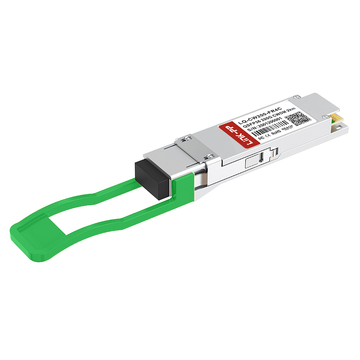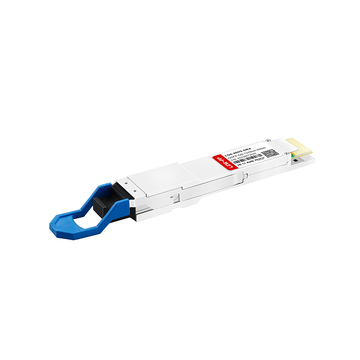






























Are you struggling to bridge long physical distances across your high-performance computing clusters without sacrificing throughput? As modern AI workloads expand across entire data center halls, traditional copper cables quickly reach their physical limits. The MMS1W50-HM, a 200G FR4 QSFP56 optical transceiver based on 4×50G PAM4, is a native building block for InfiniBand HDR fabrics. It delivers reliable single-mode connectivity up to 2 kilometers, providing the reach and speed needed to interconnect distributed compute nodes seamlessly.
But what happens to fabric latency when your interconnects stretch across multiple server rows or separate halls? In an InfiniBand HDR environment, scaling to long distances must not come at the cost of the microsecond-level timing that GPUs rely on for parallel computing. Proper architecture design and clean optical link planning ensure your distributed leaf-spine fabric delivers full 200Gb/s throughput without adding unnecessary signal delay.
🔷 What Role Does MMS1W50-HM Play in InfiniBand HDR Architecture?
Achieving both expansive reach and deterministic performance requires selecting optical components engineered specifically for high-speed computing fabrics. The MMS1W50-HM fills this role by transforming high-radix switch ports into ultra-stable, long-reach channels across the entire data center network.
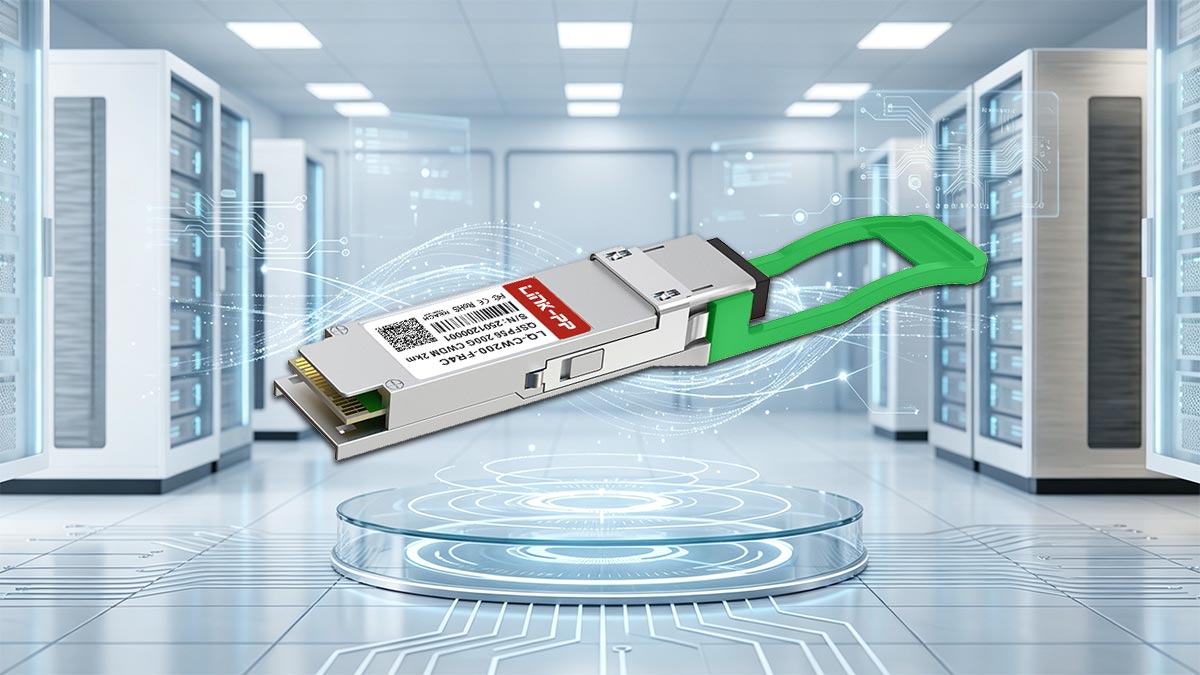
Enabling 200G High-Speed Optical Links in HDR Networks
Modern AI workloads demand sustained data streams without packet retransmissions or sudden bandwidth throttling. The MMS1W50-HM transceiver leverages 4×50Gb/s PAM4 modulation within a QSFP56 form factor to deliver an uncompromised 200Gb/s transmission speed per port. This optical link ensures that data-intensive collective operations, such as AllReduce, execute smoothly across distributed computing nodes.
Traditional short-range copper cables struggle with electrical attenuation when operating at high frequencies over longer distances. By converting electrical signals into optical pulses via CWDM4 wavelengths, the module eliminates electromagnetic interference and significantly reduces bit error rates. This reliable physical conversion forms the foundation for stable, high-throughput communication across mission-critical HDR networks.
Building Leaf-to-Spine Interconnects in Fat-Tree Topologies
In a non-blocking Fat-Tree topology, the leaf-to-spine interconnects serve as the core communication highway between distributed computing nodes. Equipping spine switches with MMS1W50-HM optics enables architects to route high-capacity uplinks to any leaf switch regardless of rack positioning. This approach preserves full bisection bandwidth across the entire switching fabric while eliminating rack-positioning constraints.
Unlike short-reach multimode transceivers, single-mode optical modules provide the link margin needed to pass through structured patch panels. System designers can route leaf-to-spine links through centralized optical distribution frames (ODF) without worrying about modal dispersion. This flexible routing capability streamlines cable organization while preserving optimal signal integrity throughout multi-tier switch meshes.
Bridging Long Distances Across Large-Scale AI Computing Fabrics
As GPU clusters scale beyond single rows, physical facility space quickly becomes a primary network design bottleneck. The MMS1W50-HM bridges physical distances up to 2km over standard single-mode fiber (SMF), allowing compute nodes to reside in separate server halls or distinct facility zones. This 2km reach frees cluster architects from the strict geographic constraints imposed by passive copper and Active Optical Cables (AOCs).
Distributing dense computing nodes across multiple data halls also resolves local power delivery and facility cooling limitations. High-density server cabinets can be positioned where power and chilled water infrastructure are readily available without fragmenting the unified computing fabric. By keeping inter-hall optical links fast and unified, the deployment operates as a single, low-latency AI cluster.
🔷 Solving Long-Distance HDR Layout Challenges with MMS1W50-HM
While establishing stable 200G leaf-to-spine connectivity is critical, physical room constraints often force network engineers to spread high-density racks across expansive facility floors. Deploying the MMS1W50-HM provides the extended optical reach required to overcome these physical layout boundaries without compromising InfiniBand HDR performance.

Extending HDR Coverage Across Distant Racks
High-density AI server rows often exceed the maximum reach of standard intra-rack cabling due to strict power footprint limits per square meter. Utilizing the MMS1W50-HM QSFP56 transceiver allows infrastructure planners to place compute and storage equipment across distant rows while maintaining native 200Gb/s speeds. This architecture eliminates physical proximity requirements and gives engineering teams total freedom during data center layout design.
Key engineering advantages of extended rack coverage include:
- Spreads compute loads evenly across different power distribution zones.
- Eliminates thermal hotspots caused by over-concentrating GPU servers in adjacent racks.
- Preserves direct leaf-to-spine connections without intermediate distribution switches.
- Allows flexible cluster expansion into newly opened rows on demand.
Building Inter-Hall Links up to 2 Kilometers
Expanding high-performance clusters across separate data center halls creates severe connectivity barriers for short-reach optical transceivers. Operating over duplex single-mode fiber (SMF), the MMS1W50-HM 200G FR4 module reliably bridges distances up to 2 kilometers with minimal signal attenuation. This extended span unites isolated server rooms into a single, cohesive InfiniBand HDR switching fabric.
Building multi-hall optical links delivers essential structural benefits:
- Unifies geographically separated facilities into one logical compute fabric.
- Maximizes existing single-mode fiber trunk infrastructure between buildings.
- Prevents data bottlenecks between centralized storage systems and remote nodes.
- Minimizes signal dispersion using precision CWDM4 wavelength multiplexing.
Eliminating Copper Cable Length Constraints
Direct Attach Copper (DAC) cables are physically limited to roughly two to three meters at 200G speeds, restricting their use to adjacent within-rack connections. Replacing rigid copper links with MMS1W50-HM optical modules liberates network layouts from these strict physical boundaries while drastically lowering bulk in cable pathways. Optical fiber also eliminates the severe electromagnetic interference and signal degradation commonly encountered when running high-speed copper bundles.
Transitioning from heavy copper to single-mode optical links provides clear operational wins:
- Replaces thick, heavy DAC bundles with lightweight, flexible optical patch cables.
- Clears airflow pathways within switch racks to improve overall chassis ventilation.
- Eliminates transmission degradation caused by high-frequency electromagnetic noise.
- Ensures uniform 200Gb/s signal integrity across both short and long network spans.
🔷 How to Design a Low-Latency HDR Network Using MMS1W50-HM?
Overcoming physical distance barriers across large data halls solves layout flexibility, but extended links must never jeopardize the razor-thin latency targets of high-performance computing. Strategically integrating the MMS1W50-HM into your core topology allows architects to maintain deterministic, sub-microsecond response times across large-scale InfiniBand HDR networks.

Reducing Switch Hops in Large AI Clusters
Scaling high-performance fabrics across distant server rows often tempts engineers to introduce intermediary aggregation switches. Utilizing MMS1W50-HM optical transceivers eliminates the need for extra conversion tiers by establishing direct, 2km optical runs between leaf and spine switches. This streamlined design directly reduces switch hops, eliminating serialization delays and packet queuing bottlenecks across the entire cluster.
Fewer switching stages also significantly cut down overall fabric transit times during intensive AI model training. By keeping the topology flat with direct 200G optical interconnects, compute nodes communicate with minimal routing overhead. This flat architecture ensures consistent, predictable round-trip latency regardless of where servers reside in the facility.
Protecting Signal Quality Over 2km Optical Links
Signal degradation over long-distance cable runs forces network gear to spend critical time recovering corrupted data packets. The MMS1W50-HM 200G FR4 module solves this by using CWDM4 optical technology to preserve exceptionally sharp eye diagrams across single-mode fiber links up to 2 kilometers. High optical signal-to-noise ratios keep the pre-FEC bit error rate well within the correctable range, ensuring that FEC operates transparently without triggering latency-inducing recovery mechanisms.
Consistent optical power levels across all four wavelength lanes also prevent link jitter during bursty traffic phases. The optical engine ensures stable PAM4 modulation even under continuous, peak-rate transmission scenarios. Maintaining pristine signal fidelity at the physical layer forms the true bedrock of low-latency communication across distributed racks.
Supporting Fast RDMA Data Transfer for GPUs
Large AI clusters rely heavily on Remote Direct Memory Access (RDMA) over InfiniBand to bypass CPU intervention and move data directly between GPU memories. The MMS1W50-HM delivers the clean 200Gb/s physical pipe needed to keep InfiniBand HDR RDMA operations running at maximum line rate. This sustained throughput guarantees that collective communication routines like All-to-All transfer without stalling worker GPUs.
Any packet drops or link fluttering in an RDMA fabric can trigger flow-control pauses that cascade through the network, stalling parallel training loops. Pairing robust optical hardware with zero-loss HDR switching prevents queue buildup and maintains fluid memory-to-memory synchronization. As a result, distributed compute engines spend less time idling for synchronization data and more time processing compute-heavy models.
🔷 Key Considerations for MMS1W50-HM Switch Port Allocation in HDR Fabrics
Achieving ultra-low latency requires more than just high-quality optical links; it hinges on how efficiently physical switch ports are assigned across the network. Careful port mapping ensures that the MMS1W50-HM interfaces seamlessly with core hardware resources to prevent throughput bottlenecks at the switching layer.

Connecting 200G HDR Optics to High-Radix Switches
Modern InfiniBand HDR chassis switches rely on high-radix designs that demand precise interface alignment to extract maximum port density. Plugging the MMS1W50-HM QSFP56 module into native 200G switch cages provides full 200Gb/s PAM4 signaling across each dedicated channel. This direct hardware matching ensures immediate link negotiation without complex configuration overhead.
Deploying transceivers directly into high-radix ports also preserves clean electrical routing across the switch backplane. Because the module operates over four 50G lanes matching the switch ASIC's native serialize/deserialize (SerDes) lanes, signal degradation between the port cage and processing silicon is minimized. This native alignment helps ensure stable continuous transmission during heavy computational bursts.
Optimizing Spine-to-Leaf Port Distribution
A balanced port distribution strategy between spine and leaf tiers prevents costly oversubscription in distributed AI fabrics. Allocating dedicated MMS1W50-HM uplinks evenly across all available spine planes helps achieve uniform bi-directional bandwidth for East-West traffic patterns. This structured arrangement reduces the risk of uneven queue depths and ensures fair bandwidth sharing across compute nodes.
Implementing an optimized port allocation scheme delivers several critical operational benefits:
- Supports the design of a strict 1:1 non-blocking oversubscription ratio across all tiers.
- Balances packet flow uniformly across every spine switch plane.
- Minimizes buffer bottlenecks during large AllReduce communication steps.
- Reserves symmetric expansion ports for seamless future rack additions.
Balancing Thermal Load Across Switch Faceplates
High-radix switch systems can exhibit localized thermal and power density variations across the front faceplate. Concentrating multiple long-distance MMS1W50-HM transceivers in physically adjacent cages creates intense thermal pockets that strain the switch's integrated cooling system. Distributing high-power optical modules evenly across available ports helps maintain uniform faceplate temperatures and prevents localized thermal throttling of the underlying switch ASIC.
Thermal proximity inside high-density chassis environments directly influences long-term hardware reliability. Rather than stacking high-power 2km optical links onto a single switch tier, spreading these uplinks across multiple chassis stabilizes overall airflow dynamics. This distributed deployment strategy protects internal switching silicon from uneven heat stress while ensuring consistent 200Gb/s performance across the entire InfiniBand HDR fabric.
🔷 Optical Cabling Best Practices for MMS1W50-HM in HDR Networks
Proper switch port allocation establishes a balanced network framework, but sustained performance ultimately relies on physical cabling integrity. Implementing standardized optical cabling practices ensures that the MMS1W50-HM maintains stable signal transmission across complex data center pathways.

Selecting High-Quality LC Duplex Single-Mode Fiber
Deploying 200G single-mode optics requires precision fiber patch cords capable of preserving tight optical budgets. The MMS1W50-HM utilizes an LC duplex optical interface that relies on OS2 single-mode fiber to support its 2km reach. Choosing premium fiber jumpers with factory-polished ceramic ferrules minimizes insertion loss and prevents back-reflection across sensitive CWDM4 channels.
Prioritizing certified fiber characteristics provides key advantages during installation:
- Minimizes insertion loss to stay within the 200GBASE-FR4 channel budget.
- Minimizes optical return loss to protect internal transceiver laser diodes.
- Ensures uniform core concentricity for repeatable optical alignment.
- Provides durable ceramic ferrules designed for repeated mating cycles.
Routing Structured Fiber Trunks Between Server Rows
Unstructured point-to-point patching quickly leads to unmanageable cable congestion between distant server cabinets. Combining MMS1W50-HM transceivers with high-density MPO-to-LC breakout cassettes and pre-terminated trunk cables establishes a clean, modular cabling backbone. This structured approach simplifies row-to-row interconnects while protecting delicate optical strands inside dedicated overhead trays.
Adopting structured cabling between rows yields immediate operational benefits:
- Reduces physical cable bulk within high-density overhead basket trays.
- Accelerates maintenance and link additions with modular patch panels.
- Simplifies link tracing and port mapping across large multi-row clusters.
- Lowers the risk of accidental cable snags during routine hardware maintenance.
Protecting Fiber Bend Radius in Cable Trays and Racks
Bending optical fiber too sharply causes light to leak from the glass core, silently degrading network performance. Because the MMS1W50-HM carries high-speed 200G signals over long distances, maintaining a safe bend radius is essential to avoid packet errors and packet drops. Following standard routing rules ensures that optical patch cords and trunk cables remain physically protected throughout the facility.
The following simplified guidelines outline the recommended bend radius limits across typical data center routing zones:
| Cabling Zone | Minimum Bend Radius Recommendation | Primary Protection Objective |
| Switch Faceplates & Patch Panels | ≥10× outer cable diameter (approx. 20 mm for 2.0mm patch cords) | Prevents stress on LC connectors and sharp fiber kinks |
| Vertical Rack Cable Managers | ≥ 10× outer cable diameter | Avoids pinching caused by overtightened ties or heavy cable bundles |
| Overhead Trays & Inter-Row Trunks | ≥ 20× outer cable diameter (under tension) | Prevents excess attenuation along long trunk routes |
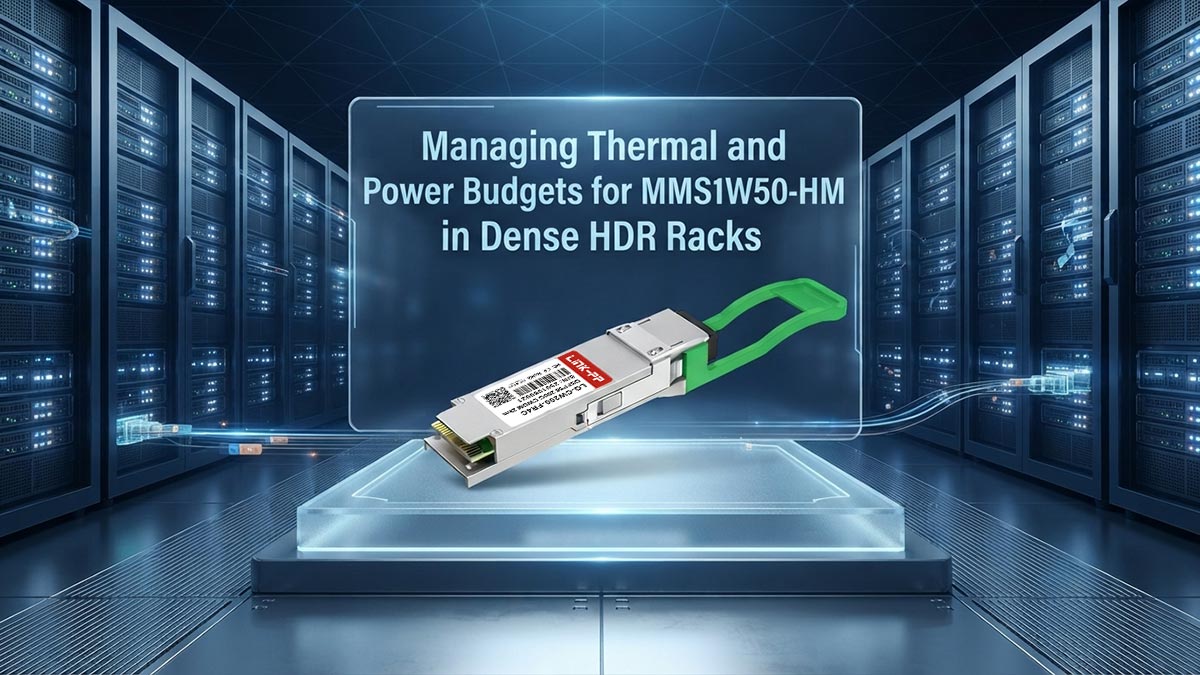
🔷 Managing Thermal and Power Budgets for MMS1W50-HM in Dense HDR Racks
Clean optical cabling guarantees signal integrity, but maintaining physical link performance in high-density facilities also depends heavily on managing heat and energy loads. Calculating realistic power budgets and cooling capacity protects the MMS1W50-HM from hardware degradation caused by accumulated rack-level thermal stress.
Mitigating Thermal Buildup in Dense Switch Racks
Populating high-radix InfiniBand switches with high-speed transceivers significantly raises localized faceplate energy concentration. The MMS1W50-HM 200G FR4 module draws up to 5.5W per port, primarily due to its on-board PAM4 signal processing and four-lane CWDM transmitter. When tens of these long-reach optics operate simultaneously in a 1U chassis, aggregate heat buildup can strain power distribution units and shorten component lifespans.
Preventing thermal hotspots requires balancing optical port density against the overall rack cooling profile. Facilities teams should verify total power delivery per cabinet to ensure power supplies operate well within their optimal efficiency curve. Staggering high-power long-reach optical uplinks across separate switch chassis prevents localized overheating and maintains a stable operational baseline across the entire computing fabric.
Improving Rack Airflow for Long-Distance Optics
High-density AI server cabinets require continuous, unobstructed air movement to carry exhaust heat away from sensitive laser cavities. Deploying MMS1W50-HM optical modules in front-to-back or back-to-front airflow setups demands clean cable management to avoid blocking switch intake grilles. Bundling fiber jumpers neatly along vertical rails ensures cold-aisle air reaches optical faceplates without turbulence or static pressure loss.
Unmanaged air recirculation inside the cabinet can quickly turn cool intake zones into localized thermal traps. Installing blanking panels in all unused rack units forces cool supply air through active equipment rather than letting it bypass switch chassis. Maintaining consistent air velocity across switch cages prevents internal transceiver optical engines from reaching thermal limits during continuous, full-line-rate compute jobs.
Monitoring Optical Operating Temperatures
Continuous real-time temperature tracking is critical for preventing thermal throttling and unexpected link flapping. The MMS1W50-HM integrates Digital Diagnostic Monitoring (DDM) to report real-time internal module temperature, supply voltage, and laser bias current. Network operators can query these telemetry metrics through NVIDIA management tools such as UFM or MLNX-OS, which access the transceiver’s I²C management interface.
Setting proactive warning thresholds ensures that cooling fans adjust dynamically as data workloads ramp up. If optical core temperatures approach manufacturer limits, monitoring tools can alert data center staff to check for air filter blockages or chassis fan failures. Automated thermal surveillance preserves physical link stability, reducing the risk of costly unscheduled downtime for mission-critical InfiniBand HDR workloads.
🔷 Why LINK-PP LQ-CW200-FR4C Is the Ideal MMS1W50-HM Alternative for HDR Design?
Balancing power budgets and thermal dissipation is essential, but cluster architects must also control overall hardware procurement expenses when scaling to hundreds of optical ports. The LINK-PP LQ-CW200-FR4C serves as a direct alternative to the MMS1W50-HM, delivering enterprise-grade optical performance while optimizing capital expenditure for large-scale InfiniBand HDR fabrics.

Seamless Fit for InfiniBand HDR Architectures
Deploying third-party compatible optics into mission-critical compute fabrics requires strict alignment with established high-speed hardware standards. The LINK-PP LQ-CW200-FR4C complies with the QSFP56 MSA and the 200GBASE-FR4 optical specification, matching the exact physical form factor and electrical pinout of the OEM MMS1W50-HM. This standards-based compliance allows network engineers to slot the transceiver into standard Quantum switch cages without requiring physical adaptations.
Beyond physical compatibility, the module natively supports the same 4×50Gb/s PAM4 modulation across standard CWDM4 wavelength channels. Fabric managers can integrate these transceivers into leaf-spine switching tiers alongside existing optics without introducing signal format mismatches. As a result, expanding cluster capacity proceeds as a clean hardware addition rather than a complex architectural redesign.
Identical 200G 2km Performance at Lower Deployment Costs
Large-scale AI clusters requiring hundreds of 2km single-mode optical runs can rapidly inflate overall networking budgets. The LINK-PP module delivers the full 200Gb/s throughput and 2-kilometer transmission reach of the MMS1W50-HM at a competitive per-port price point. This financial flexibility enables infrastructure planners to allocate critical resources toward expanding GPU compute density or upgrading back-end storage fabrics.
Importantly, cost efficiency does not require sacrificing optical signal integrity or physical durability. The LQ-CW200-FR4C is designed to operate within similar power consumption ranges as the OEM module while meeting the required transmitter dispersion penalty specifications over standard OS2 single-mode fiber. Engineering teams achieve the optical margins required for inter-row and inter-hall connectivity, effectively reducing total cost of ownership.
Reliable Interoperability with HDR Switches
Optical transceivers require precise register programming to facilitate smooth integration with high-speed switch operating systems. LINK-PP programs the LQ-CW200-FR4C with EEPROM coding designed to maximize compatibility with InfiniBand HDR switch environments. The switch firmware reads the module’s configuration parameters over the I²C bus, allowing the port to negotiate speeds and establish links reliably.
Furthermore, the module integrates comprehensive Digital Diagnostic Monitoring (DDM) interfaces that report live telemetry through NVIDIA management tools such as UFM or MLNX-OS, which access the transceiver's I²C management interface. Network administrators can monitor real-time operating metrics, including optical power levels, voltage, and internal temperatures, alongside original MMS1W50-HM units. This predictable operational behavior supports long-term fabric reliability and straightforward maintenance workflows.
🔷 Conclusion: Building Scalable and Reliable InfiniBand HDR Fabrics with MMS1W50-HM

Building modern AI computing clusters requires balancing expansive facility space with strict latency limits. The MMS1W50-HM 200G FR4 optical transceiver solves this challenge by bridging distances up to 2km across server rows. With careful port and cabling planning, this optical solution provides the sustained 200Gb/s throughput needed for intensive GPU workloads.
To maximize network efficiency and protect long-term capital investments, infrastructure planners should keep several core principles in mind:
- Plan non-blocking port allocations to balance traffic across switch tiers evenly.
- Enforce structured single-mode cabling and maintain safe fiber bend radii.
- Distribute high-power optics across faceplates to prevent concentrated thermal hotspots.
- Choose thoroughly validated compatible transceivers to accelerate deployment schedules and control costs.
If you are looking to scale out your cluster affordably without sacrificing transmission reliability, the LINK-PP LQ-CW200-FR4C delivers an enterprise-grade, cost-effective compatible alternative to the MMS1W50-HM. Visit the LINK-PP Official Store to review detailed technical specifications and equip your InfiniBand HDR fabric with high-speed 200G connectivity.