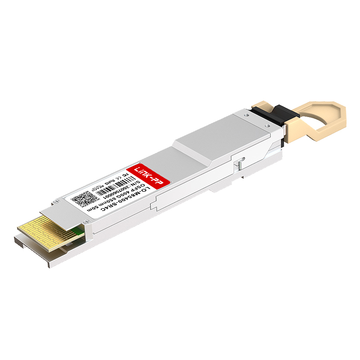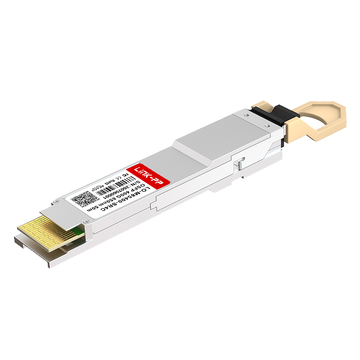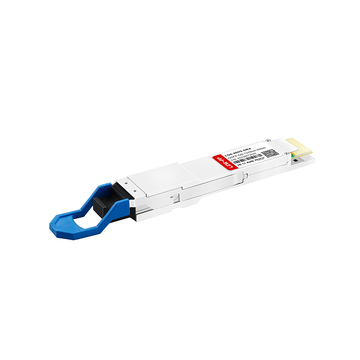
How do modern AI data centers move massive volumes of training data, gradients, and other east-west traffic between GPUs without crippling bottlenecks? The answer lies in high-performance interconnects such as the NVIDIA MMA4Z00-NS400, a 400G OSFP SR4 optical transceiver engineered for ultra-fast, low-latency computing fabrics. As AI models scale rapidly, understanding how this high-speed module sustains reliable 400G throughput has become essential for network engineers.
What physical processes occur inside the transceiver to make such extreme data rates possible? Beyond plug-and-play hardware, every transmission depends on precise 850nm VCSEL laser dynamics, advanced PAM4 modulation, multimode fiber guidance, and stringent thermal control. Exploring the core physics behind these optical components reveals how data centers preserve signal integrity and minimize costly transmission errors under intense workloads.
↘️ What Is the NVIDIA MMA4Z00-NS400 and How Does It Send 400G Data?
Delivering continuous data flow across modern server racks requires hardware designed specifically for high-density physical links. The NVIDIA MMA4Z00-NS400 addresses this demand by pairing high-speed electrical inputs with low-loss optical channels to move massive bandwidth in real time.

Basic Overview of the MMA4Z00-NS400 OSFP Module
The NVIDIA MMA4Z00-NS400 is a pluggable optical transceiver packaged in the Octal Small Form-factor Pluggable (OSFP) standard. It is engineered primarily for short-reach multimode fiber runs, connecting switches and host adapters within adjacent racks.
Its robust metal housing integrates internal laser drivers, receivers, and optical assemblies into a single compact footprint. This self-contained setup provides the structural durability and electrical shielding needed to protect sensitive optics from electromagnetic interference.
Electrical Signal Conversion into High-Speed Light Pulses
The module sits directly at the boundary where electronic computation meets high-speed photonic networking. As raw bits arrive from the host board as high-frequency voltage fluctuations, the internal driver circuits interpret these electrical patterns.
These circuits immediately feed current into an array of optical emitters to turn the electrical voltages into rapid light flashes. This electro-optical transformation ensures data moves across optical fiber without the high signal attenuation typical of pure copper cables.
Four Parallel Optical Channels Delivering 400G Bandwidth
Rather than pushing an entire 400Gbps stream through a single optical emitter, the NVIDIA MMA4Z00-NS400 divides the workload across four separate physical lanes. Each lane relies on high-speed 100G-PAM4 optical modulation, combining four light levels with a 53.125GBd symbol rate to carry a dedicated quarter of the aggregate data stream.
Inside the module, an integrated multi-fiber array directs these four light streams into an industry-standard MPO-12/APC connector. By transmitting and receiving across parallel multimode fibers in unison, the transceiver achieves full 400G line-rate speed while maintaining stable power consumption and safe thermal limits across every channel.
High-Throughput Data Connectivity for Modern AI Networks
Modern distributed training jobs require immediate gradient sharing and parameter updates among thousands of cooperating GPUs. The NVIDIA MMA4Z00-NS400 supplies the low-latency optical pipes required by fabrics like InfiniBand NDR and 400GbE to avoid idle computing cycles.
By maintaining stable 400G link performance over distances up to 50m, this transceiver keeps leaf-and-spine cluster topologies running at peak throughput. It eliminates inter-switch bottlenecks, ensuring massive computational clusters operate as a unified, highly efficient AI supercomputer.
↘️ How Does Laser Physics Work Inside the NVIDIA MMA4Z00-NS400?
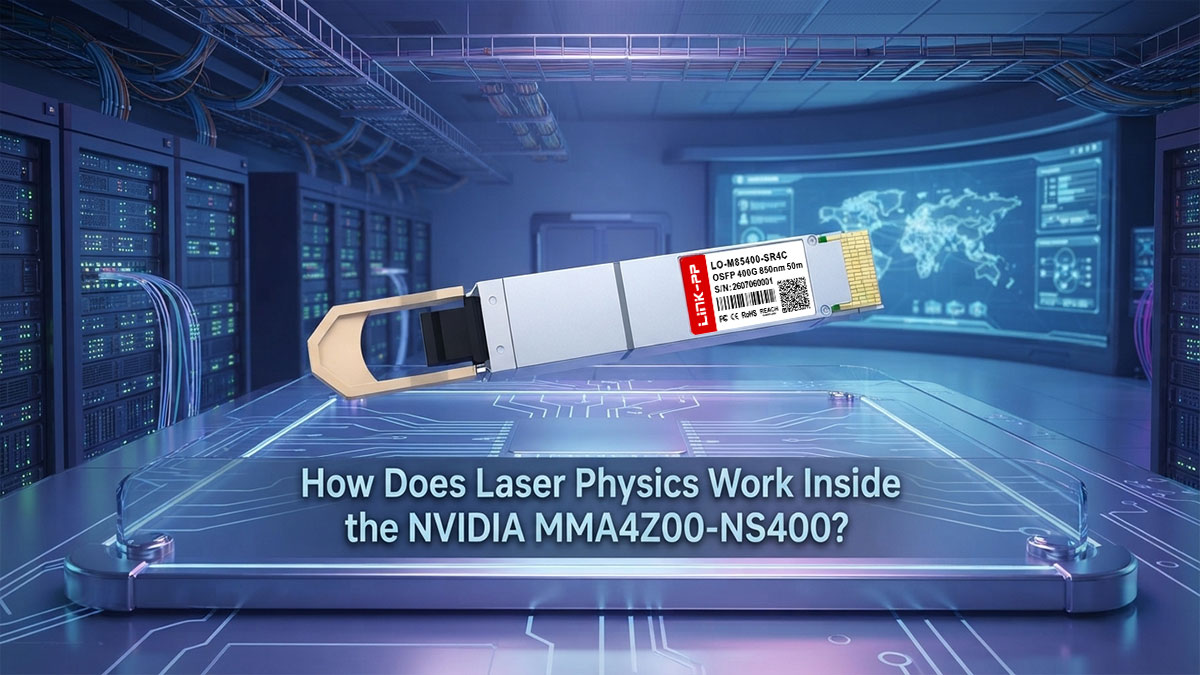
Converting electrical bits into four parallel optical streams requires an exceptionally fast, highly concentrated photonic light source. Inside the NVIDIA MMA4Z00-NS400, solid-state laser physics drives this conversion, generating bright, predictable optical pulses that travel reliably across short-reach fiber links.
850nm VCSEL Laser Diode Operation and Light Emission
At the heart of the NVIDIA MMA4Z00-NS400 optical transmitter sits a Vertical-Cavity Surface-Emitting Laser (VCSEL) array. Unlike edge-emitting lasers that fire sideways from a cleaved chip border, a VCSEL emits its optical beam perpendicular to the semiconductor surface. This specialized micro-cavity architecture allows the laser to switch states billions of times per second while consuming minimal electrical power.
The physical operation within each diode cavity relies on a sequence of precise semiconductor behaviors:
- An applied forward-bias voltage injects electrons and holes into microscopic quantum wells.
- Recombining charge carriers release photons within a resonant optical cavity.
- Parallel dielectric Bragg mirrors reflect the light back and forth to trigger stimulated emission.
- A coherent, circular optical beam exits vertically through the top circular aperture at 850nm.
Short-Reach Optical Transmission Using Multimode Light
The 850nm wavelength was intentionally selected for the NVIDIA MMA4Z00-NS400 to match the physical properties of multimode fiber cores. Near-infrared photons at this wavelength experience minimal material dispersion over short glass spans, making them well-suited for intra-rack and inter-rack connections.
Furthermore, the circular output beam emitted by an 850nm VCSEL couples efficiently into the relatively large 50-micron core of multimode fiber. This high coupling tolerance reduces the need for complex, high-precision focusing optics, keeping the assembly compact and cost-effective.
Laser Beam Stability and Output Power Regulation
Maintaining consistent data rates requires tightly managed optical launch power. Any fluctuation in laser current or temperature directly shifts the optical output, which risks distorting high-speed pulses before they ever reach the fiber.
To prevent signal degradation, the internal driver circuits of the NVIDIA MMA4Z00-NS400 monitor and adjust the bias and modulation currents in real time. Built-in photodiode sensors track actual light output continuously, ensuring the laser beam remains within safe, calibrated power boundaries during prolonged network workloads.
↘️ How Does the NVIDIA MMA4Z00-NS400 Use PAM4 to Boost Data Rates?
Emitting stable laser light is only half the battle when transferring data at ultra-high velocities. To reach 400G line rates without requiring physically unmanageable laser frequencies, the NVIDIA MMA4Z00-NS400 applies pulse-amplitude modulation to pack more information into every optical pulse.

Four-Level Light Pulsing for Double Data Throughput
The NVIDIA MMA4Z00-NS400 uses 4-Level Pulse Amplitude Modulation (PAM4) to transmit data across its four optical lanes. Instead of switching light entirely off and on, each internal VCSEL emits light across four distinct optical power thresholds labeled 00, 01, 10, and 11. These varying optical intensity steps allow the receiver to determine two distinct bits from a single measurement window.
Because each distinct brightness level maps to a specific two-bit binary combination, the module transmits double the amount of data per clock cycle. Operating at a baud rate of 53.125GBd per lane, this four-level mechanism allows the transceiver to deliver 100G-PAM4 per channel without doubling the underlying modulation frequency. As a result, each channel reaches a raw line rate of roughly 106.25Gbps, which after forward error correction overhead delivers a 100G payload.
Key Differences Between PAM4 and Traditional NRZ Signals
Legacy optical networks historically relied on Non-Return-to-Zero (NRZ) modulation, which uses binary on-and-off states to convey single bits. Moving to PAM4 allows the NVIDIA MMA4Z00-NS400 to achieve high throughput within limited electrical and optical bandwidth boundaries, though it introduces smaller eye-height margins that require higher signal precision.
The following comparison illustrates how these two signaling schemes differ across key operational metrics:
| Parameter | Traditional NRZ Signaling | PAM4 Signaling |
| Voltage / Light Levels | 2 levels (Low, High) | 4 levels (00, 01, 10, 11) |
| Bits per Symbol | 1 bit per clock transition | 2 bits per clock transition |
| Required Bandwidth | Full frequency per bit rate | Half frequency for equivalent bit rate |
| Signal-to-Noise Ratio (SNR) | Higher tolerance to noise (~9.5 dB advantage) | Tighter eye margins; requires DSP cleanup |
| Per-Lane Line Rate | Typically capped near 25G / 50G | 100G (53.125 GBd symbol rate) |
Built-In DSP Waveform Shaping and Pulse Recovery
Compressing four distinct light amplitudes into a single optical channel naturally compresses the vertical eye opening, making the signal vulnerable to noise and attenuation. The NVIDIA MMA4Z00-NS400 overcomes this physical limitation by integrating a dedicated Digital Signal Processor (DSP) directly into the signal path. This chip actively corrects distortion introduced by high-speed printed circuit traces and parasitic capacitance.
On the transmit path, the DSP applies Feed-Forward Equalization (FFE) to reshape distorted electrical waveforms before they trigger the VCSEL drivers. When optical pulses return, the DSP's Clock and Data Recovery (CDR) circuits sample degraded pulses, filter out analog jitter, and reconstruct sharp digital symbols for downstream switch processing. This constant equalization ensures reliable end-to-end data transfer even under heavy cluster traffic.
↘️ How Does Light Travel Through Fiber Cables with the NVIDIA MMA4Z00-NS400?
Once the transceiver shapes clean PAM4 optical pulses, those signals must journey across physical cabling without losing structural coherence. The NVIDIA MMA4Z00-NS400 relies on precision multi-fiber coupling and dielectric wave guidance to transport high-speed light pulses across dense server rows.

Light Transmission Path Through the MPO-12 Fiber Interface
The optical port of the NVIDIA MMA4Z00-NS400 features an industry-standard MPO-12/APC receptacle that locks multiple fibers into exact physical alignment. Internal guide pins position the external fiber ferrule directly against the module’s micro-lens array to minimize coupling tilt. This mechanical interface routes four dedicated transmit fibers and four dedicated receive fibers simultaneously, while the remaining four positions in the 12-fiber ribbon are unused in this configuration.
The Angled Physical Contact (APC) polish incorporates an eight-degree slant across the ferrule surface to manage reflected energy. Instead of bouncing backward into the sensitive VCSEL cavities, stray light deflects harmlessly into the outer fiber cladding. This precise geometry preserves optical return loss standards, preventing reflected photons from destabilizing the transmitter.
850nm Light Wave Guidance Inside Multimode Fiber Cores
After clearing the optical connector, each 850nm beam enters a 50-micron multimode glass core surrounded by a lower-index cladding layer. The refractive index boundary traps the light pulses inside the core through continuous total internal reflection. This dielectric boundary ensures that high-intensity light stays guided along the physical curve of the patch cable.
Modern OM4 cabling uses a graded-index profile where glass density decreases smoothly from the center out toward the cladding. Light traveling along longer, outer trajectories moves through less dense glass at higher velocities, while straight, central rays travel through denser media at slower speeds. This graded profile equalizes the arrival times of different modes, keeping the composite optical wave tight and readable.
Optical Signal Loss and Attenuation Across Cable Lengths
As light pulses travel down the glass pathway of the NVIDIA MMA4Z00-NS400 link, their total optical power gradually diminishes over distance. Intrinsic glass absorption and Rayleigh scattering cast a portion of the photons out of the core as heat or scattered light. Over an 850nm link, these glass imperfections contribute to the fiber's specified maximum attenuation of 3.0dB/km at 850nm, with typical values around 2.5dB/km.
Additional insertion loss occurs at every physical connector junction and adapter along the structured cable plant. Each mated MPO junction adds a typical insertion loss of 0.35dB (maximum 0.75dB), and dirty ferrule endfaces or air gaps can push losses even higher. If total link attenuation exceeds the module's calibrated link budget, the receiver photodiode struggles to distinguish PAM4 voltage thresholds from background thermal noise.
Physical Reach Limits on Standard OM4 Multimode Fiber
While standard attenuation reduces optical power, modal dispersion ultimately dictates the hard physical distance limits of the NVIDIA MMA4Z00-NS400. Because different light rays take slightly different spatial modes through the 50-micron core, optical pulses broaden temporally as they propagate along the fiber. At extreme modulation speeds of 53.125GBd per lane, this severe pulse broadening causes adjacent symbols to overlap and trigger heavy intersymbol interference (ISI).
To maintain readable eye diagrams, the transceiver is formally specified for a maximum distance of 50m over OM4 multimode fiber. Deploying the module across older OM3 cabling restricts that operating envelope to roughly 30m due to lower modal bandwidth. Respecting these physical reach boundaries guarantees that downstream receivers reconstruct every four-level PAM4 pulse without exceeding the error-correction thresholds of the network.
↘️ Why Is Heat Control Critical for the NVIDIA MMA4Z00-NS400?
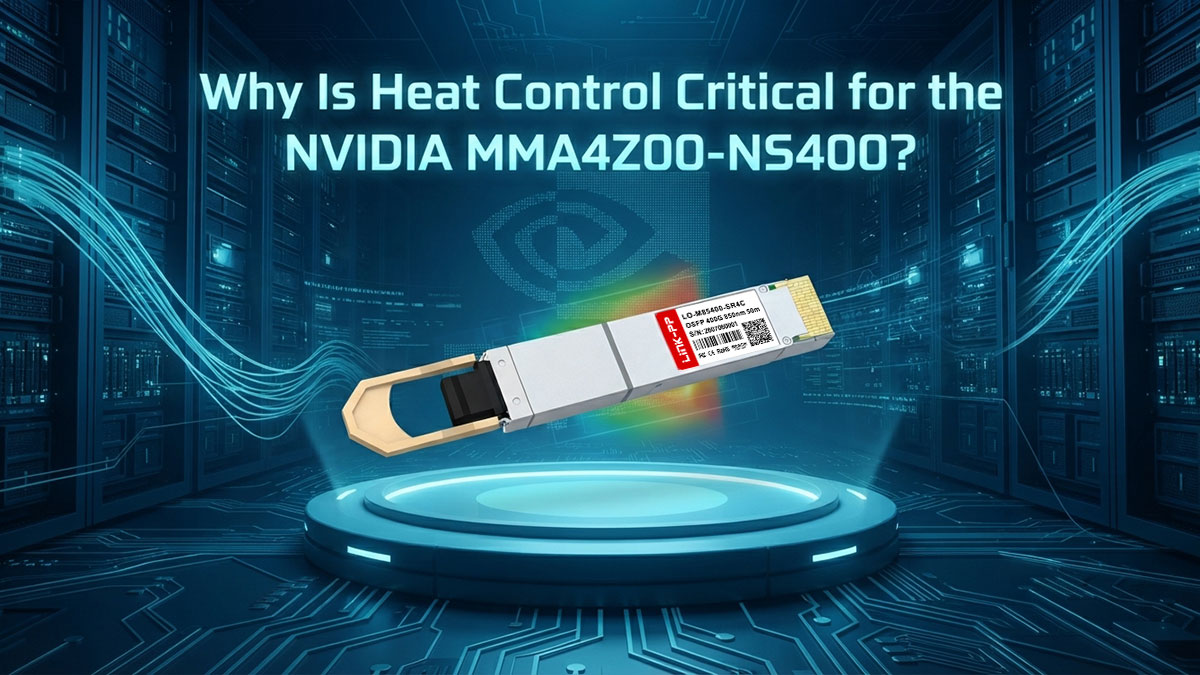
Pushing high-speed PAM4 signals across parallel fiber lanes demands significant electrical power within an ultra-dense physical footprint. The NVIDIA MMA4Z00-NS400 concentrates multiple active semiconductors into a closed metal enclosure, making thermal dissipation vital for preserving link stability.
Thermal Energy Output from Fast Optical DSP Chips
The internal DSP chip serves as the primary heat source inside the NVIDIA MMA4Z00-NS400. Operating at multi-gigahertz frequencies to process four parallel 100G lanes, billions of tiny silicon transistors continuously switch states to execute complex equalization algorithms. This rapid switching activity generates substantial dynamic power dissipation, releasing localized thermal energy directly into the transceiver substrate.
Because the DSP is widely regarded as the dominant contributor to module power consumption—typically 7W to 8W under full load, with a maximum specification of 8.5W—it creates sharp internal thermal gradients. Trapped heat elevates the internal junction temperature, which degrades silicon efficiency and increases leakage current. Without steady heat extraction away from the DSP package, thermal throttling or signal failure quickly follows.
Flat-Top OSFP Shell Design for Thermal Dissipation
Unlike finned-top optical transceivers, the NVIDIA MMA4Z00-NS400 features a smooth, flat-top OSFP housing engineered specifically for adapter and switch environments with integrated chassis cooling. When inserted into a network adapter such as the NVIDIA ConnectX-7, the flat upper surface makes direct contact with the riding heat sink mounted on the connector cage, creating a low-thermal-resistance path that conducts heat upward and away from the internal VCSEL array and DSP.
High-velocity system fans drive forced airflow across the host's cooling fins to sweep away the accumulated thermal load. Spring-loaded clips on the cage maintain consistent clamping pressure across the flat shell, ensuring stable conductive contact even during mechanical vibration. This collaborative cooling approach maintains the operating case temperature well within the standard 0°C to 70°C commercial threshold during intense data transfer.
High Operating Temperature Risks to Laser Performance
Excessive operating heat poses an immediate physical threat to the delicate 850nm VCSEL array inside the transceiver. Thermal effects alter both the physical cavity length and the refractive index of the semiconductor materials, shifting the resonance wavelength toward longer infrared bands. As internal temperatures rise toward critical thresholds, the optical output suffers severe operational penalties:
Threshold current increase: Higher thermal energy demands larger drive currents simply to initiate laser emission.
- Slope efficiency drop: Quantum efficiency deteriorates, cutting the optical output power produced per milliampere of current.
- Relative intensity noise (RIN) rise: Elevated carrier agitation amplifies random photon fluctuations, degrading PAM4 eye openings.
- Accelerated diode aging: Continuous thermal stress expedites crystal defect propagation, drastically shortening overall VCSEL lifespan.
Together, these thermal penalties compress the optical eye margin until clean PAM4 detection becomes impossible. Maintaining strict case temperature boundaries is therefore the first line of defense—and when thermal margins are tight, FEC and DSP-based signal recovery become the essential second line of protection.
↘️ How Does the NVIDIA MMA4Z00-NS400 Prevent Signal Errors?
Even with optimal thermal dissipation, four-level optical pulses remain susceptible to analog distortions and channel attenuation across high-density fiber runs. The NVIDIA MMA4Z00-NS400 counters these physical impairments through advanced digital signal processing and algorithmic error mitigation to preserve bit integrity.
Optical Noise Handling During Ultra-Fast Light Transmission
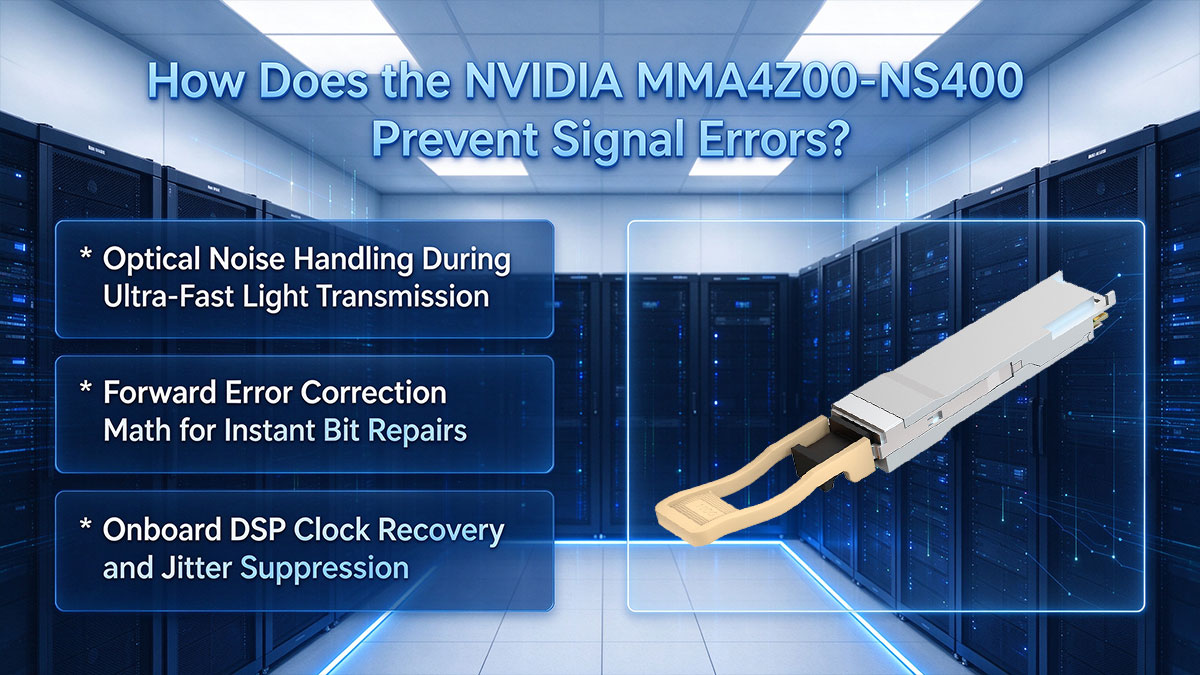
Operating four 100G lanes at 53.125GBd significantly narrows the eye openings, making subtle photon fluctuations and thermal noise capable of causing bit flips. The NVIDIA MMA4Z00-NS400 minimizes these analog disturbances by coupling high-sensitivity PIN receiver photodiodes with low-noise transimpedance amplifiers (TIAs).
These front-end receiver components convert weak optical signals into stable electrical voltages while actively suppressing background thermal noise. By isolating meaningful PAM4 amplitude transitions from spontaneous optical noise, the module preserves a clean signal margin before digital processing begins.
Forward Error Correction Math for Instant Bit Repairs
Because raw high-speed PAM4 links naturally operate with a baseline pre-FEC bit error rate, modern 400G networks rely on physical-layer Reed-Solomon Forward Error Correction—specifically RS(544, 514), also known as KP4 FEC. The NVIDIA MMA4Z00-NS400 transparently carries this structured parity data across every optical lane, ensuring the host system reconstructs degraded symbols in real time.
By appending 30 parity symbols to every 514 data symbols, the KP4 algorithm mathematically repairs up to 15 symbol errors per codeword without triggering retransmissions. This error-correction layer converts an otherwise noisy physical channel into a virtually error-free link with an effective post-FEC bit error rate below 10⁻¹⁵.
Onboard DSP Clock Recovery and Jitter Suppression
High-frequency signals traversing switch traces and multimode fiber experience severe timing jitter and phase drift that blur symbol boundaries. The onboard DSP inside the NVIDIA MMA4Z00-NS400 uses integrated Clock and Data Recovery (CDR) circuits to continuously lock onto the incoming symbol rate and realign sampling phases.
Once synchronized, internal feed-forward equalizers (FFE) and other adaptive filtering stages digitally compensate for high-frequency attenuation and intersymbol interference. This real-time filtering strips away accumulated timing jitter, delivering sharp, retimed digital waveforms to the host system.
↘️ Applying the Same Optical Physics: LINK-PP Compatible Solutions for NVIDIA MMA4Z00-NS400
Achieving reliable 400G transmission depends strictly on adhering to established optical physics, signaling standards, and physical tolerances rather than proprietary brand locks. By engineering hardware around these identical physical rules, the LINK-PP LO-M85400-SR4C delivers an electrically and optically matched alternative to the NVIDIA MMA4Z00-NS400.

Identical 850nm VCSEL Arrays and Optical Power Levels
The LINK-PP LO-M85400-SR4C 400G OSFP SR4 module integrates four-channel 850nm VCSEL arrays engineered to mirror the exact optical launch parameters of the OEM transceiver. Each laser diode emits within calibrated average power and extinction ratio boundaries, ensuring ideal optical beam coupling into standard multimode fibers.
High-precision micro-optics and internal photodiode feedback loops actively maintain laser stability and suppress intensity noise under heavy usage. This ensures the optical transmitter delivers the exact photon flux required for clean detection over OM3 and OM4 runs.
Matched PAM4 Signal Modulation and DSP Processing
High-speed physical links demand identical signal-shaping capabilities to preserve tight eye openings across every channel. LINK-PP LO-M85400-SR4C utilizes an onboard digital signal processor running at 53.125GBd per lane to generate stable 100G-PAM4 pulses.
On the receive path, integrated clock and data recovery alongside feed-forward equalization removes high-frequency jitter and compensates for channel loss. This active signal conditioning keeps incoming symbol errors well below the KP4 FEC threshold, ensuring transparent compatibility with the host system.
Equivalent Thermal Design and Power Consumption Profiles
Sustained optical performance requires thermal behavior that matches existing data center airflow and host mechanical envelopes. The LINK-PP LO-M85400-SR4C OSFP module uses a precision-machined flat-top OSFP housing that mates seamlessly with cage-mounted riding heat sinks in adapter cards and switch chassis.
Internal components are optimized to operate within a comparable power envelope—typically 7W to 8W under continuous 400G traffic, with a maximum specification of 8.5W. This tight thermal alignment prevents localized hot spots, allowing the module to maintain stable case temperatures across standard commercial operating ranges.
EEPROM Compatibility with NVIDIA Switch Hardware
Hardware-level optical parity must be paired with digital recognition at the physical management layer. LINK-PP LO-M85400-SR4C features programmed EEPROM memory formatted to comply strictly with CMIS standards and NVIDIA firmware verification routines.
When plugged into NVIDIA Quantum-2 InfiniBand switches or ConnectX-7 network adapters, the host reads serial numbers, speed bitmaps, and diagnostic telemetry through the standard I²C bus. The pre-configured EEPROM data satisfies the CMIS state-machine sequence during standard initialization, enabling the module to complete link initialization and bring the 400G port up without manual intervention.
↘️ Conclusion: Mastering the Physics Behind the NVIDIA MMA4Z00-NS400
Deploying reliable 400G connectivity in modern AI fabrics ultimately comes down to understanding how laser light is produced, pulsed, and kept cool. The NVIDIA MMA4Z00-NS400 exemplifies this balance by pairing 850nm VCSEL arrays and 100G-PAM4 DSP signaling with robust flat-top thermal conduction to maintain link stability.
Because standard Multi-Source Agreements (MSAs) and IEEE specifications establish uniform physical baselines, transceivers built to these common standards achieve broad interoperability across high-density clusters. When scaling large AI fabrics, network teams frequently seek verified compatible transceivers to optimize procurement budgets and supply availability without sacrificing link performance.
For engineers seeking a reliable alternative that adheres to these identical optical, electrical, and thermal parameters, the LINK-PP LO-M85400-SR4C 400G OSFP SR4 optical module offers proven drop-in compatibility. To review detailed technical specifications and evaluate compatible modules for your network infrastructure, visit the LINK-PP Official Store.