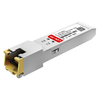
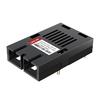
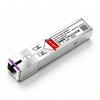







Passive Optical Network (PON) technology has become a fundamental part of modern fiber-optic access infrastructure. From Fiber-to-the-Home (FTTH) broadband services to enterprise connectivity and telecommunications networks, PON provides high-bandwidth data transmission through a shared optical fiber infrastructure. As demand for faster and more reliable connectivity continues to grow, understanding the equipment used at both ends of a PON network is increasingly important.
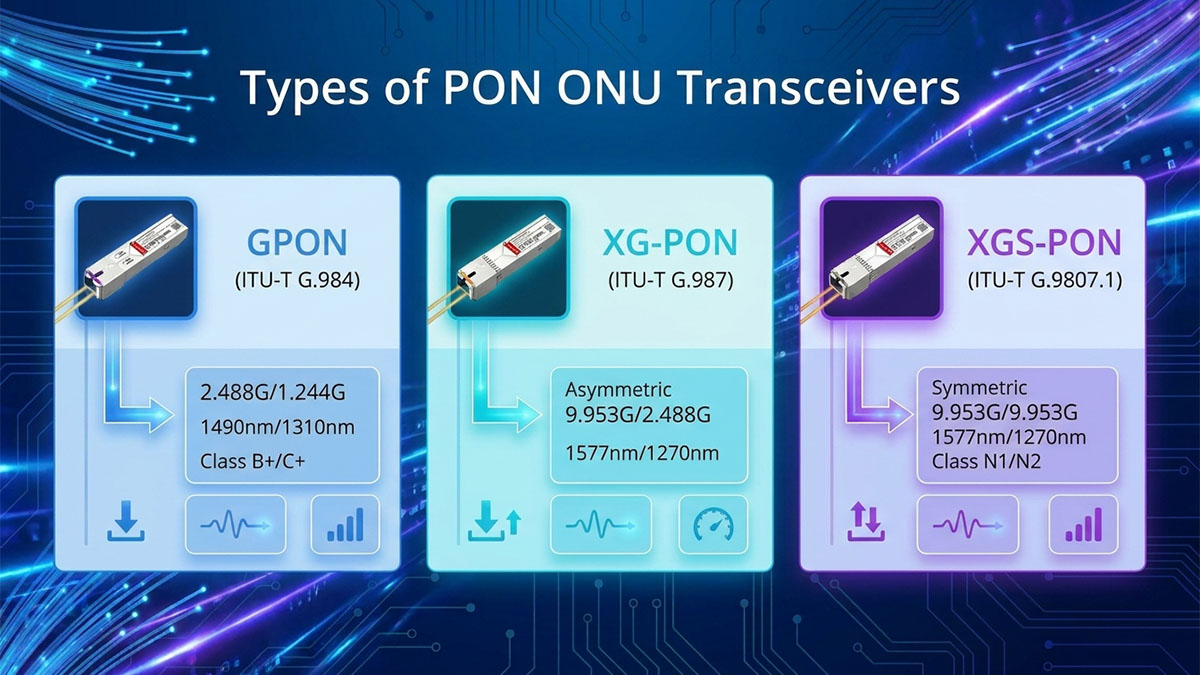
A PON ONU (Optical Network Unit) plays a critical role in connecting subscribers to the optical access network. It communicates with the Optical Line Terminal (OLT), receives downstream optical signals, and transmits upstream data over the same fiber. Depending on network requirements, ONU solutions can use traditional standalone devices or compact pluggable SFP/SFP+ optical modules. GPON, XG-PON, and XGS-PON also differ in transmission rates, wavelengths, and optical specifications.
This guide explores the essential technical and practical aspects of PON ONU deployment, including:
-
PON ONU architecture, working principles, and core functions.
-
Differences between GPON, XG-PON, and XGS-PON technologies.
-
Standalone ONU devices, ONU SFP modules, and ONU sticks.
-
Optical wavelengths, power budgets, transmission distances, and compatibility requirements.
-
LINK-PP GPON and XGS-PON optical module solutions and their applications.
Whether you are planning a new FTTH deployment, upgrading an existing PON network, or selecting a compatible ONU optical module, this guide will help you evaluate the right solution.
What Is a PON ONU and What Does It Do?
A PON ONU (Passive Optical Network Optical Network Unit) is a subscriber-side device that connects end-user equipment to a passive optical access network. It converts optical signals into electrical signals for connected devices and converts upstream electrical data into optical signals for transmission to the OLT.
In a typical fiber access network, the ONU is installed at or near the subscriber premises. It serves as the interface between the optical distribution network and customer equipment, enabling broadband internet, voice, video, and other network services.
Understanding PON and ONU Terminology
PON stands for Passive Optical Network, while ONU stands for Optical Network Unit. These terms describe two different but closely related elements of a fiber access system: the network architecture and the subscriber-side device.
The main components and related terminology include:
-
PON (Passive Optical Network): A point-to-multipoint fiber architecture that uses passive optical splitters to distribute signals from one OLT port to multiple subscriber endpoints.
-
ONU (Optical Network Unit): The subscriber-side optical device that terminates the PON connection and provides network interfaces for connected equipment.
-
ONT (Optical Network Terminal): A subscriber-side terminal that performs a similar function to an ONU. The terms are frequently used interchangeably in FTTH deployments, although some manufacturers and standards distinguish them according to device location and implementation.
-
OLT (Optical Line Terminal): The central-office-side equipment that manages communication with multiple ONUs.
-
ODN (Optical Distribution Network): The passive fiber infrastructure connecting the OLT and ONUs, including optical fibers, splitters, connectors, and other passive components.
In practical FTTH deployments, the OLT is usually located at the service provider's central office, while ONUs or ONTs are installed at subscriber locations.
Core Functions of a PON ONU
A PON ONU performs several essential functions to maintain communication between the service provider's optical network and end-user equipment.
Its primary functions include:
-
Optical-to-electrical conversion: Converts incoming downstream optical signals into electrical signals that connected network devices can process.
-
Electrical-to-optical conversion: Converts upstream electrical data into optical signals for transmission to the OLT.
-
Upstream and downstream communication: Supports bidirectional data transmission using the wavelength allocation and transmission protocols of the corresponding PON standard.
-
Bandwidth management: Follows OLT scheduling and dynamic bandwidth allocation mechanisms to coordinate upstream transmission.
-
Service delivery: Provides Ethernet connectivity and, depending on the device, additional interfaces for voice, Wi-Fi, IPTV, and other services.
-
Network management: Supports registration, configuration, monitoring, and operational management through mechanisms such as OMCI (ONU Management and Control Interface), where applicable.
These functions allow multiple subscribers to share the same optical distribution infrastructure without requiring an active Ethernet switch at every optical splitting point.
Why PON ONUs Are Important in Modern Fiber Networks
PON ONUs make it possible to extend high-speed fiber connectivity to individual subscribers while maintaining an efficient network architecture.
Their importance comes from several advantages:
-
Efficient fiber utilization: Multiple ONUs share the optical capacity of a single OLT port through passive splitters.
-
Lower field infrastructure complexity: The ODN does not require powered switching equipment at each distribution point.
-
Scalable broadband access: Service providers can expand subscriber coverage by adding ONUs within the supported split ratio and optical budget.
-
Flexible deployment: ONUs support residential FTTH, multi-dwelling buildings, business broadband, and other fiber access scenarios.
-
Technology migration: Different PON generations can coexist on a shared optical distribution network when the appropriate wavelength allocation and coexistence components are implemented.
The choice of ONU therefore affects not only the subscriber connection but also the capacity, interoperability, and long-term flexibility of the entire PON deployment.
How Does a PON ONU Work in a PON Network?
A PON ONU communicates with an OLT through an optical distribution network using bidirectional optical transmission. Downstream data travels from the OLT to multiple ONUs, while upstream data is transmitted from individual ONUs to the OLT using coordinated time slots.
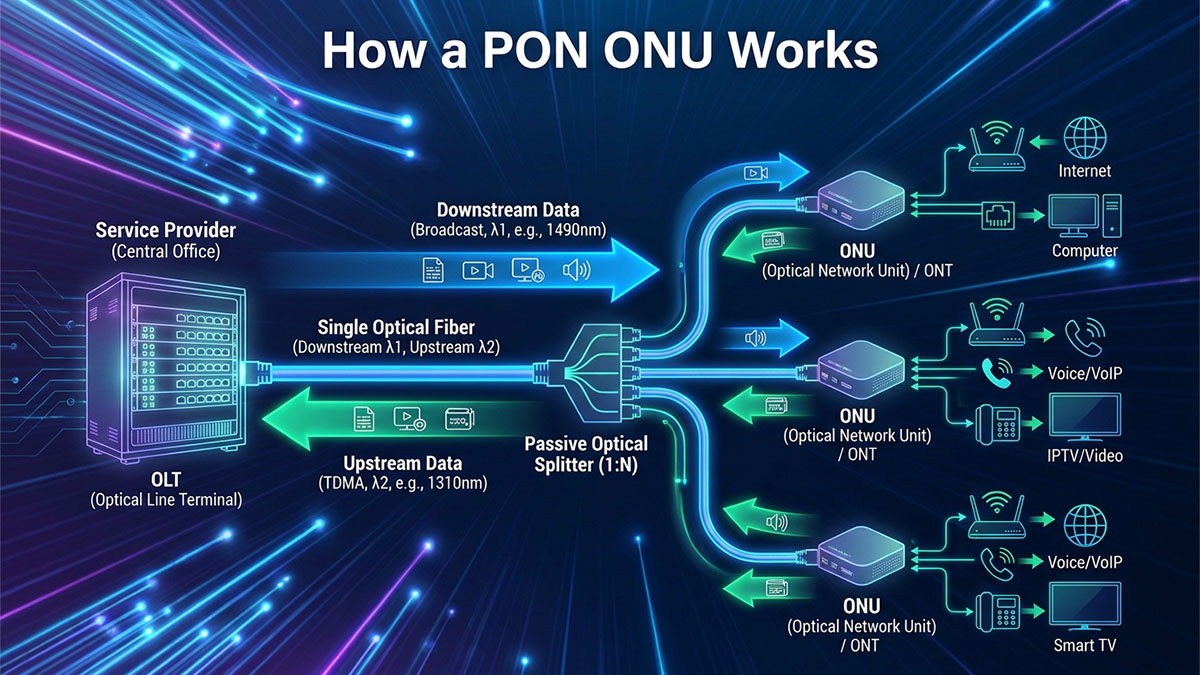
Understanding this communication process helps explain why ONU compatibility, optical wavelengths, and transmission power must match the network design.
PON Network Architecture: OLT, ODN, and ONU
A standard PON architecture consists of three major elements: the OLT, the ODN, and multiple ONUs. Together, they form a point-to-multipoint optical access network.
The three components perform different roles:
-
OLT: Connects the PON access network to the service provider's backbone and manages subscriber communication.
-
ODN: Distributes optical signals through passive components, including fiber cables and optical splitters.
-
ONU: Terminates the optical connection at the subscriber side and provides interfaces for customer equipment.
For example, one OLT PON port can connect to a 1:32 or 1:64 optical splitter, allowing multiple ONUs to share the same feeder fiber. The actual supported split ratio depends on the OLT, optical class, and available link budget.
Downstream and Upstream Signal Transmission
PON systems use different mechanisms to coordinate downstream and upstream traffic over a shared optical medium.
Downstream transmission generally works as follows:
-
The OLT sends optical data toward the passive splitter.
-
The splitter distributes the optical signal to connected ONUs.
-
Each ONU identifies and processes the data intended for its subscriber.
-
Unrelated subscriber traffic is not delivered as usable user data to the corresponding endpoint.
Because downstream signals are distributed across the shared network, PON systems use logical identifiers and protocol mechanisms to ensure that each ONU processes the appropriate information.
Upstream transmission requires more coordination because multiple ONUs share the same optical path.
-
The OLT schedules upstream transmission opportunities.
-
ONUs transmit data during their assigned time slots.
-
TDMA (Time Division Multiple Access) prevents simultaneous upstream transmissions from interfering with one another.
-
DBA (Dynamic Bandwidth Allocation) adjusts bandwidth assignments according to traffic demand and service requirements.
This coordination is particularly important in GPON and XGS-PON networks, where multiple subscribers share the upstream capacity of a single PON port.
The Role of PON Optical Modules in Signal Transmission
PON optical modules provide the optical interfaces required for communication between OLT and ONU equipment. Their transmitter and receiver characteristics must match the corresponding PON standard.
Unlike conventional duplex Ethernet optical modules that typically use separate fibers for Tx and Rx, many PON modules use a single-fiber, bidirectional configuration.
The main considerations include:
-
Wavelength separation: Upstream and downstream signals use different wavelength bands to support bidirectional communication over one fiber.
-
Transmitter output power: Determines the optical signal power launched into the fiber.
-
Receiver sensitivity: Defines the minimum optical power required for reliable signal reception.
-
Receiver overload: Specifies the maximum optical input power that the receiver can tolerate without performance degradation.
-
Optical link budget: Determines whether the received signal remains within the acceptable power range after fiber, splitter, and connector losses.
For example, a GPON ONU typically transmits at approximately 1310nm and receives downstream signals at approximately 1490nm. An XGS-PON ONU uses a different wavelength pair, with upstream transmission around 1270nm and downstream reception around 1577nm.
These wavelength differences are fundamental to selecting compatible OLT and ONU optical modules.
What Is a GPON ONU?
A GPON ONU is a subscriber-side optical device designed for Gigabit-capable Passive Optical Network deployments. It follows the ITU-T G.984 series and supports nominal downstream and upstream line rates of 2.488Gbps and 1.244Gbps, respectively.
GPON remains widely deployed in FTTH networks because it provides an established broadband access solution with mature equipment ecosystems and extensive infrastructure support.
GPON Standard and Transmission Specifications
GPON is standardized under the ITU-T G.984 series, which defines its architecture, physical-layer requirements, transmission convergence, and related network functions.
The key GPON specifications are:
| Parameter | GPON Specification |
|---|---|
| Standard | ITU-T G.984 series |
| Downstream line rate | 2.48832Gbps |
| Upstream line rate | 1.24416Gbps |
| OLT Tx wavelength | 1490nm |
| ONU Tx wavelength | 1310nm |
| Fiber type | Single-mode fiber |
| Common optical classes | B+, C+ |
| Typical nominal reach | 20km, subject to ODN design |
The wavelength direction is important: 1490nm is generally used for downstream transmission from the OLT, while 1310nm is used for upstream transmission from the ONU.
Actual optical interface parameters, including transmit power and receiver sensitivity, depend on the selected optical class and transceiver specification.
GPON Optical Classes: B+ and C+
GPON optical classes define the optical path loss range that the system is designed to support. B+ and C+ are commonly encountered in commercial GPON deployments.
Their main differences relate to optical power budgets and the supported ODN attenuation range.
-
Class B+: Commonly used in residential FTTH networks with moderate splitter ratios and standard optical distribution requirements.
-
Class C+: Provides a higher optical path loss budget, making it suitable for deployments requiring additional optical margin or more demanding distribution configurations.
The optical class should be selected according to the actual ODN loss rather than the nominal transmission distance alone. Fiber attenuation, splitter insertion loss, connector loss, and engineering margin all influence the final selection.
Common Applications of GPON ONU
GPON ONUs are suitable for many established fiber access deployments where gigabit-class shared broadband capacity meets service requirements.
Typical applications include:
-
Residential FTTH: Providing broadband connectivity to individual homes and apartments.
-
Multi-dwelling units (MDUs): Connecting multiple subscribers through a shared building fiber infrastructure.
-
Small business broadband: Supporting internet access, IP telephony, and cloud-based services.
-
Hospitality networks: Delivering fiber-based connectivity to hotels and other multi-user environments.
-
Enterprise access: Providing shared fiber access where symmetrical 10G capacity is not required.
GPON remains a practical choice for networks with an established GPON infrastructure and service requirements that do not justify an immediate migration to 10G PON technology.
What Are XG-PON and XGS-PON ONUs?
XG-PON and XGS-PON are 10G-class passive optical access technologies designed to provide higher bandwidth than traditional GPON. XG-PON uses asymmetric transmission, while XGS-PON supports symmetrical 10Gbps upstream and downstream line rates.
Both technologies use different wavelength bands from GPON, allowing appropriately designed systems to coexist on the same optical distribution network.
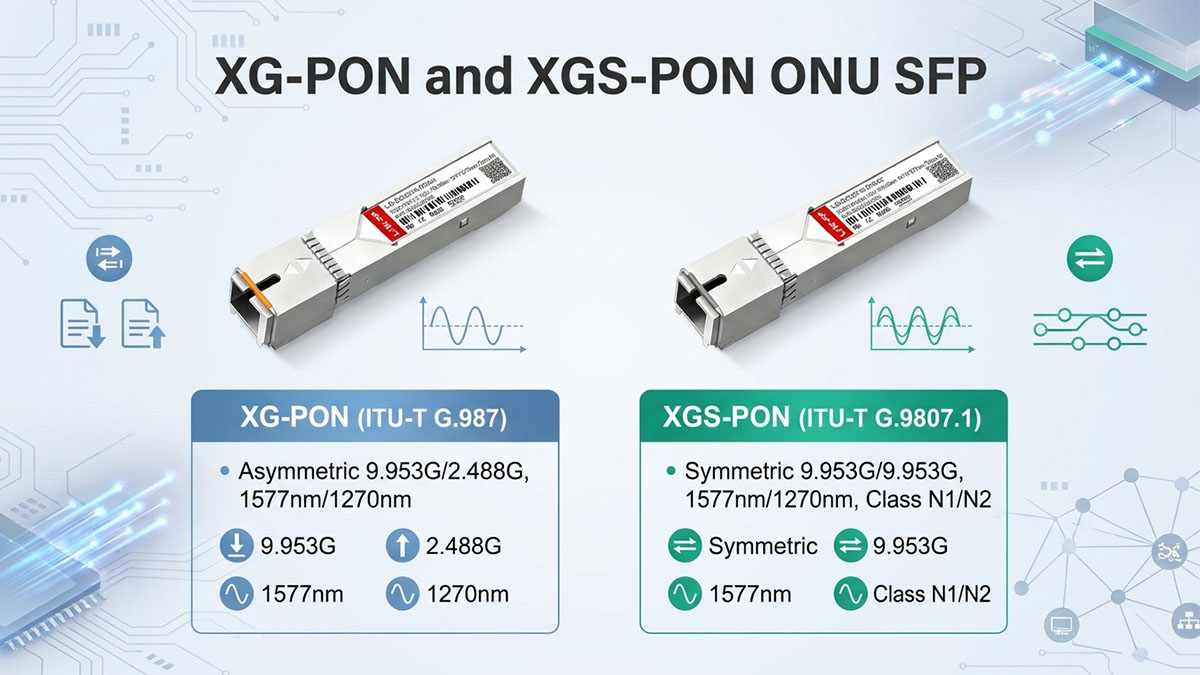
XG-PON ONU: Asymmetric 10G PON
XG-PON, standardized under the ITU-T G.987 series, is designed for networks that require higher downstream capacity without requiring equal upstream bandwidth.
Its nominal transmission rates are:
-
Downstream: 9.95328Gbps.
-
Upstream: 2.48832Gbps.
The main optical specifications include:
| Parameter | XG-PON Specification |
|---|---|
| Standard | ITU-T G.987 series |
| Downstream line rate | 9.95328Gbps |
| Upstream line rate | 2.48832Gbps |
| OLT Tx wavelength | 1577nm |
| ONU Tx wavelength | 1270nm |
| Common optical classes | N1, N2, E1, E2 |
| Typical nominal reach | 20km, depending on ODN class |
XG-PON is suitable for access networks where downstream traffic demand is significantly higher than upstream demand.
Typical applications include:
-
Residential broadband upgrades.
-
High-definition video streaming.
-
Cloud-based applications.
-
High-capacity residential access networks.
-
Fiber access environments requiring a migration path beyond GPON.
An XG-PON ONU should not be confused with an XGS-PON ONU. Although they share similar wavelength bands, their upstream line rates differ.
XGS-PON ONU: Symmetric 10G PON
XGS-PON stands for 10-Gigabit-capable Symmetric Passive Optical Network. Defined by ITU-T G.9807.1, it provides nominal 9.95328Gbps line rates in both transmission directions.
Its symmetrical bandwidth makes it particularly useful for applications with substantial upstream traffic requirements.
Key specifications include:
| Parameter | XGS-PON Specification |
|---|---|
| Standard | ITU-T G.9807.1 |
| Downstream line rate | 9.95328Gbps |
| Upstream line rate | 9.95328Gbps |
| OLT Tx wavelength | 1577nm |
| ONU Tx wavelength | 1270nm |
| Common optical classes | N1, N2, E1, E2 |
| Typical nominal reach | 20km, depending on ODN class |
Common XGS-PON optical classes include N1 and N2, with E1 and E2 providing higher optical path loss budgets in applicable implementations.
XGS-PON ONUs are commonly used in:
-
Symmetrical 10G FTTH broadband services.
-
Business broadband with substantial upload requirements.
-
Enterprise fiber connectivity.
-
Mobile network backhaul and related access applications.
-
High-capacity cloud and data-intensive network environments.
For service providers, XGS-PON provides a way to increase subscriber bandwidth while continuing to use a passive point-to-multipoint optical distribution architecture.
GPON vs. XG-PON vs. XGS-PON: Key Differences
GPON, XG-PON, and XGS-PON differ primarily in transmission speed, wavelength allocation, and upstream bandwidth. Selecting the appropriate technology requires matching both ends of the optical link and confirming the OLT's supported PON standard.
The following table summarizes their key differences.
| Parameter | GPON | XG-PON | XGS-PON |
|---|---|---|---|
| Standard | G.984 | G.987 | G.9807.1 |
| Downstream | 2.48832Gbps | 9.95328Gbps | 9.95328Gbps |
| Upstream | 1.24416Gbps | 2.48832Gbps | 9.95328Gbps |
| OLT Tx wavelength | 1490nm | 1577nm | 1577nm |
| ONU Tx wavelength | 1310nm | 1270nm | 1270nm |
| Common optical classes | B+, C+ | N1, N2, E1, E2 | N1, N2, E1, E2 |
| Typical ONU form factor | Standalone, SFP | Standalone, SFP+ | Standalone, SFP+ |
| Bandwidth characteristics | Asymmetric | Asymmetric | Symmetric |
Note: Optical class availability and form-factor support depend on the specific equipment and product implementation.
Several technical differences deserve particular attention:
-
Upstream capacity: GPON supports 1.24416Gbps upstream, XG-PON supports 2.48832Gbps, and XGS-PON supports 9.95328Gbps.
-
Wavelength configuration: GPON uses a different wavelength pair from XG-PON and XGS-PON.
-
Interoperability: An ONU designed for one PON standard cannot automatically operate with an OLT using another standard.
-
Network coexistence: GPON and 10G PON technologies can share an ODN through appropriate wavelength coexistence components and compatible optical interfaces.
-
Migration planning: Service providers must evaluate OLT capabilities, wavelength coexistence, ONU registration, and the optical budget before upgrading an existing network.
One important distinction is that XG-PON and XGS-PON use similar basic wavelength bands, but they are not interchangeable simply because their optical wavelengths are similar. Their transmission protocols and upstream capabilities must also match.
PON ONU Form Factors: Integrated ONUs vs. ONU SFP Modules
PON ONU functionality is available in several hardware form factors, including standalone ONT/ONU devices, pluggable ONU SFP modules, and compact ONU sticks. The right format depends on the network architecture, host-device capabilities, installation environment, and management requirements.
Understanding these differences is important when integrating PON connectivity into residential gateways, routers, switches, and other network equipment.
Standalone ONU and ONT Devices
A standalone ONU or ONT is a dedicated subscriber-side device that connects directly to the optical distribution network and provides electrical interfaces for customer equipment.
Most residential FTTH installations use this type of ONU because it offers a straightforward installation and service-delivery model.
Common characteristics include:
-
Optical interface: Typically uses an SC/APC or SC/UPC connector, depending on the network and device specification.
-
Ethernet ports: Provides one or more RJ45 ports for routers, computers, switches, or other Ethernet devices.
-
Wi-Fi integration: Some ONT models include wireless access points for residential connectivity.
-
Voice interfaces: Certain devices provide FXS ports for telephone services.
-
Power supply: Usually operates through an external power adapter or an integrated power solution.
-
Network management: Supports configuration and monitoring through the service provider's management system.
Standalone ONUs are particularly suitable for residential FTTH, apartment buildings, and small-business installations where dedicated subscriber equipment is preferred.
ONU SFP and SFP+ Optical Modules
An ONU SFP or SFP+ module integrates PON optical functionality into a compact pluggable transceiver form factor. Instead of relying entirely on a separate external ONU device, a compatible host platform can provide the electrical interface and associated network functions.
The two common form factors serve different PON technologies and bandwidth requirements.
-
GPON ONU SFP: Typically supports GPON transmission rates of 1.24416Gbps upstream and 2.48832Gbps downstream.
-
XG-PON ONU SFP+: Supports asymmetric 10G/2.5G transmission.
-
XGS-PON ONU SFP+: Supports symmetrical 9.95328Gbps upstream and downstream transmission.
Compared with traditional standalone ONU devices, pluggable PON modules offer several practical advantages:
-
Compact integration: Reduce the need for a separate external optical termination device.
-
Flexible deployment: Enable PON connectivity in compatible routers, gateways, and other network platforms.
-
Simplified cabling: Connect the optical fiber directly to the module's optical port.
-
Modular replacement: Allow the optical module to be replaced independently of the host device.
-
Space efficiency: Help reduce equipment footprint in installations with limited space.
However, an SFP or SFP+ interface alone does not guarantee PON functionality. The host device must support the module's electrical interface, firmware, management mechanism, and PON operation requirements.
GPON and XGS-PON ONU Stick Modules
An ONU stick is a compact pluggable PON module that integrates optical transmission and ONU-related functionality into an SFP or SFP+ form factor.
It allows compatible host equipment to connect directly to a PON access network without necessarily requiring a separate standalone ONT.
Typical ONU stick characteristics include:
-
Integrated PON optical transmitter and receiver.
-
Compact SFP or SFP+ mechanical form factor.
-
Single-fiber bidirectional optical communication.
-
Embedded control and management functions, depending on the design.
-
Support for specific PON technologies, such as GPON or XGS-PON.
ONU sticks are useful in specialized deployment scenarios, including:
-
Routers with supported SFP/SFP+ interfaces.
-
Small business fiber gateways.
-
Compact network access devices.
-
Custom fiber access installations.
-
Equipment requiring integrated PON connectivity.
Before deployment, it is essential to verify host compatibility. Different ONU sticks may use different firmware, management interfaces, authentication mechanisms, and hardware configurations.
A module that fits physically into an SFP+ cage may still fail to establish a PON connection if the host platform does not support its required functions.
How to Choose Between Standalone ONU and ONU SFP+
Standalone ONUs and pluggable ONU SFP+ modules serve similar optical access purposes but differ in installation, integration, and management.
The following comparison helps identify the more appropriate solution.
| Comparison | Standalone ONU/ONT | ONU SFP/SFP+ |
|---|---|---|
| Hardware format | Dedicated external device | Pluggable optical module |
| Installation | Separate device and power supply | Installed in a compatible host |
| Optical connection | External optical port | Module optical port |
| Ethernet interface | Usually integrated RJ45 | Provided through host equipment |
| Wi-Fi | Available on selected models | Depends on host equipment |
| Space requirements | Higher | Lower |
| Host compatibility | Generally less dependent on SFP support | Requires specific host compatibility |
| Typical applications | Residential FTTH | Integrated gateways and specialized network platforms |
For conventional residential FTTH deployments, a standalone ONU is often the simpler solution because it provides dedicated subscriber interfaces.
For compact network equipment or specialized fiber access applications, an ONU SFP or SFP+ module may provide greater integration flexibility. The decision should be based on the host platform's actual PON support rather than the module's mechanical form factor alone.
How to Choose the Right PON ONU Optical Module?
Choosing the right PON ONU optical module requires matching the PON standard, transmission rates, wavelength configuration, optical class, connector, and host-device requirements. A module with the correct SFP/SFP+ form factor may still be incompatible if its optical or protocol specifications do not match the network.
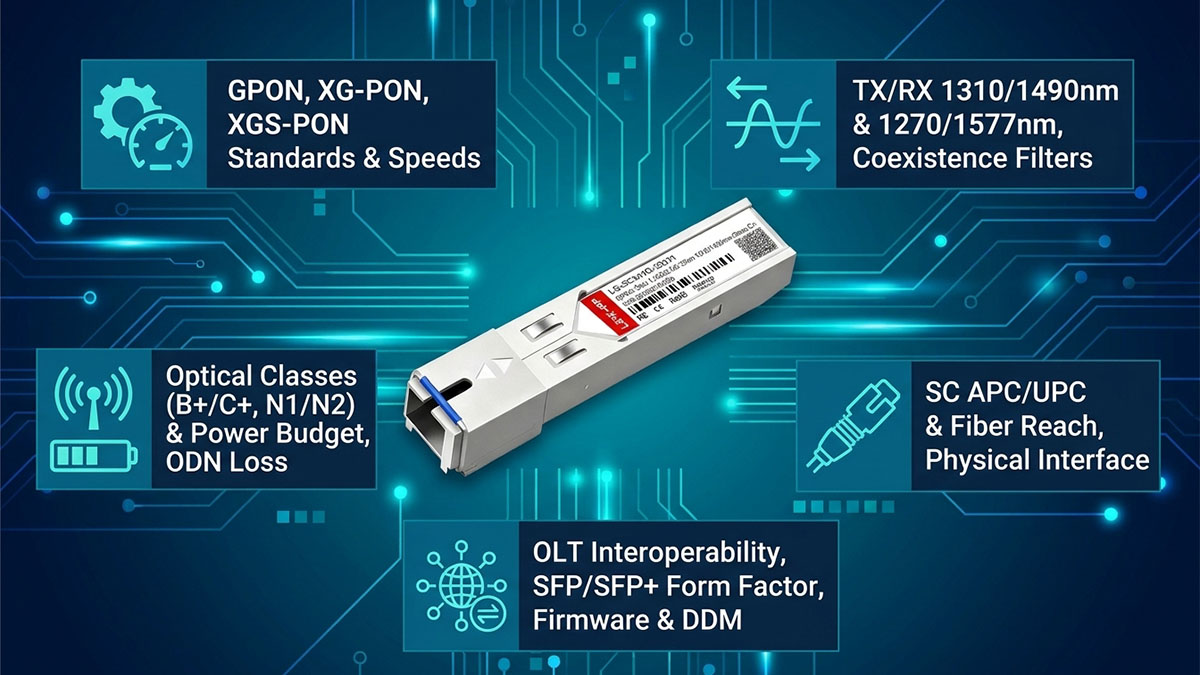
The following factors provide a practical selection framework for GPON, XG-PON, and XGS-PON deployments.
Match the PON Standard and Data Rate
The first step is identifying the PON technology supported by the OLT. The ONU module must use the corresponding standard and transmission characteristics.
Check the following parameters:
-
GPON: 2.48832Gbps downstream and 1.24416Gbps upstream.
-
XG-PON: 9.95328Gbps downstream and 2.48832Gbps upstream.
-
XGS-PON: 9.95328Gbps downstream and 9.95328Gbps upstream.
Do not select an ONU module based solely on the advertised 10G data rate. XG-PON and XGS-PON have different upstream transmission rates, even though their downstream rates are identical.
Also verify whether the OLT supports:
-
GPON-only operation.
-
XG-PON or XGS-PON operation.
-
GPON and XGS-PON coexistence.
-
Combo PON configurations.
-
The required ONU registration and authentication mechanisms.
A correct match at the protocol level is essential for successful network registration and data transmission.
Check Transmit and Receive Wavelengths
Wavelength compatibility is one of the most important considerations when selecting a PON optical module.
Because PON uses bidirectional transmission over a single fiber, the upstream and downstream wavelengths must be correctly paired between the OLT and ONU.
The following wavelength configurations are commonly used:
| PON Technology | ONU Tx Wavelength | ONU Rx Wavelength | OLT Tx Wavelength | OLT Rx Wavelength |
|---|---|---|---|---|
| GPON | 1310nm | 1490nm | 1490nm | 1310nm |
| XG-PON | 1270nm | 1577nm | 1577nm | 1270nm |
| XGS-PON | 1270nm | 1577nm | 1577nm | 1270nm |
Values represent nominal wavelength configurations; actual operating bands are defined by the applicable standard and transceiver specification.
When checking a product datasheet, pay attention to the following:
-
Tx refers to the wavelength transmitted by the module.
-
Rx refers to the wavelength received by the module.
-
ONU and OLT modules have opposite transmission and reception directions.
-
Similar wavelengths do not necessarily indicate identical PON protocol compatibility.
For example, an XGS-PON ONU SFP+ module typically transmits at 1270nm and receives at 1577nm. The corresponding OLT module transmits at 1577nm and receives at 1270nm.
This directional distinction helps prevent incorrect module selection.
Understand PON Optical Classes and Power Budgets
The optical class determines the supported optical path loss range of a PON system. It is particularly important when designing networks with multiple splitters, long fiber routes, or demanding optical distribution requirements.
Common optical classes include:
-
GPON B+: Commonly used for standard GPON access deployments.
-
GPON C+: Provides a higher optical path loss budget than B+.
-
XG(S)-PON N1: Supports a defined optical distribution loss range for 10G PON deployments.
-
XG(S)-PON N2: Provides a higher optical path loss budget than N1.
-
E1 and E2: Higher-budget optical classes defined for applicable 10G PON implementations.
A PON optical power budget is determined by the difference between the transmitter's available optical power and the receiver's minimum sensitivity, subject to the applicable standard limits.
The actual link budget must account for several sources of optical loss:
-
Fiber attenuation over the transmission distance.
-
Optical splitter insertion loss.
-
Connector insertion loss.
-
Fusion splice loss.
-
Additional engineering margin.
-
Other passive component losses within the ODN.
For example, a 1:32 splitter generally introduces more insertion loss than a 1:8 splitter. Consequently, a network with a higher split ratio may require a higher optical budget or a different distribution design.
It is also important to distinguish optical power budget from receiver overload. Even when the optical signal is strong enough to meet receiver sensitivity, excessive received power can cause performance problems.
Therefore, selecting an N2 module instead of N1 does not automatically solve every link issue. The complete OLT-to-ONU optical path must remain within the supported operating range.
Verify Transmission Distance and Connector Type
Transmission distance and connector compatibility are two additional factors that directly affect PON ONU deployment.
Many commercial GPON and XGS-PON SFP/SFP+ modules are specified for a nominal 20km reach. However, actual deployment reach depends on the optical budget, fiber characteristics, split ratio, and network design.
Before selecting an ONU module, verify:
-
Fiber type: Most conventional PON optical modules use single-mode fiber.
-
Transmission distance: Confirm that the module supports the required ODN reach.
-
Splitter ratio: Evaluate whether the selected optical class supports the distribution loss.
-
Connector type: Confirm SC/APC or SC/UPC requirements.
-
Optical cleanliness: Inspect and clean fiber connectors before installation.
SC/APC and SC/UPC connectors are not interchangeable simply because both use an SC connector interface.
Their differences include:
-
SC/APC: Uses an angled physical contact polish, commonly identified by a green connector housing. It helps reduce back reflections.
-
SC/UPC: Uses an ultra-physical contact polish, commonly identified by a blue connector housing.
The connector polish must match the optical interface requirements. Directly mating APC and UPC connectors can cause excessive insertion loss and potentially damage the end faces.
Confirm OLT Compatibility and Host Requirements
PON ONU compatibility involves more than optical specifications. The module must also work with the OLT and the host equipment in the intended deployment.
Important checks include:
-
OLT vendor and model: Verify that the ONU technology and interoperability requirements are supported.
-
ONU registration: Confirm the required serial number, LOID, password, or other authentication method.
-
Firmware compatibility: Check whether the ONU module requires particular firmware or software support.
-
Host interface: Verify the SFP/SFP+ electrical interface and host-device implementation.
-
Management functions: Confirm OMCI, web management, CLI, or other supported configuration mechanisms where applicable.
-
DDM/DOM monitoring: Check whether digital diagnostic monitoring is supported and whether the host can read the available parameters.
-
Operating temperature: Match the module's commercial or industrial temperature rating to the installation environment.
For pluggable ONU sticks, host compatibility deserves particular attention. Some modules depend on specific host firmware, customized management interfaces, or platform-level configuration.
Before deployment, review the module datasheet and confirm the complete configuration with the equipment manufacturer or supplier. This reduces the risk of optical link failures, registration problems, and unnecessary field troubleshooting.
LINK-PP PON ONU Solutions: Product Options and Selection Advantages
LINK-PP provides GPON, XG-PON, and XGS-PON optical module solutions for fiber access networks, including ONU-compatible SFP and SFP+ transceivers. These products support different transmission rates, optical classes, wavelength configurations, and host-device requirements.
For network engineers and system integrators, selecting the correct PON module means balancing optical performance, OLT interoperability, installation requirements, and long-term network flexibility.
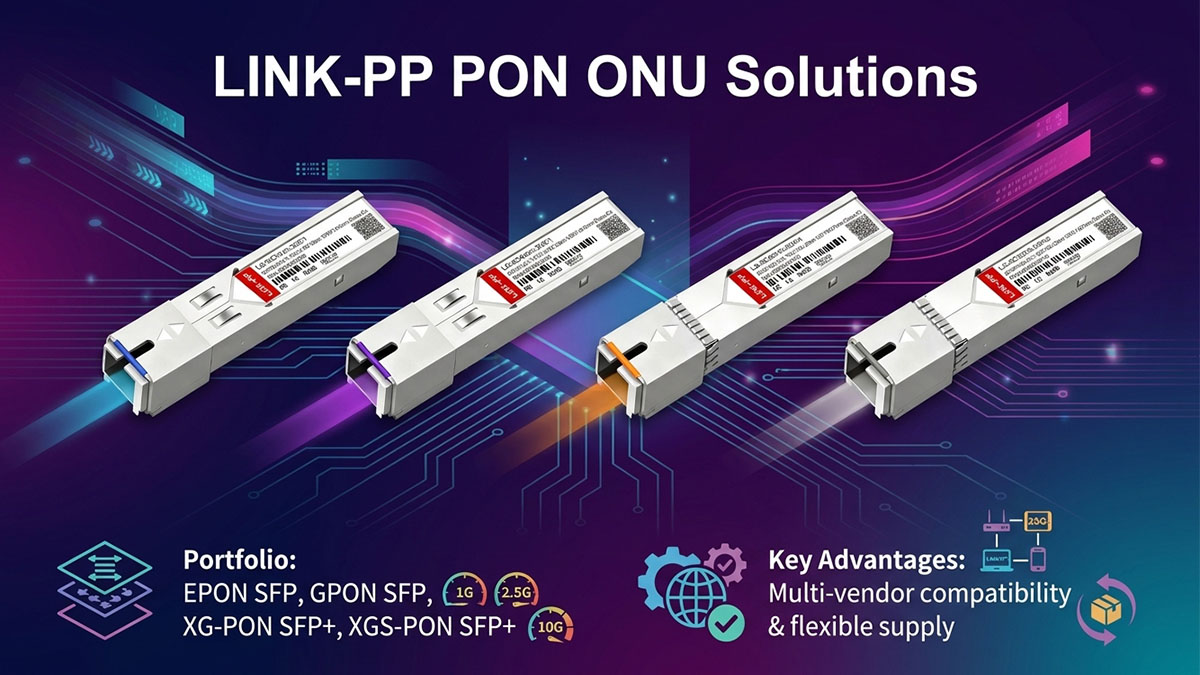
LINK-PP GPON and XGS-PON ONU Optical Modules
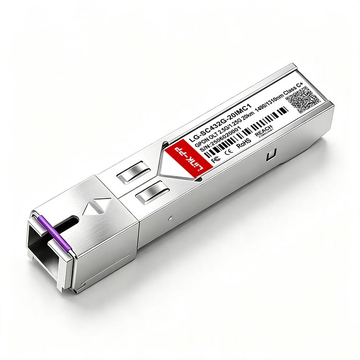
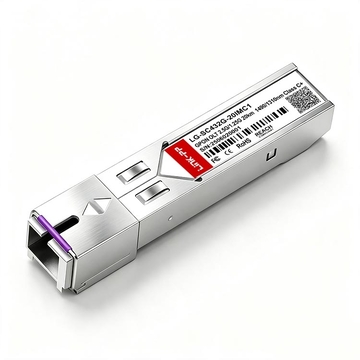
LINK-PP offers PON optical modules for different fiber access technologies, including GPON ONU SFP and XGS-PON ONU SFP+ solutions.
The product selection covers several important configurations:
-
GPON ONU SFP: Designed for GPON access networks, with B+ and C+ optical class options.
-
XG-PON ONU SFP+: Supports asymmetric 10G downstream and 2.5G upstream transmission.
-
XGS-PON ONU SFP+: Supports symmetrical 10G upstream and downstream transmission, with N1 and N2 optical class options.
-
ONU stick modules: Compact pluggable solutions for compatible host devices requiring integrated PON connectivity.
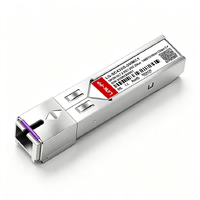
Some representative LINK-PP product models include:
LINK-PP LG-SC341G-20IB1
GPON ONU SFP, Class B+, 20km.
-
1310nm Tx / 1490nm Rx.
-
1.244G Tx / 2.488G Rx.
-
SC/APC connector.
-
Single-mode fiber.
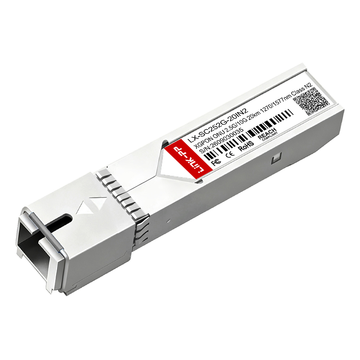
LINK-PP LX-SC252G-20CN2
XG-PON ONU SFP+, Class N2, 20km.
-
1270nm Tx / 1577nm Rx.
-
2.488G Tx / 9.953G Rx.
-
SC/UPC connector.
-
Single-mode fiber.
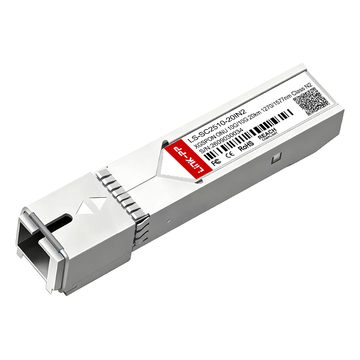
LINK-PP LS-SC2510-20CN2
XGS-PON ONU SFP+, Class N2, 20km.
-
1270nm Tx / 1577nm Rx.
-
9.953G Tx / 9.953G Rx.
-
SC/UPC connector.
-
Single-mode fiber.
These three products address different PON requirements. The GPON module is intended for established gigabit access networks, while the XG-PON and XGS-PON modules support 10G-class access with different upstream bandwidth characteristics.
For detailed product specifications and additional compatible models, explore the LINK-PP GPON SFP and PON optical module category:
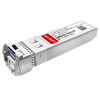
Example: LINK-PP XGS-PON ONU SFP+ Module
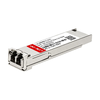
The LINK-PP LS-SC2510-20CN2 is an XGS-PON ONU SFP+ transceiver designed for symmetrical 10G PON access applications. It combines a compact SFP+ form factor with Class N2 optical specifications for single-mode fiber connectivity.
Its main specifications are summarized below.
| Parameter | Specification |
|---|---|
| Product model | LS-SC2510-20CN2 |
| PON technology | XGS-PON |
| Module type | ONU SFP+ |
| Optical class | N2 |
| Downstream rate (Rx) | 9.95328Gbps |
| Upstream rate (Tx) | 9.95328Gbps |
| Transmit wavelength | 1270nm |
| Receive wavelength | 1577nm |
| Transmission distance | 20km |
| Connector | SC/UPC |
| Fiber type | Single-mode |
| Fiber configuration | Simplex |
This module is particularly relevant to deployments requiring symmetrical 10G bandwidth. Its 1270nm transmitter and 1577nm receiver correspond to the standard XGS-PON ONU wavelength configuration.
Potential application scenarios include:
-
10G FTTH broadband access.
-
Business fiber access with symmetrical bandwidth requirements.
-
Compatible router and gateway platforms with PON SFP+ support.
-
Enterprise access networks using XGS-PON infrastructure.
One important consideration is that Class N2 and a 20km nominal reach do not independently guarantee compatibility with every XGS-PON OLT. The actual ODN attenuation, OLT interoperability, host firmware, and ONU registration requirements must also be checked.
Why Consider LINK-PP for PON Optical Connectivity?
Choosing a PON optical module supplier involves evaluating more than the transceiver's headline data rate. Product selection, specification accuracy, compatibility support, and supply flexibility all influence deployment efficiency.
LINK-PP focuses on several aspects of optical connectivity:
-
Multiple PON technology options: GPON, XG-PON, and XGS-PON modules support different access network requirements.
-
Detailed technical specifications: Product information covers transmission rates, Tx/Rx wavelengths, optical classes, connectors, and nominal transmission distances.
-
Compatibility-oriented product selection: Different equipment compatibility options help address varied network environments.
-
Flexible form factors: SFP and SFP+ options support different PON integration requirements.
-
Technical assistance: Our team can help review product specifications, host requirements, and optical compatibility before deployment.
-
Supply flexibility: Multiple product configurations support different project quantities and deployment needs.
These capabilities help network integrators and service providers evaluate PON optical connectivity according to actual network requirements rather than relying on form-factor or wavelength matching alone.
How to Identify the Right LINK-PP PON ONU Module
The most efficient way to identify a suitable LINK-PP ONU optical module is to start with the existing OLT and work through the optical and host-device requirements.
Use the following checklist:
-
Identify the PON technology: Determine whether the network uses GPON, XG-PON, or XGS-PON.
-
Confirm the OLT model: Record the equipment manufacturer, model number, and supported PON configuration.
-
Select the ONU form factor: Determine whether the host requires an SFP or SFP+ module.
-
Match the optical class: Check the required B+, C+, N1, or N2 specification.
-
Verify wavelengths: Confirm the ONU's transmit and receive wavelength configuration.
-
Check connector compatibility: Identify whether the optical interface requires SC/APC or SC/UPC.
-
Evaluate the optical budget: Review the splitter ratio, fiber distance, and total ODN attenuation.
-
Confirm interoperability: Check the module's firmware, authentication, and host compatibility requirements.
If the original optical module has a specific part number, use LINK-PP's Compatibility Tool to identify a corresponding compatible solution. For configurations requiring additional verification, our technical team can assist with specification checks and quotation requests.
Conclusion
A PON ONU is an essential component of modern fiber access networks, connecting subscriber equipment to the service provider's optical infrastructure. Whether deployed as a standalone ONT, GPON ONU SFP, or XGS-PON ONU SFP+ module, the right solution must match the network's transmission standard, optical characteristics, and equipment requirements.
The most important considerations when selecting a PON ONU include:
-
PON technology: GPON supports 2.488Gbps downstream and 1.244Gbps upstream; XG-PON supports asymmetric 10G/2.5G; XGS-PON supports symmetrical 10G/10G.
-
Optical specifications: Match Tx/Rx wavelengths, optical classes, receiver sensitivity, and power budgets.
-
Hardware format: Choose between standalone ONUs, SFP modules, and SFP+ ONU sticks according to deployment requirements.
-
Compatibility: Verify OLT interoperability, host firmware, connector type, and ONU registration requirements.
-
Network planning: Evaluate splitter loss, fiber distance, and the complete ODN optical budget before installation.
At LINK-PP, we provide GPON and XGS-PON ONU optical module solutions for different fiber access applications. Whether you need a GPON ONU SFP for an existing FTTH network or an XGS-PON SFP+ module for symmetrical 10G access, our product range offers multiple configurations to support your deployment requirements.
Explore the LINK-PP Official Store to find the right PON ONU optical module for your network. Use our Compatibility Tool to identify compatible alternatives to original optical modules by entering the original part number, then submit your requirements to receive a quotation from our team.
Choose the right optical connectivity solution, verify compatibility before deployment, and build a more flexible and reliable fiber access network with LINK-PP.