As modern enterprise workloads expand, migrating data center server fabrics from 25G to 100G has evolved from a long-term goal into an immediate operational requirement. However, replacing entire hardware ecosystems at once is rarely practical, forcing network engineers to seamlessly integrate existing server infrastructure with next-generation high-speed switch fabrics.
Addressing these exact physical-layer challenges, Swiss IT service provider Axiom Cloud faced severe bandwidth caps on existing 25G HPE server interfaces when connecting them to new 100G aggregation ports. By strategically deploying standards-compliant LINK-PP QSFP28-100G-SR4 optical modules, Axiom Cloud resolved server-facing interface mismatches, eliminated physical-layer signal degradation, and maximized front-panel port utilization — seamlessly unifying its server fabrics into a scalable, high-throughput network backbone.
Project Background & Client Infrastructure Demand
As enterprise cloud migration accelerates across Switzerland, regional service providers must continually align physical server capacity with high-density core networking fabric. Maintaining ultra-low latency and uninterrupted uptime across multi-tenant hosting environments requires an agile, scalable physical-layer infrastructure.
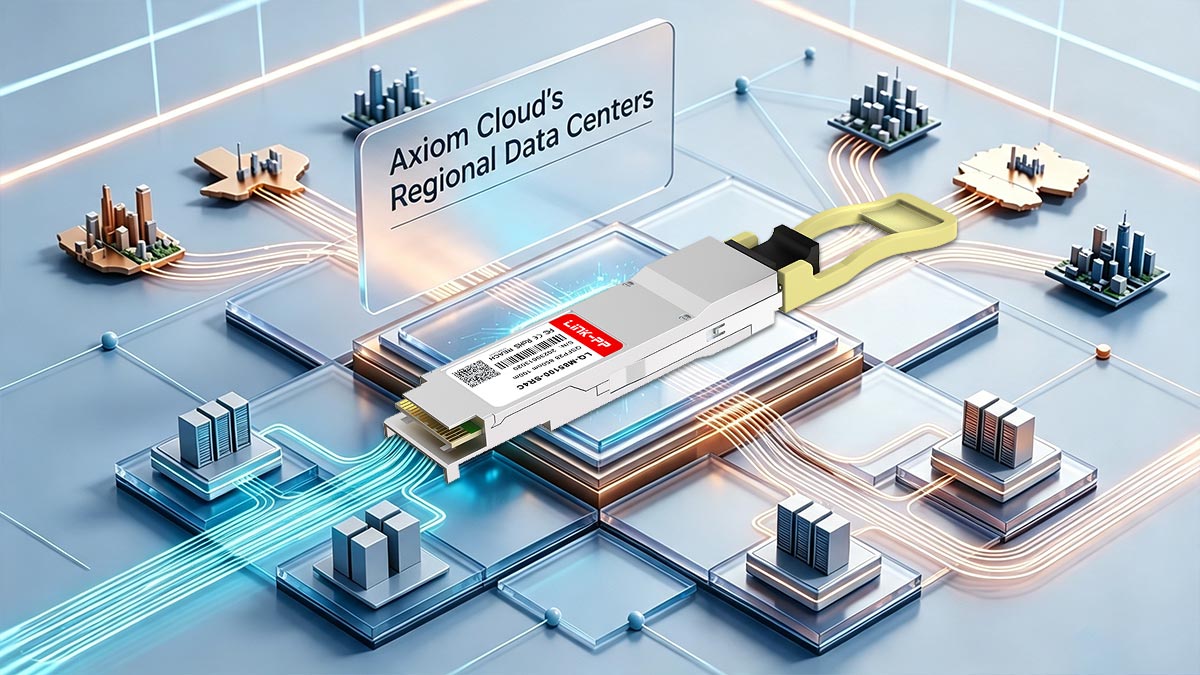
Axiom Cloud's Expanding Enterprise Managed Hosting Services
Axiom Cloud provides mission-critical managed hosting, private cloud clusters, and dedicated server environments to enterprise clients across Switzerland. Rapid adoption of data-heavy enterprise applications has driven a sharp increase in traffic density and simultaneous interconnect requests within its hosting facilities. Delivering these managed services relies on strict physical-layer stability to satisfy stringent service level agreements (SLAs) and prevent localized throughput degradation.
To support ongoing tenant expansion without compromising performance, Axiom Cloud must continually scale server density and rack interconnect capacity. High-performance hosting environments require an underlying network fabric capable of absorbing sudden workload spikes without causing I/O queuing bottlenecks. Consequently, expanding its enterprise portfolio necessitated a targeted upgrade to the provider's core rack-to-aggregation architecture.
Rising Bandwidth Requirements Across Regional Data Centers
Data movement across Axiom Cloud's regional data centers has surged due to dense virtual machine migration, real-time database replication, and automated off-site backup routines. Existing distribution-layer uplinks were routinely operating near peak capacity, leaving minimal headroom for unexpected traffic bursts. This persistent bandwidth pressure threatened to increase packet latency and limit the provider's capacity to onboard new enterprise tenants.
Upgrading east-west traffic paths within the data center became vital to eliminate internal link saturation and maintain predictable network response times. Traditional 25G links connecting server racks to aggregation switches could no longer process the concurrent data streams generated by high-density compute clusters. Resolving these bandwidth constraints required a structured migration toward a high-density 100G optical backbone.
Defining Core Objectives for the 100G Infrastructure Upgrade
The primary goal of the infrastructure upgrade was to transition the data center interconnect fabric to 100G line-rate throughput while fully protecting existing investments in HPE server hardware. Axiom Cloud needed a deployment strategy that would resolve aggregation bottlenecks without requiring a costly, disruptive replacement of operational server interface cards. Ensuring seamless multi-vendor interoperability between new 100G switch ports and legacy HPE rack servers was established as a primary benchmark.
In addition, the project prioritized strict cost efficiency and optical link stability across short-reach multimode fiber runs. The target architecture needed to leverage flexible 100G-to-4x25G breakout cabling, allowing a single 100G switch interface to serve multiple 25G server ports efficiently. By establishing these core parameters, Axiom Cloud ensured that the migration would deliver immediate throughput gains while establishing a foundation for future network scaling.
Bottlenecks in Moving Legacy 25G HPE Servers to 100G
Adding new 100G switches created immediate physical challenges for Axiom Cloud's current server racks. The engineering team identified three distinct physical-layer bottlenecks that prevented the legacy 25G HPE servers from achieving expected throughput on the new 100G fabric.

Bandwidth Limits Across Existing 25G Server Interfaces
Axiom Cloud's HPE ProLiant servers relied on 25G SFP28 network cards that worked well for daily tasks. However, when tenant traffic spiked, these single 25G links quickly ran out of room.
System testing revealed three main reasons why the existing 25G server ports reached their limits:
- Port saturation: The 25G links ran at full speed during peak hours and couldn't go faster.
- Buffer overflow: The network card's small memory got filled up, forcing data to wait.
- Traffic contention: Nightly backups and real-time traffic clashed over the same link, causing delays for live services.
Bridging Legacy 25G HPE Hardware with New 100G Switch Ports
The new core switches used large 100G QSFP28 ports, but the HPE servers only had smaller 25G SFP28 ports. Connecting these two different hardware types directly was physically impossible without a clear bridging strategy.
Replacing all server network cards was far too expensive and disruptive for active clients. Axiom Cloud needed a simple way to split one 100G switch port into four 25G channels to connect the servers smoothly.
Overcoming Uplink Congestion and Packet Loss at Aggregation Layers
Traffic from multiple 25G servers flooded the main switch connections during busy hours. The old network links could not clear data fast enough, creating traffic jams at the top of each rack.
Live network monitoring highlighted three major problems caused by this uplink congestion:
- Dropped packets: Overfilled switch buffers caused data loss during traffic spikes.
- Higher latency: Queued data slowed down application response times for users.
- Uneven loads: A few network cables carried too much traffic while others sat underused.
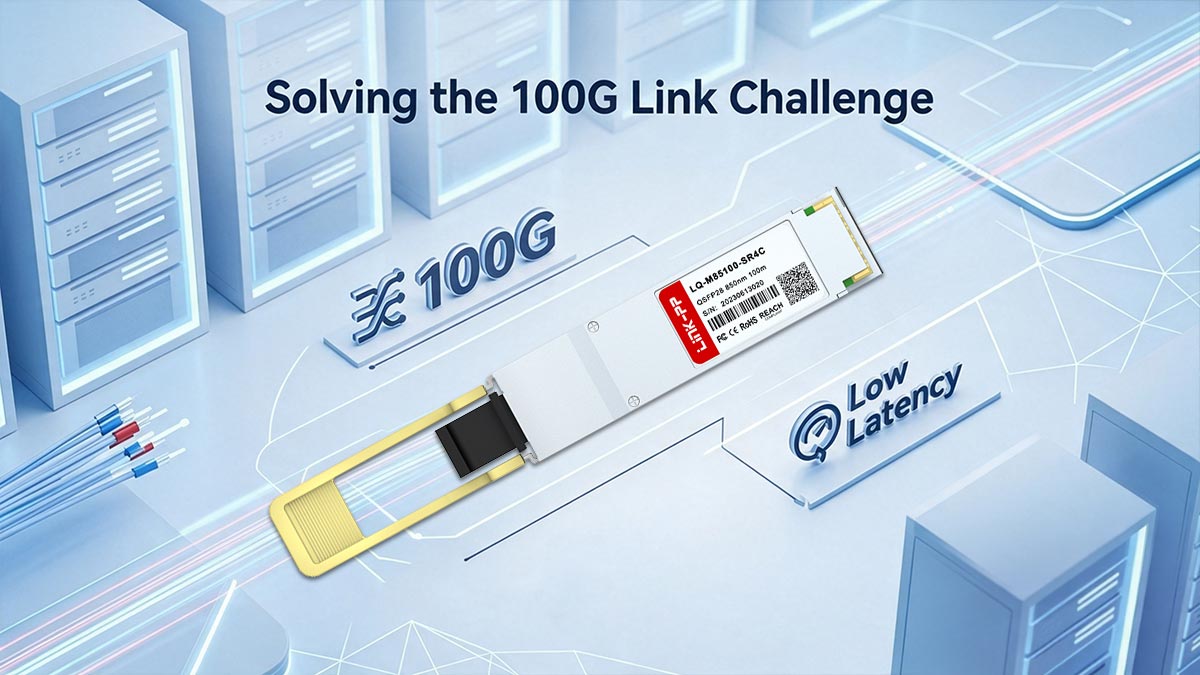
Solving the 100G Link Challenge with LINK-PP LQ-M85100-SR4C
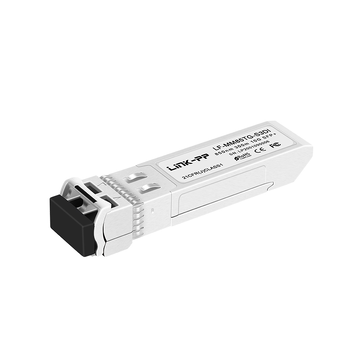
Axiom Cloud selected the LINK-PP LQ-M85100-SR4C 100G QSFP28 optical transceiver to resolve its server-facing interface mismatch and front-panel port exhaustion. This 100GBASE-SR4 transceiver solution provided the exact breakout density needed to bridge new high-speed switches with legacy 25G HPE servers without wasting switch capacity.
Optical Specifications of the 100GBASE-SR4 Standard
The LQ-M85100-SR4C QSFP28 100GBASE-SR4 module operates on four independent 25Gbps optical channels using 850nm VCSEL lasers over an MPO-12 multimode interface. By utilizing this parallel architecture, a single 100G QSFP28 switch port splits into four dedicated 25G links via an MPO-to-4xLC breakout cable. This native breakout design allowed Axiom Cloud to connect four individual 25G HPE servers to a single 100G switch port, maximizing switch port efficiency.
While individual servers remained on stable 25G connections, consolidating four server links into one 100G switch port significantly expanded overall rack port density. This higher density significantly freed up front-panel port capacity for future rack expansion without altering the existing upstream uplink configuration.
Seamless Hardware Interoperability with HPE Rack Servers
To prevent port-recognition errors on the server side, LINK-PP configured the LQ-M85100-SR4C firmware for full compatibility with HPE ProLiant servers and core switch systems. Integrated Digital Diagnostic Monitoring (DDM) enables real-time tracking of optical Rx/Tx power, operating temperature, laser bias current, and supply voltage directly from the network management console.
This hardware-level integration guarantees stable signal integrity across all four 25G breakout channels. By eliminating optical mismatch and bit-error spikes on the 25G server ports, Axiom Cloud reduced link-level bit-error retransmissions (FEC corrections), which minimized unnecessary latency spikes and stabilized response times for live client applications under sustained high-throughput loads.
Cost-Effective Short-Reach Connectivity over Multimode Fiber
Designed for intra-rack data center links, the 100GBASE-SR4 standard supports transmission distances up to 70m on OM3 and 100m on OM4 multimode fiber. Utilizing existing OM4 cabling inside the server racks allowed Axiom Cloud to avoid the high cost of replacing physical fiber runs with single-mode infrastructure.
This short-reach breakout approach provided a budget-friendly way to modernize the rack network while keeping operational 25G HPE servers online. While the SR4 breakout transceivers resolved physical-layer and port-density constraints, establishing this stable physical foundation prepares the network for higher-layer buffer tuning to handle residual micro-bursts.
Operational Execution of the 25G-to-100G Transition
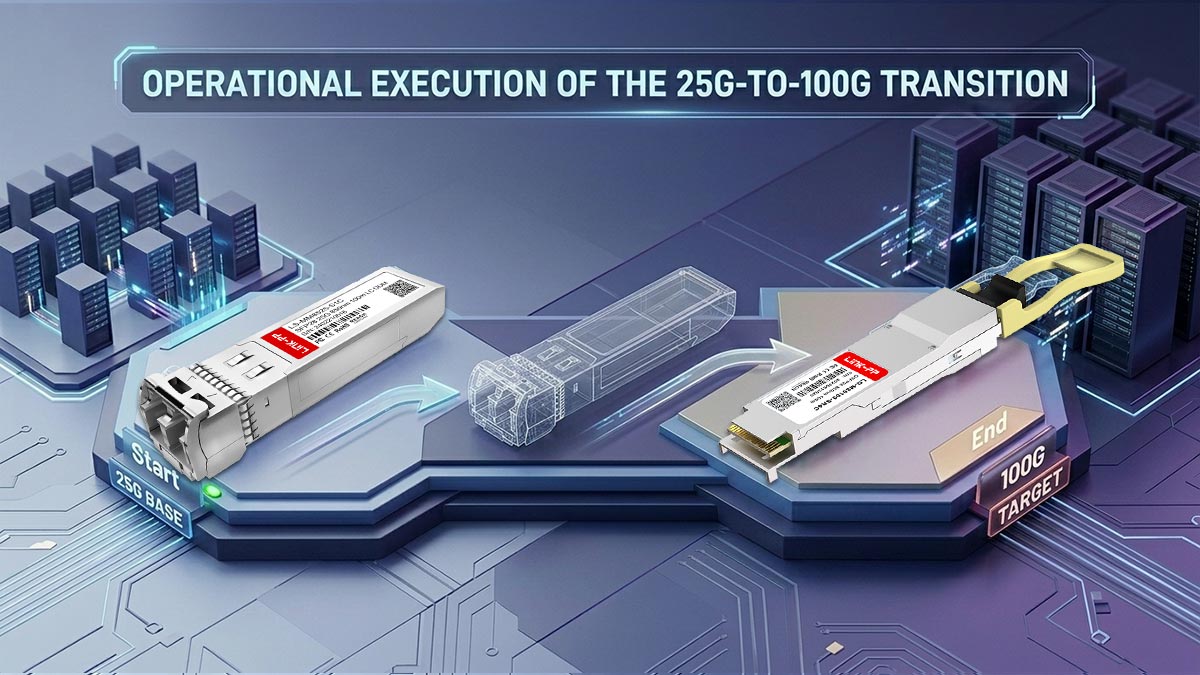
Axiom Cloud executed a structured, phased deployment plan to integrate the LINK-PP 100G-SR4 transceivers without causing unexpected service interruptions for active hosting tenants. The operational rollout focused on systematic physical rack cabling, real-time optical link verification, and thorough hardware compatibility audits across all legacy HPE server nodes.
Phased Module Installation and Rack Cabling
To minimize operational risk, deployment engineers scheduled the hardware installation during off-peak maintenance windows across target data center rows. The team installed the LINK-PP LQ-M85100-SR4C modules into the high-density ToR switches and connected MPO-to-4xLC breakout cables directly to four distinct 25G SFP28 ports on nearby HPE ProLiant servers.
Organizing the physical fiber trunks with proper bend-radius controls and color-coded breakout legs prevented cable clutter inside high-density server racks. This systematic cabling approach streamlined physical channel mapping, ensuring that each 25G server link mapped correctly to its designated QSFP28 lane on the aggregation switch.
Signal Quality Checks and Link Diagnostics
Following physical installation, the engineering team conducted rigorous physical-layer diagnostics to verify optical integrity before clearing links for production traffic. The validation process covered optical power levels, FEC error rates, and temperature stability to ensure long-term operational reliability.
The following matrix outlines the key diagnostic parameters monitored during field validation and their operational significance for the 25G-to-100G breakout links:
| Parameter Diagnostik |
Fokus Pengukuran |
Operational Impact on Breakout Links |
| Daya Optik Rx |
Received light intensity on 25G LC breakout legs |
Prevents signal attenuation and ensures receiver sensitivity alignment |
| Daya Optik Tx |
Transmitted laser power from 850nm VCSEL array |
Verifies stable light output across all four parallel 25G channels |
| Tingkat Kesalahan Bit (BER) Pra-FEC |
Raw physical-layer error counts prior to correction |
Confirms optical link quality remains within acceptable headroom limits |
| BER Pasca-FEC |
Residual uncorrected frame errors at the MAC layer |
Ensures zero packet corruption reaching switch and server interfaces |
| Module Temperature & Voltage |
Real-time thermal and electrical operating parameters |
Prevents thermal throttling and guards against power supply fluctuations |
HPE Server Compatibility and Interoperability Audits
The final execution phase involved rigorous hardware compatibility audits between the LINK-PP 100G-SR4 optical transceivers, ToR switch operating systems, and HPE ProLiant iLO management software. Transceiver firmware identification profiles were verified to confirm that HPE server NICs recognized the 25G breakout channels natively without triggering third-party hardware warnings or link flaps.
Continuous stress testing under simulated peak traffic loads confirmed stable link auto-negotiation and zero Forward Error Correction (FEC) frame drops. By completing these compatibility checks, Axiom Cloud verified that the physical-layer upgrade completely resolved prior link instability while preserving full operational visibility across its server infrastructure.
Project Outcomes and Network Scalability
Dengan menyebarkan LINK-PP LQ-M85100-SR4C 100G-SR4 optical transceiver modules, Axiom Cloud successfully modernized its server fabric, quadrupling rack interconnect density while fully protecting its operational 25G HPE server investments. The breakout architecture maximized switch port efficiency and eliminated physical-layer signal degradation, establishing a stable foundation for future network scaling and higher-layer buffer tuning. This cost-effective transition resolved front-panel port exhaustion and ensured predictable throughput across all regional data center racks.
This project proves that high-density, standards-compliant optical transceivers can bridge generational hardware mismatches without requiring costly server replacements. To discover reliable, high-interoperability optical transceivers for your data center migration, visit the LINK-PP Toko Resmi.