Modern shopping centers depend on continuous, high-speed data transmission to support essential services like point-of-sale transactions and high-definition surveillance. As commercial venues expand across multiple floors and sprawling footprints, traditional copper cabling struggles with distance limitations (exceeding 100m) and electromagnetic interference from heavy electrical equipment. Meeting these heavy bandwidth demands requires a dependable, enterprise-grade optical fiber infrastructure.
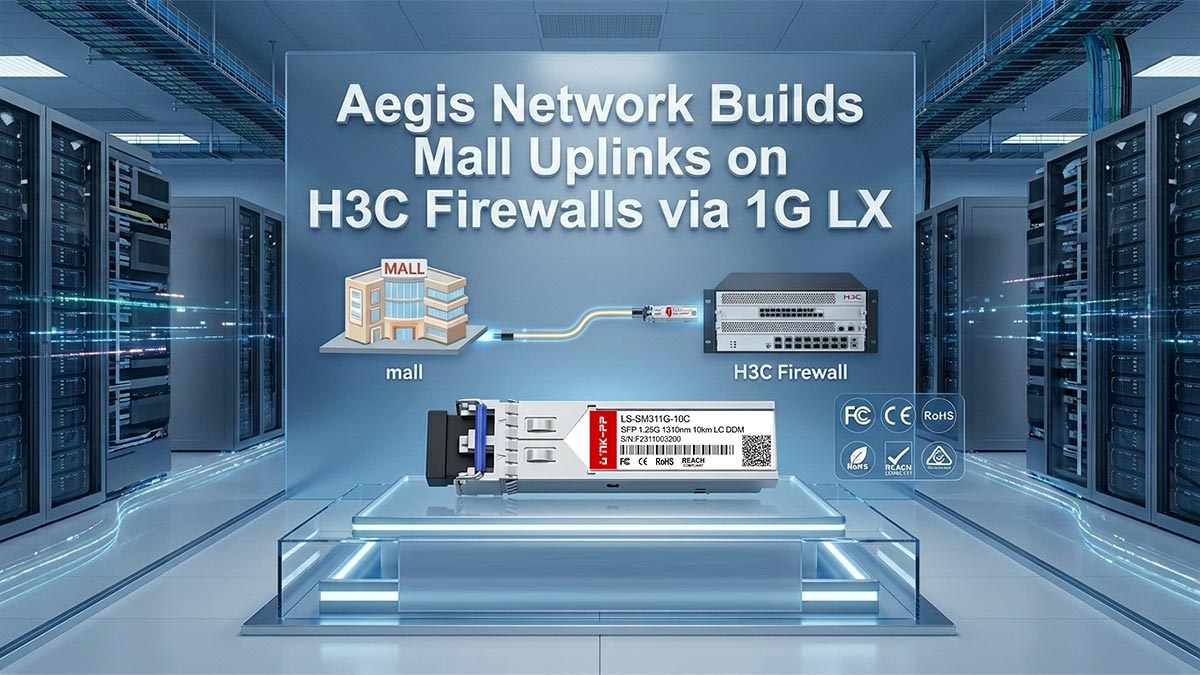
Aegis Network addressed these physical layer challenges by deploying single-mode 1G LX SFP optical modules across floor distribution switches. These fiber uplinks were aggregated via a high-performance core switching fabric, while high-availability H3C firewalls were integrated to enforce security zoning and isolated policy control across different floor zones. This deployment effectively eliminates physical-layer transmission bottlenecks, delivering deterministic, low-latency throughput and robust signal stability throughout the entire commercial complex.
Project Background & Shopping Center Network Demands
The rapid evolution of smart retail requires commercial complexes to maintain unified, high-availability digital infrastructures. Facilities must support massive concurrent connections while maintaining ultra-low transmission latency for daily operational services. Deploying enterprise-grade fiber optics ensures dependable physical layer interconnectivity between distribution switching layers and centralized core security infrastructure.
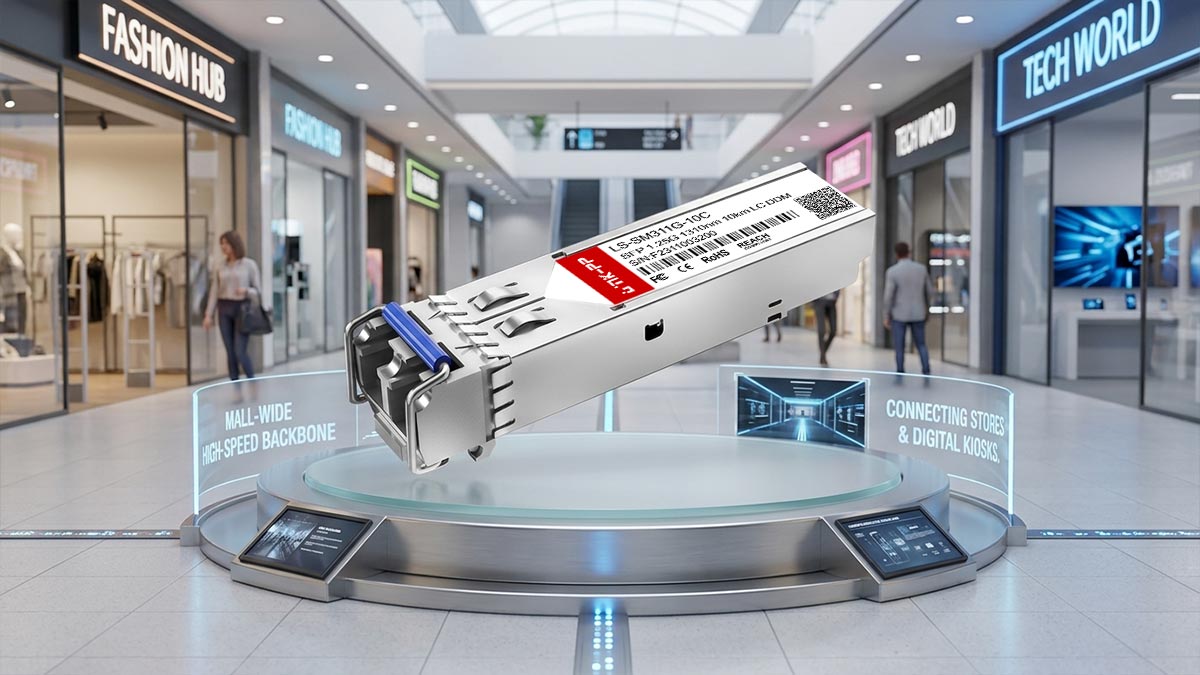
Scale and Connectivity Scope of Grand Horizon Mall
Grand Horizon Mall spans over 150,000 square meters across four above-ground retail levels and two underground parking decks. The facility hosts more than 300 tenant storefronts, extensive guest Wi-Fi coverage zones, and centralized building automation systems.
To ensure continuous venue operations, hundreds of edge access switches distribute connectivity across individual Intermediate Distribution Frames (IDFs). These floor distribution nodes aggregate back into the central Main Distribution Frame (MDF), routing high-throughput traffic into the core switching and security matrix.
Core Bottlenecks in Multi-Zone Data Aggregation
Aggregating diverse data feeds across separate commercial zones creates severe transmission bottlenecks over legacy infrastructure. High-definition surveillance video streams, digital signage broadcasts, and dynamic guest traffic consume immense bandwidth over extended conduit runs.
Legacy copper cabling fails to provide sufficient reach across multi-floor spans, resulting in periodic packet drops and network buffering. Consolidating these distributed network zones into a unified backbone requires a high-performance, single-mode optical distribution layer.
Physical Layer Demands for Core-Firewall Interconnection
Routing aggregated mall traffic through centralized H3C firewalls for north-south perimeter inspection places stringent reliability demands on core optical uplinks. The physical interconnection between core routing switches and the H3C firewall cluster must sustain line-rate performance without optical degradation or interface flaps.
To ensure uninterrupted security filtering and high-capacity traffic inspection, this critical core-to-firewall link must satisfy several stringent physical layer benchmarks:
- Sustained 1Gbps line-rate throughput across dedicated firewall security inspection ports.
- Microsecond-level transmission latency to eliminate payment processing delays on tenant POS transactions.
- Complete optical electrical isolation to protect mission-critical firewall interfaces from stray grounding currents.
- Stable transceiver interoperability ensuring error-free PHY auto-negotiation within high-density H3C SFP slots.
Optical Link Challenges in Large Commercial Malls
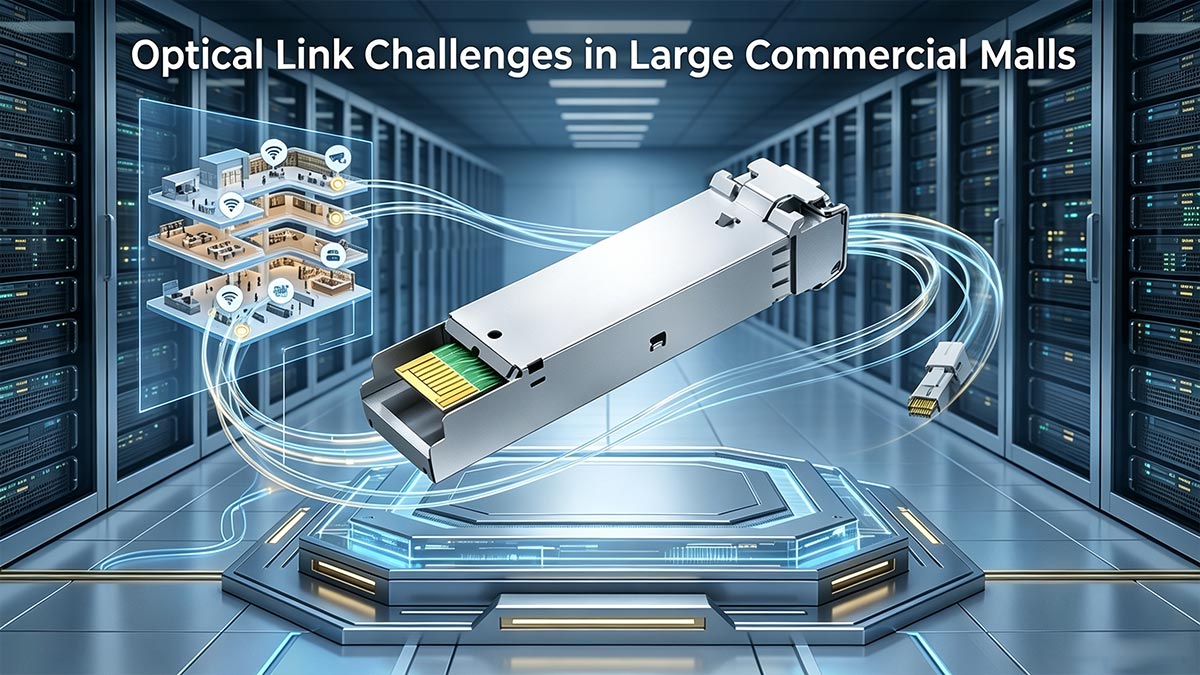
Deploying a robust optical network across a sprawling shopping center introduces severe physical layer hurdles. Long-distance conduit runs, heat-intensive equipment stacking in confined IDF rooms, and proprietary vendor-locking mechanisms in firewall operating systems test the limits of standard third-party physical infrastructure — with optical transceivers often bearing the brunt of these combined stresses. Resolving these deployment challenges requires resilient transceivers engineered for H3C compatibility and harsh operational conditions.
Distance Limits and EMI in Multi-Level Cable Runs
Interconnecting peripheral distribution closets across multi-level retail structures frequently exceeds the 100-meter physical boundary of standard copper twisted-pair cabling. Vertical conduit runs often pass through high-voltage utility shafts, chiller mechanical rooms, and subterranean parking structures where industrial power lines generate severe electromagnetic interference (EMI).
Evaluating physical transport media against the rigorous electrical and spatial challenges of commercial facilities highlights why single-mode optical fiber is essential:
| Physical Layer Metric |
Standard Copper Cable |
Serat Optik Multimode |
Single-Mode Optical Fiber |
| Max Transmission Reach |
Hingga 100m |
Up to 550m (dependent on fiber grade) |
Up to 10km (standard 1310nm, 9/125μm fiber) |
| Kekebalan EMI / RFI |
Vulnerable to cross-talk and surges |
Fully immune (dielectric core) |
Fully immune (dielectric core) |
| Pathway & Conduit Footprint |
Bulky cable bundles, fills conduits |
Lightweight, high routing flexibility |
Compact, minimal conduit congestion |
| Ground Loop Risk |
High risk across separate sub-panels |
Zero risk (complete electrical isolation) |
Zero risk (complete electrical isolation) |
| Long-Span Signal Attenuation |
Rapid insertion loss at higher frequencies |
Modal dispersion over extended lengths |
Minimal attenuation |
SFP Transceiver Interoperability on H3C Firewalls
Integrating third-party compatible optical transceivers into enterprise-grade H3C firewalls requires strict adherence to Multi-Source Agreement (MSA) EEPROM encoding standards. Security appliances with proprietary operating software enforce rigid vendor-checking mechanisms that can flag non-compliant optics, triggering port disablement or continuous alarms.
Beyond basic device recognition, transceivers must negotiate correct physical layer parameters and maintain stable I²C bus communication without generating link flaps. Consistent optical transceiver interoperability ensures that security appliances can process incoming line-rate traffic without intermittent hardware polling errors.
Thermal Stability in High-Density Weak Current Rooms
Intermediate distribution frames (IDFs) situated in service corridors and subterranean utility closets often suffer from restricted airflow and limited cooling capacity. High-density aggregation switches and rack-mounted equipment generate concentrated thermal dissipation that pushes ambient operating temperatures toward upper operational limits.
Standard optical modules experience transmitter wavelength drift and receiver degradation when subjected to elevated temperatures over prolonged operating cycles. Deploying power-efficient 1G LX SFP optical modules with wide commercial temperature tolerances protects the optical link budget from thermal derating and guarantees sustained uptime. Preventing thermal-induced interface resets is critical, as even a 10-second link outage during peak retail hours could disrupt hundreds of concurrent POS transactions.
Deployment Architecture Using LINK-PP 1G LX SFP Modules
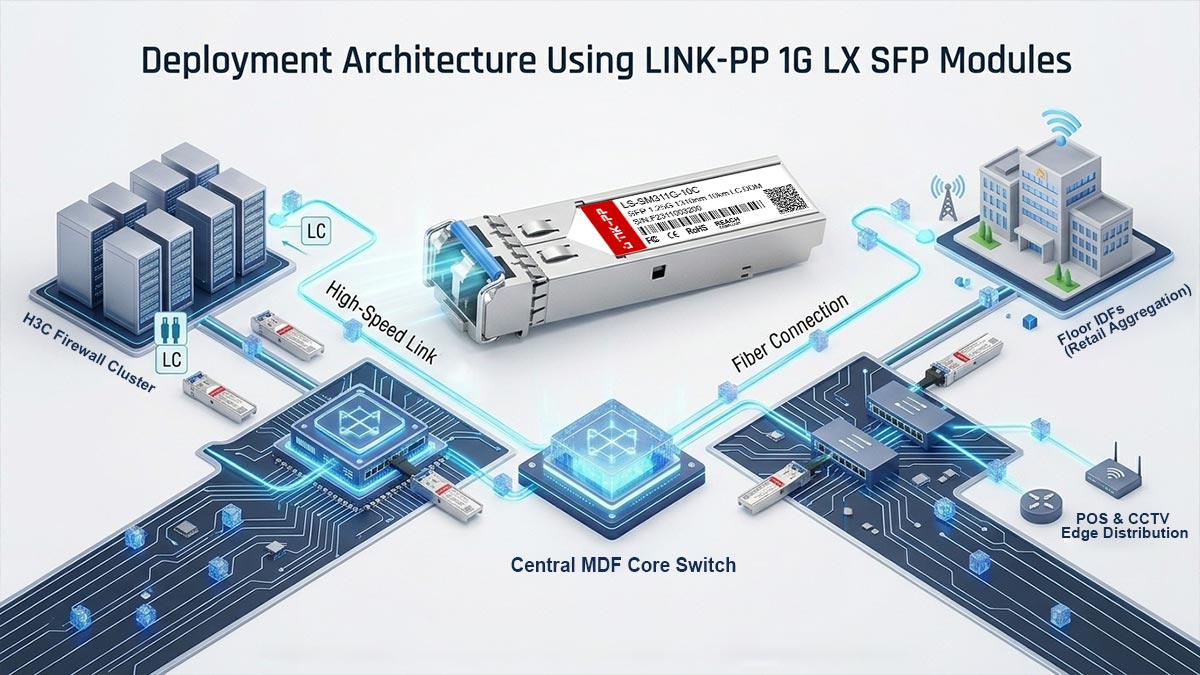
Aegis Network engineered an end-to-end optical distribution architecture to connect Grand Horizon Mall's distributed switching nodes with core network security. Integrating LINK-PP H3C-compatible 1G LX SFP transceivers established a resilient physical foundation capable of bridging sprawling commercial zones. This design delivers reliable full-duplex Gigabit connectivity across all primary data and security pathways.
Single-Mode 1310nm Backbone for Floor Aggregation
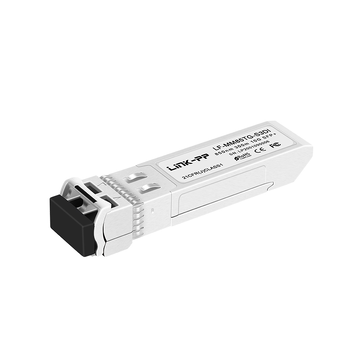
The mall's physical backbone utilizes single-mode fiber (OS2) infrastructure operating at the standardized 1310nm optical wavelength window. LINK-PP 1G LX SFP modules deploy Fabry-Pérot (FP) laser transmitters that provide an ample optical link budget, bridging the longest cable spans between floor-level IDFs and the central MDF.
Operating over unrepeatered single-mode fiber delivers complete immunity against attenuation and modal dispersion across dense vertical risers. This centralized optical topology consolidates disparate retail floor zones into a clean, unified transmission path without requiring intermediate optical signal amplification.
Core Switching Fabric with Firewall Boundary Interconnect
At the central MDF, floor aggregation traffic terminates directly into high-capacity core switches before passing to the security perimeter. LINK-PP SFP 1000BASE-LX optical transceivers bridge the core switching fabric to dedicated SFP interfaces on the H3C firewall cluster, utilizing precision-coded EEPROMs for immediate hardware recognition and stable PHY auto-negotiation.
This boundary interconnect allows the core switching layer to handle massive East-West traffic distribution while offloading North-South traffic to the H3C firewalls for deep packet inspection. Isolating the switching fabric from the security inspection boundary maintains line-rate processing speeds without introducing processing bottlenecks.
Dual-LC Duplex Patching for Redundant Uplinks
To safeguard against physical cable damage and transceiver faults, every critical aggregation node features redundant dual-LC duplex patch connections. High-purity ceramic ferrule connectors maintain precise optical alignment and minimize insertion loss across all intermediate distribution patch panels.
The primary and secondary optical paths route through physically separated risers, terminating onto diverse core switch line cards and paired H3C firewall interfaces. This dual-link topology supports sub-second failover protocols, guaranteeing continuous POS payment processing and uninterrupted CCTV video streaming during link maintenance events.
Network Performance Validation and Operational Gains
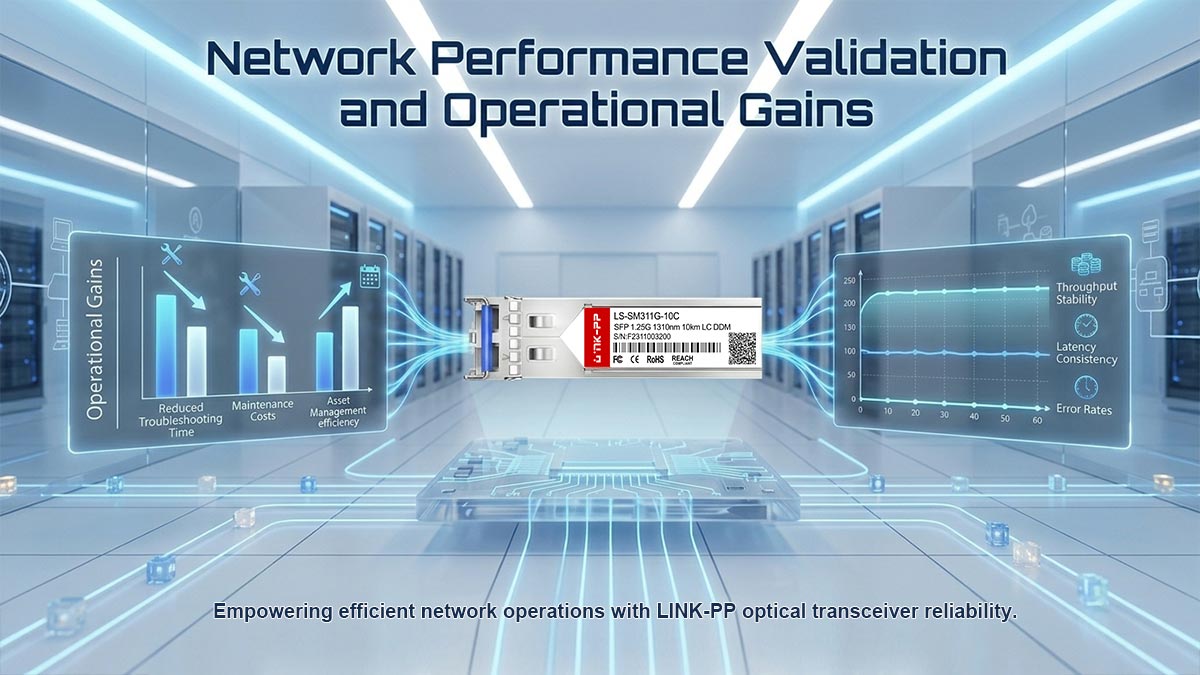
Following full-scale deployment, Aegis Network conducted rigorous physical and data-link layer testing across all commercial zones. Utilizing industry-standard testing instruments verified that LINK-PP 1000BASE-LX SFP modules fulfilled all throughput, latency, and reliability requirements on active H3C firewall ports. The resulting validation confirmed robust operational stability capable of handling peak retail traffic demands.
Zero-Frame-Loss Delivery for CCTV and POS Streams
Comprehensive RFC 2544 benchmark testing confirmed full-duplex Gigabit wire-speed throughput across all aggregation links under maximum traffic simulation. Continuous 4K surveillance video streams and concurrent POS transaction bursts passed through the core-to-firewall boundary without a single dropped Ethernet frame.
The optical transceivers eliminated the buffer bloat and packet drops previously experienced during high-volume customer hours. Preserving deterministic traffic delivery safeguards real-time video security feeds and guarantees instant payment authorization across every tenant terminal.
Consistent Physical Link Stability Across Long-Span Floors
Extensive optical power level telemetry across all multi-floor OS2 fiber runs demonstrated consistent transmitter and receiver power margins. Operating comfortably within the standardized 10km optical power budget, the LINK-PP 1310nm 1G SFP transceivers maintained stable optical signal strength across the furthest subterranean utility rooms and upper retail tiers.
Continuous 72-hour burn-in stress testing in high-density, poorly ventilated IDF closets revealed zero transmitter thermal derating or optical power drift. This exceptional physical stability ensures that environmental temperature fluctuations within weak current rooms will not compromise long-term link reliability.
Low-Bit-Error Signal Integrity on Active Firewall Ports
Bit Error Rate Testing (BERT) validated superior physical layer signal integrity across all active firewall interfaces, consistently outperforming the standard BER ≤ 10⁻¹² operational limit. The precision-engineered electrical interfaces and optimized optical-to-electrical conversion prevented link flaps and CRC error frame accumulation on the H3C security engines.
Achieving this level of signal purity eliminates FCS-related frame drops at the MAC layer and prevents TCP-layer retransmission overhead, lowering CPU utilization on core switching and firewall processors. This ensures clean, uninterrupted data ingestion into the perimeter security inspection engine during continuous multi-zone operation.
Key Achievements in Shopping Mall Security Uplink Deployment
Aegis Network successfully modernized Grand Horizon Mall's network architecture by deploying LINK-PP 1000BASE-LX SFP optical transceivers across all core-to-firewall uplinks. This implementation resolved multi-floor transmission bottlenecks, eliminated electromagnetic interference in shared utility conduits, and established reliable, full-duplex Gigabit connectivity across all retail zones. The resulting infrastructure delivers zero-frame-loss performance for mission-critical POS transactions and real-time 4K security surveillance under peak shopping traffic.
Building on the verified stability and seamless H3C hardware interoperability demonstrated in this deployment, enterprise teams can achieve comparable link reliability and cost efficiency across their own commercial facilities. Network engineers looking to deploy the exact tested modules or expand their optical infrastructure can find fully compatible transceivers through the LINK-PP Toko Resmi, where detailed specifications are also available.