





























Adelaide Edge Cloud & Data Center (AECDC) recently upgraded its core interconnect infrastructure to handle expanding enterprise cloud traffic across South Australia. Led by Marcus Vance, Lead Network Architect, the engineering team integrated LINK-PP LQ-M85200-SR4C 200G optical transceivers into their existing Dell switch environment to boost network capacity while keeping physical-layer latency to an absolute minimum.
This project highlights a successful multi-vendor integration, proving that high-density data center links can scale efficiently without vendor lock-in. Through rigorous interoperability validation, AECDC established a reliable, cost-effective framework for line-rate 200G connectivity across its facilities.
Project Background & Key Challenges
As regional cloud adoption accelerates, edge data center operators face compounding pressures on physical-layer bandwidth and infrastructure stability. Managing these workloads requires upgrading core switch links without compromising signal integrity or inflating operational expenses.
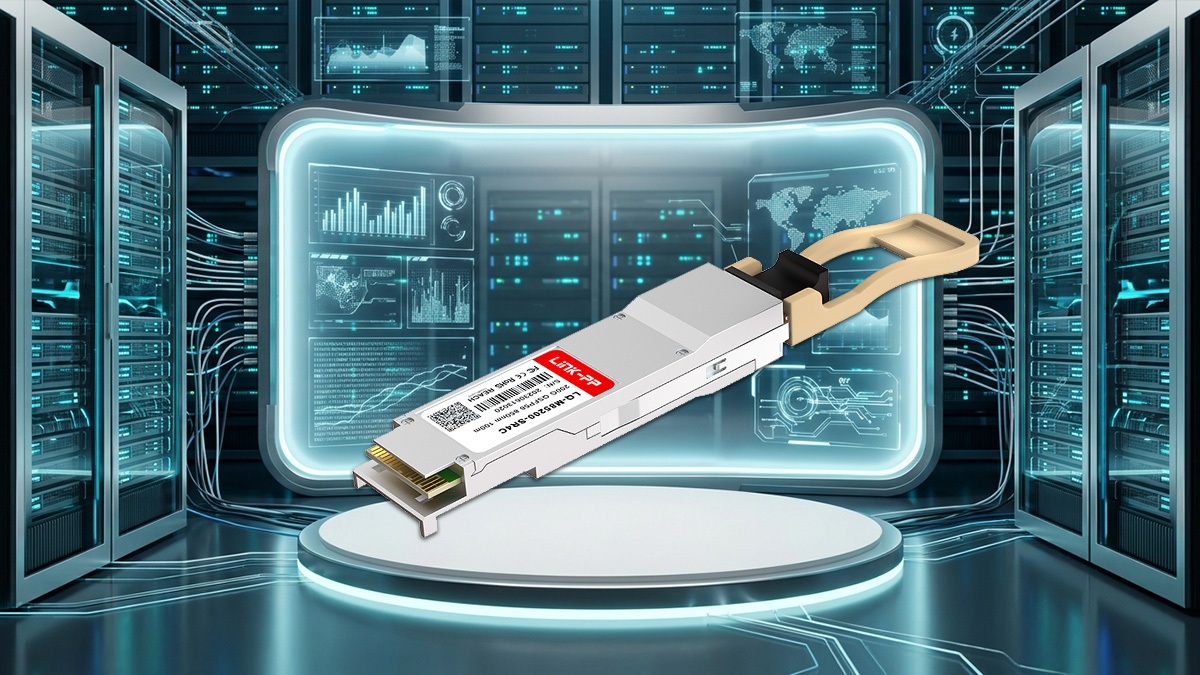
The Growing Bandwidth Demand at Adelaide DCI
Rapid expansion in local cloud services and high-frequency enterprise applications created severe transmission bottlenecks across AECDC's spine-leaf switches. Traditional 40G and 100G optical links could no longer sustain peak data traffic without introducing packet buffering delays.
To support rising throughput demands, the engineering team required an immediate upgrade path to 200G connectivity across short-reach interconnects. Upgrading link capacity was critical to maintaining seamless data exchanges between adjacent racks and compute clusters.
Dell Switch Compatibility & Interoperability Risks
Deploying optical modules into high-density Dell switch ports requires strict adherence to EEPROM programming and physical-layer signaling standards. Low-quality third-party transceivers often suffer from firmware mismatch, leading to unrecognized ports, bit error spikes, or link flap issues during operation.
In contrast, high-spec optical transceivers with fully validated EEPROM firmware deliver seamless handshake protocols and stable laser output on Dell platforms. Marcus Vance and his team needed complete assurance that the chosen 200G modules would integrate reliably without causing switch diagnostic errors or port dropouts.
Balancing High Performance with Infrastructure Costs
Scaling data center bandwidth often incurs substantial capital expenses when relying exclusively on OEM-branded optical transceivers. Budget constraints mandated a balance between deploying reliable 200G hardware and keeping overall operational spending under control.
AECDC sought an enterprise-grade transceiver vendor capable of delivering line-rate signal quality at a fraction of standard OEM vendor pricing. Finding a cost-effective optical solution was essential to scaling network capacity within strict financial boundaries.
The Solution: LINK-PP 200GBASE-SR4 QSFP56 Transceiver
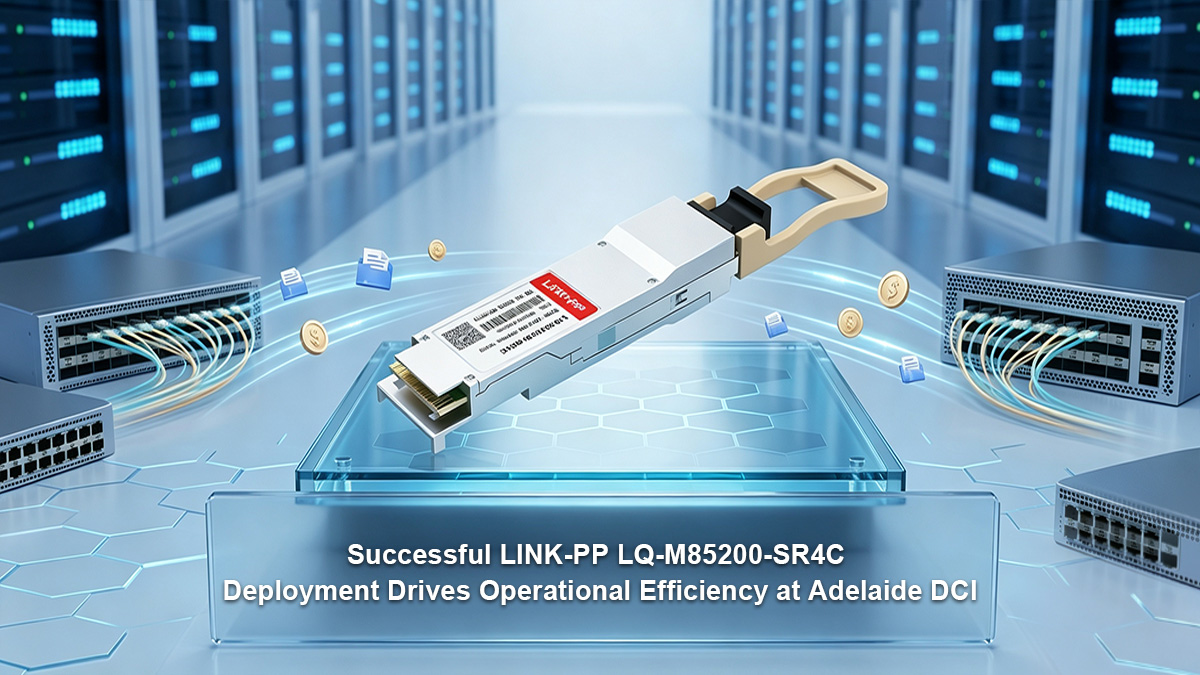
To address these core operational challenges, AECDC selected the LINK-PP LQ-M85200-SR4C 200GBASE-SR4 QSFP56 transceiver for its high-density switch interconnects. This solution delivered immediate compatibility with Dell hardware alongside low-power, high-speed optical transmission.
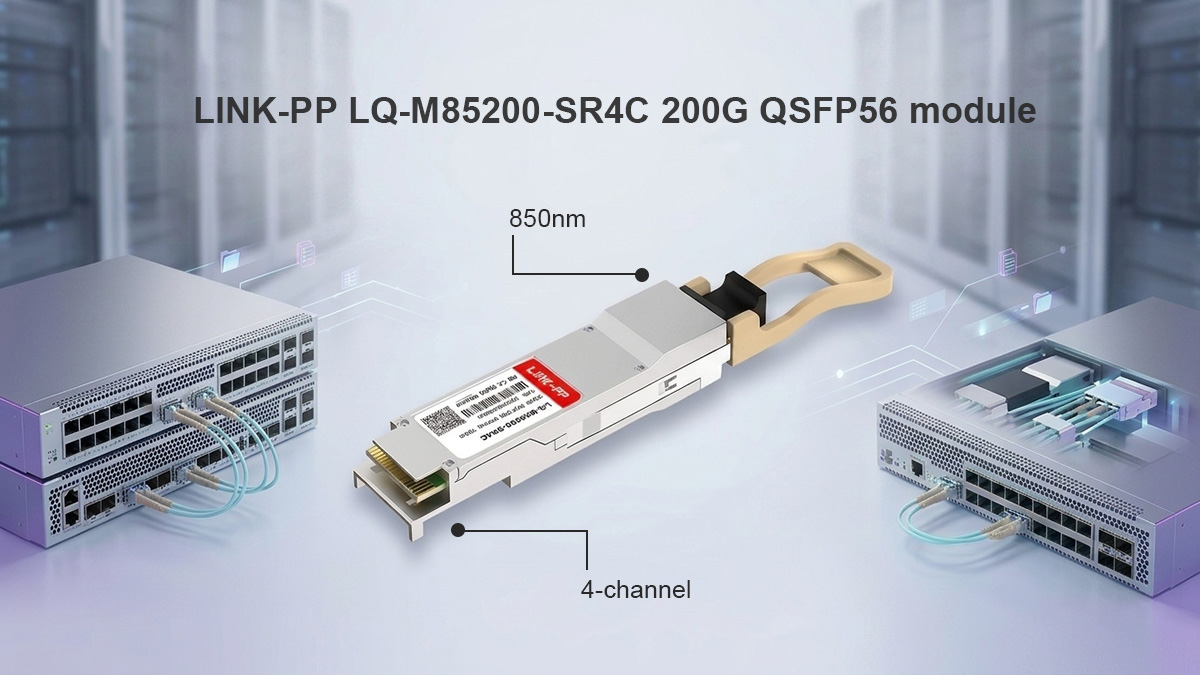
Key Specs of LINK-PP 200GBASE-SR4 Optical Module
The LINK-PP LQ-M85200-SR4C 200G QSFP56 module is built upon a 4-channel 850nm VCSEL transmitter array that utilizes 4-level Pulse Amplitude Modulation (PAM4) to deliver a total aggregate bandwidth of 200Gbps. Engineered specifically for short-reach data center interconnects, the module combines high thermal stability with low power consumption in a compact QSFP56 form factor.
To evaluate its physical-layer capabilities and operational parameters in detail, the key technical specifications are summarized in the table below.
| Parameter | Specification Details |
| Form Factor | QSFP56 |
| Data Rate | 200Gbps (4x 50Gbps PAM4) |
| Wavelength | 850nm VCSEL |
| Optical Interface | MPO-12 |
| Max Transmission Distance | 70m over OM3 MMF / 100m over OM4 & OM5 MMF |
| Power Consumption | < 5.0W |
| Digital Optical Monitoring (DOM) | Supported (Tx/Rx Power, Temperature, Voltage, Bias Current) |
| Operating Temperature Range | 0°C to 70°C (Commercial Grade) |
| Standard Compliance | IEEE 802.3cd 200GBASE-SR4, QSFP MSA |
Seamless Integration with Dell Data Center Switches
The LQ-M85200-SR4C optical transceivers feature pre-programmed EEPROM configurations fully aligned with standard Multi-Source Agreement (MSA) specifications and Dell operating systems. Upon insertion into Dell data center switches, the switch firmware instantly recognizes the modules without throwing port mismatch errors.
This seamless hardware handshake ensures immediate link initialization and line-rate speed negotiation across all active ports. Marcus Vance's team achieved full native functionality without modifying switch firmware or applying software bypass commands.
Multi-Mode Fiber Layout for Short-Reach Connectivity
Deploying LINK-PP LQ-M85200-SR4C MPO modules over multi-mode fiber infrastructure provided the ideal physical-layer foundation for intra-data center links. This architecture optimizes short-reach connections between adjacent racks while maintaining minimal optical signal degradation.
The specific architectural advantages of implementing a multi-mode fiber layout for short-distance data center links include the following core factors:
- Optimized MPO Cabling: Parallel 4-lane optical routing reduces cable clutter and simplifies patch panel management.
- Low Signal Attenuation: High-grade OM4 & OM5 fiber maintains clean PAM4 signal eye diagrams across 100-meter spans.
- Simplified Insertion Loss Margins: MPO-12 connectors deliver stable optical alignment with minimal dB coupling loss.
- Flexible Rack-to-Rack Topology: Short-reach runs allow rapid row upgrades without altering existing tray pathways.
Interoperability Testing, Verification, and Field Deployment
Before launching live production traffic, AECDC executed a rigorous three-phase field validation strategy across isolated testbenches and live Dell switch chassis. Marcus Vance’s team focused on validating EEPROM table decoding, PAM4 eye-diagram clarity, DDM real-time telemetry accuracy, and hitless physical insertion under full traffic loads.
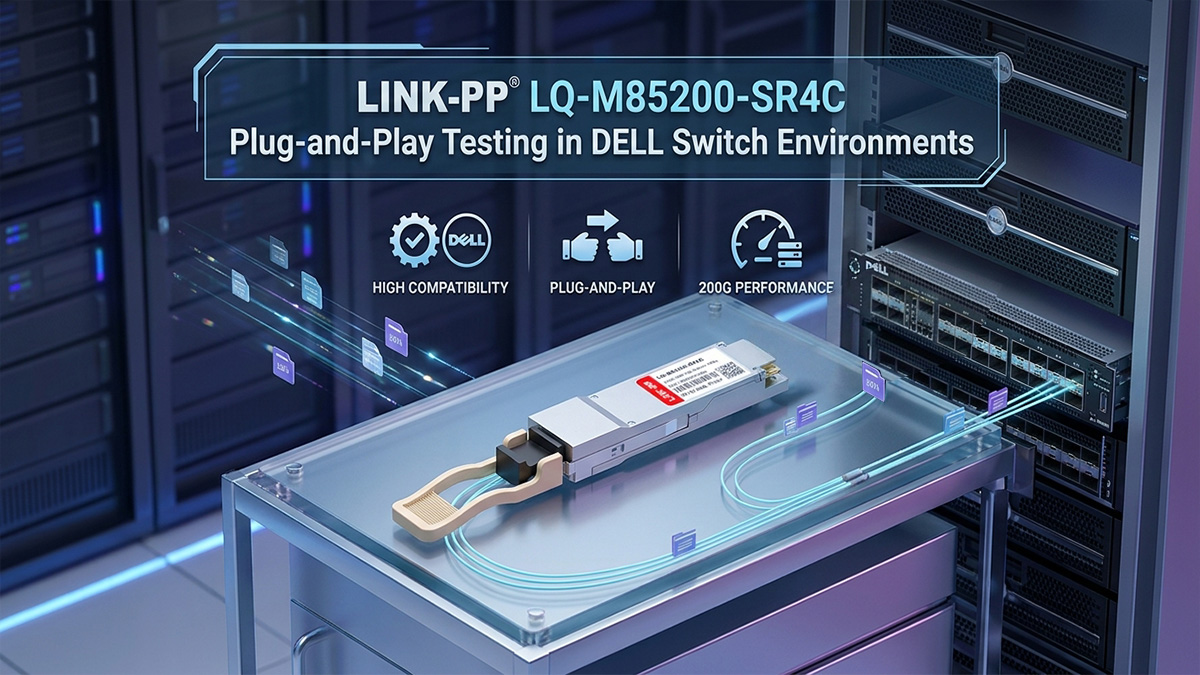
Plug-and-Play Testing in Dell Switch Environments
To confirm native switch recognition, technicians inserted the LINK-PP LQ-M85200-SR4C modules into Dell PowerSwitch S5448F-ON series ports running Dell SmartFabric OS10. The switch OS decoded the transceiver's EEPROM table instantly, mapping vendor ID, serial numbers, and wavelength parameters without triggering EEPROM checksum faults or unsupported-transceiver port shutdowns.
The verification protocol confirmed immediate hardware recognition across two essential operational criteria:
- Automated Speed Negotiation: The port interface locked onto the 200Gbps (4x 50Gbps PAM4) line rate in under 1.5 seconds after physical insertion under testbench conditions, automatically applying the required port configuration without manual CLI intervention.
- Hot-Swap Stability: Repeated physical insertion and removal cycles across 50 test iterations yielded zero kernel panic events, switch driver hangs, or unhandled OS system logging errors.
Live Optical Monitoring & Bit Error Rate Validation
Signal integrity validation was conducted using an Ixia 200G traffic generator alongside Dell OS10 internal Digital Diagnostic Monitoring (DDM). Real-time optical telemetry confirmed that transmit (Tx) and receive (Rx) power levels across all four 50Gbps PAM4 lanes remained exceptionally stable within standard IEEE 802.3cd operating thresholds.
Bit Error Rate (BER) stress testing demonstrated superior signal clarity across maximum-length OM4 fiber runs under full thermal load:
- Pre-FEC BER Performance: Recorded at 1.2 × 10⁻⁸, well within the IEEE 802.3cd Forward Error Correction limit (2.4 × 10⁻⁴), leaving generous signal noise headroom.
- Post-FEC Frame Loss: Achieved a clean zero-frame-loss result (0%) over a 72-hour continuous 100% line-rate soak test across all active PAM4 channels.
- Thermal Dissipation: Internal DDM sensors reported module operating temperatures capping at 44.5°C under maximum traffic density, safely below the 70°C commercial threshold.
Physical Installation and Network Rollout Steps
Following lab sign-off, AECDC deployed the modules across primary distribution rows connecting core leaf and spine switches. The physical installation process was structured into three standardized engineering phases to eliminate physical-layer attenuation risks and maintain continuous data center uptime.
Optical Fiber Inspection and Cleaning
Technicians inspected all MPO-12 multi-mode trunk connectors using a digital fiber microscope to ensure zero dust contamination. Every optical interface was cleaned with dry-cloth optical cassette cleaners prior to mating, preventing interface scratches and signal coupling loss.
Transceiver Insertion and Patching
LINK-PP LQ-M85200-SR4C transceivers were latched into Dell switch QSFP56 bays until fully seated. MPO-12 female connectors were clicked into place, ensuring correct keying orientation to maintain physical polarity across 4-lane transmit and receive arrays.
Link Bring-Up and Telemetry Audit
Engineers monitored switch port status LEDs and verified link-up states via central SNMP network management dashboards. DDM optical Rx power readings were logged into the network management system to establish baseline telemetry for future predictive maintenance.
Business Values & Technical Results
The successful integration of LINK-PP LQ-M85200-SR4C 200G QSFP56 transceivers delivered measurable operational and financial improvements for AECDC. The network upgrade solved immediate bandwidth bottlenecks while enhancing overall infrastructure efficiency.
Ultra-Low Latency and Line-Rate Performance
Upgrading core links to 200G PAM4 optics dramatically reduced packet serialization delay across intra-datacenter connections. High-density cloud traffic now flows seamlessly across leaf-spine links at full 200Gbps line rate without packet queuing spikes.
This latency reduction directly improved application response times for AECDC's enterprise-hosted clients. The physical network now handles heavy burst traffic with consistent, predictable throughput.
Cost Savings on High-Density Data Center Links
By choosing LINK-PP optical modules over direct OEM equivalents, AECDC achieved a significant reduction in capital expenditure for the network upgrade. These savings enabled the engineering team to deploy additional redundant links across secondary switch bays.
The favorable cost-to-performance ratio optimized total cost of ownership (TCO) without compromising hardware quality. This deployment proved that enterprise data centers can scale high-speed links cost-effectively.
Zero-Downtime Reliability in Live Network Operations
Since completing the deployment, the LINK-PP LQ-M85200-SR4C modules have maintained uninterrupted operation across all active Dell switch ports. Integrated telemetry provides continuous visibility into optical health, preventing unexpected link degradations.
The combination of low operating temperatures and stable power consumption has ensured long-term optical reliability. AECDC's network operations team continues to report zero module-related service tickets.
Summary: Building a Scalable Future for Adelaide DCI
The successful deployment of LINK-PP LQ-M85200-SR4C QSFP56 transceivers at Adelaide Edge Cloud & Data Center (AECDC) establishes a validated blueprint for high-density, low-latency interconnects on Dell switch infrastructure. Reflected by Lead Network Architect Marcus Vance, the modules registered instantly on their Dell OS10 platform with zero firmware friction, delivering flawless signal integrity and enabling AECDC to double rack-to-rack throughput while keeping capital expenditure fully optimized.
As regional cloud workloads continue to surge across South Australia, this deployment provides AECDC with a resilient, cost-effective path for future network expansion. For engineering teams looking to achieve similar performance gains and streamline core switch upgrades, the LINK-PP Official Store offers a complete range of fully tested optical transceivers backed by comprehensive compatibility verification. Our technical team is also available to provide custom interoperability testing and tailored hardware recommendations for your specific data center architecture.