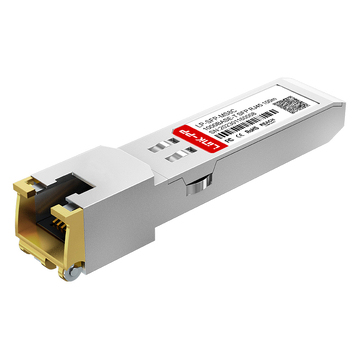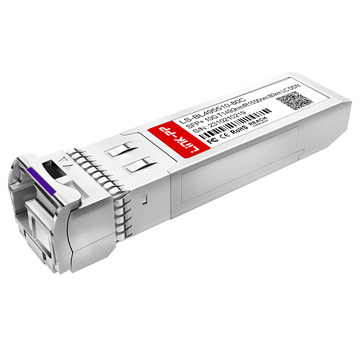





























SFP 1G LX is a 1310nm single-mode Gigabit SFP transceiver designed for up to 10km transmission over single-mode fiber and remains one of the most widely deployed 1Gbps optical module in enterprise and campus networks. It is standardized under IEEE 802.3z as 1000BASE-LX and is commonly used for switch uplinks, building-to-building fiber links, and legacy Gigabit infrastructure that still requires stable long-distance connectivity.
Despite the growth of 10Gbps and higher speeds, SFP 1G LX continues to be relevant because many access switches, industrial systems, and campus backbones still operate at 1Gbps. Its combination of long reach, low power consumption, and broad vendor compatibility makes it a practical choice for extending network links without upgrading to higher-speed optics.
From a technical perspective, SFP 1G LX operates at 1310nm, typically uses LC duplex connectors, and supports both single-mode fiber (for full-distance transmission) and multimode fiber with a mode-conditioning patch cable. Because it follows the Multi-Source Agreement (MSA), it is widely interoperable across major networking platforms such as Cisco, HPE/Aruba, Juniper, and others.
This technical guide explains how SFP 1G LX works, its key specifications, distance limits, fiber requirements, compatibility considerations, and how to choose the right module for real-world deployments.
⏩ What Is an SFP 1G LX?
SFP 1G LX is a 1000BASE-LX small form-factor pluggable transceiver that operates at 1310nm and supports up to 10km transmission over single-mode fiber for Gigabit Ethernet links. It is defined by the IEEE 802.3z standard and is commonly used for long-reach 1Gbps optical connections between switches, routers, and network infrastructure.
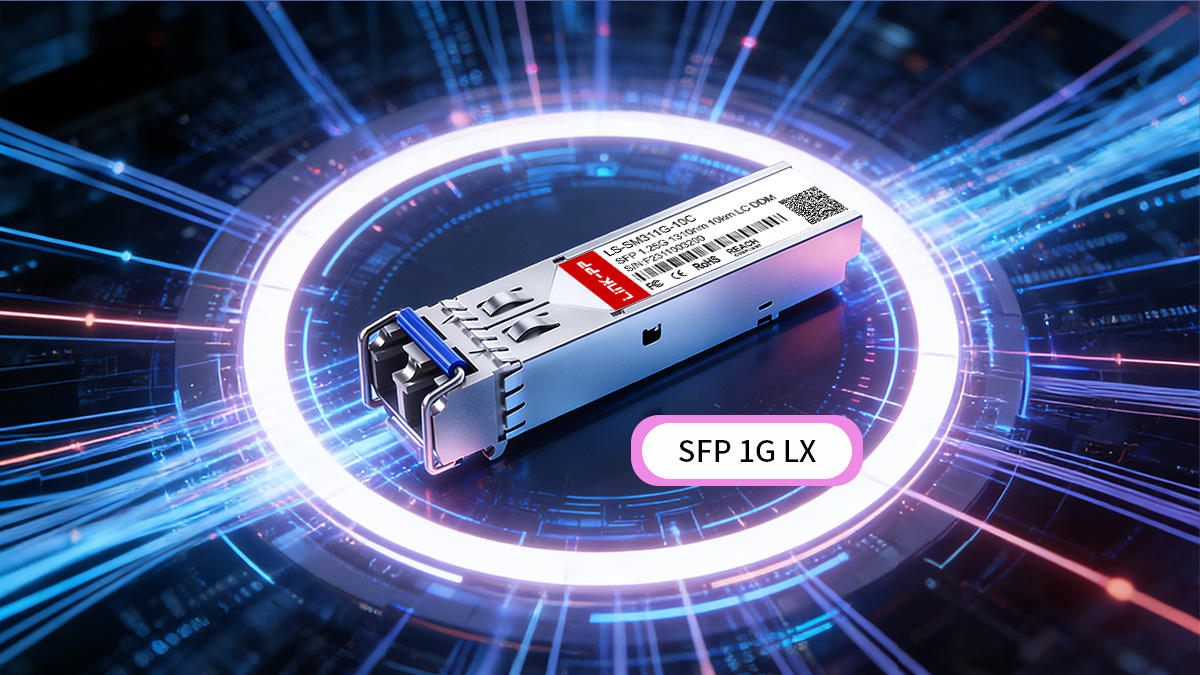
Definition and Standard
SFP 1G LX refers to the optical module implementing the 1000BASE-LX specification. It uses a 1310nm laser and duplex LC interface to transmit and receive data at 1.25Gbps line rate (1Gbps Ethernet payload). The module follows the SFP Multi-Source Agreement (MSA), allowing interoperability across multiple networking vendors.
| Parameter | Value | Notes |
|---|---|---|
| Ethernet standard | 1000BASE-LX | IEEE 802.3z |
| Nominal data rate | 1.25Gbps | 1GbE payload |
| Wavelength | 1310nm | Single-mode optimized |
| Typical reach | 10km | Over SMF |
The 1000BASE-LX specification was designed to provide longer reach than multimode-only Gigabit optics while maintaining low power consumption and compact SFP form factor.
Operating Characteristics
SFP 1G LX modules are primarily designed for single-mode fiber links up to 10km but can also operate over multimode fiber with proper conditioning.
Key characteristics include:
-
Duplex LC optical interface
-
Single-mode fiber support (OS1/OS2)
-
Optional multimode operation with mode-conditioning patch cable
-
Digital optical monitoring (DOM/DDM) support on most modules
-
Hot-swappable SFP form factor
Because the LX standard uses a 1310nm wavelength, it provides lower attenuation over longer distances compared with 850nm multimode optics.
Position Within 1G SFP Types
SFP 1G LX is the long-reach single-mode option within the 1G SFP family, positioned between short-range SX and extended-reach EX/ZX modules.
| SFP type | Wavelength | Fiber type | Typical reach |
|---|---|---|---|
| 1000BASE-SX | 850nm | Multimode | 220–550m |
| 1000BASE-LX | 1310nm | Single-mode | 10km |
| 1000BASE-EX | 1310nm | Single-mode | 40km |
| 1000BASE-ZX | 1550nm | Single-mode | 80km |
This makes SFP 1G LX the most commonly used module for medium-distance Gigabit fiber links such as campus connections and inter-building networks.
⏩ Key Specifications of SFP 1G LX Modules
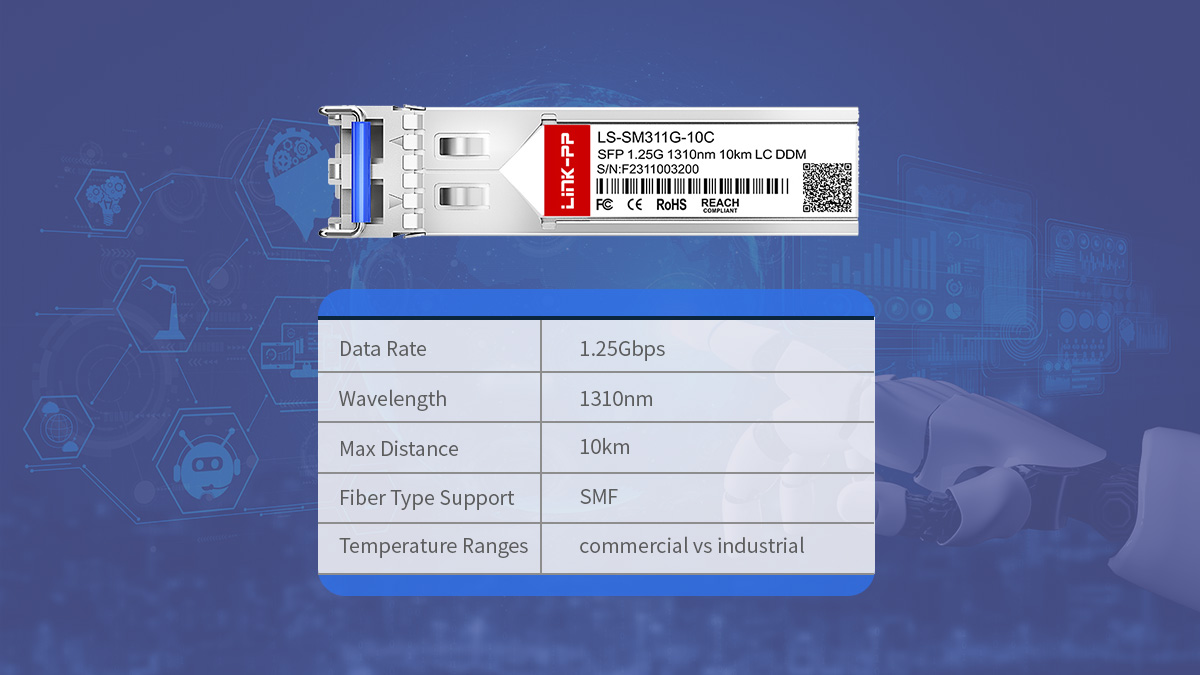
SFP 1G LX modules operate at 1.25Gbps over a 1310nm wavelength and typically support up to 10km over single-mode fiber, making them the standard long-reach option for Gigabit Ethernet optical links. While exact values vary by vendor, most compliant modules follow the IEEE 802.3z 1000BASE-LX specification and SFP MSA requirements.
Core Optical and Electrical Parameters
The fundamental parameters of an SFP 1G LX define its reach, compatibility, and link budget.
| Parameter | Typical Value | Notes |
|---|---|---|
| Data rate | 1.25Gbps | 1GbE line rate |
| Wavelength | 1310nm | FP laser |
| Max distance | 10km | Over SMF |
| Connector | LC duplex | Standard SFP interface |
| Fiber type | SMF (OS2) | MMF with conditioning |
These parameters determine whether the module can meet the required transmission distance and fiber infrastructure.
Optical Power and Sensitivity
Transmit power and receiver sensitivity determine the achievable link distance and margin.
| Optical spec | Typical range | Purpose |
|---|---|---|
| Tx output power | −9dBm to −3dBm | Launch power |
| Rx sensitivity | ≤ −20dBm | Minimum receive level |
| Power budget | ~10–12dB | Link margin |
A higher optical budget allows more tolerance for fiber attenuation, connectors, and patch panels. For short links (under 2km), attenuators may sometimes be required to prevent receiver overload.
Fiber Compatibility
SFP 1G LX is optimized for single-mode fiber but can operate over multimode fiber with limitations.
| Fiber type | Supported | Distance |
|---|---|---|
| OS2 SMF | Yes | Up to 10km |
| OM3 MMF | With MCP | ~550m |
| OM1/OM2 MMF | With MCP | 220–550m |
When using multimode fiber, a mode-conditioning patch cable (MCP) helps prevent differential mode delay caused by the 1310nm laser.
Power Consumption and Thermal Range
Most SFP 1G LX modules consume low power and support multiple temperature grades for different environments.
| Spec | Typical value | Notes |
|---|---|---|
| Power consumption | <1W | Low thermal load |
| Commercial temp | 0°C to 70°C | Standard data centers |
| Industrial temp | −40°C to 85°C | Harsh environments |
Industrial-grade modules are commonly used in outdoor cabinets, factory automation, and transport networks.
Digital Diagnostics Monitoring (DDM/DOM)
Most modern SFP 1G LX modules support digital diagnostics monitoring for real-time optical visibility.
Supported monitoring parameters typically include:
-
Tx optical power
-
Rx optical power
-
Module temperature
-
Supply voltage
-
Laser bias current
These metrics help with troubleshooting fiber links and predicting failures before they occur.
Mechanical and Form Factor
SFP 1G LX uses the standard hot-swappable SFP form factor, ensuring compatibility with most Gigabit SFP ports.
Key mechanical characteristics:
-
Hot-pluggable SFP package
-
LC duplex optical interface
-
Supports MSA-compliant cages
-
EEPROM for vendor coding
Because it follows the SFP MSA, SFP 1G LX modules are widely interoperable across switches and routers that support Gigabit SFP ports.
⏩ SFP 1G LX vs Other 1G SFP Types
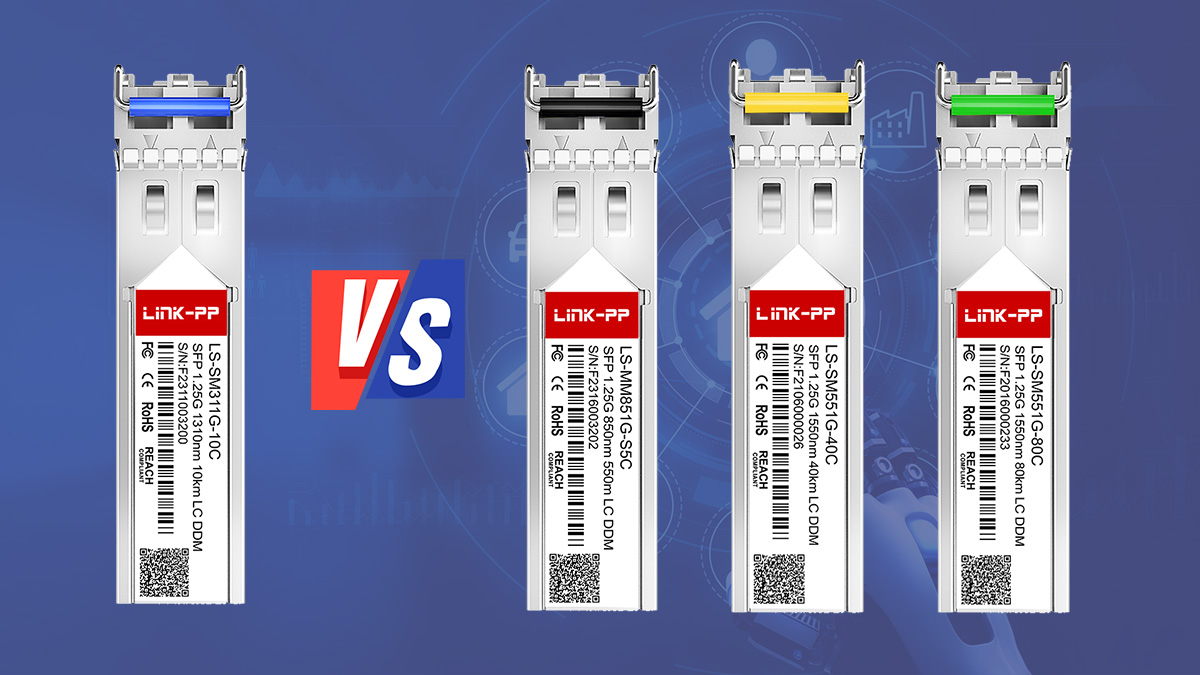
SFP 1G LX is the standard long-reach 1Gbps optical module using 1310nm over single-mode fiber, positioned between short-range SX modules and extended-reach EX/ZX modules. Choosing the right 1G SFP type depends mainly on transmission distance, fiber type, and deployment environment.
SFP 1G LX vs SFP SX
LX supports longer distances over single-mode fiber, while SX is optimized for short-range multimode links inside buildings or data centers.
| Type | Wavelength | Fiber type | Typical reach |
|---|---|---|---|
| 1000BASE-SX | 850nm | Multimode | 220–550m |
| 1000BASE-LX | 1310nm | Single-mode | Up to 10km |
LX is typically chosen for campus or inter-building links, whereas SX is used for short switch-to-switch connections within a single facility. LX can run on multimode fiber with a mode-conditioning patch cable, but SX cannot run on single-mode fiber.
SFP 1G LX vs EX and ZX
EX and ZX modules extend beyond LX distance but require higher optical budgets and are used in metro or long-haul access networks.
| Type | Wavelength | Fiber type | Typical reach |
|---|---|---|---|
| 1000BASE-LX | 1310nm | SMF | 10km |
| 1000BASE-EX | 1310nm | SMF | 40km |
| 1000BASE-ZX | 1550nm | SMF | 80km |
LX is the most commonly deployed option because most enterprise and campus links fall within 10km. EX and ZX are used when connecting remote sites, aggregation nodes, or metro access locations.
SFP 1G LX vs Copper SFP (1000BASE-T)
Copper SFP modules use RJ45 and twisted-pair cabling, while LX uses fiber for longer distance and EMI-resistant links.
| Type | Medium | Max distance | Typical use |
|---|---|---|---|
| 1000BASE-T SFP | Cat5e/6 | 100m | Rack or office |
| 1000BASE-LX SFP | SMF | 10km | Campus backbone |
Fiber-based LX modules provide lower signal attenuation over long distances and are immune to electromagnetic interference, making them suitable for industrial sites and building-to-building links. Copper SFP is limited to short-range connections inside equipment rooms.
Selection Logic Across 1G SFP Types
Distance and fiber infrastructure are the primary factors when choosing among 1G SFP module.
Use LX when:
-
Distance exceeds multimode limits
-
Single-mode fiber is available
-
Links are under 10km
-
Campus or building connections are required
Use SX when:
-
Distance is under 550m
-
Multimode fiber is already installed
-
High port density inside a facility is needed
Use EX/ZX when:
-
Distance exceeds 10km
-
Remote sites must be connected
-
Metro or long-haul access is required
Understanding these distinctions helps ensure the selected SFP module matches both the physical fiber plant and the required transmission distance.
⏩ Fiber and Cabling Requirements of SFP 1G LX
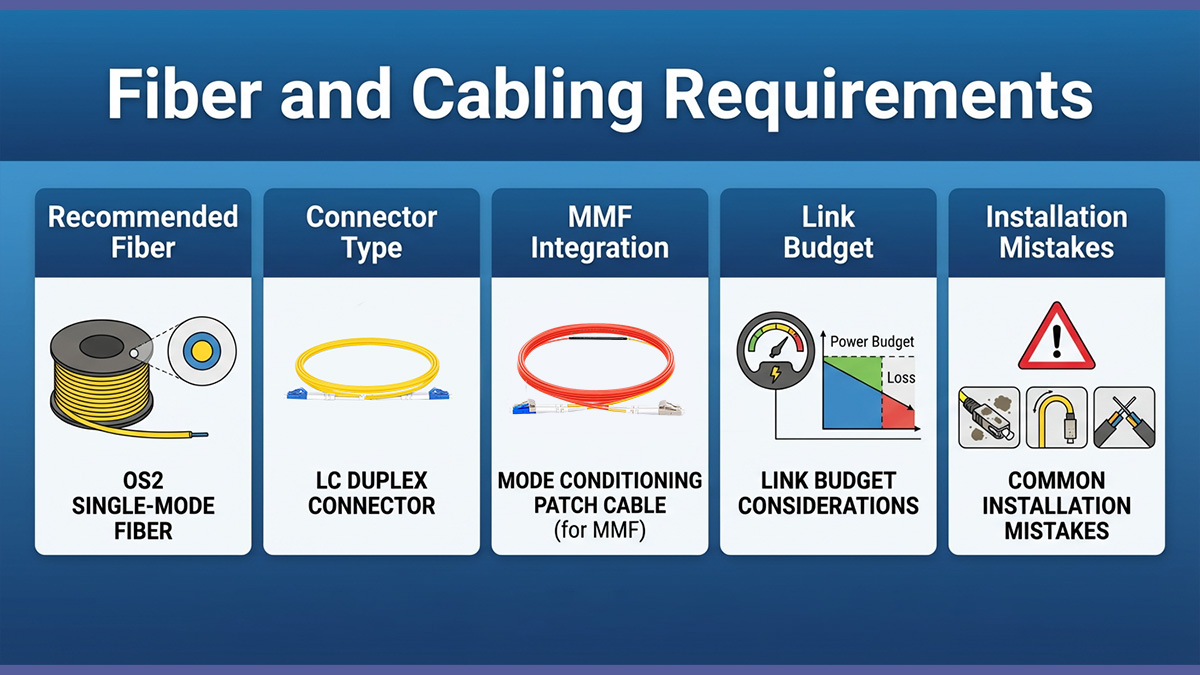
SFP 1G LX is designed primarily for single-mode fiber and supports up to 10km over OS2 fiber using LC duplex connectors, while multimode operation is possible only with a mode-conditioning patch cable. Correct fiber type and cabling practices are critical to achieving stable link performance and avoiding signal issues.
Recommended Fiber Types
Single-mode fiber is the standard medium for SFP 1G LX and ensures full-distance operation with predictable attenuation.
| Fiber type | Supported | Typical distance |
|---|---|---|
| OS2 SMF | Yes | Up to 10km |
| OS1 SMF | Yes | Up to 10km (shorter margins) |
| OM3 MMF | With MCP | Up to ~550m |
| OM1/OM2 MMF | With MCP | 220–550m |
OS2 single-mode fiber is recommended for new installations because of its lower attenuation and better long-distance performance. OS1 can work for shorter campus links but offers less margin.
When using multimode fiber, a mode-conditioning patch cable (MCP) is required to prevent differential mode delay caused by the 1310nm laser. Without MCP, link instability or high bit error rates may occur.
Connector and Patch Cabling
SFP 1G LX modules use LC duplex connectors and require proper polarity and clean fiber interfaces for reliable operation.
| Component | Requirement | Notes |
|---|---|---|
| Connector type | LC duplex | Standard SFP interface |
| Patch cable type | LC–LC SMF | OS2 recommended |
| Polarity | Tx to Rx | Cross-connect required |
| Cleaning | Mandatory | Before insertion |
Dirty connectors are one of the most common causes of optical link failure. Always clean fiber end faces before installation.
Link Budget and Distance Planning
The typical optical budget of an SFP 1G LX is around 10–12dB, which determines maximum supported distance and allowable loss.
| Link element | Typical loss |
|---|---|
| Fiber attenuation | ~0.4dB/km |
| LC connector | ~0.3–0.5dB |
| Splice | ~0.1dB |
| Patch panel | ~0.5dB |
To maintain a stable link:
-
Total link loss must stay within the module’s optical budget
-
Excess connectors or splices reduce margin
-
Long campus runs should be calculated before deployment
For very short links (for example under 1km), the received optical power may be high. In rare cases, an attenuator may be used if the receiver approaches overload thresholds.
Multimode Operation Considerations
Although SFP 1G LX can operate over multimode fiber, it is not optimized for it and requires additional components.
Use multimode only when:
-
Existing MMF infrastructure must be reused
-
Distance is within 550m
-
Mode-conditioning patch cable is installed
If new cabling is being deployed, single-mode fiber is generally preferred because it supports longer distances and future upgrades.
⏩ Typical Applications of SFP 1G LX
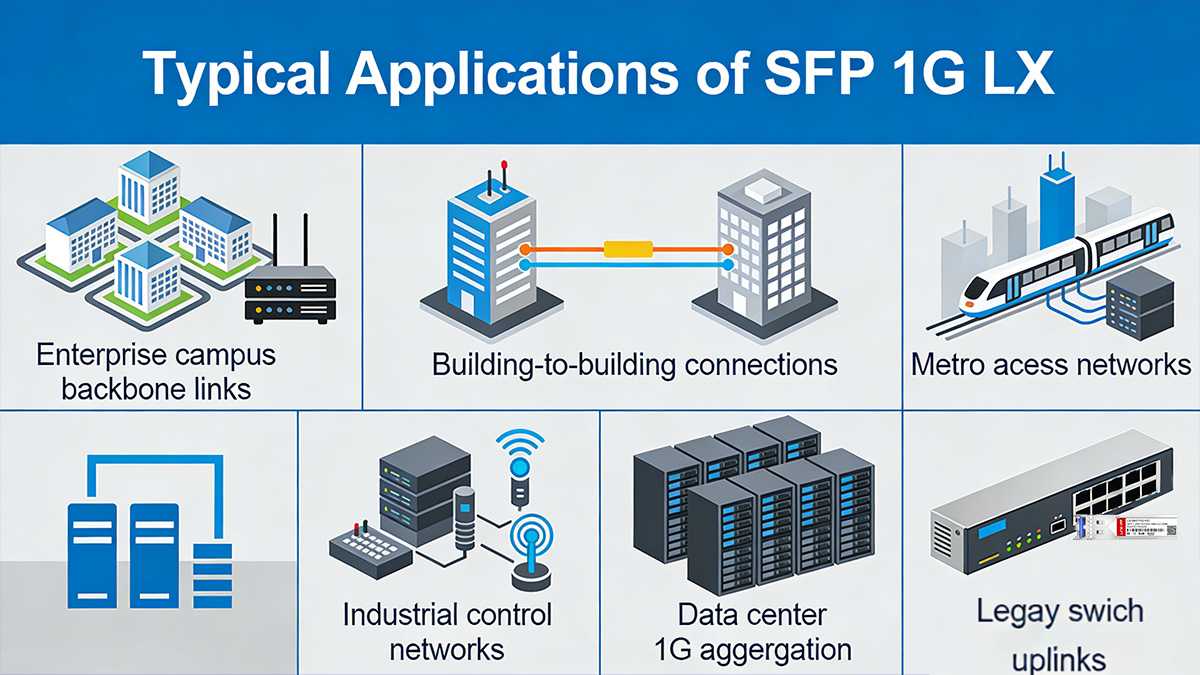
SFP 1G LX is most commonly used for medium-distance Gigabit fiber links up to 10km, especially in campus networks, enterprise backbones, and building-to-building connections where single-mode fiber is available. Its long reach and low power consumption make it suitable for stable 1Gbps infrastructure that does not require higher-speed optics.
Campus and Enterprise Backbone Links
SFP 1G LX is widely deployed for inter-building and campus backbone connections within a 10km range.
| Scenario | Fiber type | Typical distance |
|---|---|---|
| Building-to-building | SMF | 500m–5km |
| Campus core to access | SMF | 1–10km |
| Aggregation uplinks | SMF | <10km |
These links often connect access switches to aggregation or core layers. Because many enterprise environments still run Gigabit uplinks, LX remains a practical and cost-efficient choice.
Metro Access and Last-Mile Connectivity
In metro access networks, SFP 1G LX is used for short metro spans and last-mile fiber connections where distances remain under 10km.
Common use cases include:
-
Enterprise access to service provider edge
-
Small metro rings
-
Fiber-to-building aggregation
-
Access switch uplinks
For longer metro spans beyond 10km, EX or ZX modules are typically used instead.
Industrial and Utility Networks
Industrial environments use SFP 1G LX for reliable long-distance connections between control systems and remote equipment.
Typical deployments:
-
Factory automation networks
-
Transportation control systems
-
Energy and utility monitoring
-
Outdoor cabinet connections
Single-mode fiber provides strong immunity to electromagnetic interference, which is important in electrically noisy environments.
Data Center and Legacy Infrastructure
SFP 1G LX is often used in data centers for legacy 1G uplinks or connections between separate buildings within a campus.
| Use case | Reason |
|---|---|
| Legacy switch uplinks | Many 1G ports still deployed |
| Cross-building links | Distance beyond SX limits |
| Management networks | Low bandwidth but long reach |
Although modern data centers use 10G or higher for primary traffic, 1G LX remains common for management networks, out-of-band connections, and legacy systems.
Network Upgrade and Migration Scenarios
SFP 1G LX is frequently used during phased network upgrades where existing 1G infrastructure must remain operational.
Use in:
-
Gradual migration from copper to fiber
-
Extending existing Gigabit networks
-
Temporary backbone links
-
Compatibility with older switches
Because SFP 1G LX is widely supported across vendors and platforms, it serves as a stable bridging technology in mixed-speed environments.
⏩ Compatibility and Interoperability
SFP 1G LX modules are widely interoperable because they follow the SFP Multi-Source Agreement (MSA) and IEEE 802.3z 1000BASE-LX standard, allowing them to operate across most Gigabit SFP ports when properly coded for the target device. Compatibility issues usually relate to vendor EEPROM coding rather than optical specifications.

MSA and Standards Compliance
Most SFP 1G LX modules are MSA-compliant, meaning their electrical and optical interfaces follow shared industry specifications for broad hardware compatibility.
| Standard | Purpose | Impact |
|---|---|---|
| SFP MSA | Form factor & interface | Cross-vendor support |
| IEEE 802.3z | 1000BASE-LX optics | Link interoperability |
| DOM/DDM spec | Diagnostics | Monitoring support |
Because the optical parameters are standardized, two compliant LX modules from different vendors can typically link successfully if both sides support 1000BASE-LX.
Vendor Compatibility
Switch compatibility depends mainly on EEPROM coding rather than optical design.
| Vendor platform | Compatibility note |
|---|---|
| Cisco | May require Cisco-coded SFP |
| HPE/Aruba | Vendor-coded or unlocked |
| Juniper | Typically accepts MSA |
| Huawei | Vendor-coded recommended |
Some switches check the module EEPROM and may reject unsupported vendor IDs. In these cases, using a correctly coded third-party module resolves the issue without affecting optical performance.
Third-Party vs OEM Modules
MSA-compliant third-party SFP 1G LX modules are widely used and often interoperable with OEM modules when properly coded.
| Aspect | OEM module | Third-party module |
|---|---|---|
| Optical performance | Standardized | Equivalent |
| Vendor coding | Native | Programmable |
| Cost | Higher | Lower |
| Availability | Limited | Broad |
As long as the module matches required specifications—1310nm, 1.25Gbps, 10km reach—interoperability is generally determined by coding compatibility rather than hardware differences.
Digital Diagnostics and Monitoring
DOM/DDM support may vary by device platform, but most modern switches can read diagnostics from compliant LX modules.
Common monitored values:
-
Tx optical power
-
Rx optical power
-
Module temperature
-
Voltage
-
Laser bias current
Some legacy switches may support basic link operation but not full diagnostic reporting.
Interoperability Best Practices
Stable cross-vendor operation depends on matching optical standards, fiber type, and coding requirements.
Key practices:
-
Use 1000BASE-LX on both link ends
-
Match wavelength and distance class
-
Confirm switch compatibility list
-
Use vendor-coded modules if required
-
Check DOM support if monitoring is needed
When these factors are aligned, SFP 1G LX modules typically provide reliable interoperability across mixed-vendor network environments.
⏩ Advantages of SFP 1G LX
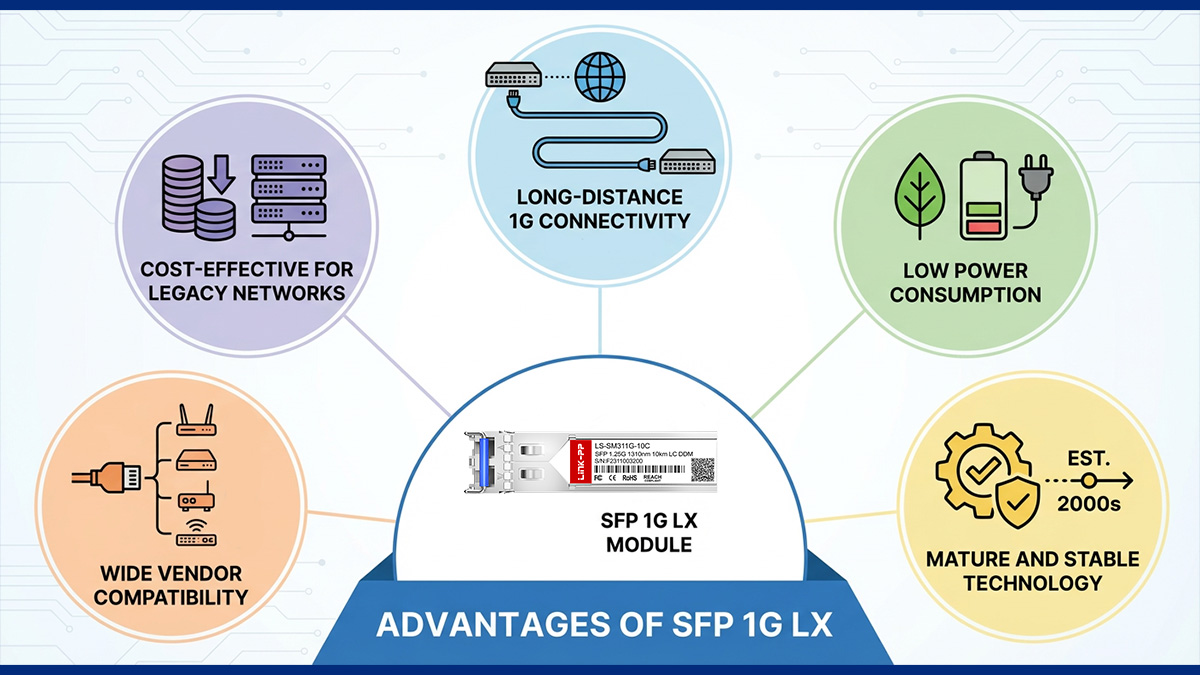
SFP 1G LX provides reliable 1Gbps transmission up to 10km over single-mode fiber, offering a stable, low-power, and widely compatible solution for medium-distance optical links. Its mature technology and standardized specifications make it one of the most practical Gigabit transceivers for enterprise and campus networks.
Longer Reach Than Multimode 1G Optics
The primary advantage of SFP 1G LX is its ability to support significantly longer distances than multimode-based SX module.
| Module type | Fiber type | Typical reach |
|---|---|---|
| 1000BASE-SX | MMF | 220–550m |
| 1000BASE-LX | SMF | Up to 10km |
This extended reach makes LX suitable for campus backbones, building interconnects, and aggregation links where multimode fiber distance limits would otherwise require additional equipment.
High Compatibility Across Vendors
Because SFP 1G LX follows IEEE and MSA standards, it is widely supported across networking platforms from multiple vendors.
Common compatibility benefits:
-
Supported by most Gigabit SFP ports
-
Interoperable across mixed-vendor environments
-
Available in OEM and third-party coded versions
-
Works with legacy and modern switches
This broad compatibility simplifies network expansion and maintenance, especially in environments with multi-vendor equipment.
Low Power Consumption and Thermal Load
SFP 1G LX modules typically consume less than 1W, making them efficient for high-density switch deployments.
| Feature | Benefit |
|---|---|
| Low power draw | Reduced heat generation |
| Compact SFP form factor | High port density |
| Passive cooling support | No additional airflow needed |
Lower power usage reduces thermal stress on switches and supports stable long-term operation.
Mature and Proven Technology
SFP 1G LX is based on a long-established standard and has been deployed extensively in enterprise and carrier networks.
Advantages of mature technology:
-
Stable optical performance
-
Predictable link budgets
-
Broad ecosystem support
-
Extensive field-proven reliability
Because of its long history, troubleshooting practices and compatibility behaviors are well understood by network engineers.
Flexible Deployment Scenarios
SFP 1G LX supports a wide range of deployment environments, from indoor enterprise networks to outdoor industrial installations.
Common flexible uses:
-
Campus backbone links
-
Building-to-building fiber
-
Industrial control networks
-
Metro access within 10km
-
Legacy 1G infrastructure
Industrial-temperature versions also allow operation in harsh environments such as outdoor cabinets or factory floors.
Cost Efficiency for Existing 1G Networks
For networks that still operate at 1Gbps, SFP 1G LX offers a cost-effective way to extend fiber links without upgrading to higher-speed optics.
| Scenario | Benefit |
|---|---|
| Existing 1G switches | No upgrade required |
| Medium-distance links | No DWDM needed |
| Campus fiber | Reuse SMF plant |
This makes LX an efficient option when bandwidth requirements remain within Gigabit levels but distance exceeds copper or multimode limits.
⏩ Limitations and Considerations
SFP 1G LX provides reliable 10km Gigabit connectivity, but it is limited to 1Gbps bandwidth, requires single-mode fiber for full reach, and may need careful link planning for short or multimode deployments. Understanding these constraints helps avoid mismatched expectations and deployment issues.

Bandwidth Limitations
SFP 1G LX is restricted to 1Gbps and is not suitable for networks requiring higher throughput such as 10Gbps or beyond.
| Module type | Data rate | Typical use |
|---|---|---|
| 1G LX | 1Gbps | Legacy or access links |
| 10G LR | 10Gbps | Modern backbone |
| 25G LR | 25Gbps | High-density access |
If network traffic is expected to grow significantly, deploying LX on new infrastructure may limit scalability and require future upgrades.
Dependence on Single-Mode Fiber
Full 10km performance requires single-mode fiber; multimode operation is limited and less predictable.
| Fiber type | Result |
|---|---|
| OS2 SMF | Full 10km reach |
| OM3 MMF (with MCP) | Up to ~550m |
| MMF without MCP | Potential instability |
Using multimode fiber without a mode-conditioning patch cable can introduce differential mode delay and cause link errors. For new installations, single-mode fiber is generally recommended.
Short-Link Optical Power Considerations
On very short fiber runs, received optical power may approach upper thresholds and reduce margin.
| Link length | Consideration |
|---|---|
| <1km | Rx power may be high |
| 1–10km | Normal operation |
Although most modern modules tolerate short links, high optical power in short-distance deployments can occasionally require an attenuator to maintain optimal signal levels.
Compatibility and Coding Constraints
Even though optical standards are uniform, some switches enforce vendor-specific module recognition.
| Issue | Impact |
|---|---|
| Vendor lock | Module rejection |
| Limited DOM support | Reduced monitoring |
| Firmware checks | Compatibility errors |
Using properly coded modules for the target platform typically resolves these issues, but compatibility verification is recommended before deployment.
Not Ideal for High-Density Future Upgrades
Deploying new 1G LX links in environments planning near-term upgrades to 10G or higher may not be efficient.
Consider alternatives when:
-
Upgrading to 10G soon
-
Installing new fiber infrastructure
-
Building high-density data center links
In such cases, deploying higher-speed optics from the start can reduce future replacement costs.
Deployment Planning Requirements
Reliable operation depends on correct fiber selection, connector cleanliness, and link budget planning.
Key considerations:
-
Verify total link attenuation
-
Minimize connector count
-
Clean fiber end faces
-
Confirm compatibility coding
-
Check DOM support if needed
When these factors are properly managed, SFP 1G LX remains a stable and predictable solution for medium-distance Gigabit fiber links.
⏩ How to Choose the Right SFP 1G LX Module
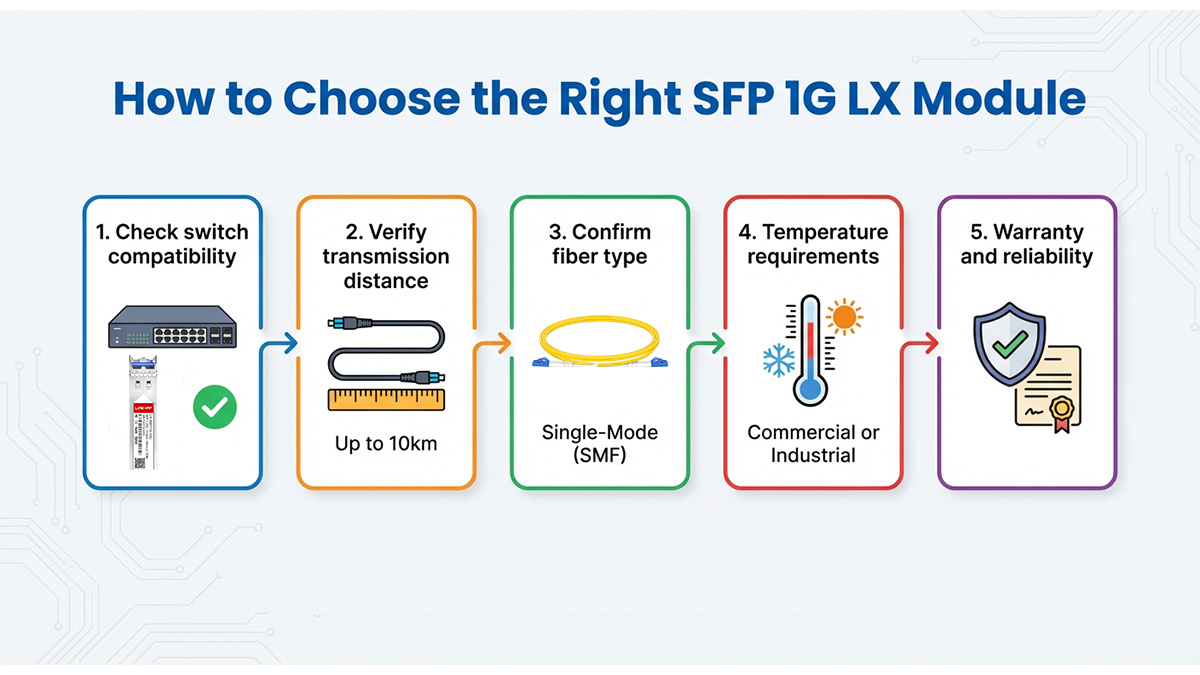
Choosing the right SFP 1G LX module depends on four primary factors: switch compatibility, transmission distance, fiber type, and operating environment. Matching these parameters ensures stable links and avoids interoperability or optical budget issues.
Check Switch and Platform Compatibility
The first step is confirming that the module is supported by the target switch or router, including correct vendor coding if required.
| Check item | Why it matters | Action |
|---|---|---|
| SFP port type | Must support 1G SFP | Verify port spec |
| Vendor coding | Some switches lock modules | Use compatible coding |
| DOM support | Monitoring visibility | Confirm if needed |
Always verify compatibility lists or test with a known supported module before large deployments.
Match Required Transmission Distance
Select an SFP 1G LX module only when link distance falls within its typical 10km optical budget.
| Link distance | Recommended module |
|---|---|
| <550m MMF | SX may be better |
| 1–10km SMF | LX |
| >10km | EX or ZX |
If the link approaches the maximum 10km distance, consider fiber loss, connectors, and splices to ensure sufficient margin.
Confirm Fiber Type and Cabling
Fiber infrastructure determines whether LX can operate at full performance or requires additional components.
| Fiber plant | Recommendation |
|---|---|
| OS2 SMF | Ideal for LX |
| OS1 SMF | Acceptable |
| Existing MMF | Use MCP cable |
| New install | Prefer SMF |
Single-mode fiber is recommended for new deployments because it supports longer reach and future upgrades.
Consider Temperature and Environment
Operating environment affects whether a commercial or industrial-grade module is required.
| Environment | Module type |
|---|---|
| Data center | Commercial (0–70°C) |
| Outdoor cabinet | Industrial |
| Factory floor | Industrial |
Industrial-temperature SFP 1G LX modules are designed for extended ranges such as −40°C to 85°C.
Evaluate Monitoring and Diagnostics Needs
If network monitoring is important, choose modules with DOM/DDM support compatible with the switch platform.
Key diagnostics:
-
Tx optical power
-
Rx optical power
-
Temperature
-
Voltage
-
Bias current
These metrics help detect fiber degradation or optical issues early.
Decision Flow for Selection
A simple selection logic helps determine whether SFP 1G LX is the correct choice.
Choose SFP 1G LX if:
-
Distance is within 10km
-
Single-mode fiber is available
-
Switch supports 1G SFP
-
No immediate upgrade to 10G planned
Consider alternatives if:
-
Distance exceeds 10km
-
Only multimode fiber is available without MCP
-
Network is upgrading to higher speeds
-
Vendor compatibility is uncertain
Following these decision points ensures the selected SFP 1G LX module matches both the physical network and future requirements.
⏩ Installation and Troubleshooting Tips
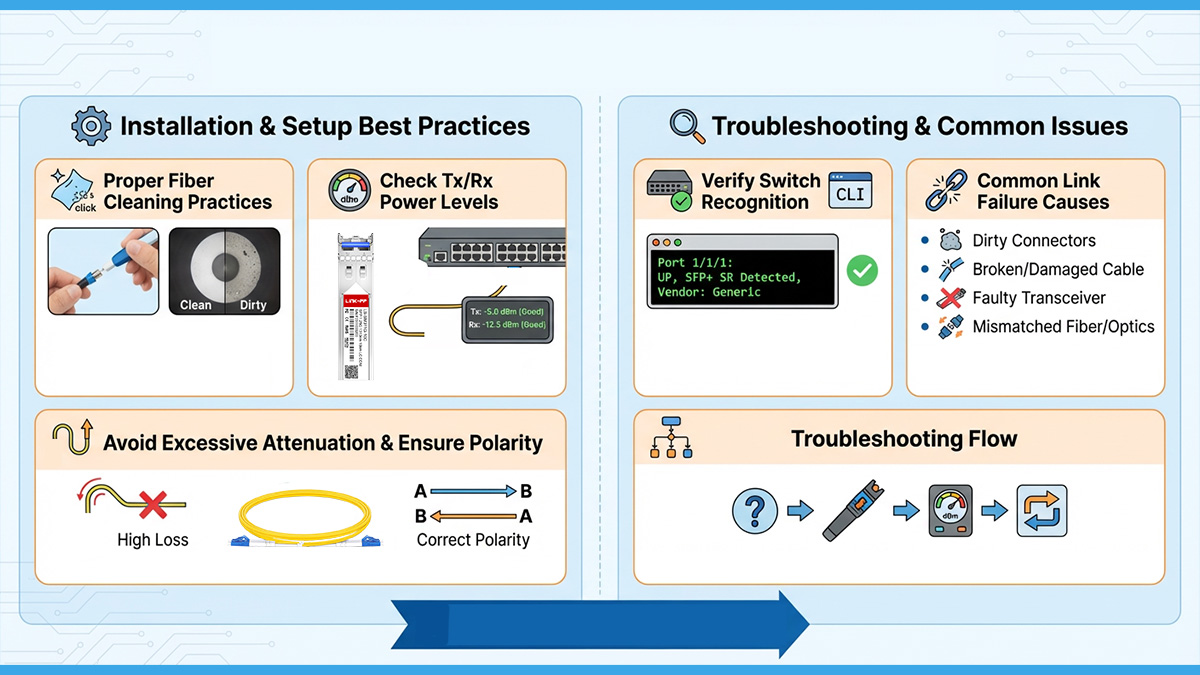
Proper installation and basic optical checks resolve most SFP 1G LX link issues, with fiber cleanliness, correct polarity, and optical power levels being the most critical factors. Because LX operates over single-mode fiber at 1310nm, even small connector or cabling problems can affect link stability.
Installation Best Practices
A clean and correctly connected fiber path ensures stable SFP 1G LX operation from the start.
| Step | Action | Purpose |
|---|---|---|
| Clean connectors | Use fiber cleaner | Prevent signal loss |
| Verify polarity | Tx→Rx cross-connect | Ensure link |
| Check fiber type | Confirm SMF | Full distance support |
| Seat module fully | Click into cage | Electrical contact |
Before inserting the module, inspect and clean both patch cord ends. Contaminated connectors are one of the most common causes of optical link failure.
Verify Link After Installation
After installation, confirm that the link establishes and optical levels fall within normal ranges.
| Check | Expected result |
|---|---|
| Link LED | On |
| Switch log | Module recognized |
| Rx power | Within sensitivity range |
| DOM values | Stable readings |
If digital diagnostics monitoring (DOM) is supported, verify that received power is above the minimum sensitivity and below overload thresholds.
Common Link Issues and Causes
Most SFP 1G LX problems relate to fiber path issues rather than module defects.
| Symptom | Likely cause |
|---|---|
| No link | Polarity reversed |
| Intermittent link | Dirty connector |
| High errors | MMF without MCP |
| Low Rx power | Excess loss |
| Module rejected | Coding mismatch |
Swapping fiber pairs or replacing patch cables often resolves initial link failures.
Short-Link Power Considerations
Very short single-mode links may produce higher-than-expected receive power, reducing margin.
| Distance | Action |
|---|---|
| <500m | Check Rx level |
| <1km | Consider attenuator if high |
Although most modern modules tolerate short distances, monitoring receive power helps prevent receiver overload in very short runs.
Multimode Deployment Checks
When operating over multimode fiber, additional validation is required.
Ensure:
-
Mode-conditioning patch cable installed
-
Distance within MMF limits
-
Stable DOM readings
-
No excessive bit errors
Without proper conditioning, LX modules on multimode fiber can exhibit unstable performance.
Step-by-Step Troubleshooting Flow
A structured approach helps isolate link issues quickly.
-
Confirm module is recognized by switch
-
Check fiber polarity
-
Clean all connectors
-
Verify fiber type and distance
-
Check DOM optical levels
-
Swap patch cords
-
Test with known-good module
Following this sequence resolves most deployment issues without replacing hardware unnecessarily.
⏩ FAQs About SFP 1G LX
What distance does an SFP 1G LX support?
SFP 1G LX typically supports up to 10km over single-mode fiber. Actual distance depends on total link loss and connector quality.
Can SFP 1G LX run over multimode fiber?
Yes, but only over short distances and usually with a mode-conditioning patch cable. Without it, link stability may be affected.
What wavelength does SFP 1G LX use?
It operates at 1310nm, which enables longer reach than 850nm multimode optics and supports single-mode transmission.
Is SFP 1G LX compatible with SX modules?
No. LX and SX use different wavelengths and fiber types, so they cannot directly link unless media conversion is used.
Does SFP 1G LX support DOM/DDM monitoring?
Most modern modules support digital diagnostics monitoring, allowing visibility into Tx/Rx power, temperature, and voltage.
When should you choose LX instead of SX?
Choose LX when link distance exceeds multimode limits or when single-mode fiber is available for campus or building connections.
Can SFP 1G LX connect to 10G modules?
No. SFP 1G LX is designed for 1Gbps ports and cannot directly link with 10Gbps optics without compatible dual-speed interfaces.
Is SFP 1G LX still used in modern networks?
Yes. It remains widely used for legacy Gigabit infrastructure, management networks, and medium-distance fiber links under 10km.
⏩ Conclusion
SFP 1G LX remains the standard 1310nm single-mode Gigabit transceiver for stable fiber links up to 10km, offering wide compatibility, low power consumption, and proven reliability across enterprise and campus networks. For organizations maintaining or extending 1Gbps infrastructure, choosing a properly coded and specification-matched SFP 1G LX module ensures predictable performance and long-term interoperability. If you are sourcing compatible and field-tested 1000BASE-LX modules for real deployments, explore the options available at the LINK-PP Official Store for dependable supply and platform-ready solutions.