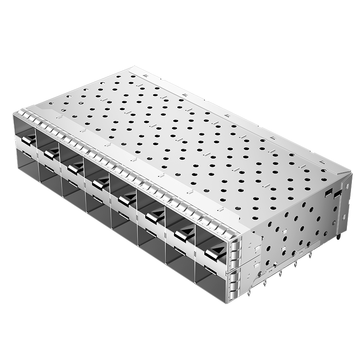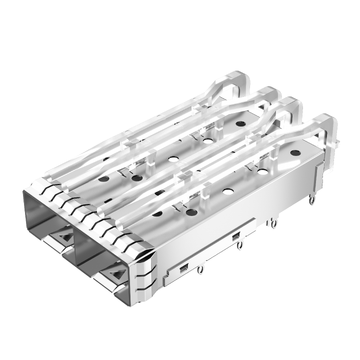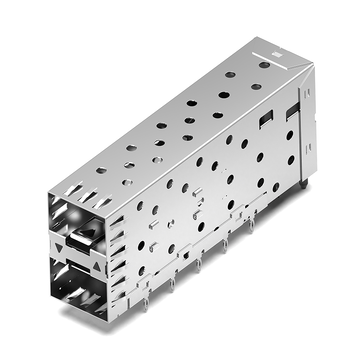
What are SFP Cages?
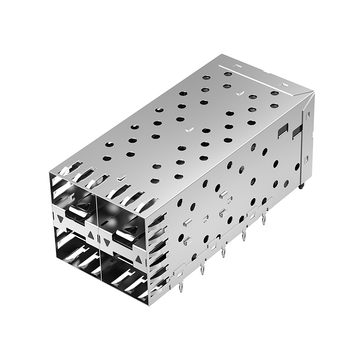
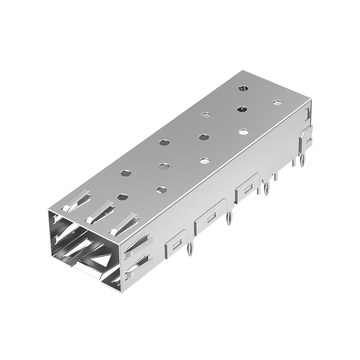
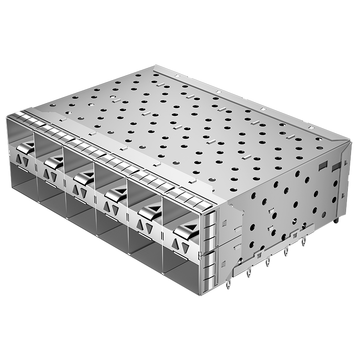
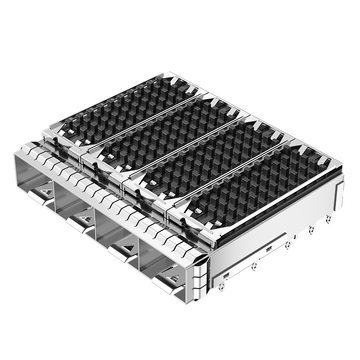
An SFP (Small Form-factor Pluggable) cage is a metal receptacle mounted on a Printed Circuit Board (PCB) that houses the optical transceiver. It serves as the critical mechanical and electrical interface for network equipment, ensuring stable data transmission and protecting sensitive internal components.
They deliver three core functions essential for any modern networking hardware:
-
EMI Containment: Blocks Electromagnetic Interference to maintain signal integrity across the entire system.
-
Thermal Management: Efficiently dissipates the heat generated by active optical transceivers during high-speed data transfers.
-
Physical Security: Provides a robust, plug-and-play locking mechanism for secure and reliable module connections.
High-quality cages, like those manufactured by LINK-PP, guarantee that networking hardware remains protected, cool, and fully compliant with global MSA standards for seamless integration.
Types of SFP Cages
SFP cages are primarily differentiated by port configuration, mounting method, EMI shielding structure, light-pipe arrangement, and whether the electrical connector is included. Selecting the right type is crucial for optimizing PCB space and meeting specific bandwidth requirements for your hardware infrastructure.
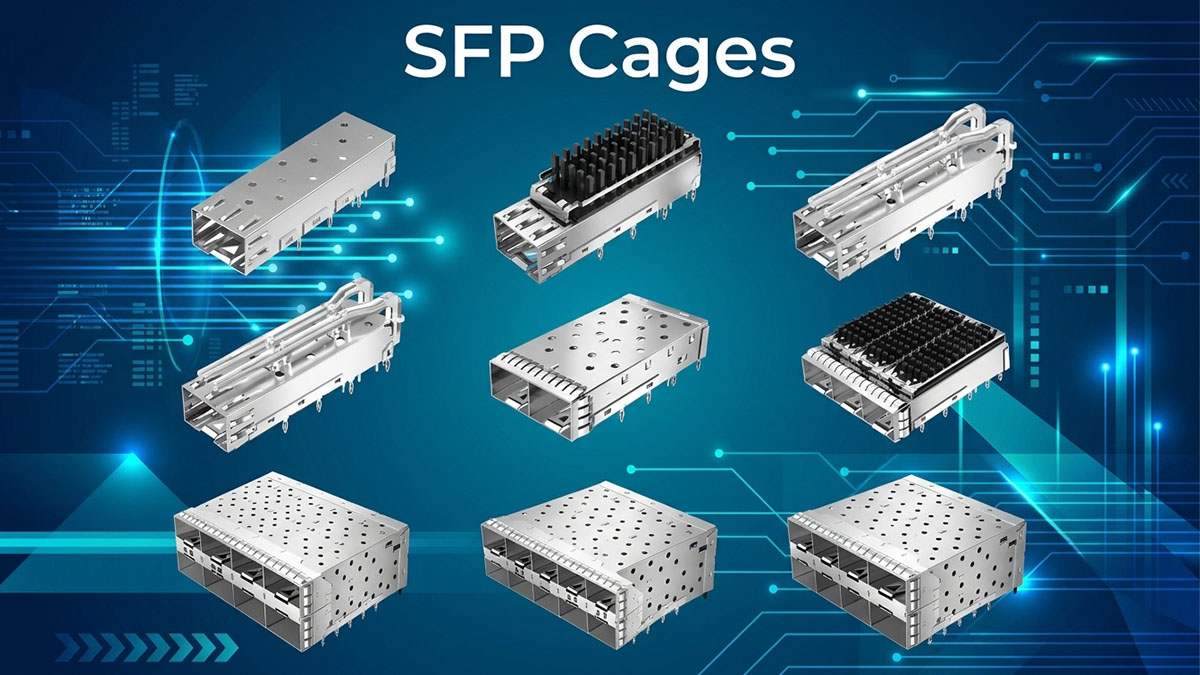
SFP Cage by Port Configuration
LINK-PP currently provides multiple SFP cage configurations, from single-port 1X1 designs to higher-density 1X10 and 2X12 arrangements.
| SFP Cage Configuration | Port Arrangement | Typical Selection |
|---|---|---|
| 1X1 | Single port | Single-interface equipment |
| 1X2 | One row × two ports | Compact dual-port layouts |
| 1X4 | One row × four ports | Four-port network interfaces |
| 1X6 | One row × six ports | Higher-density front panels |
| 1X8 | One row × eight ports | High-density horizontal layouts |
| 1X10 | One row × ten ports | Very high-density horizontal layouts |
| 2X1 | Two rows × one port | Stacked dual-port arrangement |
| 2X2 | Two rows × two ports | Four-port stacked layout |
| 2X4 | Two rows × four ports | Higher-density stacked design |
| 2X6 | Two rows × six ports | Dense stacked interfaces |
| 2X8 | Two rows × eight ports | High-density stacked equipment |
| 2X12 | Two rows × twelve ports | Very high-density port integration |
The correct configuration should match the equipment's front-panel opening, PCB footprint, port spacing, and required port count rather than simply selecting the highest available density.
SFP Cage by Mounting Method
LINK-PP offers SFP cages with two primary mounting methods to suit different PCB layouts and assembly processes:
-
Press-fit: A solderless installation method where the cage's pins are mechanically pressed into the PCB's plated through-holes. This approach simplifies assembly and avoids thermal stress, but requires careful verification of the PCB thickness and exact hole dimensions.
-
Solder: A traditional mounting method designed for standard wave or reflow soldering processes. This method provides a highly robust mechanical bond to the board and requires strict matching of the cage's pin configuration and footprint keep-out areas.
SFP Cage by Light Pipe Configuration
Based on the need for front-panel visual status indication, SFP cages are directly categorized into two main types: those with light pipes and those without.
-
With Light Pipes: These cages integrate light-guiding components to transmit LED signals from the host PCB directly to the equipment's front panel. They are ideal for applications where users need to monitor port link and data activity status in real-time.
-
Without Light Pipes: These are purely mechanical shielding enclosures that do not include any light-guiding components. They feature a simpler structure and are suitable for equipment that does not require front-panel LED indication, or where the LEDs are already mounted directly on the front panel.
SFP Cage by SFP Connector Configurations
Based on how the electrical interface is integrated, SFP cages are categorized into two types: those with an integrated connector and those without.
-
SFP Cages without Integrated Connectors (Cage Assembly): These cages serve purely as the mechanical enclosure and EMI shield, requiring a separate electrical SFP connector to be mounted on the host PCB. By default, LINK-PP's 1x1 and single-row (1xN) SFP cages are supplied as cage-only assemblies.
-
SFP Cages with Integrated Connectors: These products combine the mechanical cage and the electrical connector into a single, coordinated module, which simplifies PCB layout and interface design. By default, LINK-PP's stacked double-row (2xN) SFP cages are supplied as cage assemblies with integrated connectors.
SFP Cage By Integrated Heatsinks
Based on thermal management requirements, SFP cages are categorized into two types: those with integrated heatsinks and those without.
-
SFP Cages with Integrated Heatsinks: These cages feature a heatsink (typically finned) mounted on top of or built into the cage structure. They are designed to efficiently dissipate heat generated by high-power optical transceivers, ensuring stable performance and preventing overheating in high-density environments.
-
SFP Cages without Heatsinks: These are standard mechanical enclosures that do not include additional thermal components, relying instead on the system's ambient airflow for cooling. They feature a lower profile and are typically used for standard-power SFP modules or in equipment where chassis-level cooling is sufficient.
SFP Cage by EMI Shielding Design
Based on the method used to contain electromagnetic interference at the equipment's front panel, SFP cages are typically categorized into two primary shielding designs:
-
Elastomeric Gasket: These cages feature a conductive rubber or foam gasket surrounding the front collar. When installed, the gasket compresses against the chassis bezel to create a continuous, tight seal, making it highly effective for preventing EMI leakage in environments with strict emission requirements.
-
EMI Spring Fingers: These cages utilize stamped metallic spring fingers, including Internal and External types. External springs are designed to make multiple secure grounding contacts with the equipment's chassis or front panel, while internal springs provide direct grounding and shielding continuity with the inserted SFP module.
How to Choose the Right SFP Cage?
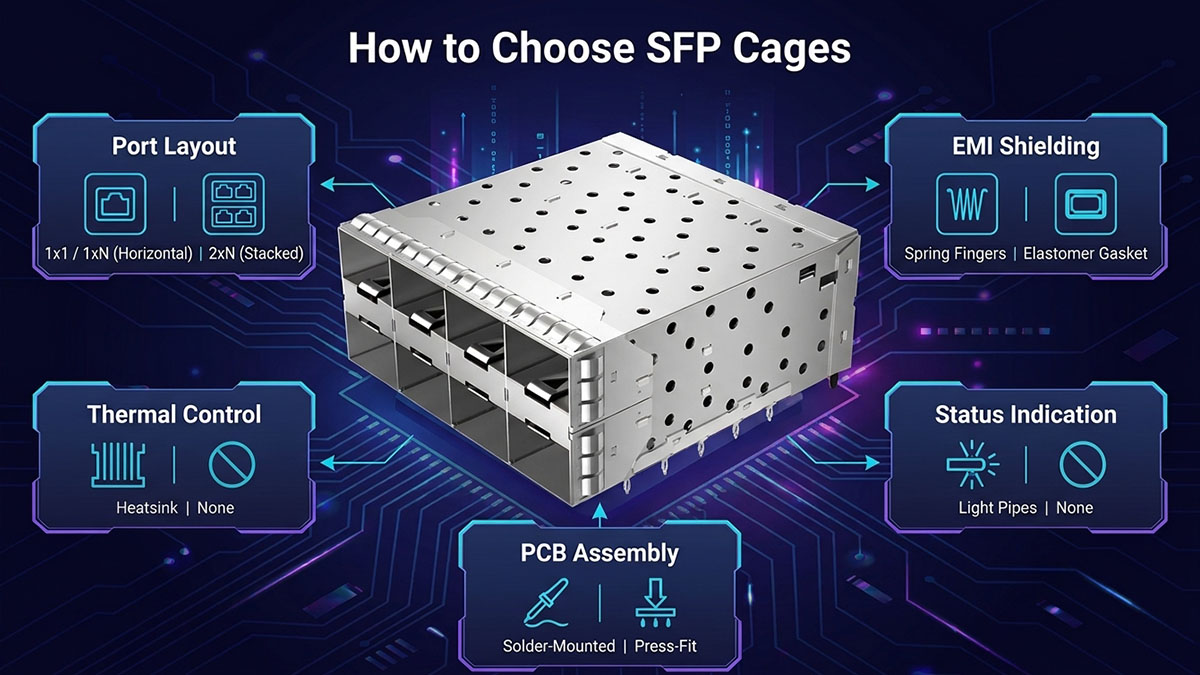
Selecting the correct SFP cage for your networking equipment involves matching your PCB layout, thermal constraints, and EMI needs. Follow this straightforward step-by-step guide to quickly narrow down your options:
-
Step 1: Determine Port Configuration & Connector Needs
-
For standard horizontal layouts, choose a 1x1 or single-row (1xN) configuration. Note: LINK-PP's 1x1 and 1xN configurations are typically supplied as cage-only assemblies (without connectors).
-
To maximize front-panel density, choose a stacked double-row (2xN) configuration. Note: LINK-PP's 2xN configurations are supplied with integrated connectors by default.
-
-
Step 2: Evaluate Thermal Management (Heatsinks)
-
Select cages with integrated heatsinks if your design uses high-power optical transceivers or operates in a high-density chassis where thermal dissipation is critical.
-
Select cages without heatsinks for standard-power modules, gaining a lower physical profile and simplifying the mechanical design.
-
-
Step 3: Choose the EMI Shielding Design
-
Opt for EMI Springs (Spring Fingers) for standard, highly reliable multi-point metal grounding between the module, cage, and front-panel chassis.
-
Opt for an Elastomeric Gasket if your enclosure requires a highly compressible, continuous seal to meet extremely strict EMI leakage standards.
-
-
Step 4: Consider Front-Panel Indication (Light Pipes)
-
Select cages with light pipes if you need to route LED signals from the host PCB to the equipment's front panel to display link/activity status.
-
Select cages without light pipes if your design doesn't require visual indication or if LEDs are already designed into the front panel.
-
-
Step 5: Verify the PCB Mounting Method
-
Choose Solder-mounted cages if your manufacturing process uses traditional wave soldering.
-
Choose Press-fit cages for a solderless assembly process that uses mechanical pressure to secure the pins directly into the PCB holes.
-
Applications
SFP cages are essential mechanical components used across a wide range of networking and communication equipment that require modular optical interfaces. Common applications include:
-
Ethernet Switches: Provide modular, high-density fiber and copper port configurations (from 1x1 to 2x12 layouts) for enterprise and data center networks.
-
Routers & Network Appliances: Enable interchangeable optical interfaces for modular routing, firewall, and security platforms.
-
Network Interface Cards (NICs): Add high-speed modular fiber connectivity to rack servers and storage devices.
-
Data Center Equipment: Support high-density, reliable networking in Storage Area Networks (SAN) and Top-of-Rack (ToR) switches.
-
Telecom & Fiber Access: Provide secure mechanical retention and EMI shielding in broadband access equipment, such as PON and OLT platforms.
-
Industrial & Embedded Networking: Secure pluggable optical interfaces in rugged, temperature-resistant industrial switches and IoT gateways.
Next: Select → Buy
Stay on the guide for specs—use these exits when you are ready to shortlist parts.
- Browse this category
Open SFP Cages & Connectors to filter by the specs that match your BOM.
Browse SFP Cages & Connectors - Request a quote
Send part numbers or OEM codes if you want a quote—no obligation.
Request a quote
FAQ
Can I request samples before ordering?
Yes, we provide standard samples so you can verify the mechanical fit and PCB compatibility before placing a bulk order.
What is the typical lead time?
In-stock items ship within 1-3 business days. Mass production or customized orders typically require 2 to 4 weeks.
Do you offer wholesale pricing?
Yes, we provide tiered volume discounts. Contact us with your estimated project volume to receive our best competitive quote.
Do you support custom SFP cage designs?
Yes, we offer OEM/ODM customization for specific port layouts, heatsink dimensions, light pipe lengths, and EMI shielding materials.
Are your SFP cages compliant with industry standards?
Yes, all cages fully comply with standard MSA specifications for universal compatibility, as well as RoHS, REACH, and UL94 flammability standards.
How Do I Check SFP Cage Compatibility?
Check the port configuration, PCB footprint, mounting method, connector arrangement, dimensions, EMI structure, light-pipe requirements, and operating conditions.
Certifications & Standards
To ensure universal compatibility, safety, and environmental responsibility, our SFP cages comply with strict international industry standards:
-
MSA (Multi-Source Agreement): Fully compliant with standard mechanical specifications (such as SFF-8432) to guarantee universal fit and interchangeability with all standard SFP/SFP+ transceivers.
-
EMI/EMC Compatibility: Engineered to provide excellent electromagnetic shielding, helping your host equipment pass strict FCC and CE emission requirements.
-
RoHS & REACH: Manufactured with eco-friendly, lead-free materials, fully compliant with global hazardous substance restrictions.
-
UL Flammability: Any integrated plastic components (such as mating connectors or light pipes) meet the strict UL 94V-0 flame retardant standard for maximum equipment safety.
-
Quality Management: Produced in ISO 9001 and ISO 14001 certified facilities, ensuring consistent manufacturing quality and reliability for every batch.
Support & Purchase Guidance
To ensure a smooth selection and procurement process for your networking equipment, follow these simple steps:
-
Explore Configurations: Browse our complete product matrix, from standard 1x1 to high-density 2x12 layouts, to find your ideal port arrangement.
-
Verify Datasheets: Download our precise mechanical drawings and PCB footprints to ensure a flawless fit with your host board and chassis.
-
Get Expert Advice: Need a custom heatsink, specific light pipe, or advanced EMI shielding? Reach out to our engineering team for tailored OEM/ODM solutions.
-
Test with Samples: Validate the physical fit and PCB assembly process in your own lab. Contact us today to request standard SFP cage samples for your R&D team.
-
Secure Bulk Pricing: Ready for mass production? Send inquiry with your target volume to receive our best wholesale pricing and exact lead times.
Browse LINK-PP's SFP Cages & Connectors Catalog or Submit an RFQ to get started!