As AI clusters and HPC data centers rapidly scale to 400G NDR InfiniBand architectures, are you evaluating the deployment feasibility and sourcing options for the MMS1X00-NS400 optical transceiver? High-density compute fabrics require reliable single-mode interconnects that maintain low latency across leaf-spine switches and compute nodes. Exploring compatible single-mode QSFP112 alternatives has become a practical approach for engineering teams seeking to balance link performance with multi-vendor sourcing flexibility.
When multi-mode fiber reaches its distance limits across large compute halls, how can network architects select compatible single-mode 400G QSFP112 options that meet strict InfiniBand standards? A viable alternative must deliver identical 1310nm optical performance, seamless EEPROM recognition on Quantum-2 switches, and robust thermal stability under full traffic loads. Validating these physical-layer metrics ensures uninterrupted transmission across switch-to-switch links and high-speed host connections.
📝 Why Consider MMS1X00-NS400 Alternatives for Your Network?
Building a resilient 400G NDR InfiniBand infrastructure requires balancing peak physical-layer performance with sustainable procurement strategies. Evaluating viable MMS1X00-NS400 alternatives allows enterprise engineering teams to optimize optical transceiver deployment across dense compute environments.
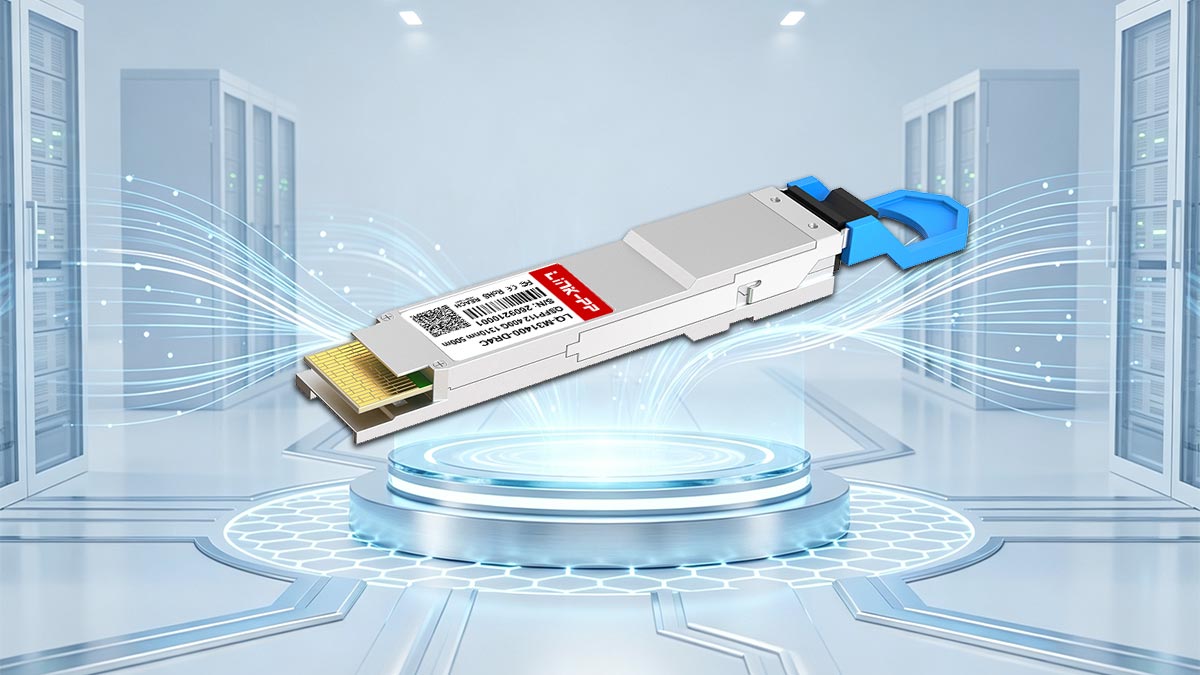
Rapid Bandwidth Growth Driven by AI and HPC Clusters
Modern distributed training models and high-performance computing workloads generate massive east-west traffic across GPU clusters. This exponential data surge requires sustained 400Gb/s throughput per port to prevent fabric congestion and job execution delays. Deploying high-quality MMS1X00-NS400 equivalent optics ensures non-blocking interconnects capable of handling intensive parallel processing tasks.
High-density compute fabrics rely on low-latency data transfers between accelerator nodes and core switching layers. When scaling InfiniBand fabrics, network architects require consistent 4x100G PAM4 modulation performance across every active physical channel. Qualified single-mode 400G QSFP112 options maintain clean optical transmission to meet these demanding compute workloads.
Lowering Total Cost of Ownership (TCO) in Large-Scale Deployments
Interconnect optics represent a major percentage of the total capital expenditure when constructing large-scale AI fabrics with thousands of ports. Standardizing on third-party MMS1X00-NS400 compatible optics significantly reduces upfront optical hardware acquisition costs across leaf-spine layers. These capital savings allow data center operators to allocate financial resources toward expanded compute and storage infrastructure.
Beyond initial CapEx, high-efficiency compatible modules lower operational costs through optimized power consumption and thermal performance. Transceivers engineered for low power dissipation minimize heat generation inside high-density chassis, reducing ongoing facility cooling overhead. Over multi-year deployment lifecycles, these thermal and operational efficiencies deliver substantial TCO improvements for enterprise operators.
Eliminating Single-Vendor Lock-In with Multi-Sourcing Strategies
Relying exclusively on a single hardware manufacturer introduces strategic vulnerabilities to enterprise expansion roadmaps. Implementing proven MMS1X00-NS400 alternatives establishes a multi-vendor sourcing framework that protects network expansion projects from unexpected supply constraints. This procurement flexibility guarantees that critical data center builds proceed on schedule without hardware bottlenecks.
Multi-sourcing optical hardware also gives procurement teams greater commercial leverage and ensures competitive long-term pricing. Sourcing compliant 400G QSFP112 single-mode transceivers from specialized optical manufacturers ensures adherence to open standards and cross-platform compatibility. Ultimately, a diversified optical supply chain strengthens overall infrastructure resilience against market volatility.
📝 Technical Baseline: Key Specs of the NVIDIA MMS1X00-NS400 Module
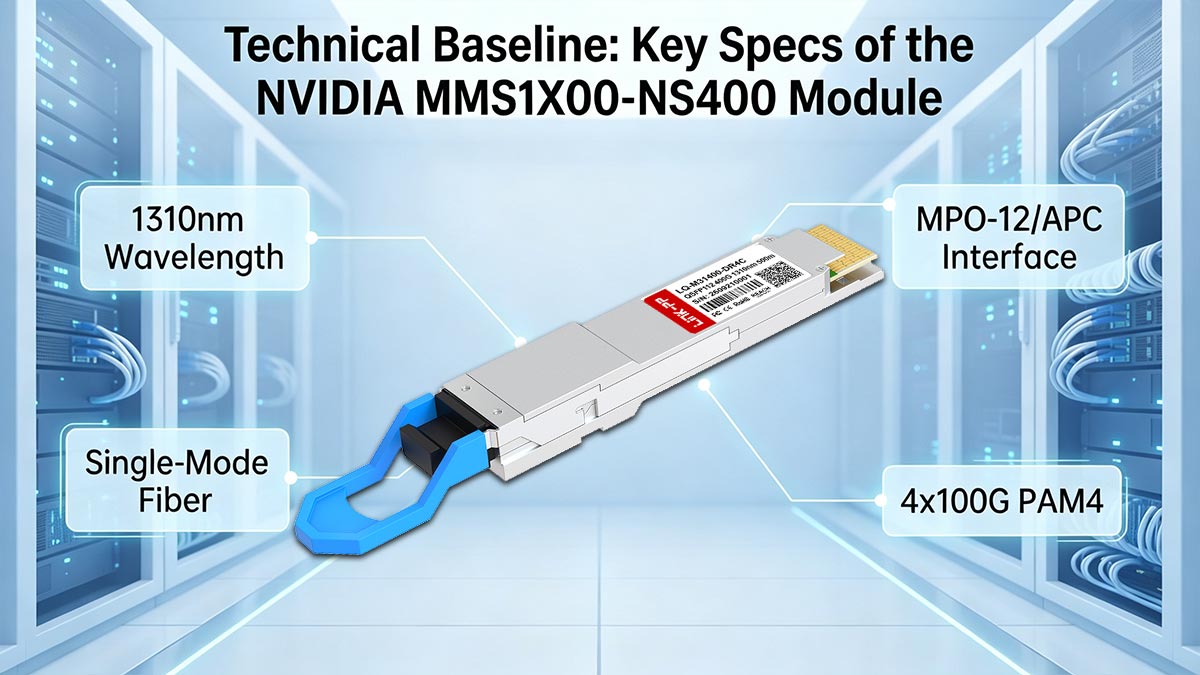
Establishing an effective multi-sourcing strategy requires a comprehensive understanding of the physical and optical benchmarks set by original hardware. Analyzing the baseline specifications of the NVIDIA MMS1X00-NS400 provides the engineering criteria necessary to evaluate fully compatible single-mode transceivers.
Form Factor & Pinout: QSFP112 Architecture vs. QSFP-DD/OSFP
The MMS1X00-NS400 leverages the compact QSFP112 form factor, which upgrades the proven 4-lane electrical interface to support 100Gb/s per lane. Compared to 8-lane alternatives like QSFP-DD or OSFP, the 4-channel design significantly simplifies host PCB trace routing and reduces connector pin density. This streamlined architecture enables switch and network interface card (NIC) designers to maximize faceplate density while minimizing power consumption and signal crosstalk.
The following comparison highlights how key 400G transceiver form factors differ in electrical lanes, per-lane speed, and design priorities:
| Form Factor | Electrical Lanes | Per-Lane Data Rate | Total Bandwidth | Key Architectural Advantage |
| QSFP112 | 4 Lanes | 100Gb/s PAM4 | 400Gb/s | Native 4-lane routing, backward mechanical compatibility, low power density |
| QSFP-DD | 8 Lanes | 50Gb/s PAM4 | 400Gb/s | Broad legacy ecosystem, 8-channel host electrical breakout |
| OSFP | 8 Lanes / 4 Lanes | 50Gb/s or 100Gb/s PAM4 | 400Gb/s / 800Gb/s | High thermal headroom with integrated top heatsink for dense chassis |
Integrating the QSFP112 architecture allows the MMS1X00-NS400 to maximize port density on Quantum-2 faceplates while reducing high-frequency insertion losses across switch mainboards. This balance of mechanical density and high-speed electrical efficiency establishes a reliable physical layer foundation for high-throughput NDR clusters.
Optical Layer: 1310nm Wavelength, Single-Mode Fiber, and MPO-12/APC Interface
At the optical layer, the MMS1X00-NS400 operates at a nominal center wavelength of 1310nm over standard single-mode fiber. Using 4 parallel optical lanes (4x100G) with an MPO-12/APC connector interface, the module prevents back-reflection and ensures high return loss on angled physical contact surfaces. This single-mode parallel architecture allows the optical signal to achieve reach distances up to 500m, far exceeding multi-mode limits.
Parallel single-mode transmission also facilitates flexible optical breakout configurations without requiring complex wavelength division multiplexing (WDM) filters. Transmitting over 8 active fiber strands (4 Tx and 4 Rx) ensures linear attenuation characteristics and minimal chromatic dispersion across links. These optical layer specifications form the baseline requirement for any drop-in MMS1X00-NS400 compatible replacement.
Electrical Signaling: 4x100G PAM4 Modulation and Signal Integrity Requirements
The electrical interface of the MMS1X00-NS400 utilizes 4-level Pulse Amplitude Modulation (PAM4) operating at a baud rate of 53.125 GBd per lane to deliver 100Gb/s throughput. Because PAM4 packs two bits per symbol, the electrical eye opening is significantly smaller than legacy NRZ signaling, demanding stringent signal integrity and low insertion loss across the host connector. Integrated Digital Signal Processors (DSP) perform continuous clock and data recovery (CDR) alongside adaptive equalization.
Maintaining strict Bit Error Rate (BER) thresholds prior to host Forward Error Correction (FEC) is essential for uninterrupted InfiniBand NDR traffic. The MMS1X00-NS400 module relies on low-noise driver circuitry and optimized transimpedance amplifiers (TIA) to preserve eye mask margins under high-speed switching conditions. Equivalent transceivers must match these precise electrical signaling parameters to guarantee transparent link-up behavior with NVIDIA Quantum-2 switches and ConnectX-7 adapters.
📝 Why Single-Mode Matters for MMS1X00-NS400 Alternatives
While electrical and mechanical specifications define the interface standard, the optical transmission medium dictates physical network boundaries. Selecting single-mode MMS1X00-NS400 alternatives enables data center architects to bypass the distance limits of legacy multi-mode links while ensuring signal clarity across expansive compute fabrics.
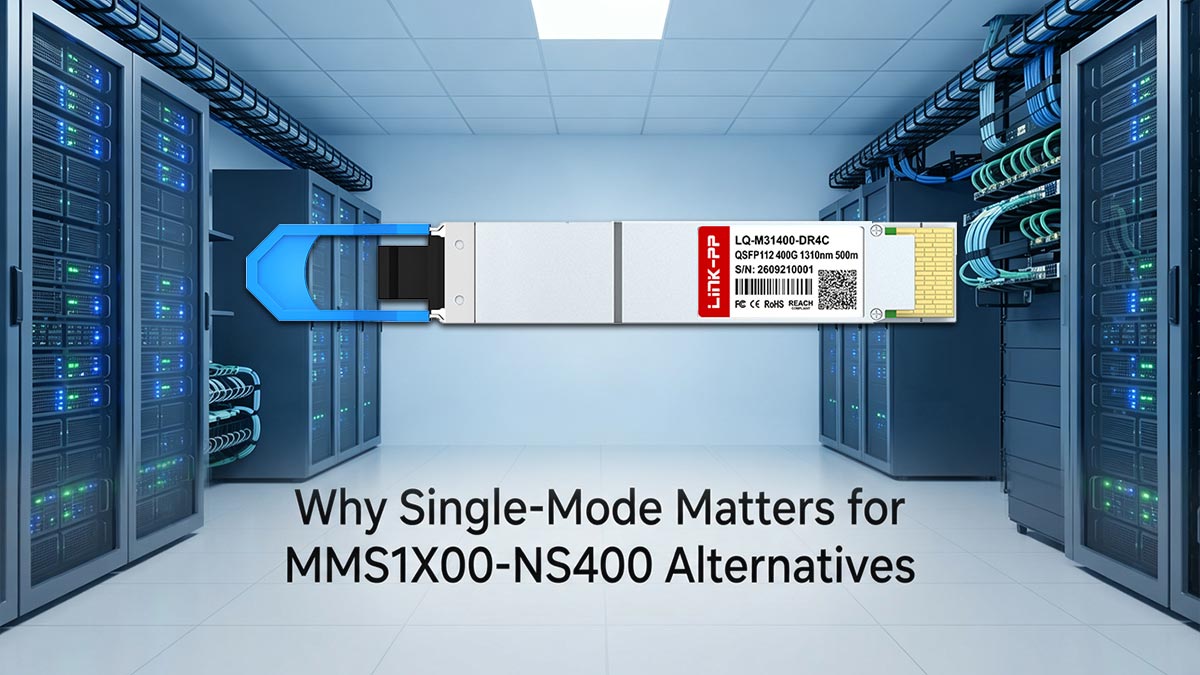
Overcoming the 50m/100m Reach Bottleneck of Multi-Mode (SR4) Transceivers
At 100Gb/s PAM4 per lane, multi-mode VCSEL optics experience severe modal dispersion that restricts transmission to just 50m on OM4 fiber. In contrast, single-mode MMS1X00-NS400 equivalent transceivers eliminate intermodal distortion by confining light propagation to a single spatial mode. This single-mode optical engine reliably delivers clean 400Gb/s transmission reaches up to 500m without high-order jitter degradation.
The following core physical factors explain why single-mode optics outperform multi-mode alternatives in high-speed links:
- Modal Dispersion Limits: Multi-mode fibers suffer from differential mode delay where distinct light paths arrive at staggered intervals, causing severe inter-symbol interference at 53.125 GBd PAM4.
- Extended Reach Boundary: Single-mode 1310nm EML laser optics expand connectivity from nominal sub-50m intra-rack limits to a robust 500m data hall reach.
- Link Budget Reliability: Narrow-linewidth single-mode transmission maintains pristine optical eye diagrams and stable Forward Error Correction (FEC) margins across the entire link span.
Structured Cabling Longevity: Leveraging OS2 Fiber for Future 800G/1.6T Upgrades
Deploying MMS1X00-NS400 compatible optics over OS2 single-mode cabling builds an evergreen physical plant that protects long-term infrastructure investments. While multi-mode OM3/OM4 fiber requires recurring, costly rip-and-replace cycles as lane rates advance, standard single-mode fiber offers virtually unlimited modal bandwidth. This continuous optical headroom ensures that installed parallel fiber trunks remain fully viable across successive network generations.
The strategic migration benefits of deploying single-mode fiber trunks include:
- Seamless Bandwidth Evolution: The same OS2 MPO-12/APC structured plant supports current 400G NDR links and scales directly to 800G XDR (2x400G) and 1.6T systems.
- Wavelength Multiplexing Support: Single-mode glass easily accommodates future CWDM/DWDM wavelength expansions without requiring extra fiber strand pulls.
- Asset Protection: Preserving physical layer cabling across multiple hardware refresh cycles substantially lowers cumulative data center CapEx.
Inter-Rack and Inter-Hall Connectivity in Modern AI SuperPOD Clusters
Large AI SuperPOD installations scale across hundreds of server racks, distributed leaf-spine rows, and segregated power halls. Multi-mode optics and direct attach copper cables cannot span the physical distances required for large-footprint compute halls. Single-mode MMS1X00-NS400 alternatives bridge these long-span inter-rack corridors, providing uniform latency and high-throughput connectivity throughout the entire GPU fabric.
These single-mode interconnects provide several practical routing advantages across modern cluster topologies:
- Spine-to-Core Spans: Seamlessly interconnects distributed leaf switches and core aggregation chassis separated by hundreds of meters across tiered facilities.
- SuperPOD Scalability: Enables physical separation of high-density GPU racks and power-intensive cooling zones without exceeding physical-layer optical power budgets.
- Streamlined Pathway Management: High-density single-mode trunk cables reduce bulk in overhead ladder racks, optimizing cooling airflow throughout the facility.
📝 How to Qualify a Reliable MMS1X00-NS400 Alternative
Selecting single-mode transceivers is only the first step toward building a scalable high-performance network fabric. Engineering teams must rigorously validate electrical, optical, and firmware metrics to ensure that any third-party MMS1X00-NS400 alternative performs identically to original equipment under production workloads.
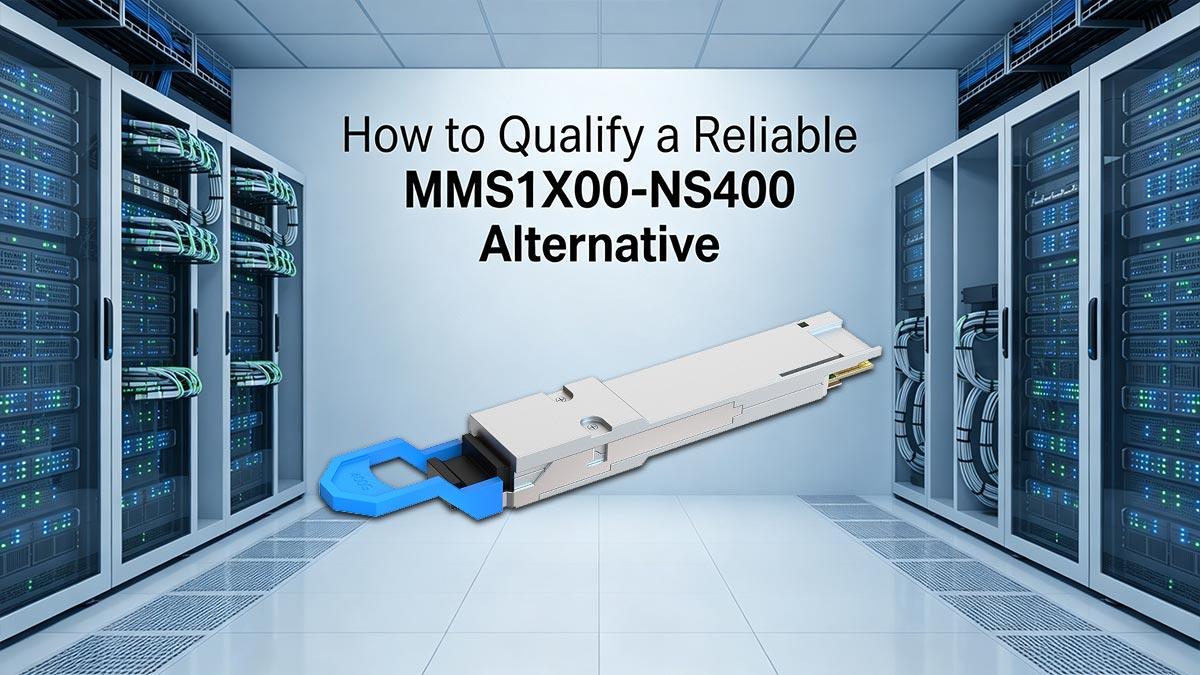
InfiniBand NDR Protocol Support and Quantum-2 Switch Interoperability
Operating at 400Gb/s InfiniBand NDR speeds requires strict physical-layer compliance and low-latency packet forwarding. A compliant MMS1X00-NS400 alternative must establish a clean link handshake with NVIDIA Quantum-2 switch ports and ConnectX-7 host channel adapters. Transparent protocol negotiation prevents port flapping, synchronization drops, and collective communication delays during intensive AI model training phases.
Key interoperability checkpoints for InfiniBand NDR integration include:
- Host Link-Up Synchronization: Fast auto-negotiation and link training across all 4x100G PAM4 lanes without manual port resets.
- Unified Fabric Telemetry: Accurate telemetry data reporting to the NVIDIA Unified Fabric Manager (UFM) for proactive link health monitoring.
- Subnet Manager Alignment: Uninterrupted state synchronization and traffic management across complex multi-tier leaf-spine topologies.
EEPROM Memory Map, Vendor Coding, and Firmware Handshake Integrity
Seamless hardware recognition relies on an accurately programmed Common Management Interface Specification (CMIS) memory map. A qualified MMS1X00-NS400 compatible module must feature correct vendor-specific firmware encoding to pass strict switch authentication checks upon insertion. Flawless EEPROM table structures allow host network operating systems to correctly identify module capabilities, supported link rates, and default equalization settings.
Fully compliant CMIS 5.0 firmware tables ensure instant plug-and-play identification, eliminating non-genuine transceiver warnings while enabling real-time Digital Diagnostic Monitoring (DDM) for voltage, Tx/Rx optical power, and operating temperature.
Optical Sensitivity, Launch Power Budget, and Bit Error Ratio (BER) Thresholds
High-speed single-mode parallel transmission over OS2 fiber demands balanced optical power budgets to prevent signal distortion or receiver saturation. Premium MMS1X00-NS400 alternatives match native 400G-DR4 optical specifications, delivering an average launch power between -2.9 dBm and +4.0 dBm per lane. Maintaining an Optical Modulation Amplitude (OMA) launch power between -0.8 dBm and +4.2 dBm guarantees sufficient optical headroom across single-mode link reaches up to 500m.
The critical optical and signal integrity criteria required for link qualification include:
- Transmitter Launch Quality: High-linearity 1310nm EML laser transmitters and low-noise receivers that minimize Transmitter and Dispersion Eye Closure Quaternary (TDECQ) penalties across MPO-12/APC fiber trunks.
- Receiver Sensitivity: An average receive power range of -5.9 dBm to +4.0 dBm with an OMA sensitivity better than -4.5 dBm to reliably decode high-speed PAM4 symbols.
- BER Threshold Margins: A pre-Forward Error Correction (pre-FEC) Bit Error Ratio strictly compliant with the 2.4×10⁻⁴ threshold to ensure completely error-free, post-FEC packet reconstruction under continuous InfiniBand traffic.
Low Power Consumption Design to Prevent Thermal Throttling in High-Density Ports
High-density 1U and 2U switches fully populated with 400G QSFP112 transceivers face significant thermal challenges during sustained compute bursts. An efficient MMS1X00-NS400 alternative must minimize heat dissipation to protect internal chassis airflow and prevent laser output drift. Maintaining a low electrical power profile ensures that adjacent optical ports operate reliably without triggering thermal throttling or packet retransmissions.
Key electrical and thermal criteria required to prevent port-level overheating include:
- Power Consumption Envelope: Operating with a maximum power dissipation strictly under 10.0W under full 400Gb/s InfiniBand NDR line-rate traffic.
- Operating Thermal Range: Reliable case operating temperature support from 0°C to 70°C, alongside an industrial-grade storage tolerance of -40°C to 85°C.
- Internal Thermal Transfer: High-conductivity thermal interface materials that rapidly conduct heat away from the DSP to the outer module shell for efficient switch fan dissipation.
📝 Compatible Option: LINK-PP LQ-M31400-DR4C as an MMS1X00-NS400 Alternative
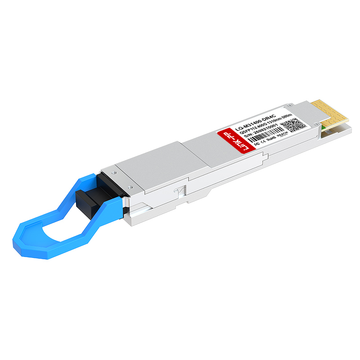
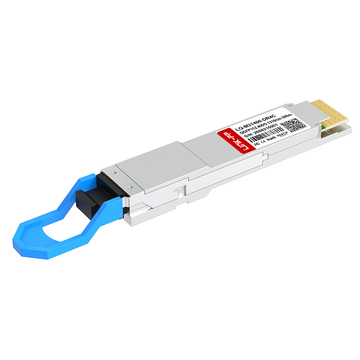
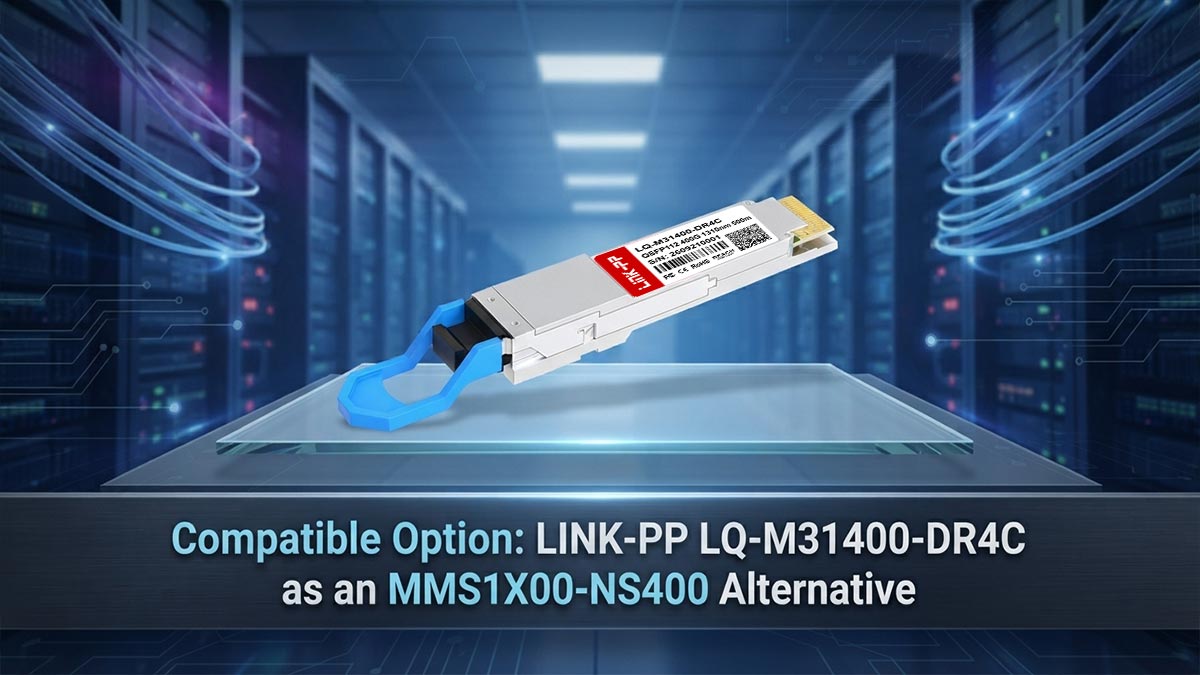
Evaluating hardware against strict qualification criteria makes finding a direct, drop-in replacement straightforward for network architects. The LINK-PP LQ-M31400-DR4C is engineered to meet these exact physical and optical standards, serving as a fully compliant MMS1X00-NS400 alternative for high-density InfiniBand NDR deployments.
Hardware Architecture and Optical Engine of the LQ-M31400-DR4C
The LQ-M31400-DR4C 400G QSFP112 module is engineered around an advanced 4-channel 100G PAM4 Digital Signal Processor (DSP) integrated into a standard QSFP112 mechanical housing. Its transmitter block incorporates four high-speed 1310nm cooled Electro-absorption Modulated Lasers paired with ultra-low-noise driver ICs. An integrated MPO-12/APC optical receptacle ensures precise fiber core alignment across all eight active single-mode strands.
On the receive path, high-responsivity PIN photodiode arrays and integrated transimpedance amplifiers (TIA) deliver clean signal recovery under fluctuating channel conditions. Built-in Clock and Data Recovery (CDR) circuits on both electrical and optical paths continuously suppress phase jitter and transient noise. This robust internal architecture guarantees a reliable 1:1 hardware alternative to the MMS1X00-NS400.
Interoperability Verification with Quantum-2 Switches and ConnectX-7 NICs
To ensure frictionless deployment, the LQ-M31400-DR4C incorporates custom-tailored CMIS 5.0 firmware tables verified for NVIDIA hardware. When inserted into NVIDIA Quantum-2 QM9700/QM9790 switches or ConnectX-7 host channel adapters, the module authenticates instantly without triggering unrecognized transceiver alarms. Real-time Digital Diagnostic Monitoring (DDM) continuously streams link metrics directly to network operating systems and management dashboards.
During physical link-up, the module completes auto-negotiation and electrical lane training seamlessly with host SerDes channels. It fully supports native InfiniBand NDR protocol handshakes, preventing link flapping or packet corruption during dynamic traffic spikes. Network operators can deploy the LQ-M31400-DR4C directly into production clusters alongside existing MMS1X00-NS400 transceivers without configuration adjustments.
Key Optical Benchmarks: Tx/Rx Power, Receiver Sensitivity, and Eye Diagram Margins
The LQ-M31400-DR4C delivers consistent optical power across its 4x100G lanes, maintaining per-channel launch power comfortably between -2.9 dBm and +4.0 dBm. High-linearity optical modulation produces wide, symmetrical PAM4 eye openings with low Transmitter and Dispersion Eye Closure Quaternary (TDECQ) penalties. These stable transmitter characteristics provide the optical headroom necessary for multi-hop single-mode fiber links.
On the receiving end, the module achieves an OMA sensitivity better than -4.5 dBm across an average receive power window of -5.9 dBm to +4.0 dBm. This receiver performance keeps the pre-FEC Bit Error Ratio well below the standard 2.4×10⁻⁴ limit, ensuring completely clean post-FEC data transmission over 500-meter OS2 spans. These optical benchmarks match the baseline performance of the OEM MMS1X00-NS400 across full-throughput InfiniBand workloads.
Thermal Stability and Power Dissipation in High-Density Port Layouts
Sustained AI training clusters demand superior thermal dissipation across fully loaded 1U and 2U high-density switch faceplates. The LQ-M31400-DR4C utilizes an energy-efficient DSP fabrication process and a high-conductivity internal thermal layout to maintain maximum power consumption below 10.0W. Efficient internal heat dissipation prevents local hotspot accumulation near sensitive laser diodes.
Under continuous line-rate traffic, the module maintains strict wavelength stability and optical power output across commercial case temperatures of 0°C to 70°C. Its rugged housing design ensures optimal convective cooling compatibility with standard front-to-back and back-to-front switch airflow patterns. This thermal resilience makes the LQ-M31400-DR4C a dependable MMS1X00-NS400 alternative for round-the-clock compute operations.
📝 Practical Link Scenarios for MMS1X00-NS400 Single-Mode Alternatives
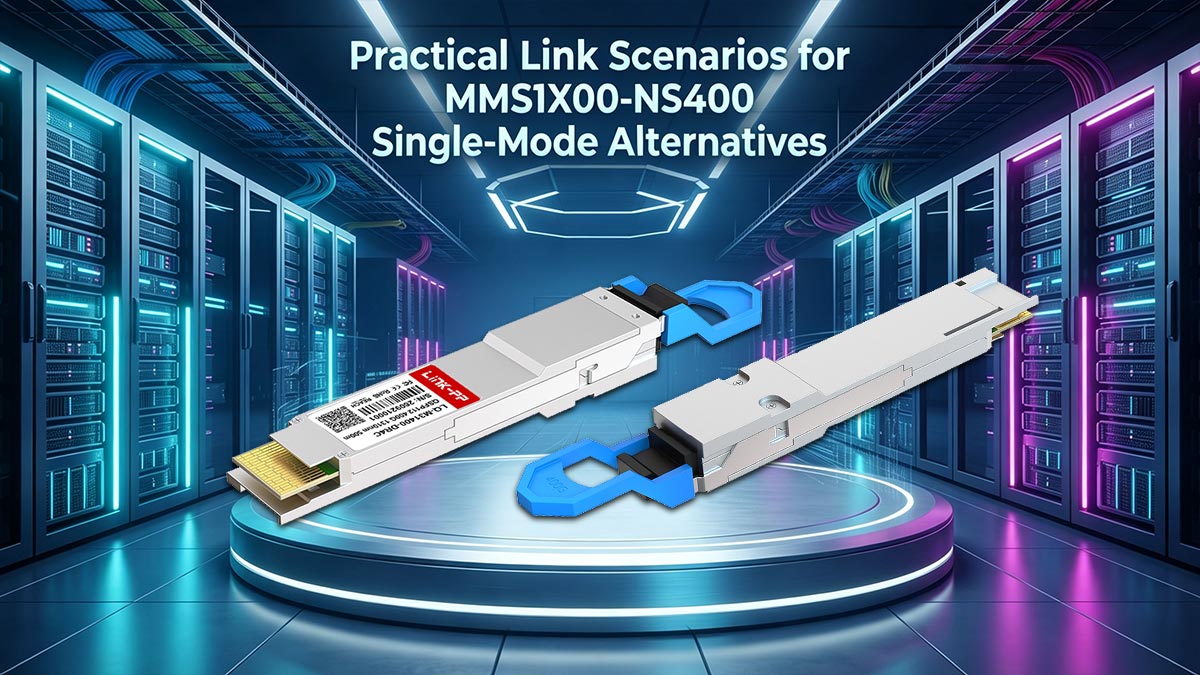
With fully qualified hardware in hand, integrating optical modules into production topologies requires understanding real-world connectivity requirements. Deploying single-mode MMS1X00-NS400 alternatives delivers versatile cabling options across modern AI clusters, from core aggregation layers to high-density compute nodes.
Switch-to-Switch Interconnects in 400G NDR Leaf-Spine Fabrics
In large-scale leaf-spine topologies, single-mode optics provide the core transmission medium linking Quantum-2 distribution switches. Using standard MPO-12/APC patch cables over OS2 trunks, single-mode MMS1X00-NS400 equivalent transceivers establish deterministic 400Gb/s uplinks across multi-tier switching layers. This continuous optical reach eliminates the distance limits of copper and multi-mode links across expansive data halls.
Maintaining symmetric low latency and zero packet loss is essential for synchronization phases in distributed AI model training. The parallel 4x100G PAM4 optical architecture ensures high-bandwidth aggregate pipelines without introducing serialization delays. Deploying compatible single-mode transceivers across spine fabrics provides the scalable backplane capacity demanded by modern accelerated compute clusters.
Direct Host Connections to ConnectX-7 Adapters in AI Compute Nodes
Direct server connectivity links high-density GPU compute nodes to top-of-rack (ToR) and leaf switches via ConnectX-7 host channel adapters. Single-mode MMS1X00-NS400 alternatives plug directly into QSFP112 host ports, delivering full 400G NDR bandwidth per adapter. This point-to-point configuration supports maximum remote direct memory access (RDMA) throughput with minimal protocol processing overhead.
The single-mode interface allows compute servers to be physically distributed across separated power and cooling rows without exceeding optical power budgets. Low heat dissipation at the server faceplate prevents thermal congestion around dense PCIe accelerator slots. These stable host links ensure reliable, sustained data ingestion during intensive multi-node training jobs.
Breakout Link Options: 400G QSFP112 to Dual 200G or Quad 100G Ports
Parallel single-mode architecture provides native flexibility for high-density breakout configurations across heterogeneous network tiers. An MMS1X00-NS400 compatible module on a Quantum-2 switch can split into two 2x100G (NDR200) links using an MPO-12/APC to 2x MPO-12/APC single-mode breakout cable. It can also divide into four distinct 100G single-mode channels using MPO-12/APC to LC duplex breakout assemblies.
This optical splitting capability allows network architects to maximize switch port utilization while connecting mixed-speed servers and legacy storage nodes. Because each parallel fiber lane operates independently at 1310nm, physical channel separation occurs without complex optical multiplexing filters. This versatile breakout capability protects previous capital investments while supporting phased network upgrades to 400G NDR fabrics.
Mixed Deployment: Running Compatible Optics Alongside OEM Transceivers
Modern enterprise procurement strategies frequently require gradual integration of multi-sourced hardware into existing environments. Qualified MMS1X00-NS400 alternatives seamlessly interoperate with original NVIDIA transceivers on the opposite end of the same single-mode link. Compliant optical modulation, matched center wavelengths, and standard receiver sensitivities ensure transparent communication across all four channels.
Running third-party optics alongside OEM modules introduces no link-up anomalies, latency differences, or forward error correction penalties. Network telemetry engines like Unified Fabric Manager (UFM) read real-time diagnostic data consistently from both module types. This seamless coexistence allows data center operators to scale fabrics flexibly without replacing existing optical inventory.
📝 How to Test and Validate MMS1X00-NS400 Compatible Optics
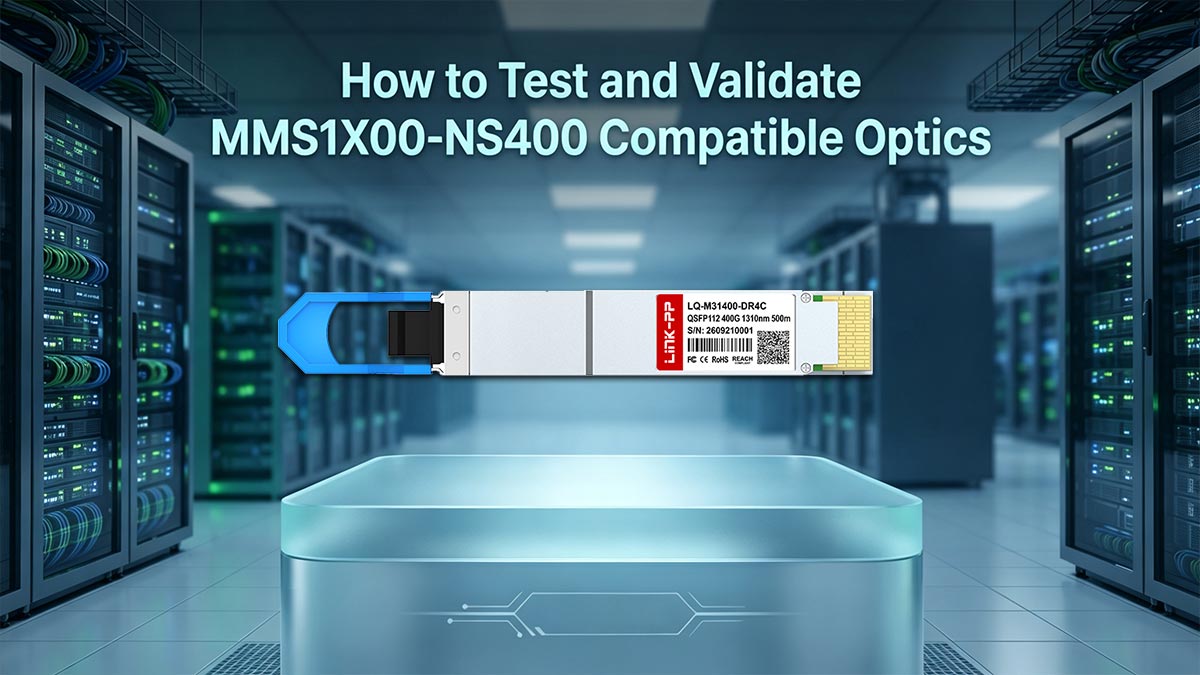
Implementing alternative optical modules across diverse link scenarios demands a structured laboratory and field validation workflow. Establishing systematic testing procedures ensures that every third-party MMS1X00-NS400 compatible transceiver delivers carrier-grade reliability prior to full-scale production rollout.
EEPROM and Firmware Compatibility Checks Before Installation
Before physical deployment into production chassis, verifying the module's memory encoding prevents configuration conflicts with host operating systems. Reading the internal Common Management Interface Specification (CMIS) tables confirms accurate part identification, supported data rates, and manufacturer serialization. Flawless firmware decoding guarantees that the switch control plane recognizes the transceiver without throwing unrecognized hardware alarms.
Essential pre-installation verification checks include the following parameters:
- CMIS Table Conformance: Confirming that baseline memory maps and diagnostic pages strictly follow CMIS 5.0 standards for seamless host negotiation.
- Vendor Authentication Data: Validating vendor name, part number, and serial coding against OEM MMS1X00-NS400 identification rules.
- DDM Functionality: Ensuring accurate real-time reporting of supply voltage, laser bias currents, case temperature, and optical power levels.
Real-World Link-Up and Traffic Testing on Quantum-2 Switches
Laboratory qualification requires connecting transceivers directly into production-grade NVIDIA Quantum-2 switch ports to observe real-world link negotiation. The module must complete high-speed 4x100G PAM4 SerDes training and lock active lanes without requiring manual port resets or administrative toggling. Once linked, running sustained line-rate InfiniBand NDR traffic verifies full 400Gb/s throughput under continuous packet load.
Key switch-level traffic benchmarks focus on these operational metrics:
- Fast Link Synchronization: Achieving instant link-up upon insertion with stable auto-negotiation across all four PAM4 physical channels.
- Zero Packet Drop Verification: Sustaining continuous bidirectional traffic streams without interface resets or dropped packet counters.
- Telemetry Reporting: Verifying clean integration with the NVIDIA Unified Fabric Manager (UFM) to ensure accurate link health telemetry.
Monitoring Bit Error Rates (BER) and Signal Quality
Quantifying optical signal fidelity requires continuous measurement of pre-Forward Error Correction (pre-FEC) bit error rates across all active channels. A reliable MMS1X00-NS400 alternative must maintain raw error rates well below the 2.4 × 10⁻⁴ threshold under full traffic load across OS2 fiber links. Keeping pre-FEC error rates consistently low ensures completely error-free post-FEC frame reconstruction and eliminates transmission latency spikes.
Critical physical-layer signal quality indicators include:
- Pre-FEC BER Margins: Maintaining substantial margin below standard thresholds to prevent uncorrectable frame errors during peak traffic bursts.
- FEC Correction Rate Stability: Monitoring corrected symbol counters across all 4x100G lanes to ensure uniform error distribution.
- Optical Power Consistency: Confirming launch power and receive sensitivity remain firmly within nominal 400G-DR4 operating windows.
Temperature and Power Stability During Full-Load Runs
Stress testing optical modules under maximum thermal and computational loads verifies hardware resilience inside high-density switch chassis. Operating multiple transceivers simultaneously in adjacent ports simulates real-world thermal stacking and airflow resistance. An optimal MMS1X00-NS400 compatible module must sustain stable internal junction temperatures without exceeding its 10.0W power envelope.
The thermal validation procedure evaluates the following operational behaviors:
- Thermal Steady-State Verification: Monitoring case temperature across multi-hour stress runs to confirm heat equilibrium between 0°C and 70°C.
- Laser Wavelength Stability: Verifying that the 1310nm optical output experiences no spectral drift or power degradation under high case temperatures.
- Power Draw Regulation: Ensuring total module power dissipation remains stable during continuous line-rate data transmission.
📝 Conclusion: Choosing the Best MMS1X00-NS400 Alternative for Your Network
Expanding AI and HPC clusters to 400G NDR InfiniBand requires balancing physical-layer transmission reliability with long-term infrastructure procurement costs. By evaluating MMS1X00-NS400 single-mode 400G QSFP112 alternatives against strict CMIS 5.0 firmware compliance, optical link budgets, and Quantum-2 switch compatibility, engineering teams can build a resilient multi-source supply chain. Implementing these validated single-mode optics guarantees the extended reach, low Bit Error Rate (BER) margins, and thermal stability required for non-blocking fabric performance.
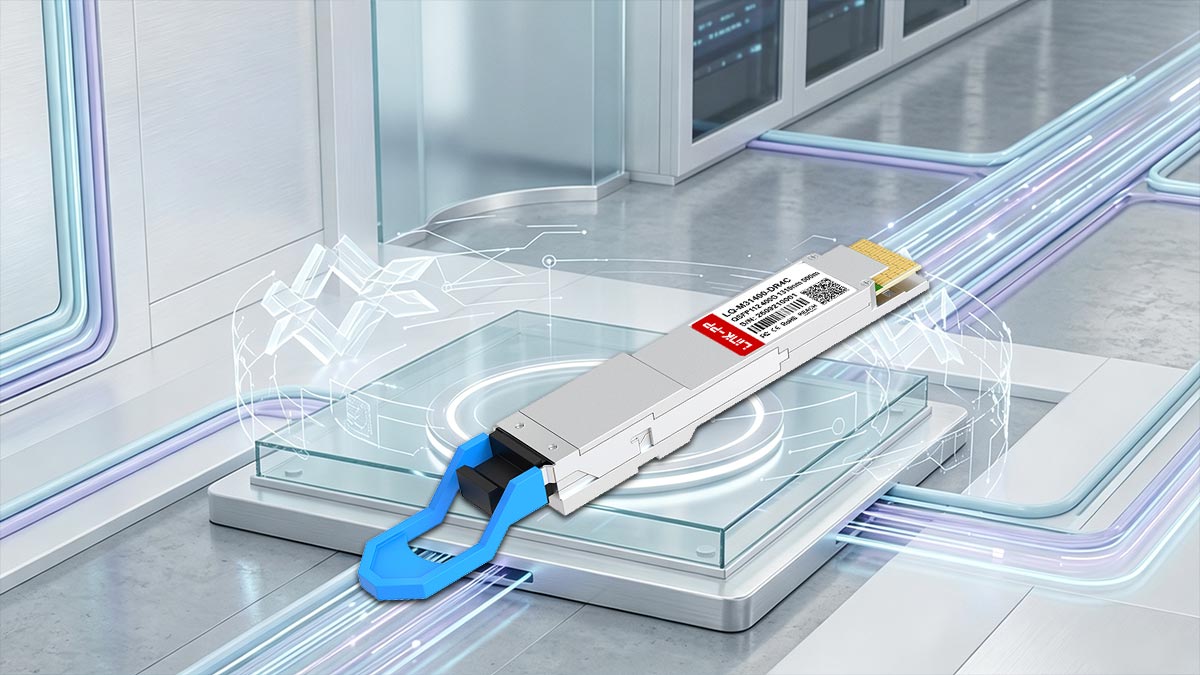
Among available MMS1X00-NS400 single-mode QSFP112 compatible alternatives, the LINK-PP LQ-M31400-DR4C module matches native 400Gb/s InfiniBand NDR line-rate specifications while maintaining sub-10.0W power efficiency across OS2 fiber links. Validating transceivers through comprehensive real-world hardware testing ensures predictable host-to-switch interoperability and reliable data flow across dense compute nodes. To evaluate full technical specifications or source enterprise-grade single-mode 400G QSFP112 optical modules, visit the LINK-PP Official Store.